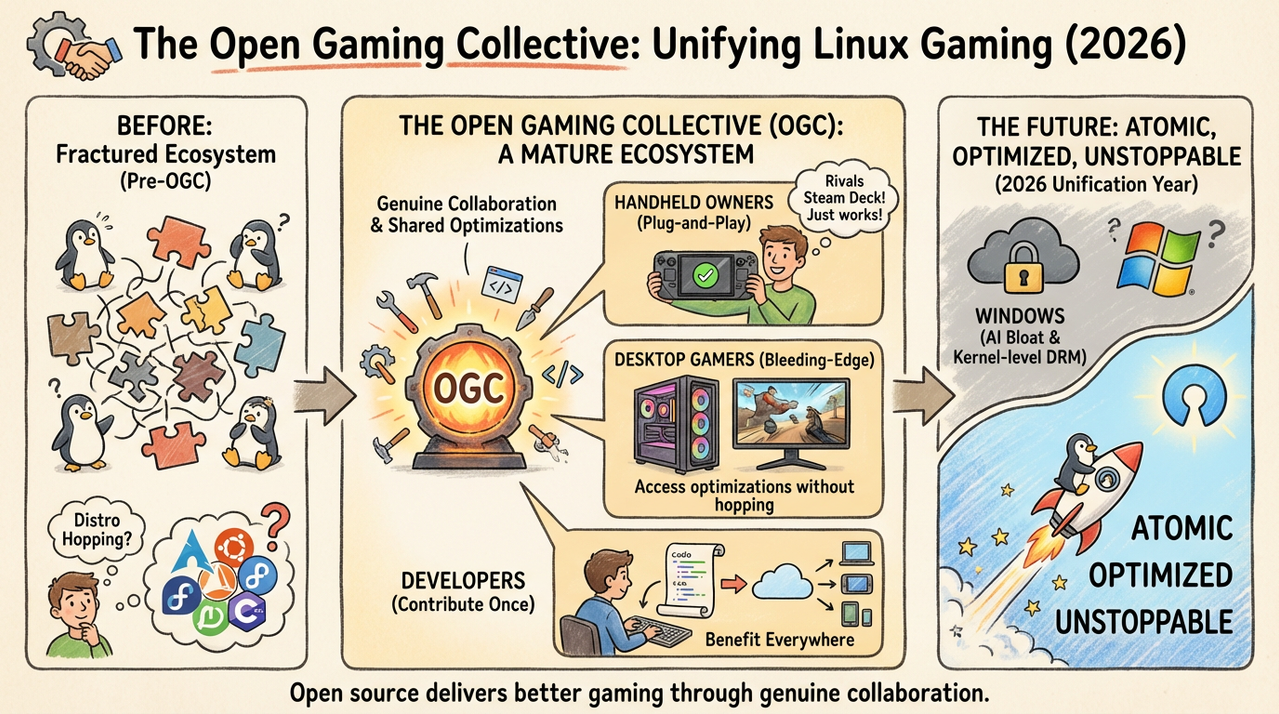
Linux gaming just took a massive leap forward. Seven major gaming distributions announced the Open Gaming Collective (OGC) to finally solve the ecosystem’s biggest problem: endless duplication of effort across fragmented projects. Instead of every distro maintaining separate kernels and drivers, OGC centralizes development around shared components that benefit everyone.
The Fragmentation Problem Ends Now
Anyone who’s tried Linux gaming knows the frustration. Bazzite excels at handhelds but lags desktop features. Nobara optimizes RPM Fusion packages but reinvents controller support. ChimeraOS perfects Steam Big Picture but duplicates kernel patches everyone needs. Each project spends countless hours on identical problems: Gamescope compositing, hardware drivers, input mapping.
OGC changes everything. Founding members include Bazzite (Universal Blue), Nobara, ChimeraOS, Playtron, Fyra Labs (Ultramarine), PikaOS, ShadowBlip, and ASUS Linux. Their first targets: unified kernel with upstream-first patches, shared Gamescope improvements, and standardized input tooling. One team’s breakthrough instantly upgrades every member.
Founding Members and Their Strengths
| Project | Specialty | OGC Contribution |
|---|---|---|
| Bazzite | Handheld/Steam Deck | Secure boot kernel, controller patches |
| Nobara | Desktop performance | Mesa optimizations, RPM packages |
| ChimeraOS | Console emulation | Gamescope compositing, Big Picture |
| Playtron | HTPC gaming | Media integration, remote play |
| Fyra Labs | Fedora Atomic | Immutable base, update system |
The beauty lies in synergy. Bazzite’s steering wheel patches benefit Nobara gamers. ChimeraOS’s Gamescope upgrades help Playtron HTPCs. ASUS Linux shares enterprise-grade driver validation. No more choosing between excellent handheld support and poor desktop experience – you get both.
Technical Foundation: Upstream-First Kernel
OGC’s crown jewel is their shared kernel. Every patch targets upstream Linux inclusion first, ensuring longevity beyond any single distro. Features like secure boot, expanded controller support (including racing wheels), and hardware enablement flow through one pipeline instead of seven parallel dead ends.
Bazzite immediately adopts the OGC kernel, promising no regressions in their hallmark features. They’ll also upstream Valve package modifications, potentially benefiting SteamOS itself. This upstream focus separates OGC from typical distro kernel hacks that break on every upstream change.

Handheld Gaming Revolution Incoming
Timing couldn’t be better. With Steam Deck dominating handhelds and competitors like Lenovo Legion Go S rising, Linux needs unified hardware support now. OGC delivers:
- Single kernel handles ROG Ally, Legion Go, MSI Claw
- Shared controller profiles eliminate per-distro tweaking
- Gamescope improvements boost frame pacing across devices
- Fedora Atomic base enables reliable OTA updates
Imagine flashing Bazzite on any AMD handheld, instantly getting optimal TDP controls, fan curves, and button mapping – no manual tinkering required. OGC makes this reality.
Bazzite’s Bold Moves
Bazzite leads by example, announcing immediate OGC adoption plus experimental changes:
- Testing Faugus Launcher to replace Lutris (6-month notice promised)
- Upstreaming all Valve package patches
- OGC kernel with rollback/pinning for stability
- Shared hardware database across members
Project lead Kyle Gospodnetich emphasized community continuity: “Your hardware stays supported. Rollback and pin system has you covered.” This pragmatic approach builds trust across the fragmented userbase.

Why This Changes Linux Gaming Forever
OGC attacks Linux gaming’s core weaknesses:
- Fragmentation: Seven projects become one ecosystem
- Maintenance: Shared burden scales with membership
- Innovation: Cross-pollination accelerates features
- Stability: Upstream-first prevents distro-specific breakage
Valve wins too. Unified distros mean better Proton testing coverage, faster anti-cheat progress, and Steam Deck alternatives that actually work out of box.
FAQs
What is the Open Gaming Collective?
Collaboration between Bazzite, Nobara, ChimeraOS, Playtron, Fyra Labs, PikaOS, ShadowBlip, ASUS Linux and others to share kernel patches, Gamescope, drivers and input tooling instead of duplicating effort.
Will my Bazzite setup break?
No. OGC kernel maintains all features. Rollback/pinning handles edge cases. Six months advance notice for launcher changes.
Which handhelds benefit most?
All AMD handhelds (ROG Ally, Legion Go, Claw) gain unified TDP controls, controller support, Gamescope optimizations from single kernel.
Is this competing with SteamOS?
Complementary. OGC upstreams Valve patches, improving Proton across ecosystem. Steam Deck owners gain better third-party handheld support.
When do updates start?
Immediate. Bazzite adopts OGC kernel now. Other members follow rolling schedule. Upstream patches flow continuously.
Can I contribute?
Yes! OGC welcomes patches, testing, funding. Shared git repos replace siloed development. Greater impact through collective effort.
What about NVIDIA support?
ASUS Linux brings enterprise driver validation. Shared kernel targets broad compatibility including latest NVIDIA handhelds.
Conclusion
The Open Gaming Collective transforms Linux gaming from promising-but-fractured to mature ecosystem. Handheld owners get plug-and-play experience rivaling Steam Deck. Desktop gamers access bleeding-edge optimizations without distro hopping. Developers contribute once, benefit everywhere.
2026 becomes Linux gaming’s unification year. As Windows embraces AI bloat and kernel-level DRM, OGC proves open source delivers better gaming through genuine collaboration. The future looks atomic, optimized, and unstoppable.