Remedy Entertainment has officially confirmed that Control Resonant will launch in Q2 2026, marking a significant shift from earlier expectations. According to investor reports shared by the Finnish developer, the highly anticipated sequel is targeting a late June or early July release window, potentially hitting shelves sooner than the gaming community anticipated.
The Release Window Revelation
The Q2 2026 release window came directly from Remedy’s investor documents, with analyst Anne Riikola noting this represented a positive surprise compared to initial forecasts. The company had previously estimated a broader 2026 launch, but the investor report pinpoints the end of the second quarter as the target timeframe.
Remedy estimates approximately 1.8 million sales in 2026 alone, with projections climbing to 2.2 million copies in 2027. While these numbers might seem conservative, they reflect careful planning from a studio known for efficient development practices. The original Control sold over 5 million copies and attracted more than 20 million players across various platforms through Game Pass, PlayStation Plus, and Epic Games Store giveaways.
What Makes Resonant Different
Control Resonant represents Remedy’s most ambitious project to date, shifting away from the original’s formula in several key ways. Players won’t be stepping into Jesse Faden’s shoes this time around. Instead, the game centers on her brother Dylan Faden, who appeared as a supporting character in the first game.
The combat system has undergone a major transformation. While Jesse wielded the Service Weapon, a supernatural firearm that could morph into different gun types, Dylan uses the Aberrant – a shapeshifting melee weapon. This crude yet powerful artifact can transform into dual blades, massive hammers, and other forms that players will unlock throughout the story. Creative director Mikael Kasurinen emphasized that this shift enables increased player autonomy and a wider array of combat strategies.

Manhattan Under Siege
The setting has expanded dramatically from the claustrophobic Oldest House to an open-ended Manhattan twisted by paranatural forces. Set seven years after the original Control, the sequel finds Dylan deployed by the Federal Bureau of Control at the peak of a supernatural crisis. A mysterious cosmic entity has severed New York City from the outside world, warping reality itself across multiple districts.
Remedy describes Manhattan as an expansive, reality-warping playground filled with danger and discovery. Unlike the first game’s indoor brutalist architecture, Resonant takes the action outdoors into a sprawling urban environment. Dylan won’t be the only human survivor – players will encounter FBC agents, civilians, and non-FBC factions vying for control of the ravaged city.
The Action-RPG Evolution
Control Resonant leans harder into action-RPG territory than its predecessor. The game promises deep character progression systems, expanded exploration mechanics, and player choice that affects how you approach combat encounters. Kasurinen outlined three core combat elements: fast-paced traversal through distorted environments, chaotic unpredictable enemies with agency matching the player’s capabilities, and mind-bending abilities combined with the Aberrant’s versatile forms.
Enemies have been upgraded significantly to match Dylan’s enhanced toolkit. They can navigate the same warped environments as players, jumping between platforms, unleashing paranatural attacks, and appearing in diverse shapes and sizes. This creates more dynamic encounters than the first game’s primarily ground-based confrontations.
Pricing and Platform Details
The investor report confirms Control Resonant will carry a $70 price tag at launch, aligning with current industry standards for AAA titles. The game will release simultaneously on PlayStation 5, Xbox Series X/S, and PC through Steam and Epic Games Store. macOS support has also been confirmed, expanding Remedy’s reach beyond typical console and Windows platforms.

Annapurna Pictures is co-funding 50% of the game’s development budget, which sits at approximately €50 million. This partnership extends beyond gaming, with both companies planning original film and television adaptations of Remedy’s franchises. Tencent also holds investment stakes in the project, positioning Control Resonant as a major multimedia initiative.
What This Means for Fans
The accelerated timeline represents good news for fans who’ve been waiting since 2019 for a proper sequel. Remedy revealed Control Resonant during The Game Awards in December 2025, and the Q2 2026 window means players could be experiencing Dylan’s journey in just a few months. The developer has emphasized that newcomers need not feel intimidated – Resonant functions as a standalone entry point while expanding the connected universe for returning players.
The shift from production readiness in mid-2024 to near-completion status demonstrates Remedy’s streamlined development pipeline. The studio leverages its proprietary Northlight engine, avoiding third-party licensing fees while maintaining cutting-edge visual fidelity. Their experience with 4D-scanned motion capture and efficient asset creation has allowed them to build their largest game without bloating budgets to industry extremes.
FAQs
When exactly does Control Resonant release?
Control Resonant targets Q2 2026, specifically late June or early July according to Remedy’s investor documents. The company hasn’t announced a specific date yet, but the window could shift slightly to Q3 if development requires additional time.
Do I need to play the first Control game before Resonant?
No, Remedy has designed Control Resonant as a standalone experience. While returning fans will appreciate connections to the original story, the game introduces newcomers to the universe through Dylan’s perspective without requiring prior knowledge.
Why is Dylan the protagonist instead of Jesse?
Control Resonant explores Dylan Faden’s journey after years of FBC confinement. The shift allows Remedy to tell a fresh story while inverting the original’s structure – where Jesse went inside the Oldest House, Dylan ventures out into a transformed Manhattan searching for his missing sister.
How much will Control Resonant cost at launch?
The game will carry a $70 price tag across all platforms, matching current AAA industry pricing. It launches simultaneously on PS5, Xbox Series X/S, PC (Steam and Epic Games Store), and macOS.
Will Control Resonant have DLC or expansions?
While Remedy hasn’t officially announced post-launch content, analyst reports speculate that significant DLC could arrive by Q1 2028 based on projected sales patterns. The company’s previous Control expansions (The Foundation and AWE) suggest additional story content is likely.
What’s different about the combat system?
Control Resonant replaces the Service Weapon’s ranged gunplay with the Aberrant, a shapeshifting melee weapon. Dylan can transform it into dual blades, hammers, and other forms during combat, combined with his paranatural abilities for more varied strategic options than the original game offered.
Is Control Resonant open world?
Not exactly. Remedy describes it as open-ended rather than fully open world. Manhattan serves as an expansive, reality-warping playground with multiple districts to explore, but it’s structured as an action-RPG with defined zones rather than a seamless sandbox.
Looking Ahead
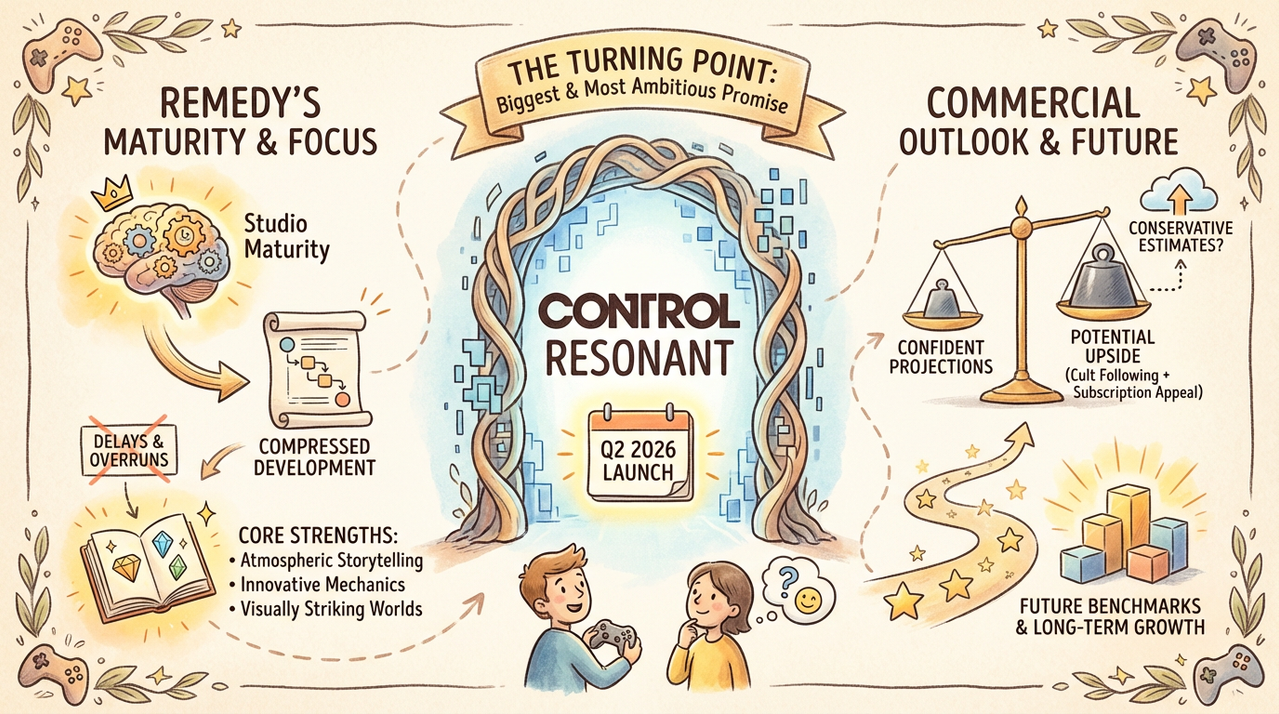
Control Resonant represents a turning point for Remedy Entertainment’s investment story. The developer has positioned this release as critical to their long-term growth, with confident projections about its commercial success. Given the original game’s cult following and mainstream appeal through subscription services, Remedy’s conservative sales estimates might prove overly cautious.
The compressed development timeline from concept to release demonstrates the studio’s maturity. They’ve avoided the delays and budget overruns plaguing other AAA projects, maintaining focus on their core strengths: atmospheric storytelling, innovative gameplay mechanics, and visually striking worlds. If Control Resonant delivers on its promise of being Remedy’s biggest and most ambitious game, the Q2 2026 launch could establish new benchmarks for the studio’s future projects.