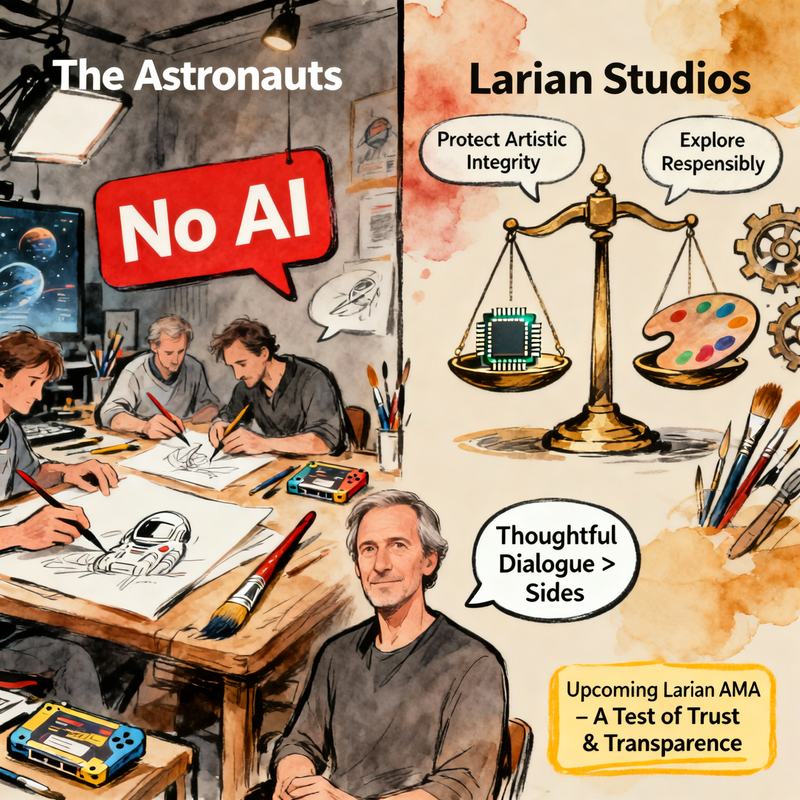
The gaming world recently found itself in yet another heated debate about artificial intelligence in game development. This time, Larian Studios – the beloved creators of Baldur’s Gate 3 – became the center of controversy after CEO Swen Vincke revealed the studio uses generative AI tools during early development stages. While fans expressed outrage across social media, one unexpected voice emerged with a measured take: Adrian Chmielarz, CEO of The Astronauts and creator of Witchfire.
What Actually Happened
The controversy erupted in mid-December 2024 when Bloomberg published an interview with Larian’s Swen Vincke about the studio’s upcoming RPG, Divinity. The report stated that Larian had been “pushing hard on generative AI,” using it for PowerPoint presentations, placeholder text, concept art exploration, and early ideation. Vincke was quick to clarify that no AI-generated content would appear in the final game, and that all art, writing, and voice acting remained entirely human-created.
Despite these clarifications, the gaming community’s response was swift and fierce. Former Larian employees spoke out on social media, fans threatened boycotts, and the studio found itself defending practices that many saw as a betrayal of the creative workforce that made Baldur’s Gate 3 such a masterpiece. The backlash was so intense that Vincke announced plans for an Ask Me Anything session in early 2025 to address concerns directly.
Witchfire’s Strict No-AI Policy
Adrian Chmielarz and his studio The Astronauts maintain a completely different approach. Witchfire operates under a rigorous “no AI” mandate where every final asset, sound effect, and line of text is crafted exclusively by human hands. Chmielarz has been vocal about his philosophy, explaining that he wants Witchfire to be “a song sung from one person to another.” He compared his preference for human-created work to choosing a handcrafted wine glass over a mass-produced alternative – even with its imperfections, the handmade glass tells a story and reflects genuine craftsmanship.
This stance isn’t just philosophical posturing. Chmielarz believes that even if an asset seems generic, it’s the nuances in a game that highlight the craftsmanship of its makers. For him, games cluttered with uninspired, AI-generated content represent everything he’s fighting against in the industry.
A Surprisingly Nuanced Defense
Given his strong anti-AI position, Chmielarz’s response to the Larian controversy surprised many. Rather than piling on criticism, he took a measured approach, stating that Larian was “definitely not the bad guys” and suggesting they were simply “a little unlucky” in how their comments were perceived. He acknowledged that based on Larian’s December 18 statements, the studio appeared to be seriously reflecting on what AI technology means for their future.
Chmielarz doesn’t condemn using AI for initial brainstorming and experimentation. He recognizes why some fans feel uneasy – the idea of a project growing from what he calls a “rotten seed” of AI-generated material can be off-putting, even if the final product is entirely human-made. However, he maintains that if a game is completely created by people and AI was only used as a source of inspiration, it can be considered free from AI influence.
The Bigger Picture
The controversy highlights a fundamental tension in modern game development. Larian employs 23 concept artists, none of whom are being replaced by AI. The studio insists they’re using these tools for rapid prototyping and exploration, not for creating final assets. Vincke emphasized in follow-up statements that “any machine learning tool used well is additive to a creative team’s workflow, not a replacement for their skill or craft.”
Yet critics argue that even using AI for early-stage work impacts job opportunities. When artists’ work serves as reference material, it can lead to employment opportunities as decision-makers evaluate their portfolios. Using AI for this stage potentially cuts off that pipeline, even if no current positions are eliminated. Former Larian employees have urged the studio to reconsider, arguing that world-class talent doesn’t need AI assistance to generate amazing ideas.
Where Do We Go From Here
Chmielarz’s perspective offers important nuance to a debate that often descends into extremes. He acknowledges that AI technology has become impossible to ignore – it’s “too good to ignore” but simultaneously “too weak to use the way it’s often presented.” Talk of games fully created by neural networks in the coming years remains unrealistic in his view.
The planned AMA from Larian Studios should provide more clarity on their position and processes. Whether it satisfies concerned fans remains to be seen. What’s clear is that the gaming industry is still figuring out where the lines should be drawn with AI technology, and voices like Chmielarz’s – critical yet measured – might help guide that conversation toward more productive territory than outright condemnation or uncritical adoption.
FAQs
What is Larian Studios’ current AI policy?
Larian uses generative AI tools for early-stage exploration, prototyping, and reference gathering. The studio has stated that no AI-generated content will appear in their final games, and they’re not replacing any team members with AI technology. All art, writing, and voice acting in their games remains entirely human-created.
Does Witchfire use any AI in its development?
No. The Astronauts maintains a strict “no AI” policy for Witchfire. Every final asset, sound effect, and line of text in the game is created exclusively by human developers and artists without any AI assistance.
Why did the Larian AI controversy become so heated?
The controversy intensified because many in the gaming community see AI as a threat to creative jobs and artistic integrity. Even though Larian clarified they weren’t replacing workers or using AI in final game content, fans felt the studio’s approach could normalize AI in creative processes and potentially impact future hiring decisions.
What did Adrian Chmielarz mean by calling Larian “unlucky”?
Chmielarz suggested that Larian’s intentions were misconstrued and the backlash was disproportionate to their actual AI usage. He believes the studio’s comments were poorly timed and phrased in a way that sparked unnecessary outrage, rather than reflecting genuinely problematic practices.
Will there be AI-generated content in Larian’s Divinity game?
No. Larian has explicitly stated that Divinity will contain zero AI-generated content. All voice acting, writing, art, and other creative elements will be produced entirely by human team members.
Is AI use in game development becoming more common?
Yes, many studios are experimenting with AI tools for various development tasks, from early prototyping to automated testing. However, the extent and application vary widely, and the industry hasn’t reached consensus on best practices or ethical boundaries.
When will Larian hold their AMA about AI usage?
Larian announced they’ll conduct an Ask Me Anything session featuring different departments after the holiday break in early 2025. The exact date hasn’t been announced yet, but it will give fans an opportunity to ask direct questions about their development process and AI usage.
Conclusion
The clash between technological advancement and artistic integrity continues to challenge the gaming industry. While studios like The Astronauts draw hard lines against AI usage, others like Larian attempt to find middle ground. Adrian Chmielarz’s measured response to the controversy demonstrates that productive dialogue is possible even among those with fundamentally different approaches. As AI technology evolves, the gaming community will need more voices willing to engage thoughtfully rather than simply choosing sides. The upcoming Larian AMA may prove crucial in determining whether studios can successfully navigate these concerns while maintaining fan trust and supporting their creative workforce.