What if your cozy shop management sim was secretly a psychological horror game? That’s the unsettling premise behind Shop Crush, a genre-blending indie from Ukrainian studio BSL Team that combines visual novel storytelling, economic strategy, and surreal illusion-based puzzles into something genuinely weird and compelling. You’re running a thrift shop where customers aren’t just buying products – they’re hiding secrets that blur the line between reality and madness.
The setup sounds straightforward. Manage inventory, set prices, negotiate with customers, balance profit against reputation. Standard shop sim stuff. But every customer carries literal illusions – surreal hidden-image puzzles you rotate and manipulate to uncover disturbing truths about who these people really are and what your shop is hiding. The deeper you dig, the more you realize nothing about this seemingly innocent thrift store is what it appears.
Running the World’s Strangest Thrift Shop
Shop Crush positions you as the owner of a mysterious thrift store dealing with an eclectic clientele who range from charming to deeply unsettling. Your daily operations follow typical shop management mechanics – customers enter requesting products, you set prices, negotiate deals, manage inventory, and try to keep your business profitable while maintaining your reputation.
The twist lies in the moral dilemmas embedded in every transaction. Selling common goods like milk provides safe income but minimal profit. Selling “sin goods” – items the game deliberately keeps vague and morally questionable – brings in serious cash at the cost of your reputation. Some customers actively want illegal or suspicious items. Do you refuse and lose their business, or accept and watch your shop’s reputation plummet?
These aren’t abstract choices that only affect numbers. Every customer has unique personalities, purchasing patterns, and preferences. Building relationships with specific customers changes how they interact with you. Give someone their favorite products at good prices and they’ll become loyal regulars who improve your business. Rip them off repeatedly and they’ll trash your reputation to other potential customers.
The Profit vs Reputation Dilemma
Shop Crush’s central tension comes from constantly balancing profit against reputation. Maximizing income often requires morally dubious decisions that tank how people perceive your business. Maintaining spotless reputation means turning away lucrative deals and accepting lower margins on ethical products.
If your reputation drops too low, customers stop visiting entirely. Your shop becomes known as the sketchy place that sells questionable merchandise, and foot traffic dries up no matter how good your prices are. But playing it safe with only legitimate products makes growing your business painfully slow, potentially dooming you to failure anyway.
The game procedurally generates these dilemmas through card-based encounters. Each customer visit presents choices about pricing, negotiation tactics, what products to stock, and how to handle special requests. The procedural generation ensures no two playthroughs feel identical, with different customers visiting at different times demanding different inventory strategies.
The Literal Illusion Mechanic
Here’s where Shop Crush gets genuinely weird and separates itself from every other shop management game. Each of your 10 unique customers has a Literal Illusion puzzle connected to their persona – surreal hidden images that reveal secrets when you zoom, rotate, and manipulate them correctly.
These aren’t standard jigsaw puzzles or find-the-object challenges. Literal illusions use forced perspective and visual trickery where rotating or repositioning images reveals entirely different pictures depending on viewing angle. What looks like an innocent scene from one perspective transforms into something disturbing from another angle.
Solving these puzzles unlocks layers of story about each customer. Who are they really? Why do they want these specific products? What connection do they have to the shop’s dark history? The illusion puzzles function as metaphors for the game’s central theme – nothing and nobody is what they initially appear to be.
Completing all the illusion puzzles allegedly reveals the sinister truth about your shop itself. The marketing materials deliberately keep this revelation vague, but the implication is clear: You’re not just running a thrift store. You’re part of something darker that the game slowly unveils through these surreal puzzle sequences.
10 Customers, 10 Mysteries
Shop Crush features 10 distinct customers, each with fully developed personalities, shopping habits, favorite products, and things they refuse to buy. One customer might be a luxury goods enthusiast who pays premium prices but demands top-tier inventory. Another could be a bargain hunter who scrutinizes every price and threatens your reputation if you overcharge.
Some customers are manipulative, attempting to guilt trip or threaten you into selling products you’re uncomfortable offering. Others might be genuinely kind people looking for mundane household items. A few customers enter with suspicious requests that make you question whether you should be selling to them at all.
The game lets you level up each customer through repeated positive interactions, improving their visit frequency, average purchase amount, and reputation impact. Maxing out a customer requires 50+ levels, creating long-term progression goals as you optimize relationships with your favorite clientele while managing difficult ones.
You can even customize customer appearance with three “skin types” – alien, female, and male – changing their visual presentation while maintaining their core personality and shopping behavior. It’s a small touch but adds personalization to the experience.

Managing Your Inventory and Operations
Beyond the psychological elements, Shop Crush includes legitimate shop management depth. You’re ordering products from a catalog of 70+ items ranging from everyday essentials to weird specialty goods. Keeping shelves stocked requires predicting customer demand and budgeting appropriately.
Some products are universally popular – everyone needs milk, bread, basic household items. Stocking these provides consistent income even if margins are slim. Other products appeal to specific customer types but sit unused by others. You need to understand your regular customers’ preferences to optimize inventory without tying up capital in products nobody wants.
The game also throws operational challenges at you beyond just sales. Shoplifters will attempt to steal products, forcing you to decide whether investing in security measures is worth the cost. Managing customer rage becomes crucial – push prices too high or stock offensive products and people get angry, damaging your reputation even faster.
Your shop spans five distinct locations, each with carefully crafted storylines that tie into the broader mystery. Different locations apparently attract different customer types and offer unique strategic considerations, though exact details on how this works remain vague in pre-release materials.
The Visual Novel Storytelling
Underneath all the shop management mechanics, Shop Crush is fundamentally a visual novel about insanity, doubt, and questioning reality. Customer interactions play out through dialogue choices that affect not just immediate sales but long-term relationships and story progression.
The narrative apparently deals with themes of madness and reality-checking – appropriate for a game where literal illusions hide the truth about everyone you meet. The atmosphere is described as psychological horror, though how intense that horror gets remains to be seen. This isn’t a jump-scare game, it’s psychological unease delivered through increasingly bizarre customer interactions and puzzle revelations.
BSL Team promises that all narrative threads converge on revealing the shop’s dark secret. Whether that payoff lands depends on execution, but the ambition to tell a cohesive horror story through shop management and puzzle mechanics is genuinely unique.
The Ukrainian Studio Behind It
BSL Team is an indie game studio based in Kyiv, Ukraine, known for creating narrative-driven games with bold concepts and vibrant visuals. Shop Crush represents their most ambitious project yet, blending multiple genres into something that doesn’t fit neatly into any existing category.
Developing a game in Kyiv during ongoing conflict adds layers of challenge most studios never face. The fact that BSL Team continued working on Shop Crush throughout 2025, delivering consistent updates and polishing the game to the point where it feels “completely different” from early versions, speaks to serious dedication.
The studio released a trailer in August 2025 showcasing the game’s visual novel, shop simulator, and psychological horror elements. That trailer emphasized the economic strategy aspects – every decision matters, every customer holds secrets. The marketing positions Shop Crush as something genuinely innovative rather than iteration on established formulas.
Shop Crush launched on Steam, Epic Games Store, and other platforms with support for Windows, Mac, Linux, web browsers, and Steam Deck. The wide platform support helps accessibility for a niche indie title that needs every potential player it can reach.
2025 Development Journey
According to a December 2025 developer update, Shop Crush underwent massive transformation throughout the year. Comparing the game at the start of 2025 to its current state, the developers describe it as feeling like a completely different game – in a good way. That level of iterative refinement suggests a team willing to cut features that don’t work and double down on what makes their game special.
The development approach seems collaborative with player feedback. BSL Team actively engages with the community, presumably gathering impressions and adjusting mechanics based on actual player experiences rather than just internal playtesting. This community-driven refinement often separates indies that find their audience from those that miss the mark.

Who Should Play Shop Crush
If you’ve ever wanted a shop management game with actual narrative weight and thematic depth, Shop Crush might be exactly what you’re looking for. Most shop sims are breezy optimization puzzles where narrative is window dressing. Here, the story and atmosphere are fundamental to the experience, creating tension between business mechanics and psychological horror.
Visual novel fans who enjoy darker subject matter will appreciate the emphasis on character relationships and moral decision-making. The customer interactions aren’t just flavor text – they’re the core loop driving both business success and story progression. If you loved games like VA-11 Hall-A or Coffee Talk that blend service industry management with meaningful conversations, this scratches a similar itch with significantly darker undertones.
Puzzle game enthusiasts looking for something unconventional should check out the literal illusion mechanic. These aren’t traditional puzzles most games offer. The forced-perspective manipulation creates genuinely surreal moments that tie directly into narrative reveals rather than existing as separate minigames.
What Might Turn You Off
If you’re looking for a cozy wholesome shop sim, Shop Crush absolutely is not that. The psychological horror elements and morally grey choices create uncomfortable situations. You’re not running a cheerful bakery where everyone leaves happy. You’re managing a business where customers want questionable products and everyone is hiding something disturbing.
The profit versus reputation system might frustrate players who want to min-max without consequences. You can’t have both maximum profit and perfect reputation – the game forces uncomfortable tradeoffs where winning financially often means compromising ethically. Some players will love that tension. Others will find it stressful rather than engaging.
As with many Ukrainian indie projects, resources are limited compared to AAA productions or even well-funded Western indies. Expect some rough edges in presentation and polish. The visual style looks intentionally stylized, but animation and UI refinement might not match big-budget games.

Frequently Asked Questions
What is Shop Crush?
Shop Crush is a hybrid visual novel and shop management game developed by Ukrainian studio BSL Team. You run a mysterious thrift shop while uncovering dark secrets through illusion-based puzzles, balancing profit against reputation through morally complex customer interactions.
Who developed Shop Crush?
Shop Crush is developed by BSL Team, an indie game studio based in Kyiv, Ukraine. They’re known for creating narrative-driven games with bold concepts and vibrant visuals. Shop Crush is their most ambitious project to date.
What are Literal Illusions in Shop Crush?
Literal Illusions are surreal puzzles using forced perspective where you zoom, rotate, and manipulate hidden images to uncover secrets about customers. Each of the 10 customers has a unique illusion puzzle that reveals disturbing truths when solved correctly.
What platforms is Shop Crush available on?
Shop Crush is available on Steam, Epic Games Store, and other platforms. It supports Windows, Mac, Linux, web browsers, and Steam Deck, making it accessible across multiple devices.
Is Shop Crush a horror game?
Shop Crush is described as psychological horror rather than traditional scary horror. It creates unease through customer interactions, moral dilemmas, and illusion puzzles that reveal disturbing truths rather than jump scares or gore.
How many customers are in Shop Crush?
Shop Crush features 10 unique customers, each with distinct personalities, shopping habits, favorite products, and secrets. You can level up each customer through 50+ progression levels, improving their visit frequency and purchase amounts.
Does Shop Crush have replayability?
Yes, Shop Crush uses procedurally generated card-based encounters, meaning each playthrough presents different customer interactions and business challenges. With 70+ products, 10 customers, and multiple locations, no two games play identically.
Can I customize characters in Shop Crush?
You can customize customer appearance by selecting between three skin types – alien, female, and male. This changes their visual presentation while maintaining their core personality and shopping behavior.
What makes Shop Crush unique?
Shop Crush uniquely combines shop management simulation with visual novel storytelling, psychological horror atmosphere, and innovative illusion-based puzzles. The profit versus reputation system creates genuine moral dilemmas where business success often requires ethically questionable decisions.
Supporting Ukrainian Indie Development
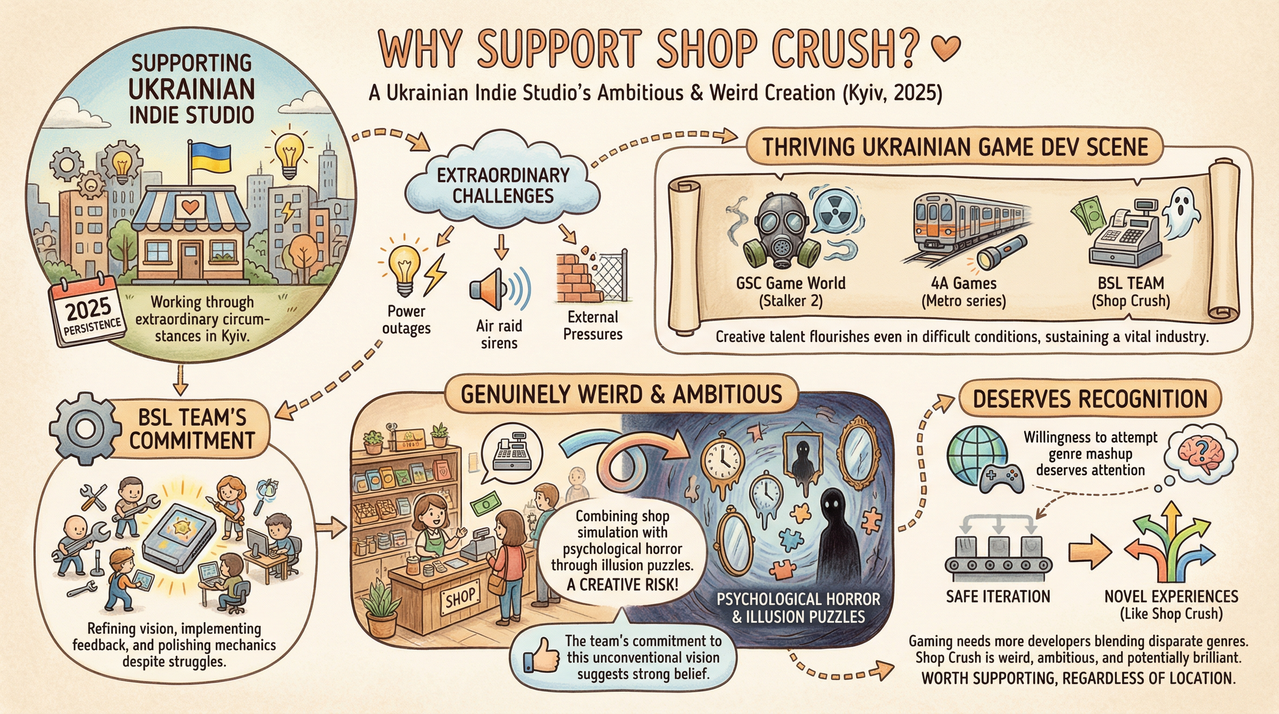
Buying Shop Crush means supporting a Ukrainian indie studio working through extraordinary circumstances. Creating games in Kyiv during 2025 required persistence most developers never need to demonstrate. BSL Team kept refining their vision, implementing feedback, and polishing mechanics while dealing with challenges far beyond normal development struggles.
The Ukrainian game development scene has produced remarkable work despite ongoing hardships. Studios like GSC Game World (Stalker 2), 4A Games (Metro series), and smaller indies like BSL Team prove that creative talent flourishes even in difficult conditions. Supporting these developers helps sustain an industry that could easily collapse under external pressures.
Beyond the political context, Shop Crush deserves attention purely on its merits. This is genuinely weird and ambitious in ways most indies avoid. Combining shop simulation with psychological horror through illusion puzzles is not a safe bet. It’s a creative risk that could easily fail if execution doesn’t land. The fact BSL Team committed to this vision and refined it throughout 2025 suggests they believe in what they’re building.
Whether Shop Crush becomes a cult classic or fades into obscurity depends on whether its genre mashup resonates with players. But the willingness to attempt something this unconventional deserves recognition. Gaming needs more developers willing to blend disparate genres into novel experiences rather than safely iterating on proven formulas. Shop Crush is weird, ambitious, and potentially brilliant. That’s worth supporting, regardless of where you’re from.