Blue Prince launched in April 2025 with virtually zero mainstream hype and immediately became the year’s highest-rated game on review aggregate sites. This indie puzzle roguelike from solo developer Tonda Ros at Dogubomb somehow achieved what massive AAA studios couldn’t, crafting an experience so universally praised that critics ran out of superlatives. IGN compared it to The Witness, Portal, and Myst as potential Mount Rushmore material for first-person puzzle games. Game Informer called it everything they want in an indie game. And players who fell into its trap lost dozens of hours trying to find one more secret in a mansion that never stops revealing new layers.
The Premise That Sounds Completely Absurd
You’re called to a family mansion at Mt. Holly to claim your inheritance, which depends on finding the 46th room in a house that only has 45 rooms. That’s it. That’s the entire setup. The mansion’s layout completely changes every single day, resetting your progress but not your knowledge. There’s no combat whatsoever, no enemies chasing you, no health bars or weapons. You just walk through rooms, draft new additions to the mansion’s floorplan, solve increasingly complex puzzles, and chase the mystery of what happened to your family.
The core mechanic involves opening doors and choosing which of three randomly offered rooms to draft into the mansion’s 5×9 grid. Every room costs steps from your daily allowance to traverse. Some rooms offer items, others provide additional steps, and many contain puzzles or clues about the overarching mystery. Your goal each day is navigating north through the mansion toward the central chamber while managing your limited movement budget and the random rooms the game throws at you.
Why It Works Despite Being Completely Random
The brilliance of Blue Prince lies in how it layers knowledge-based progression over roguelike randomness. Unlike traditional roguelikes where you unlock better weapons or stat upgrades, Blue Prince’s persistence comes entirely from what you learn. Discovering that a specific item combination opens a secret passage remains valuable forever because that knowledge transfers between runs. Understanding how certain room types interact becomes a permanent advantage no randomness can take away.
The game does provide some incremental progression through Upgrade Disks that let you enhance random rooms with lasting bonuses. These upgrades feel small individually but snowball dramatically as you stack effects and learn to exploit them. However, the real progression happens inside your brain. You get better at reading room patterns, anticipating puzzle solutions, and manipulating the seemingly random drafting system to generate the specific floorplans you need.
The Boardgame DNA
Tonda Ros never intended to make a roguelike. According to interviews, Blue Prince was primarily inspired by single-session boardgames like Dominion and Ascension, the same influences that inspired Slay the Spire. The drafting mechanic where you pick one of three options comes directly from boardgame design philosophy. The limited movement budget creates spatial puzzle challenges impossible in digital-only games. Even the mansion’s grid layout and daily resets feel more boardgame than video game.
This boardgame foundation gives Blue Prince a crunchy mechanical depth that purely video game-inspired puzzlers often lack. Every decision has weight and consequence. Choosing a closet that offers valuable items but no exits means sacrificing forward momentum. Drafting a bedroom that grants extra steps but takes you off your planned path creates difficult resource management trade-offs. The game constantly forces meaningful choices where no option feels obviously correct.
Ros explicitly describes the experience as walking through your own boardgame, and that framing helps explain why Blue Prince feels so unique. It occupies this hybrid space between physical and digital game design, taking the best aspects of both mediums. The freedom of digital implementation allows for elaborate puzzles and hidden mechanics that would be impossible to track manually. The structure of boardgame design keeps the scope focused and the decision space comprehensible despite the complexity.
The Mystery That Never Ends
Blue Prince structures its narrative around layers of interlocking mysteries that reveal themselves gradually across dozens of hours. The obvious surface mystery asks why the mansion only has 45 rooms when your inheritance requires finding room 46. Beneath that lies the question of what happened to your family and why the mansion behaves so strangely. Deeper still are geopolitical mysteries about the fictional nation the mansion exists within, historical events that shaped the family’s fate, and philosophical questions about inheritance, memory, and the spaces we inhabit.
Critics consistently praised how the game doles out worldbuilding with remarkable patience. Nothing gets forced down your throat through cutscenes or exposition dumps. Every piece of lore you discover feels earned through exploration and puzzle-solving. Reading notes and documents scattered throughout the mansion isn’t mandatory for progression, but the information often provides crucial clues for solving future puzzles. This creates a virtuous cycle where narrative curiosity drives mechanical mastery and vice versa.
The Post-Game That Consumed Players
Reaching the credits in Blue Prince doesn’t mean you’re finished. Not even close. The game contains an absolutely gigantic amount of optional content, post-game mysteries, and additional puzzles that only unlock after completing the main campaign. Players report sinking 40, 60, even 100+ hours into the game while still discovering new interactions and secrets. The feeling of discovery never really ends because wrapping up one puzzle invariably opens doors to new ways of using items or interacting with rooms.
Multiple reviewers mentioned becoming obsessed to the point where they couldn’t stop thinking about Blue Prince even when not actively playing. The puzzles burrow into your brain and set up camp. You’ll be doing completely unrelated activities when suddenly a solution clicks and you need to immediately boot up the game to test your theory. This addictive quality comes from the perfect marriage of roguelike’s one-more-run compulsion with puzzle gaming’s aha moment satisfaction.
The Critical Consensus
Blue Prince currently sits at the top of 2025’s critical rankings with nearly universal acclaim. IGN gave it a 9 out of 10, calling its complex mysteries brilliantly woven into the careful decision-making of room placement. Game Informer awarded 9.25 out of 10, celebrating how it makes players feel smart while keeping them infinitely hungry for another run. GameSpot praised its masterfully intricate layering of systems. GamesRadar described it as an obsession they couldn’t shake across multiple runs where they constantly discovered something new.
Even outlets that don’t typically cover indie puzzle games went out of their way to highlight Blue Prince. PC Gamer declared it the best-reviewed game of 2025 shortly after launch. The Guardian called it a potential new obsession with thoughtful design details throughout. XboxEra went as far as suggesting it might be one of the best games they’ve ever played, period. Adventure Game Hotspot labeled it an absolute classic that everyone owes themselves to play.
Common threads run through the praise. Critics consistently highlight the layered mystery structure, the satisfying progression system built on knowledge rather than stats, the patient worldbuilding that rewards curiosity, and the addictive loop that blends roguelike and puzzle mechanics seamlessly. Multiple reviewers compared it favorably to genre-defining classics like The Witness, Myst, and Portal, suggesting Blue Prince deserves similar recognition as a watershed moment for first-person puzzle design.

The Divisive Roguelike Elements
Not everyone loves Blue Prince unconditionally. The roguelike randomness creates friction for players approaching it primarily as a puzzle game. Once you understand what a puzzle requires, you have all the pieces mentally assembled and desperately want to test your solution. However, the game often forces you to complete multiple runs before the random drafting system gives you the specific room combinations needed to execute your plan. This can feel frustratingly arbitrary when you know exactly what needs to happen but can’t make it happen due to bad RNG.
The Reddit discussion highlights this tension perfectly. Roguelike fans view the overarching puzzles as a massive bonus layered onto familiar genre mechanics. Puzzle purists see the roguelike elements as obstacles preventing them from engaging with the actual puzzles they want to solve. Neither perspective is wrong, they’re just approaching the game from opposite directions and bumping into each other.
Tonda Ros seems aware of this divide and implemented systems to mitigate pure randomness without eliminating it entirely. The game secretly tips the scales to pull you toward your goals, offering better or worse rooms based on hidden factors beyond pure chance. Persistent upgrades gradually reduce the randomness by bending probabilities in your favor. The drafting system itself provides agency through meaningful choices even when you don’t get perfect options. These design decisions help bridge the gap between roguelike chaos and puzzle determinism, though they won’t satisfy everyone.
Eight Years in the Making
Blue Prince spent over eight years in development, an eternity for an indie project from a small team. That extended timeline shows in the meticulous attention to detail, the depth of interlocking systems, and the sheer volume of content packed into the experience. This wasn’t a game that could be rushed or simplified. The complexity emerges organically from dozens of interconnected design decisions that needed time to mature and balance against each other.
One of the lead playtesters, Matthew Iggy Kowalski, contributed enormously to the game’s final form. According to developer statements, Iggy was absolutely brilliant at the game and discovered countless original strategies the team had never considered. His testing helped identify edge cases, balance issues, and opportunities for emergent gameplay. Tragically, Iggy developed health complications requiring a kidney transplant, and the Blue Prince community rallied to help spread awareness and find potential donors. The outpouring of support demonstrated how deeply the game connected with its players.
Why It Matters
Blue Prince represents everything great about independent game development. A solo creator with a weird idea spent nearly a decade refining it into something genuinely special. No focus groups demanded it be simplified. No publisher insisted on adding microtransactions or live-service elements. No committee mandated that combat be included because puzzle games don’t sell. The game exists exactly as intended, uncompromised by market pressures or conventional wisdom about what players want.
The critical and commercial success proves that audiences crave creative ambition and unique experiences. Players responded enthusiastically to a first-person puzzle roguelike about drafting rooms in a mystery mansion because nothing else offers that specific combination of mechanics and themes. In an industry increasingly dominated by safe sequels and live-service clones, Blue Prince stands out by refusing to fit neatly into predetermined genre boundaries.
Frequently Asked Questions
What type of game is Blue Prince?
Blue Prince is a first-person puzzle roguelike where you explore a mansion that changes layout daily. You draft rooms to build the floorplan, solve interconnected puzzles, and uncover mysteries about your family’s inheritance. There’s no combat, just exploration and problem-solving.
How long does Blue Prince take to complete?
Reaching the credits takes roughly 20-30 hours depending on puzzle-solving ability. However, the post-game content adds another 40-80 hours of optional mysteries and challenges. Many players report 100+ hours of playtime while still discovering new secrets.
Is Blue Prince actually roguelike or just puzzle?
It’s genuinely both. The mansion resets daily with randomized room drafting, but progression comes from knowledge retention rather than stat upgrades. Roguelike fans enjoy the core loop while puzzle enthusiasts appreciate the overarching mysteries. The blend creates friction for some players.
Who developed Blue Prince?
Tonda Ros at Dogubomb, a California-based indie studio, developed Blue Prince over eight years. Ros designed it primarily around boardgame inspirations like Dominion rather than traditional roguelike influences, despite the genre overlap.
Why is Blue Prince so highly rated?
Critics praised the layered mystery structure, knowledge-based progression, patient worldbuilding, seamless genre blending, and addictive loop. It launched with near-universal acclaim and became 2025’s highest-rated game shortly after release.
What platforms is Blue Prince available on?
Blue Prince released on PC, PlayStation 5, and Xbox Series X/S on April 10, 2025. It’s available through Steam, Epic Games Store, PlayStation Store, and Microsoft Store.
Is Blue Prince similar to The Witness or Outer Wilds?
Thematically yes, all three emphasize knowledge-based progression and environmental storytelling. However, Blue Prince adds roguelike randomness and resource management that creates different mechanical challenges. It’s like those games filtered through a boardgame design philosophy.
Does Blue Prince have any combat?
No. Blue Prince contains zero combat. The challenge comes entirely from spatial puzzles, resource management, drafting decisions, and solving interconnected mysteries. It’s purely a thinking game.
The Puzzle Game That Changed Everything
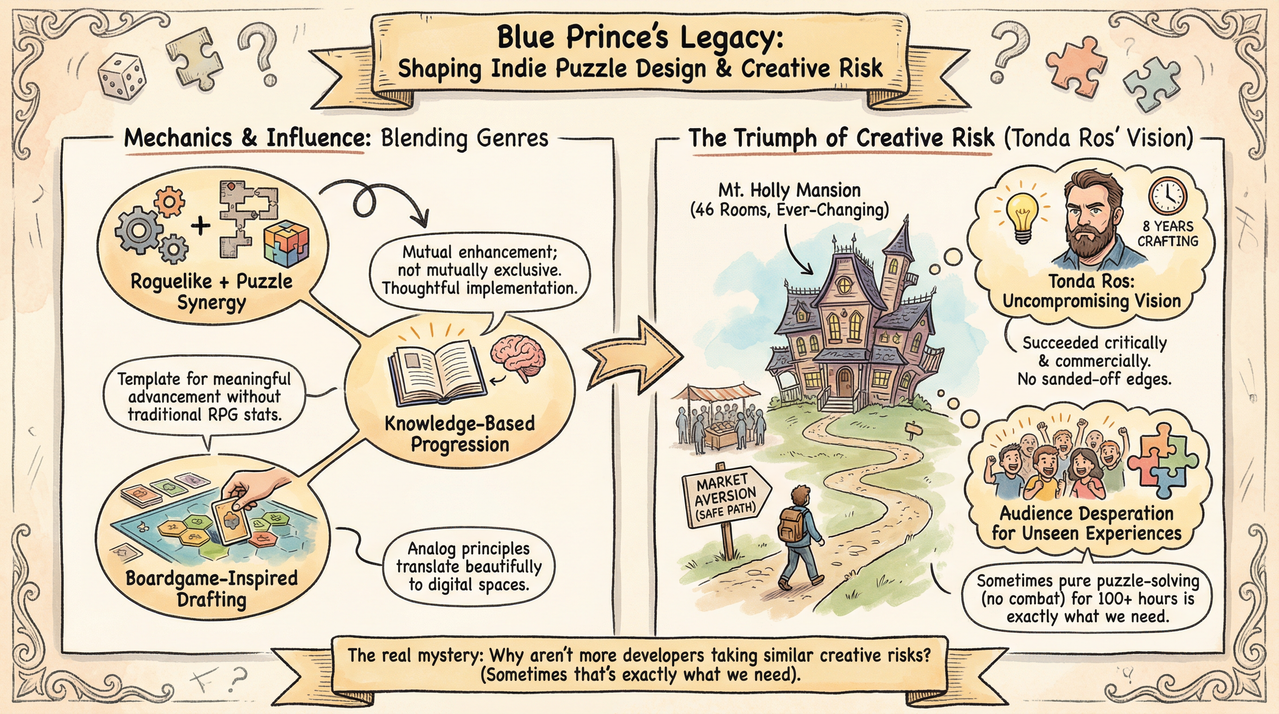
Blue Prince will likely influence indie puzzle design for years to come. It proved that roguelike mechanics and puzzle solving aren’t mutually exclusive but can enhance each other when implemented thoughtfully. The knowledge-based progression system offers a template for how to create meaningful advancement without relying on traditional RPG stat increases. The boardgame-inspired drafting mechanic demonstrates how analog game design principles translate beautifully to digital spaces.
Most importantly, Blue Prince showed that weird, ambitious, genre-defying ideas can succeed both critically and commercially when executed with care and vision. Tonda Ros didn’t compromise or sand off the rough edges to make the game more marketable. He spent eight years crafting exactly what he wanted to create, and it resonated with audiences precisely because of its uncompromising nature. In an industry often paralyzed by risk aversion and market research, Blue Prince stands as a reminder that sometimes the best path forward is the one nobody else is walking. The mansion at Mt. Holly holds 46 rooms, but the real mystery is why more developers aren’t taking similar creative risks. If Blue Prince proves anything, it’s that audiences are desperate for experiences they’ve never seen before, even when those experiences involve walking through an ever-changing boardgame mansion with no combat and pure puzzle-solving for 100+ hours. Sometimes that’s exactly what we need.