Edmund McMillen dropped a 50-minute gameplay walkthrough for Mewgenics on New Year’s Day 2026, giving the world its most detailed look yet at his long-awaited cat breeding tactical RPG. The creator of The Binding of Isaac and Super Meat Boy has spent over five years developing this current iteration of Mewgenics after the original Team Meat version was canceled back in 2014. Now launching February 10, 2026, the game promises 200 hours of content combining turn-based tactical combat with legacy roguelike breeding mechanics that McMillen insists is his best work ever.
What Mewgenics Actually Is
Mewgenics blends several genres into something genuinely unique. You manage a house full of cats that you breed, raise, and send out on roguelike runs to gather resources, level up, and hopefully return alive. Each run consists of randomized encounters and grid-based tactical battles similar to Into the Breach or Fire Emblem, where positioning and ability synergy determine whether your cats survive or become maggot food in some disgusting back alley.
The breeding mechanics form the core meta-progression system. When cats return from successful runs, they can mate with other cats in your house, producing offspring that inherit their parents’ traits, stats, and abilities. This creates a legacy system where you’re constantly improving your bloodline across generations, breeding specialized cats optimized for specific roles or strategies. Die with all your cats during a run and you start over, but the knowledge and breeding strategies you’ve learned persist.
The Combat That Looks Deceptively Simple
Combat takes place on isometric grids filled with enemies, environmental hazards, food items, and literal piles of waste because this is an Edmund McMillen game. Your squad of four cats starts on one side with enemies scattered across the battlefield. Each cat can move, use an active ability, and benefits from passive abilities that trigger automatically. Standard classes include Fighter, Mage, Tank, and Hunter, each playing distinctly different roles.
Where things get complex is the ability system. Each class has 50 active abilities and 25 passives to draw from when leveling up. That’s 1,200+ total abilities across the game that can combine in unexpected ways. McMillen and his development partner Tyler Glaiel understand how abilities within a single class interact, but they’re confident players will discover broken combinations by mixing classes, stacking status effects, and exploiting environmental mechanics they never anticipated.

The Breeding That Makes Everything Weird
After completing runs, surviving cats return home where they can breed with other cats in the same room. The offspring inherit traits from both parents including stats, abilities, mutations, and physical characteristics. This creates opportunities to breed specialized super-cats optimized for specific strategies or roles. Want a tank with incredible health regeneration and multiple defensive abilities? Breed two tanky parents with those traits and hope their kitten inherits the best of both.
However, inbreeding produces cats with mutations and deficiencies that can range from minor inconveniences to complete disasters. A cat might inherit brain damage, rabies, deal with the devil complications, or multiple stab wounds to vital areas. These afflictions aren’t just cosmetic, they affect combat performance and long-term viability. Some mutations might actually be useful though, creating bizarre builds that shouldn’t work but somehow do.
Cats also age and eventually die from old age, forcing you to constantly breed new generations. This creates emotional attachment despite the grotesque presentation. You might have a hideous, diseased, barely functional cat that you’ve kept alive for a dozen runs because it inherited one incredibly useful ability. When that cat finally dies of old age, it feels genuinely sad even though it looked like something that crawled out of a nightmare.
The 200-Hour Promise
McMillen and Glaiel claim Mewgenics contains roughly 200 hours of content, which seems absurd until you understand the scope. The game features hundreds of unique encounters that trigger based on where you explore and what choices you make. These play like D&D skill checks where you use cat stats outside of combat. Multiple story paths and endings branch based on decisions. Boss battles provide massive challenges requiring specific strategies.
The sheer number of ability combinations and breeding possibilities creates infinite theorycrafting potential. Players will spend dozens of hours just experimenting with different builds, discovering synergies, and optimizing their breeding programs. IGN’s preview specifically highlighted how the game felt designed for the kind of obsessive min-maxing that keeps people playing roguelikes for hundreds of hours even after beating the main content.

The Size Comparison That Matters
McMillen compared Mewgenics’ content volume to The Binding of Isaac: Rebirth plus the Afterbirth expansion. For context, Rebirth alone contains enough content to keep players engaged for hundreds of hours, and Afterbirth doubled the available items, characters, and challenges. If Mewgenics delivers on that comparison, we’re talking about one of the most content-dense indie games ever released.
The game features hundreds of complex systems each filled with hundreds of variables according to McMillen’s Twitter. This complexity emerged over five years of active development on the current iteration, making it his longest development cycle ever despite the project being announced 10 years ago as a Team Meat game. The original version was essentially scrapped and rebuilt from scratch with Glaiel as co-developer.
Why It Took 13 Years
Mewgenics has one of gaming’s more bizarre development histories. Edmund McMillen and Tommy Refenes originally announced Mew-Genics as Team Meat’s follow-up to Super Meat Boy back in 2012. The game was canceled in 2014, though McMillen claims he found out about the cancellation through someone else rather than directly from his partner. Tommy Refenes apparently felt the project was too risky and didn’t want to work on it anymore.
McMillen never lost interest in the cat game despite moving on to The Binding of Isaac, which ironically started as practice for eventually making Mewgenics. Isaac became a genre-defining roguelike hit that continues receiving expansions and updates over a decade later. In 2018, McMillen announced he’d secured the rights to Mewgenics and development had resumed, this time with Tyler Glaiel handling programming and co-design.
The current version shares the original concept of breeding cats and sending them on adventures but has evolved into something far more complex. What was once primarily a life simulation game inspired by The Sims, Tamagotchi, and Animal Crossing transformed into a full tactical RPG with deep combat mechanics, extensive ability systems, and roguelike structure. This pivot required essentially rebuilding the game from scratch rather than continuing the original 2012-2014 development work.

The Controversial Aesthetic
Mewgenics embraces Edmund McMillen’s signature grotesque art style featuring mutation, disease, decay, violence, and general grossness. The game includes cat sex animations, graphic depictions of injuries, visible waste products scattered across battlefields, and visual representations of mental and physical disabilities. The title itself references eugenics, which has raised some eyebrows despite McMillen and Glaiel insisting the game is very much not pro-eugenics.
This aesthetic projects what PC Gamer described as a 90s kind of edginess that revels in the world’s flaws: grime, disease, decay, senseless violence, and general stupidity. It’s the Newgrounds Flash game era distilled into a 2026 release, complete with crude humor and deliberately off-putting visuals. McMillen occasionally hears people questioning why his art is so ugly, but that misses the point entirely. The ugliness is intentional commentary, not laziness or lack of skill.
The Disability Representation Angle
Interestingly, Mewgenics attempts to represent various disabilities and mental health conditions through game mechanics. McMillen has been thinking about how to represent ADHD, which runs in his family, and fans have enthusiastically pitched ideas for including their own disorders. They like the challenge of representing their minds and bodies with game logic and the idea that they might in some small way be understood through the context of tactical cat battles.
Eurogamer’s preview highlighted how the game’s central message revolves around the worth of even the most repugnant beings. You might have a disfigured, diseased cat who struggles with basic tasks and suffers from terrible inherited conditions. While some might view this cat as worthless, closer examination reveals formidable resilience or unexpected utility. That seemingly useless feline could very well serve as a five-star tank. This theme of finding value in the grotesque and damaged feels surprisingly heartfelt despite the crude presentation.

The Critical Consensus So Far
Preview coverage from outlets that got hands-on time has been overwhelmingly positive. IGN called it one of the most exciting roguelikes they’ve played in years, praising the unique abilities and cool class system. PC Gamer declared it McMillen’s best game yet after their preview session, trusting his judgment about the project’s quality. Game Informer spent three hours on Discord with McMillen and Glaiel, finding their enthusiasm infectious as they discussed the game’s comedic, bizarre, and ingenious elements.
GamesRadar compared it to Into the Breach but with cats, highlighting the turn-based tactical combat on isometric grids and the deckbuilder-style ability drafting after each battle. Eurogamer described it as remarkably intricate despite its crude presentation, offering a hilariously dark adventure that ultimately delivers a surprisingly heartfelt message. Even outlets expressing skepticism about the aesthetic acknowledged the sophisticated systems and compelling gameplay loop underneath.
The consistent thread across previews is shock at the game’s depth and content volume. Reviewers expected something weird and possibly good based on McMillen’s track record, but nobody anticipated a 200-hour tactical RPG with over 1,200 abilities, hundreds of encounters, and breeding mechanics this complex. The scope seems almost impossible for a two-person team working for five years, yet everything demonstrated so far suggests they actually pulled it off.
The February 10 Launch
Mewgenics releases exclusively on PC via Steam on February 10, 2026. McMillen and Glaiel announced they’re sending out full review copies to critics soon, suggesting the game is essentially complete and just undergoing final polish. This marks the end of a 13-year journey from initial announcement to actual release, though only five years of active development on the current version.
The team hasn’t announced console ports yet, focusing entirely on the PC launch. Given McMillen’s history, console versions will probably arrive eventually after the PC release stabilizes and receives post-launch updates. The Binding of Isaac followed this pattern, launching on PC before expanding to every platform imaginable over the following years.

Frequently Asked Questions
When does Mewgenics release?
Mewgenics launches February 10, 2026 exclusively on PC via Steam. Console versions haven’t been announced but will likely arrive after the PC release stabilizes.
Who is developing Mewgenics?
Edmund McMillen (The Binding of Isaac, Super Meat Boy) and Tyler Glaiel are co-developing Mewgenics. The current version has been in active development for roughly five years after the original Team Meat version was canceled in 2014.
What type of game is Mewgenics?
Mewgenics is a turn-based tactical RPG roguelike with legacy breeding mechanics. You breed cats, send them on runs featuring grid-based tactical battles, and use survivors to breed improved future generations. Think Into the Breach meets The Sims with cats.
How long is Mewgenics?
McMillen and Glaiel claim Mewgenics contains roughly 200 hours of content, comparable to The Binding of Isaac: Rebirth plus the Afterbirth expansion. The massive ability pool and breeding combinations create extensive replayability beyond the base story.
Why is it called Mewgenics?
The title references eugenics because the game centers on selectively breeding cats to create superior offspring. However, the developers insist the game is very much not pro-eugenics and the title is deliberately provocative commentary.
Is Mewgenics appropriate for kids?
Absolutely not. The game features graphic violence, crude humor, cat sex animations, visible waste products, and disturbing representations of disease and mutation. This is firmly mature content despite starring cats.
How many abilities are in Mewgenics?
Over 1,200 abilities total across all classes. Each class has 50 active abilities and 25 passives that can combine in unexpected ways. The theorycrafting potential is enormous.
Can cats permanently die in Mewgenics?
Yes. Cats can die from combat injuries if they take three hits after being incapacitated, or from old age between runs. Dead cats lose all their equipped items permanently. However, their offspring can inherit their best traits.
The Game That Might Define 2026
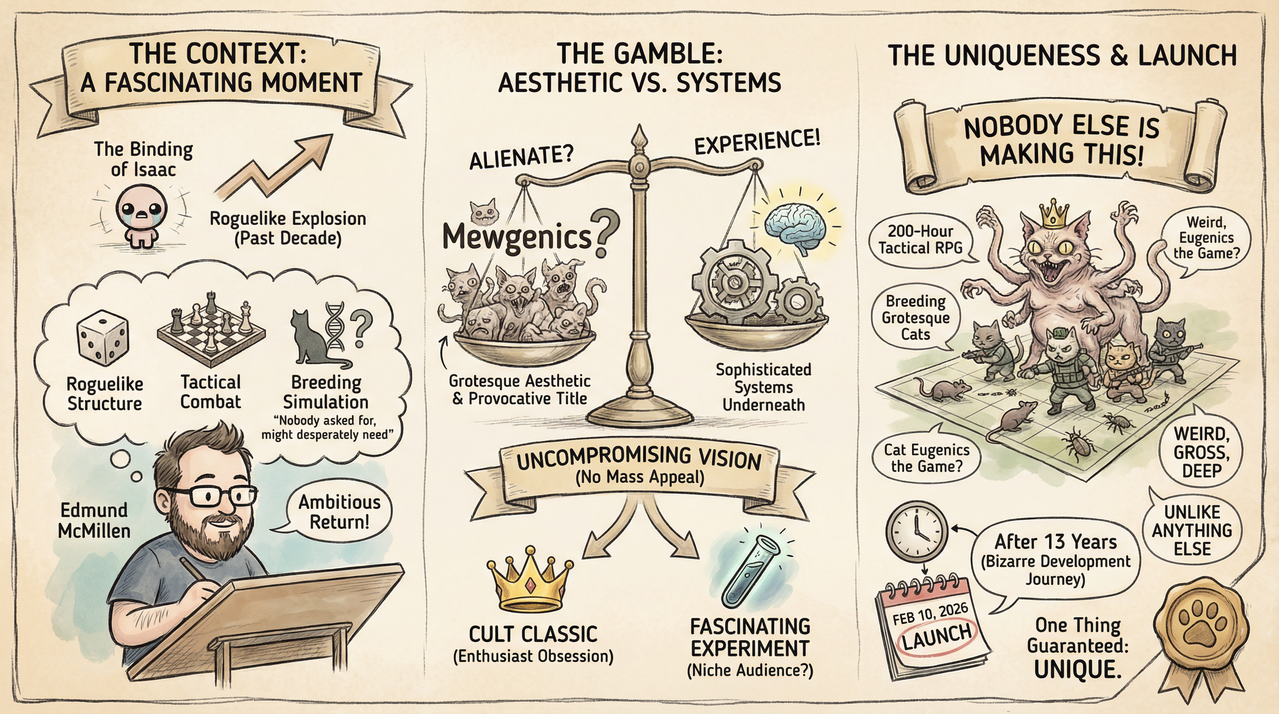
Mewgenics arrives at a fascinating moment in gaming. Roguelikes have exploded in popularity over the past decade, partly because The Binding of Isaac helped define the genre’s modern form. Now McMillen returns to his creation with something even more ambitious, combining roguelike structure with tactical combat and breeding simulation mechanics nobody asked for but might desperately need.
The game’s success or failure will largely depend on whether the grotesque aesthetic and provocative title alienate potential players before they experience the sophisticated systems underneath. McMillen and Glaiel clearly don’t care about mass appeal, designing exactly the game they wanted without compromising for broader audiences. This uncompromising vision could result in a cult classic that enthusiasts obsess over for years, or a fascinating experiment that never finds its audience despite obvious quality.
What’s certain is that nobody else is making anything remotely like Mewgenics. A 200-hour tactical RPG about breeding increasingly powerful and grotesque cats to send them into turn-based battles against rats, bugs, and rival toms doesn’t exist elsewhere in gaming. Whether that’s because the concept is brilliant or because nobody else wanted to spend five years making cat eugenics the game remains to be seen. We’ll find out on February 10, 2026 when Mewgenics finally launches after 13 years of the most bizarre development journey in indie gaming history. One thing is guaranteed: it will be weird, gross, deep, and unlike anything else releasing that month or possibly that year.