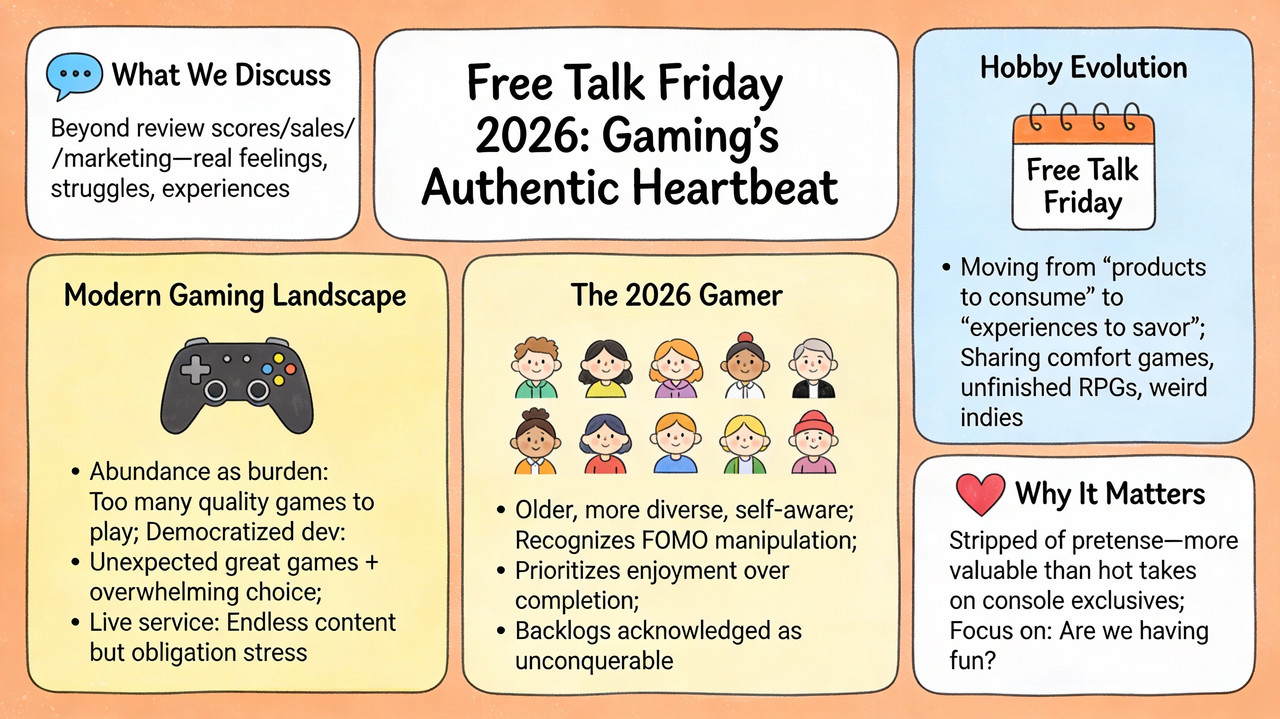
The first Free Talk Friday of 2026 arrived on January 3, giving the gaming community a chance to reflect on holiday gaming sessions, share New Year gaming resolutions they’ll definitely break by February, and discuss what they’re actually playing versus the massive backlog they accumulated during the Steam Winter Sale. As always, these weekly discussion threads reveal what’s genuinely capturing gamers’ attention beyond the hype cycles and marketing campaigns that dominate gaming news.
The Post-Holiday Backlog Struggle
Every January brings the same ritual: gamers staring at libraries bloated with Steam Sale purchases, holiday gifts, and games they swore they’d finish last year. The Free Talk Friday thread inevitably fills with confessions about buying games on sale that sit unplayed while people replay the same comfort titles they’ve beaten multiple times. It’s the gaming equivalent of buying gym memberships in January, except at least games don’t judge you for not using them.
The psychology behind backlog anxiety has become a genuine discussion point in gaming communities. People feel guilty about unplayed games despite rationally understanding that games aren’t obligations. The fear of missing out drives purchases during sales, creating libraries so massive that choosing what to play becomes paralyzing. Some gamers have embraced backlog acceptance, acknowledging they’ll never play everything and that’s perfectly fine. Others maintain elaborate spreadsheets tracking completion percentages like they’re training for competitive backlog clearing.
The Games People Are Actually Playing
Despite enormous backlogs, Free Talk Friday discussions reveal most people gravitate toward a handful of games rather than constantly jumping between titles. Live service games like Genshin Impact, Destiny 2, and various multiplayer shooters dominate because they provide structured goals and social experiences. Roguelikes and roguelites remain popular because they’re perfect for the just one more run mentality that keeps people engaged without requiring massive time commitments to finish.
Single-player narrative games get discussed differently. People talk about finally starting that acclaimed RPG everyone raved about two years ago, or returning to a game they bounced off previously now that they’re in the right mood for it. The communal gaming experience has shifted from everyone playing the same new release simultaneously to a more fragmented landscape where people experience games on their own timelines and share thoughts with others doing the same.
The Best of 2025 Debates Continue
Even though we’re into 2026, gamers continue arguing about 2025’s best releases. These discussions get interesting because they reveal how different player types evaluate games through completely different lenses. Someone praising a game for tight mechanical execution gets into debates with someone who values narrative and atmosphere above gameplay. Neither perspective is wrong, but the conversations often devolve into people talking past each other rather than understanding different priorities.
Clair Obscur: Expedition 33 appears frequently in these discussions as a consensus pick that united critics and players. However, some contrarians argue it’s overrated, sparking debates about whether something can be simultaneously popular and excellent or if popularity automatically means something is designed for the lowest common denominator. These arguments reveal more about the participants than the games being discussed.
New Year Gaming Resolutions
January brings the annual tradition of gamers declaring resolutions they won’t keep. Common pledges include finishing that one massive RPG they’ve restarted three times, finally getting good at fighting games, cutting back on live service time sinks, or clearing a specific number of backlog games. By February, most of these resolutions have been abandoned in favor of whatever new release captures attention or that comfortable multiplayer game that’s always there waiting.
The more realistic gamers skip resolutions entirely, acknowledging that gaming should be enjoyable rather than another obligation generating guilt and stress. If playing the same comfort game for the hundredth time brings joy, that’s a valid way to spend gaming time. If bouncing between games without finishing any of them is how someone enjoys the hobby, completionist purists can cope with that reality. Gaming is supposed to be fun, not homework.

The Completion Percentage Debate
Related to backlog discussions, the completion percentage conversation always generates fascinating perspectives. Some gamers take pride in 100% completion rates, viewing it as respecting developers’ work and getting full value from purchases. Others argue that finishing games you’re not enjoying is absurd, that life is too short to force yourself through mediocre content out of some misplaced sense of consumer responsibility.
The middle ground acknowledges that different games demand different engagement levels. A tight 10-hour indie game might deserve completion while a 100-hour open-world game packed with filler content doesn’t require clearing every checklist activity. The conversation becomes less about objective completion and more about personal satisfaction and respecting your own time as a limited resource.
Anticipation for Upcoming Releases
Free Talk Friday threads always feature discussions about upcoming games generating the most hype. For early 2026, Kingdom Come: Deliverance 2, Civilization VII, Ghost of Yotei, and Mewgenics appear frequently in anticipation discussions. People share whether they’re buying day one, waiting for reviews, or planning to grab these titles on sale months later after patches fix inevitable launch issues.
The conversation about day one purchases versus patient gaming has evolved. More gamers have embraced waiting for games to be patched, discounted, and properly evaluated before purchasing. The era of blindly pre-ordering based on hype has diminished as high-profile disappointments taught expensive lessons. However, certain franchises and developers still inspire day one faith from their communities based on consistent track records.
The Live Service Relationship
Every Free Talk Friday features conversations about love-hate relationships with live service games. People acknowledge spending hundreds or thousands of hours in games like Destiny 2, Genshin Impact, or Fortnite while simultaneously complaining about feeling trapped by FOMO mechanics, battle passes, and daily login rewards. The tension between genuine enjoyment and exploitative design creates complex feelings that gamers struggle to articulate.
Some have successfully broken free from live service loops, describing the liberation of no longer feeling obligated to log in daily or complete weekly challenges. Others defend their continued engagement, arguing that if they’re having fun and can afford it, external judgment about their gaming choices is irrelevant. The conversation rarely reaches resolution because live service games are designed to be divisive, extracting maximum value from engaged players while creating negative experiences for those who can’t keep up.
The State of Gaming Discourse
Meta discussions about gaming discourse itself appear in Free Talk Friday threads. People lament the toxicity dominating gaming discussions online, the inability to have nuanced conversations about controversial topics, and the exhausting culture war battles that invade every gaming space. The desire for spaces where people can just talk about games without everything becoming a proxy war for broader political conflicts gets expressed frequently.
However, these meta discussions often become the very arguments they’re criticizing. Someone complains about discourse quality, another person disagrees about what constitutes good discourse, and suddenly the thread devolves into the exact toxic argument everyone wanted to avoid. Gaming communities struggle with self-awareness about their own contribution to problems they identify in others.
Hardware and Setup Discussions
Free Talk Friday always features people sharing new hardware acquisitions, seeking setup advice, or discussing the eternal PC versus console debate. These conversations have become less hostile over time as cross-platform gaming has reduced the stakes. Most gamers acknowledge that different platforms serve different needs and preferences, though you’ll still find diehards evangelizing their chosen platform as objectively superior.
The Steam Deck and other portable PC gaming devices generate substantial discussion as people discover the joy of playing PC games on the couch or during commutes. The democratization of high-quality gaming across multiple form factors has fundamentally changed how people think about where and when they play. The question isn’t which platform is best anymore but which combination of platforms provides the most flexibility for individual lifestyles.
The Cozy Gaming Movement
An interesting trend in Free Talk Friday discussions is the growing embrace of cozy gaming experiences. People share recommendations for relaxing, low-stakes games that provide comfort rather than challenge. Stardew Valley, Animal Crossing, various farming simulators, and puzzle games get discussed as antidotes to the stress of competitive multiplayer or frustratingly difficult single-player games.
This shift reflects broader gaming demographic changes as the medium matures. Not everyone wants heart-pounding action, frame-perfect execution, or punishing difficulty. Sometimes people want to fish virtually, tend digital gardens, or solve gentle puzzles without consequence. The gaming industry has slowly recognized this audience, though cozy games still don’t receive the same marketing budgets or critical attention as blockbuster action titles.
Frequently Asked Questions
What is Free Talk Friday?
Free Talk Friday is a weekly discussion thread on gaming forums and subreddits where community members can discuss anything gaming-related without strict topic restrictions. It’s a more casual space compared to structured news discussions.
Why do gamers struggle with backlogs?
Backlog anxiety stems from fear of missing out, sale-driven impulse purchases, and treating games as obligations rather than entertainment. The abundance of quality games available creates decision paralysis about what to play next.
Should I finish games I’m not enjoying?
No. Life is too short to force yourself through entertainment you’re not enjoying out of some misplaced sense of obligation. Drop games that aren’t working for you and move on to something you’ll actually enjoy.
Are live service games bad?
Live service games aren’t inherently bad, but they use psychological techniques to maximize engagement and monetization that can feel exploitative. Whether they’re worth your time depends on if you genuinely enjoy the experience or feel trapped by FOMO mechanics.
What were the best games of 2025?
Clair Obscur: Expedition 33, Ghost of Yotei, Hollow Knight: Silksong, Hades II, and Death Stranding 2 appear frequently in best of 2025 discussions. However, the best game is subjective and depends on individual preferences and priorities.
Should I pre-order games?
Generally no, unless you have complete faith in the developer based on consistent track records. Waiting for reviews and post-launch patches usually results in better experiences at lower prices.
What are cozy games?
Cozy games prioritize relaxing, low-stakes gameplay over challenge and competition. Examples include farming simulators, life sims, puzzle games, and other titles designed to provide comfort rather than adrenaline.
How do I decide what to play from my backlog?
Stop overthinking it. Pick something that sounds appealing in the moment, play it if you enjoy it, drop it if you don’t. Your backlog isn’t a job, it’s a collection of potential entertainment options.
The Real Conversation About Gaming
Free Talk Friday threads represent gaming discourse at its most authentic. Away from review scores, sales figures, and marketing hype, people discuss what they’re actually experiencing, feeling, and struggling with as gamers. The conversations aren’t always profound or insightful, but they’re genuine in ways that structured discussions about specific news items often aren’t.
What emerges from these weekly discussions is a portrait of gaming as a hobby that’s simultaneously more accessible and more complicated than ever. More quality games exist than any person could reasonably play, creating abundance that feels like burden. The democratization of game development means incredible experiences come from unexpected sources, but it also means overwhelming choice. Live service games provide endless content and community, but at the cost of feeling trapped by obligation.
The gaming community in 2026 is older, more diverse, and more self-aware than previous generations. People recognize when they’re being manipulated by FOMO mechanics, acknowledge their backlogs will never be conquered, and increasingly prioritize enjoyment over completion. The hobby is moving away from treating games as products to be consumed and toward treating them as experiences to be savored at your own pace on your own terms.
Free Talk Friday captures this evolution better than any structured discussion about specific games or industry news. It’s where people admit they’ve played the same comfort game for a decade, confess they’ll never finish that acclaimed RPG everyone loves, and share excitement about finally trying that weird indie nobody else seems to know about. It’s gaming discourse stripped of pretense, and that makes it more valuable than a thousand hot takes about which exclusive justifies which console purchase. Here’s to the first Free Talk Friday of 2026, and to all the future Fridays where gamers gather to talk about what really matters: whether they’re having fun.