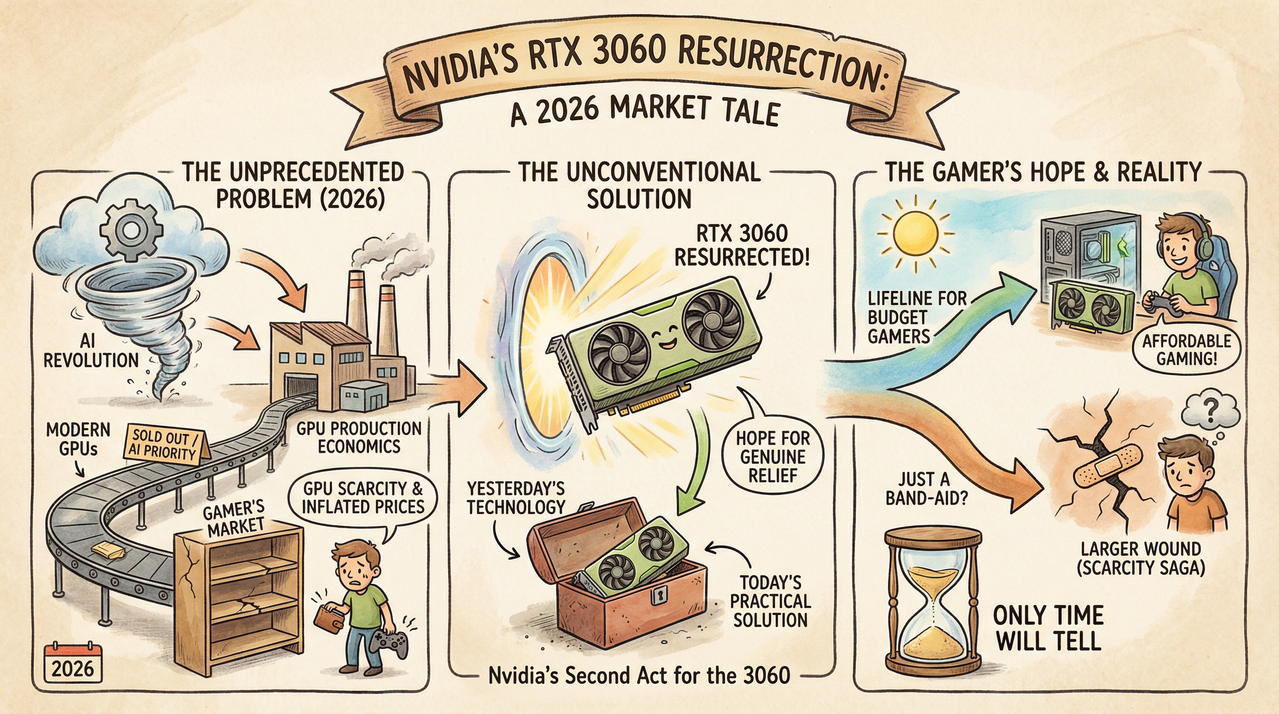
In an unexpected twist that has the PC gaming community buzzing, Nvidia is reportedly bringing back the GeForce RTX 3060 in Q1 2026. The graphics card, which was officially discontinued in 2024, is getting a second life thanks to ongoing memory shortages that have severely impacted the production of newer RTX 50 series GPUs.
Why Nvidia Is Reviving a Three-Year-Old GPU
The decision to restart RTX 3060 production comes as Nvidia faces a perfect storm of supply chain issues. According to industry insider @hongxing2020, Nvidia has informed its partners that production lines for the RTX 3060 will reopen soon, though it remains unclear whether both the 12GB and 8GB variants will return to shelves.
The primary culprit behind this unusual move is the DRAM shortage that began in the second half of 2025. This crisis has driven up memory prices across the board and directly impacted the availability of current-generation GPUs worldwide. Japanese and German suppliers have reportedly run completely out of high-end RTX 50 series units, leaving gamers scrambling for alternatives.
What makes the RTX 3060 particularly attractive in this scenario is its use of GDDR6 memory rather than the newer GDDR7 found in RTX 50 series cards. With GDDR7 supplies being prioritized for AI data centers and commanding premium prices, the older GDDR6 technology offers a more viable production path for consumer graphics cards.
The Memory Crisis Hitting RTX 50 Series Hard
Nvidia’s latest RTX 50 series launch hasn’t gone as smoothly as hoped. Reports suggest the company plans to cut gaming GPU production by 30 to 40 percent in the first half of 2026 compared to the same period in 2025. The models hit hardest include the RTX 5060 Ti 16GB and RTX 5070 Ti 16GB, with the former already rumored for discontinuation due to prohibitively high DRAM costs.
The situation has created a cascade effect throughout the GPU market. Memory chips are increasingly being swallowed up by the AI boom, with GDDR7 and other high-performance memory prioritized for data centers and AI hardware. This leaves fewer components available for consumer graphics cards, potentially making midrange RTX 50 models harder to find and more expensive.
Price hikes are already on the horizon. AMD GPU prices are expected to increase starting January 2026, while Nvidia is anticipated to implement price adjustments in February. Some reports suggest the RTX 5090, which launched at $1,999, could eventually climb to $5,000 later in 2026, though such extreme predictions should be taken with caution.
Is the RTX 3060 Still Relevant in 2026?
The RTX 3060 has maintained impressive staying power since its 2021 launch. Despite being nearly four years old, it consistently competes for the top spot in Steam’s monthly hardware surveys alongside the RTX 4060. Its 12GB of VRAM and $329 original MSRP made it a sweet spot for budget-conscious gamers, though modern AAA games are beginning to push its capabilities.
The big question is whether Nvidia can price these resurrected cards competitively. Bringing back the RTX 3060 only makes sense if the GPUs are sold at attractive price points. If the cards command premium pricing due to overall market conditions, gamers might find themselves paying current-gen prices for last-gen performance.
What This Means for PC Gamers
The RTX 3060’s return highlights both the severity of the current GPU crisis and Nvidia’s need to keep retail shelves stocked with its popular xx60 lineup. The xx60 series represents the budget-friendly, mass-market segment that drives significant volume for the company.
For gamers, this development presents a mixed bag. On one hand, increased GPU availability is always welcome, especially during a shortage. The RTX 3060 remains capable of handling 1080p gaming and can tackle 1440p in many titles, making it a viable option for mainstream gamers. On the other hand, paying 2026 prices for 2021 technology feels like a step backward for an industry that typically moves relentlessly forward.
The situation also raises questions about Nvidia’s RTX 50 Super lineup, which has been rumored for late 2026. With memory supplies constrained and prices volatile, these refreshed models may be delayed or arrive with less aggressive specifications than originally planned.
Looking Ahead
The RTX 3060’s comeback serves as a stark reminder that the GPU market remains far from normal. While the cryptocurrency mining frenzy that plagued previous years has subsided, the AI boom has created new demand pressures on the same underlying components. Memory manufacturers are prioritizing more profitable AI and data center contracts, leaving consumer graphics cards to compete for scraps.
Whether this strategy succeeds depends entirely on pricing and availability. If Nvidia can deliver RTX 3060 cards at genuinely budget-friendly prices, they could provide relief for gamers priced out of the RTX 50 series. If not, this resurrection risks becoming just another symptom of a market struggling to serve its core gaming audience.
Frequently Asked Questions
When will the RTX 3060 be available again?
According to reports, Nvidia plans to restart RTX 3060 production in Q1 2026, which means cards could start appearing on retail shelves between January and March 2026.
Will both the 8GB and 12GB versions return?
It’s currently unclear which variant or variants Nvidia will produce. The original 12GB model was more popular, but the company may choose to manufacture both versions depending on market demand and memory availability.
Why is Nvidia bringing back an old GPU instead of making more RTX 50 series cards?
The RTX 3060 uses GDDR6 memory, which is more readily available and less expensive than the GDDR7 memory used in RTX 50 series cards. With GDDR7 supplies being prioritized for AI data centers, producing RTX 3060 cards offers a more economically viable option to keep retail shelves stocked.
How does the RTX 3060 perform compared to newer cards?
The RTX 3060 performs roughly on par with or slightly below the RTX 4060 in most gaming scenarios. It can handle 1080p gaming comfortably and manages 1440p in many titles, though it struggles with the most demanding modern AAA games at maximum settings. It lacks the AI-enhanced features like DLSS 3 frame generation found in newer cards.
Should I wait for the RTX 3060 rerelease or buy a current-gen card?
This depends on pricing and your specific needs. If the reissued RTX 3060 launches at a significantly lower price than RTX 50 series cards and you primarily game at 1080p, it could be a solid budget option. However, if prices are comparable to RTX 5060 or RTX 4060 cards, you’re better off with the newer technology.
Will this solve the GPU shortage problem?
While additional RTX 3060 supply will help, it won’t solve the underlying memory shortage affecting the entire GPU market. The fundamental issue is that memory manufacturers are prioritizing AI and data center contracts over consumer graphics cards, a problem that will likely persist throughout 2026.
Could Nvidia bring back other old GPUs too?
While there’s no confirmation of other models returning, Nvidia previously restarted production of the GTX 1080 Ti in 2021 during a previous shortage. If the RTX 3060 resurrection proves successful, the company might consider bringing back other popular Pascal or Ampere-based cards that use older memory technologies.
Final Thoughts
Nvidia’s decision to resurrect the RTX 3060 is an unconventional solution to an unprecedented problem. It reflects the reality that the GPU market in 2026 looks very different from what anyone anticipated just a few years ago. The AI revolution has fundamentally altered the economics of graphics card production, creating a situation where yesterday’s technology becomes today’s practical solution. For gamers, the hope is that this move provides genuine relief rather than becoming another chapter in the ongoing saga of GPU scarcity and inflated prices. Only time will tell whether the RTX 3060’s second act proves to be a lifeline for budget gamers or simply a Band-Aid on a much larger wound.