The golden age of isometric CRPGs gave us masterpieces like Baldur’s Gate, Planescape: Torment, and Fallout 2. While the genre has seen a renaissance with games like Divinity: Original Sin and Pillars of Eternity, indie developer Absent Dragon is taking things back to basics with Aletheia: Prophecy of Perseus. This single-developer passion project drops you into Ancient Greece as Perseus, tasked with the impossible mission of slaying the gorgon Medusa. With turn-based combat, multiple quest solutions, and a commitment to mythological authenticity, this March 2026 release could scratch that old-school CRPG itch.
Walking in Perseus’s Sandals
Aletheia: Prophecy of Perseus centers on one of Greek mythology’s most famous tales. You play as Perseus, the demigod son of Zeus, on his legendary quest to behead Medusa, whose gaze turns mortals to stone. But this isn’t just a hack-and-slash adventure through mythological set pieces. Absent Dragon promises a story-rich experience that stays faithful to the original myths while giving players agency over how events unfold.
The game draws heavily from ancient sources including Apollodorus and Hesiod, aiming for accuracy rather than Hollywood reinterpretation. That means encountering the gods, monsters, and heroes as the ancient Greeks actually depicted them, not modern sanitized versions. Expect divine intervention, mortal hubris, and the kind of consequences that Greek tragedies are famous for.
What sets Aletheia apart from other mythology games is its commitment to never contradicting the source material. The developers want to let players experience everything Perseus did in the original myths without upstaging or rewriting the texts. It’s a respectful approach that suggests the game will appeal to mythology enthusiasts as much as CRPG fans.
Classic CRPG Mechanics Meet Greek Tragedy
If you played Baldur’s Gate or the original Fallout games, Aletheia: Prophecy of Perseus will feel immediately familiar. The game uses isometric perspective with beautiful pre-rendered backgrounds that capture the ancient Mediterranean world. Turn-based combat takes inspiration specifically from Fallout 2, with detailed character creation determining your approach to challenges.

Character creation goes deep into your background. You determine Perseus’s upbringing, racial background within the Greek world, skills, and attributes. These choices aren’t just cosmetic flavor text. They fundamentally shape how you interact with the world and what solutions become available during quests. A Perseus skilled in diplomacy might talk his way past obstacles, while a combat-focused build solves problems with bronze and blood.
The quest design emphasizes player choice and multiple solutions. Absent Dragon promises no hand-holding, meaning you need to explore, experiment, and think creatively about problems. Want to sneak past guards? Bribe them? Fight them? Convince them you’re on a divine mission? The game aims to support all those approaches without forcing you down predetermined paths.
Choices carry consequences that ripple through the narrative. Help one faction and another might remember. Break an oath and face divine retribution. The reactive storytelling creates the kind of emergent narratives that made classic CRPGs so memorable, where every playthrough feels personalized based on your decisions.
Combat and Encounters
Turn-based combat means battles are tactical affairs rather than twitch-based action. You carefully position Perseus and any companions, manage resources, and exploit enemy weaknesses. Given the mythological setting, expect encounters with iconic creatures like gorgons, sea monsters, and hostile warriors. Each fight requires strategy appropriate to the enemy type, rewarding players who pay attention to mythological lore.
The game features a reactive combat system where your equipment, skills, and preparation determine your effectiveness. Perseus might need specific divine gifts to overcome certain challenges, mirroring how he received Hades’s helm of invisibility, Hermes’s winged sandals, and other artifacts in the original myth. Finding and using these tools correctly becomes part of the strategic depth.

Part of a Larger Mythological Vision
Aletheia: Prophecy of Perseus isn’t a standalone project. Absent Dragon has bigger ambitions for the Aletheia series. They’re also developing Aletheia: Return of Odysseus, which adapts Homer’s Odyssey with the same commitment to authenticity and classic CRPG design. That game puts you in control of Odysseus during his ten-year journey home after the Trojan War.
The developer’s ultimate vision extends beyond just Greek mythology. They hope to create a community passionate about authentic mythology games, eventually expanding into Egyptian, Mesopotamian, and other ancient cultures. Each game in the series would maintain the same design philosophy: faithfulness to source material, reactive storytelling, and classic isometric RPG gameplay.
This approach mirrors what Age of Mythology did for real-time strategy or what Hades accomplished for roguelikes, using mythology as more than window dressing. By committing to accuracy and treating ancient stories with respect, Absent Dragon could carve out a unique niche in a crowded RPG marketplace.
The Solo Developer Journey
Aletheia: Prophecy of Perseus is essentially a one-person project from developer TavernKing, who’s been sharing updates on Reddit and building a small but dedicated community. The game has a playtest available on Steam, allowing curious players to try the mechanics before the March 2026 launch.
Solo-developed CRPGs face enormous challenges. These games traditionally require massive teams to create the content, balance systems, and polish presentation. However, modern tools and engines have made ambitious one-person projects more feasible. Games like Underrail and Tales of Maj’Eyal proved that solo developers can create deep, engaging RPG experiences if they focus on strong systems over AAA production values.
The reception so far has been cautiously optimistic. CRPG communities on Reddit and RPG Codex have shown interest, though some remain skeptical about scope and whether the developer can deliver on ambitious promises. The March 2026 release date gives a clear target, and the available playtest suggests development is progressing beyond vapor-ware status.
Standing Out in a Crowded Genre
The CRPG renaissance has given us incredible games, but it’s also created market saturation. Larian Studios set a new standard with Baldur’s Gate 3, making it harder for smaller projects to compete. What gives Aletheia: Prophecy of Perseus potential is its specific focus. Rather than trying to be everything to everyone, it commits fully to authentic Greek mythology within a classic CRPG framework.
The Greek mythology setting itself isn’t unique anymore. Hades became a phenomenon, Assassin’s Creed Odyssey explored ancient Greece, and countless indie games borrow mythological elements. However, most of these games use mythology as aesthetic inspiration rather than committing to faithful adaptation. Aletheia’s promise to never contradict source texts and to let players experience authentic myths creates differentiation.
The old-school design philosophy also targets a specific audience. While Baldur’s Gate 3 brought modern conveniences and production values, many CRPG fans still crave the purity of late 90s design. No quest markers, no extensive voice acting, just solid systems and reactive storytelling. If Absent Dragon delivers on that vision, they could find their niche.
What We Still Don’t Know
With a March 2026 release approaching, some questions remain unanswered. How long is the campaign? What’s the full scope of character progression systems? Will there be companions with their own storylines? How does the game handle the famous Perseus encounters like the gray sisters or Atlas holding up the sky? What happens after Medusa’s defeat since that’s only one part of Perseus’s larger myth?
The developer has been relatively transparent with development updates, but typical indie game caution applies. Release dates can slip, scope can shrink, and final products sometimes don’t match initial promises. The playtest availability helps manage expectations by letting people experience the core gameplay before committing to a purchase.
Pricing hasn’t been announced yet, though comparable indie CRPGs typically launch between fifteen and thirty dollars depending on scope. Given this is a solo-developer project without extensive voice acting or AAA production values, a budget-friendly price point seems likely.
Frequently Asked Questions
When does Aletheia: Prophecy of Perseus release?
The game is scheduled to launch in March 2026 on PC via Steam. An exact date hasn’t been confirmed yet.
What platforms will it be available on?
Currently, Aletheia: Prophecy of Perseus is confirmed only for PC via Steam. There’s been no announcement about console versions, though one Reddit commenter asked about console plans without receiving a confirmed answer.
Is there a demo or playtest available?
Yes, the game has a playtest available on Steam that lets you try the core mechanics before launch. Check the Steam page for current availability.
What games inspired Aletheia: Prophecy of Perseus?
The developer cites Baldur’s Gate 1 and Fallout 1 and 2 as primary inspirations. The game aims to recapture the feel of late 90s isometric CRPGs with turn-based combat and reactive storytelling.
Is this based on accurate Greek mythology?
Yes, Absent Dragon emphasizes faithfulness to ancient sources including Apollodorus and Hesiod. The developers aim never to contradict the original myths and texts.
Do you have to know Greek mythology to enjoy the game?
While mythology knowledge enhances the experience, the game tells Perseus’s story from the beginning, so newcomers can jump in. The authentic approach means you’ll learn actual Greek myths rather than Hollywood versions.
Is combat turn-based or real-time?
Combat is turn-based, specifically inspired by Fallout 2’s combat system. This allows for tactical positioning and strategic decision-making rather than action-focused gameplay.
Are there multiple endings or choices that matter?
Yes, the game promises choices with consequences, multiple quest solutions, and reactive storytelling where decisions ripple through the narrative.
Who is developing Aletheia: Prophecy of Perseus?
Absent Dragon, effectively a solo developer going by TavernKing on Reddit, is creating the game. This is a passion project rather than a large studio production.
Will there be more Aletheia games?
Yes, Absent Dragon is also working on Aletheia: Return of Odysseus, which adapts Homer’s Odyssey. The developer hopes to create a series exploring various mythologies with the same authentic approach.
Final Thoughts
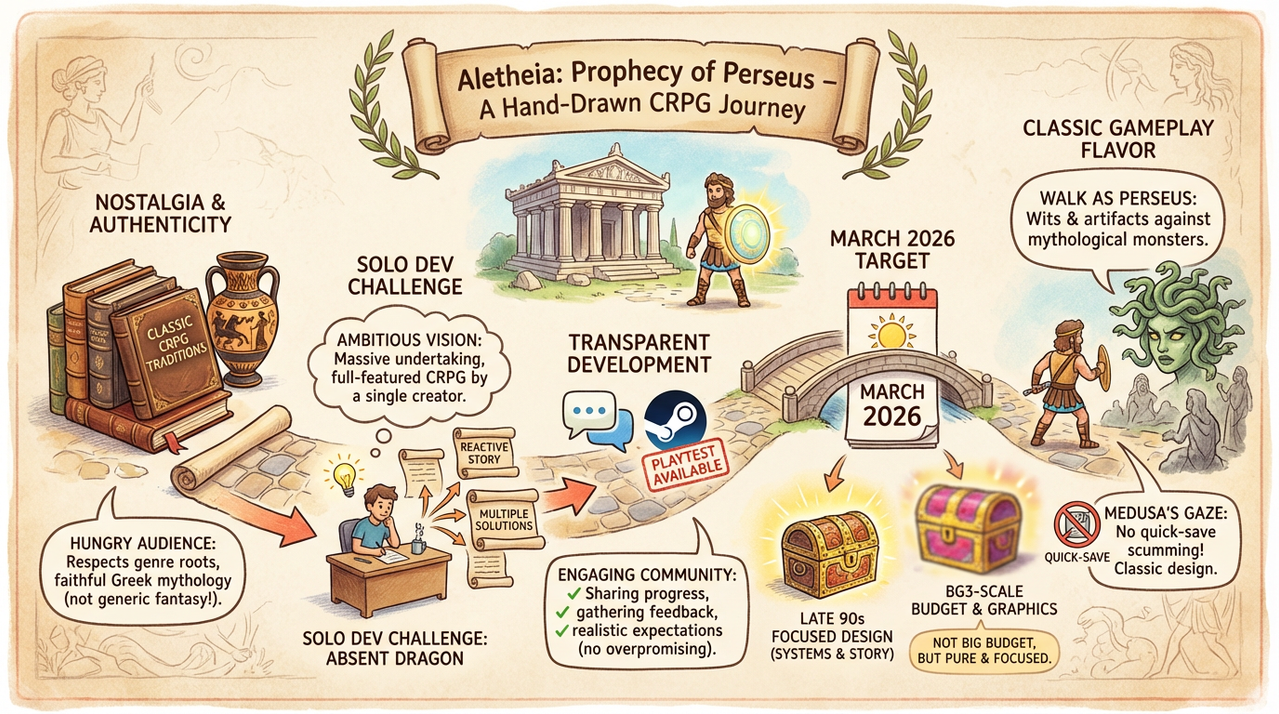
Aletheia: Prophecy of Perseus represents an interesting bet on nostalgia and authenticity. The CRPG audience has proven hungry for new experiences that respect genre traditions, and Greek mythology remains endlessly fascinating when treated with care rather than as generic fantasy window dressing. Whether Absent Dragon can deliver on their ambitious vision as a solo developer remains the big question. Creating a full-featured CRPG with reactive storytelling, multiple quest solutions, and faithful mythology adaptation is a massive undertaking even for experienced teams. The available playtest suggests the core systems work and the vision is clear, but turning that into a polished, complete game requires tremendous effort. What’s encouraging is the developer’s transparency and willingness to engage with the CRPG community. They’re sharing progress, gathering feedback, and setting realistic expectations rather than overpromising. The March 2026 release date is close enough to be believable while allowing time for final polish. For fans of classic CRPGs who’ve exhausted modern offerings and want something different, Aletheia: Prophecy of Perseus could be exactly what you’re looking for. It won’t have Baldur’s Gate 3’s production values or Larian’s budget, but it might capture something those bigger games miss: the pure, focused design of late 90s RPGs where systems and stories mattered more than graphics and voice acting. If you’re curious about walking through ancient Greece as Perseus, facing mythological monsters with nothing but your wits and divine artifacts, the playtest is available now on Steam. Just remember that when Medusa’s gaze threatens to turn you to stone, there’s no quick-save scumming your way out. This is classic CRPG design, after all.