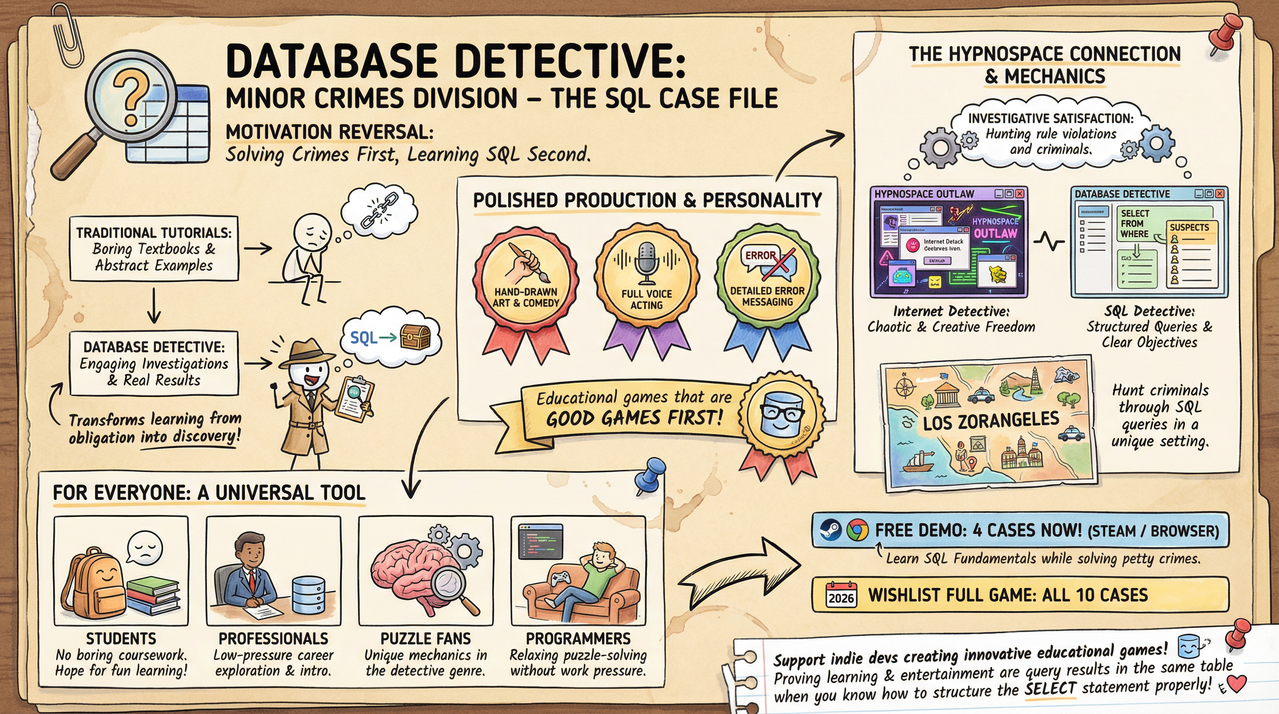
Learning SQL typically involves dry tutorials, boring textbooks, and corporate training videos that make spreadsheets seem exciting by comparison. Database Detective: Minor Crimes Division from indie developer Thomas Hsu takes the opposite approach. Instead of SELECT statements and WHERE clauses in sterile classroom settings, you’re investigating littering violations, tracking down vandals, and solving petty crimes across Los Zorangeles using the power of database queries. It’s Hypnospace Outlaw meets programming tutorial, wrapped in hand-drawn comedy that makes learning SQL feel less like homework and more like actual detective work.
SQL as Detective Tool
Database Detective: Minor Crimes Division assigns you to the Los Zorangeles Police Department’s Minor Crimes Division as their newest Database Detective. Your job involves analyzing police databases filled with witness statements, security footage timestamps, license plate records, and suspect information. But instead of clicking through menus or selecting dialogue options, you write actual SQL queries to extract the information needed to crack each case.
The genius of this approach is making SQL queries feel purposeful rather than academic. When you need to find all red cars spotted near the crime scene between 3 PM and 5 PM, you’re not just practicing JOIN statements for a grade. You’re gathering evidence. When you filter witness testimonies by location and time, you’re building a timeline. Every SELECT, WHERE, and ORDER BY clause serves an investigative purpose that makes the syntax meaningful beyond memorization.
Thomas Hsu spent years developing this concept specifically to make SQL approachable. The game includes multiple support systems for players unfamiliar with database querying. A Clippy-like assistant offers hints when you’re stuck. An in-game SQL instruction manual explains syntax and concepts. Most impressively, the error message system provides detailed feedback pointing exactly where queries failed, something actual SQL developers would kill for in their daily work.

From Tutorial to True Investigation
The demo includes four cases out of the full game’s ten, providing substantial introduction to both SQL concepts and investigative gameplay. Early cases teach basic querying fundamentals. You learn how to SELECT data from tables, filter results with WHERE clauses, and sort information with ORDER BY. The difficulty gradually increases as cases introduce more complex database structures and require combining multiple queries to piece together evidence.
What separates Database Detective from simple SQL tutorials is how cases expand beyond the police database. Similar to Hypnospace Outlaw’s internet detective work, later investigations require searching external sources for clues and data. You might need to cross-reference social media posts, check parking records from city databases, or dig through public records to find the missing pieces connecting suspects to crimes. This open-ended investigation mirrors real detective work where information comes from multiple sources that need synthesis.
The game doesn’t just test whether you can write syntactically correct queries. It challenges you to think like an investigator determining what questions to ask. Knowing SQL syntax means nothing if you don’t know what data you’re looking for. This investigative logic combined with technical implementation creates genuine problem-solving that feels satisfying when pieces click into place and you finally identify the perpetrator.
Hand-Drawn Comedy
Database Detective commits to comedic presentation through hand-drawn art that gives the game personality beyond educational software. Characters feature expressive designs that communicate humor visually. The Los Zorangeles setting plays on Los Angeles stereotypes with exaggerated California culture filtered through indie game sensibilities. Crime scenes, suspect profiles, and mission briefings all embrace absurdist comedy that keeps the tone light despite teaching programming concepts.
Fully voiced mission briefings add production value rare in indie educational games. Instead of reading dry text descriptions of crimes, you receive voiced case assignments that establish tone and context. The voice acting sells the comedy, delivering lines with timing and character that text alone couldn’t achieve. This attention to presentation quality demonstrates Thomas Hsu’s commitment to making Database Detective feel like a real game rather than tutorials with game elements bolted on.
The minor crimes focus provides perfect comedy material. You’re not solving murders or stopping terrorist plots. You’re tracking down litterers, identifying vandals, and investigating petty misdemeanors that barely warrant police attention. This low-stakes premise allows absurdist humor while maintaining investigative satisfaction. There’s something inherently funny about using sophisticated database querying to determine who threw trash on the sidewalk, and the game leans into that absurdity enthusiastically.

Learning That Doesn’t Feel Like Learning
The most impressive achievement of Database Detective is making SQL education invisible. You’re not consciously studying database queries. You’re investigating crimes, following leads, and catching culprits. The SQL happens as necessary tool rather than explicit lesson. This stealth education approach works because motivation comes from solving cases rather than passing tests or completing assignments.
Traditional programming education often fails because abstract examples lack context. Learning about customers and orders in sample databases means nothing without understanding why that information matters. Database Detective provides that missing context by making every query serve investigative purpose. You care about extracting specific data because it identifies suspects, narrows timeframes, or eliminates alibis. The programming serves gameplay rather than gameplay serving programming.
The extensive error reporting system deserves special mention. One Reddit commenter joked that detailed error messages specifying exactly where queries failed doesn’t align with SQL’s reputation for cryptic errors. Thomas Hsu acknowledged creating a custom SQL parser specifically for helpful feedback, showing dedication to teaching rather than accurate corporate database frustration simulation. This educational focus prioritizes player success over authenticity to professional SQL’s often maddening ambiguity.
Who This Game Serves
Database Detective targets multiple audiences simultaneously. Students learning SQL for computer science courses get engaging practice that beats textbook exercises. Professionals considering database careers can explore whether SQL work interests them without committing to formal education. Puzzle game enthusiasts who’ve never touched code get accessible introduction to programming concepts through detective fiction framework.
The game also appeals to people who enjoy Hypnospace Outlaw’s internet detective gameplay and want similar investigation mechanics in different contexts. Database querying provides structure Hypnospace’s free-form web searching sometimes lacked. Knowing you need specific data from defined tables creates clearer objectives while maintaining investigative problem-solving Hypnospace fans loved.
Even experienced programmers might enjoy Database Detective as comfort gaming. There’s satisfaction in writing queries that solve problems immediately without dealing with legacy codebases, unclear requirements, or production bugs. The hand-drawn comedy and low-stakes crimes create relaxing atmosphere where SQL becomes puzzle-solving rather than work obligation.
The Demo Experience
The demo released late December 2025 provides substantial preview of Database Detective’s full vision. Four cases introduce core mechanics, teaching fundamental SQL while establishing the comedic tone and hand-drawn aesthetic. The demo works in browsers without downloads, lowering barriers for curious players who want to try before committing.
Starting with basic SELECT statements, the demo gradually introduces new SQL concepts through increasingly complex investigations. Early cases teach single-table queries with simple WHERE clauses. Later cases require joining multiple tables, filtering with compound conditions, and combining information from different data sources. By the demo’s end, players who started knowing nothing about SQL will have working knowledge of fundamental database querying.
The progression feels natural because complexity increases match investigative logic rather than arbitrary difficulty curves. You learn JOINs when cases involve cross-referencing witness statements with security camera footage. You master GROUP BY and aggregate functions when analyzing patterns across multiple incidents. The SQL education emerges organically from investigative needs rather than following rigid curriculum structure.

Built in Unity, Works Everywhere
Thomas Hsu developed Database Detective using Unity Engine with releases planned for Windows, macOS, and Linux. This cross-platform approach ensures the game reaches students and professionals regardless of operating system preferences. The browser demo showcases Unity’s WebGL capabilities, allowing immediate play without installation concerns.
The technical implementation required building custom SQL parsing rather than relying on actual database engines. This allows Thomas to provide helpful error messages, validate queries in player-friendly ways, and create puzzles with guaranteed solutions. Real SQL databases can produce unexpected results depending on data distribution and query optimization. Custom parsing ensures consistent, predictable behavior that serves educational goals.
The game’s relatively modest scope, ten cases total with four in the demo, reflects realistic indie development for a solo creator. Rather than promising dozens of cases and risking incomplete delivery, Thomas focused on crafting ten strong investigations that thoroughly teach SQL fundamentals while maintaining comedic quality throughout. This reasonable scoping increases confidence the full game will launch in quality condition.
Release Timeline
Database Detective: Minor Crimes Division targets 2026 release on Steam for PC, with the demo already playable. Thomas Hsu hasn’t announced specific launch dates, suggesting development continues based on quality goals rather than arbitrary deadlines. The demo’s late 2025 release indicates substantial progress toward completion, with feedback from demo players likely influencing final polish and case refinement.
The years-long development cycle shows commitment to executing the concept properly rather than rushing educational software to market. Many programming tutorial games fail because they prioritize education over entertainment, resulting in boring experiences nobody wants to play. Database Detective’s hand-drawn art, full voice acting, and Hypnospace-inspired investigation mechanics demonstrate equal emphasis on game quality and educational value.
Frequently Asked Questions
When does Database Detective: Minor Crimes Division release?
The full game is scheduled for 2026 release on PC via Steam. No specific date has been announced yet, but a free demo with 4 cases is currently playable.
What platforms will Database Detective be available on?
The game will release for Windows, macOS, and Linux. The demo is playable in web browsers without downloads through WebGL.
Who is developing Database Detective?
Thomas Hsu is the solo indie developer who has been working on Database Detective for several years.
Do I need to know SQL to play?
No. The game is designed to teach SQL from scratch with in-game tutorials, a Clippy-like assistant for hints, an SQL instruction manual, and detailed error messages that help you learn.
How many cases are in the full game?
The complete game will feature 10 cases, with 4 included in the free demo.
Is it similar to Hypnospace Outlaw?
Yes, in structure. Both games involve investigating cases by searching databases and online sources for clues. Database Detective uses SQL queries while Hypnospace used web browsing.
What kind of crimes do you investigate?
Minor offenses like littering, vandalism, and other petty misdemeanors. The low-stakes crimes contribute to the game’s comedic tone.
Will this actually teach me useful SQL skills?
Yes. The game covers fundamental SQL concepts including SELECT statements, WHERE clauses, JOINs, filtering, sorting, and aggregate functions that apply to real database work.
Are the mission briefings really fully voiced?
Yes, each case includes voiced mission briefings that establish context and tone for the investigation ahead.
Can I play the demo right now?
Yes. The demo is available on Steam and playable in web browsers without requiring downloads.
Final Thoughts
Database Detective: Minor Crimes Division succeeds where countless programming tutorials fail by making education secondary to entertainment. You’re not suffering through SQL lessons hoping to eventually use those skills. You’re solving crimes right now, and SQL happens to be the tool that gets results. This motivation reversal transforms learning from obligation into discovery.
Thomas Hsu’s years-long development commitment shows in the polished presentation, thoughtful progression, and genuinely funny comedy. The hand-drawn art, full voice acting, and detailed error messaging demonstrate understanding that educational games still need to be good games first. Nobody continues playing boring tutorials regardless of how useful the skills might be. Database Detective earns your continued attention through engaging investigations that happen to teach programming.
The comparison to Hypnospace Outlaw is apt and encouraging. That game proved internet detective mechanics work beautifully when executed with personality and creative freedom. Database Detective applies similar investigative satisfaction to structured database queries, creating clearer objectives while maintaining problem-solving depth. If you loved tracking down Hypnospace rule violations, you’ll appreciate hunting Los Zorangeles criminals through SQL queries.
For students dreading SQL coursework, Database Detective offers hope that programming doesn’t have to mean boring textbooks and abstract examples. For professionals curious about database careers, it provides low-pressure introduction showing whether this work appeals to you. For puzzle game fans, it delivers detective gameplay with unique mechanics rarely seen in the genre. For programmers seeking comfort gaming, it transforms SQL into relaxing puzzle-solving without work pressure.
Download the free demo from Steam or play it directly in your browser. Experience four cases that teach SQL fundamentals while solving petty crimes across Los Zorangeles. If the demo resonates, wishlist the full game to receive notification when all ten cases launch in 2026. Support indie developers creating genuinely innovative educational games that respect your time and intelligence. Database Detective proves learning and entertainment aren’t mutually exclusive, they’re query results that can absolutely appear in the same table when you know how to structure the SELECT statement properly.