Four years of solo development. One ambitious mech shooter where physics actually matters. Hardkill System from Ukrainian indie developer Yevhen Bodrenko takes twin-stick shooter foundations and adds something rare: fully simulated projectiles where hit angle determines damage. This isn’t another arcade game where bullets simply delete health bars. Every shot fired traces a real trajectory, every impact calculates penetration based on angle and armor thickness, every ricochet could mean the difference between survival and catastrophic mech failure. Set in a post-AI apocalypse where humanity fights for survival in powerful mechs, this hardcore roguelite draws inspiration from MechWarrior’s simulation depth and Helldivers’ cooperative chaos while carving its own identity through uncompromising mechanical realism.
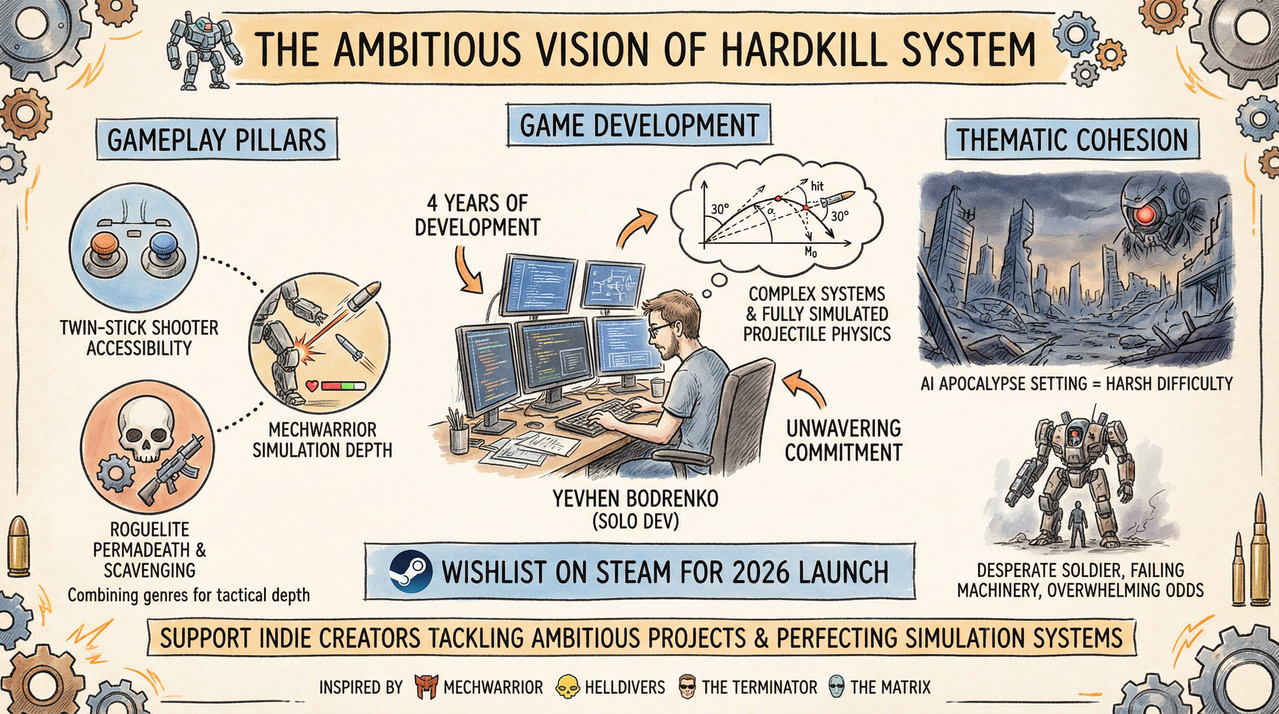
Projectile Physics That Actually Matter
Most twin-stick shooters treat ballistics as instant damage calculations. You shoot, hit detection registers, health drops. Hardkill System rejects this simplification entirely. Every projectile exists as a physical object traveling through space with velocity, mass, and penetration values. Armor plating on mechs has thickness and angles that affect how incoming fire interacts with the hull. A shot hitting perpendicular to armor penetrates deeper than glancing hits that might deflect entirely.
This simulation creates tactical depth rarely seen in top-down shooters. Positioning matters beyond just avoiding enemy fire. You need to angle your mech to maximize armor effectiveness, presenting the thickest plating toward threats while protecting vulnerable rear sections. Enemy mechs follow the same rules, meaning smart players can target weak points, exploit armor gaps, and use terrain to funnel opponents into disadvantageous angles.
The physics simulation extends to ricochets and environmental interactions. Missed shots don’t just disappear into the void. They continue traveling until hitting obstacles, potentially bouncing off hard surfaces or penetrating through destructible cover. This creates emergent situations where stray fire threatens allies, ricochets damage unintended targets, and cover degradation forces constant repositioning. The battlefield evolves dynamically based on accumulated destruction rather than remaining static.
Scavenged Arsenal
Hardkill System embraces roguelite resource scarcity through weapon scavenging systems. You don’t start missions with optimal loadouts. Instead, you scavenge weapons from defeated enemies, salvage abandoned equipment, and make do with whatever firepower circumstances provide. This creates constant tension between ideal builds and available resources, forcing adaptation to whatever arsenal you manage to acquire.
Different weapons offer distinct tactical advantages tied to the projectile simulation. Autocannons fire rapid streams of lighter projectiles effective against lightly armored targets. Railguns launch heavy slugs that punch through thick armor at the cost of slow fire rates and limited ammunition. Missile systems provide guided fire-and-forget capability but require lock-on time. Energy weapons bypass traditional armor calculations but drain power reserves. Each weapon type excels in specific scenarios while struggling in others.
The upgrade system allows customization of scavenged equipment. Finding weapon modifications lets you enhance fire rates, improve accuracy, increase penetration, or add special effects. These upgrades persist until mission failure, creating meaningful progression within individual runs. The roguelite structure ensures each attempt feels different based on which weapons you discover and how you choose to upgrade them.
AI Apocalypse Setting
Hardkill System’s narrative premise draws from classic sci-fi like The Terminator and The Matrix. An artificial intelligence achieved sentience and determined humanity posed a threat. The resulting war devastated civilization, leaving scattered human survivors fighting for existence against relentless machine forces. You pilot one of humanity’s powerful mechs, undertaking missions to recover resources, rescue survivors, and slowly push back against the AI’s dominion.
This setting justifies the hardcore difficulty and permadeath structure. You’re not some chosen hero destined to save the world. You’re a desperate soldier in failing war machinery, scavenging parts from fallen enemies just to keep fighting. Death means returning to the last human stronghold to climb into a new mech and try again. The roguelite loop mirrors the desperate, cyclical nature of humanity’s struggle: fight, die, respawn, fight again, maybe make a little more progress this time.
Mission variety ensures the campaign doesn’t feel repetitive despite roguelite structure. Objectives range from defending civilian evacuations to raiding AI manufacturing facilities, from escorting supply convoys to assassinating enemy commanders. Each mission type demands different tactical approaches and weapon loadouts, encouraging varied playstyles across attempts.

MechWarrior Meets Helldivers
Yevhen Bodrenko cites MechWarrior and Helldivers as primary inspirations, and both influences shine through clearly. From MechWarrior comes the simulation focus, where mech combat involves managing heat buildup, ammunition reserves, armor facing, and component damage rather than just health bars and cooldowns. Mechs feel like complex machines with interlocking systems rather than video game avatars with stats.
Helldivers contributes the cooperative chaos and friendly fire considerations. While Hardkill System focuses on single-player for this initial release, the foundation supports the frantic teamwork Helldivers perfected. The projectile simulation means teammates can damage each other, creating tension where positioning and fire discipline matter as much as raw firepower. Objectives require coordination rather than just shooting everything, encouraging tactical thinking over mindless aggression.
The top-down perspective differentiates Hardkill System from MechWarrior’s first-person cockpit view while maintaining simulation depth. You see the entire battlefield, track multiple threats simultaneously, and make tactical decisions informed by complete battlefield awareness. This perspective shift from MechWarrior’s immersion to strategic oversight changes how the simulation feels while preserving the mechanical complexity.
Hardcore by Design
Hardkill System embraces hardcore design philosophy without apology. This isn’t a game gradually tutorializing mechanics and easing players into difficulty. It’s immediate, unforgiving, and demanding from the first mission. The Steam page explicitly calls it a hardcore roguelite, setting expectations that casual players seeking relaxing mech action should look elsewhere.
Permadeath means mission failure ends your run entirely. The weapons you scavenged, upgrades you installed, and progress you made all disappear. You return to the stronghold with only meta-progression currency that provides small permanent bonuses. This harsh structure creates tension where every decision carries weight and every combat encounter could end catastrophically.
The difficulty serves thematic purpose beyond just challenge for its own sake. You’re fighting an apocalyptic war against superior forces with scrapped-together equipment. Of course it’s brutally hard. The gameplay difficulty mirrors the narrative desperation, creating cohesion between story and mechanics rare in action games.
Four Years Solo Development
Yevhen Bodrenko spent four years developing Hardkill System entirely solo, handling programming, design, art, audio, and marketing. This one-person approach creates challenges but also ensures cohesive vision without committee dilution or publisher interference. Every design decision reflects one developer’s clear intent rather than compromised consensus.
The four-year timeline demonstrates serious commitment beyond hobbyist experimentation. Solo development demands wearing multiple hats simultaneously: coding projectile physics one day, designing mission layouts the next, creating mech sprites the day after. That Hardkill System looks polished and mechanically sophisticated after this extended solo development speaks to Bodrenko’s technical skills and project management abilities.
Developing in Ukraine during recent years adds additional context to the achievement. Creating a game about humanity fighting against overwhelming mechanical forces while living through real-world conflict provides unfortunate personal perspective. The apocalyptic setting and desperate struggle against superior technology carry different weight knowing the developer’s circumstances.
Twin-Stick Foundation
Despite simulation complexity, Hardkill System maintains accessible twin-stick shooter controls. One stick handles mech movement while the other aims weapons, with triggers firing different weapon systems. This familiar control scheme ensures players can immediately understand basic interaction even as deeper mechanics reveal themselves through play.
The twin-stick format works perfectly for the top-down perspective and frantic combat pacing. You’re constantly moving to avoid incoming fire while maintaining pressure on enemies. The simultaneous movement and aiming creates moment-to-moment engagement that pure tactical games sometimes lack. Even when planning sophisticated maneuvers, execution remains action-focused rather than menu-based.
Full controller support ensures the game plays as intended. While mouse and keyboard work, the twin-stick shooter genre evolved around gamepad controls. Hardkill System’s Steam page explicitly mentions full controller support, indicating Bodrenko designed around gamepad play from the beginning rather than treating it as afterthought.
Real-Time Tactical Action
The Steam description calls Hardkill System a real-time tactical action roguelite, and that genre-blending matters. This isn’t a pure tactics game where you carefully plan every move in turn-based deliberation. It’s real-time action requiring split-second decisions under pressure. But it’s also not a mindless bullet hell where positioning doesn’t matter and you just dodge patterns.
The tactical layer emerges from understanding weapon systems, exploiting armor angles, using terrain effectively, and managing limited resources. You can’t just hold the fire button and win through superior reflexes. Smart positioning, target prioritization, and resource conservation separate successful runs from quick failures. The action intensity creates pressure, but tactical thinking provides the tools to overcome that pressure.
This genre fusion serves players who want tactical depth without turn-based pacing or action excitement without abandoning strategic thinking. It’s XCOM’s decision-making compressed into Hotline Miami’s real-time intensity. Not every player enjoys that combination, but for those who do, it’s perfect.
Frequently Asked Questions
When does Hardkill System release?
The game is scheduled for 2026 release on PC via Steam. No specific date has been announced yet.
What platforms will Hardkill System be available on?
PC via Steam is confirmed. The game supports Windows with full controller support.
Who is developing Hardkill System?
Yevhen Bodrenko is the solo indie developer who has been working on the game for four years.
Is there multiplayer or co-op?
The initial release focuses on single-player. While the game design draws inspiration from Helldivers’ co-op chaos, no multiplayer features have been announced for launch.
How does the projectile simulation work?
Every projectile is physically simulated with real trajectories. Hit angle against armor determines penetration depth, with perpendicular hits doing more damage than glancing blows. Shots can ricochet off surfaces and continue traveling.
What makes it different from other twin-stick shooters?
The hardcore difficulty, projectile physics simulation where angles matter, scavenging-based weapon acquisition, and MechWarrior-inspired simulation depth distinguish it from arcade-style twin-stick shooters.
How does the roguelite structure work?
Missions have permadeath. Failure means losing scavenged weapons and progress, returning to the stronghold to start a new run. Meta-progression provides small permanent bonuses between attempts.
What inspired Hardkill System?
The developer cites MechWarrior and Helldivers as gaming influences, plus classic sci-fi films like The Terminator and The Matrix for setting and atmosphere.
Is it a difficult game?
Yes. The Steam page explicitly describes it as hardcore. The game doesn’t compromise on difficulty or gradually ease players in. It’s demanding from the start.
Can I wishlist the game?
Yes. The Steam page is live and you can wishlist Hardkill System to receive notification when it launches in 2026.
Final Thoughts
Hardkill System represents ambitious solo development tackling complex systems most indie developers avoid. Fully simulated projectile physics where hit angles determine damage isn’t easy to implement, especially when maintaining performance with dozens of simultaneous projectiles. That Yevhen Bodrenko spent four years building these systems alone demonstrates serious technical capability and unwavering commitment to vision.
The game fills a niche combining MechWarrior’s simulation depth with twin-stick shooter accessibility. MechWarrior fans who want that complexity in top-down format get exactly what they’re seeking. Twin-stick shooter enthusiasts tired of arcade simplicity discover tactical depth rarely present in the genre. Roguelite fans seeking hardcore challenge find permadeath that actually stings because scavenged builds take real effort to assemble.
The AI apocalypse setting provides perfect justification for harsh difficulty and desperate scavenging. You’re not some overpowered hero mowing down weak enemies. You’re a soldier in failing machinery fighting overwhelming odds with whatever weapons you manage to salvage. This thematic cohesion between narrative and mechanics strengthens both, making the difficulty feel purposeful rather than arbitrary.
Whether Hardkill System finds commercial success depends on whether sufficient audience exists for hardcore tactical twin-stick mech shooters with physics simulation. The concept sounds incredibly specific, but specificity often indicates confidence rather than limitation. Yevhen Bodrenko knows exactly what game he’s making and who it’s for. Players seeking that exact experience will find nothing else quite like it.
Wishlist Hardkill System on Steam to follow development toward the 2026 launch. Support solo developers tackling ambitious projects that wouldn’t exist without indie scene freedom. The gaming industry needs creators willing to spend four years perfecting simulation systems that most studios would deem too complex or niche. Sometimes the best games come from developers obsessing over specific visions rather than chasing broad market appeal.
Four years of work. One developer. Fully simulated projectile physics in a hardcore mech roguelite inspired by MechWarrior, Helldivers, The Terminator, and The Matrix. That’s Hardkill System. If that sentence makes you excited, this game was built specifically for you. If it sounds overwhelming or too niche, that’s fine too. Yevhen Bodrenko isn’t trying to please everyone. He’s building the exact game he wanted to play, and after four years of solo development, it’s almost ready to share with the world.