Kazutaka Kodaka, the Danganronpa creator behind 2025’s wildly ambitious The Hundred Line: Last Defense Academy, has big plans for the game’s future that sound absolutely insane. In an interview with RPG Site published January 4, 2026, Kodaka explained that the game’s unique branching structure means he can theoretically add new content forever through DLC. “Routes expanding lore or adding characters, and even collaborations with other writers. Hundred Line’s structure allows limitless possibilities,” he stated. This is the same guy who took out loans to finish the game and nearly bankrupted his studio, so when he talks about treating a visual novel like a live service game that evolves over a decade, you know he’s serious.
- The Game That Almost Killed Too Kyo Games
- How The Structure Enables Endless Content
- Collaborations With Other Writers
- The Live Service Visual Novel Dream
- The Darumi Character Discussion
- Platform Choices And Switch 2
- What DLC Could Actually Look Like
- The Uchikoshi Connection
- FAQs About The Hundred Line DLC Plans
- Conclusion
The Game That Almost Killed Too Kyo Games
Before diving into Kodaka’s ambitious DLC plans, context matters. The Hundred Line: Last Defense Academy released in May 2025 after five years of development that nearly destroyed Too Kyo Games financially. Kodaka admitted to Bloomberg in July 2025 that the game’s lengthy development threatened bankruptcy, forcing him to take personal loans to complete the project. The script alone ballooned to over 1.5 million English words, equivalent to roughly 60 paperback novels.
What makes that investment particularly risky is that The Hundred Line targets an extremely niche audience. It’s a visual novel with strategy RPG combat that requires 30+ hours just to reach what most games would call the ending, except that’s actually only the prologue. The real game unlocks after day 100, revealing a branching timeline structure with multiple routes written by different authors leading to 100 different endings. That’s Kodaka’s vision: a game so massive and weird that nothing else resembles it.
According to the RPG Site interview, the gamble paid off. Kodaka says the game “received extremely high praise” and is selling “pretty well,” eliminating bankruptcy as a “serious future” concern. That financial stability opens the door for his next crazy idea: treating The Hundred Line like GTA Online or Cyberpunk 2077, continuously expanding it with new storylines through patches and DLC over the next decade.
How The Structure Enables Endless Content
The reason Kodaka can even contemplate this approach lies in how The Hundred Line is structured. The game presents itself initially as a conventional visual novel about high school students defending an academy from alien invaders for 100 days. Players experience structured days with morning briefings, free time for social links, and tactical battles against monsters. It feels cohesive and linear, building toward an obvious climax on day 100.
Then you reach day 100 and everything changes. The game transforms into something resembling AI: The Somnium Files or the Zero Escape series, revealing a branching timeline system where you explore alternate routes that diverge at critical decision points. Each route is helmed by different writers, meaning every path has distinctly different tones, genres, and storytelling approaches. Some routes are dark psychological thrillers. Others are almost comedic. A few go completely off the rails into genres nobody expected.
This structure means Kodaka can add entirely new routes without breaking continuity or requiring players to experience them in specific orders. Each route functions semi-independently, exploring different what-if scenarios and character combinations. Adding a new route is like adding a new story arc to an anthology series; it exists alongside the others without invalidating them. That’s what Kodaka means by “limitless possibilities.”

Collaborations With Other Writers
One particularly exciting aspect of Kodaka’s DLC vision is bringing in outside writers to create new routes. The base game already features a route written by Kotaro Uchikoshi, Kodaka’s collaborator at Too Kyo Games and creator of the Zero Escape series. Kodaka told RPG Site: “I was reminded once again that he really writes interesting scenarios. I had never experienced having him bring to life characters that I created, so it left a strong impression on me. I’d love to read another ‘Uchikoshi-style’ Hundred Line scenario in the DLC.”
But the potential extends beyond Uchikoshi. Kodaka’s phrasing about “collaborations with other writers” suggests he wants to invite guest authors from across gaming, visual novels, or even other media to write routes using The Hundred Line’s established characters and world. Imagine a route written by the Persona team exploring social dynamics. Or a Fate/stay night writer crafting a route focused on philosophical debates about survival. The framework exists; it just needs creative voices to fill it.
This approach has precedent in visual novels through fan discs and expansions, but typically those extend the original story or add side content. What Kodaka proposes is more radical: treating The Hundred Line as an ongoing platform for narrative experimentation where different creative voices can explore the same characters and scenario from wildly different angles. It’s ambitious and potentially brilliant if executed well.
The Live Service Visual Novel Dream
Kodaka’s comparison to Cyberpunk 2077 and GTA Online reveals his thinking about The Hundred Line’s future. Both games launched as complete experiences, then received substantial post-launch content that transformed them into long-term ecosystems. Cyberpunk 2077 added the Phantom Liberty expansion nearly two years after launch. GTA Online has run for over a decade with continuous updates adding new missions, modes, and content.
Applying that model to a visual novel sounds bizarre because the genres operate on completely different economics. GTA Online works because players keep buying Shark Cards and cosmetics, funding continuous development. Visual novels typically sell once with maybe a fan disc or two years later. There’s no monetization hook to support decade-long development unless Kodaka plans selling individual routes as DLC chapters, effectively creating a subscription-like model where fans pay for each new story addition.
The interview doesn’t clarify how this would work financially. Maybe each new route is a $10-15 DLC. Perhaps Too Kyo Games releases season passes covering multiple routes. Or maybe Kodaka is thinking beyond traditional monetization entirely, using Patreon-style crowdfunding where fans directly support ongoing development. Without specifics, it’s impossible to judge feasibility, but the ambition alone is noteworthy.

The Darumi Character Discussion
One fascinating tangent in the interview involves Darumi, a character who constantly pokes fun at killing game tropes throughout The Hundred Line. When asked if he always wanted someone pushing boundaries and subverting expectations, Kodaka responded: “She’d be too troublesome in Danganronpa, but she fits perfectly in this game, which only appears like a death game.”
That comment reveals Kodaka’s awareness that The Hundred Line occupies different creative space than Danganronpa. While both involve high schoolers in life-or-death scenarios with mystery elements, The Hundred Line’s structure allows for more meta-commentary and fourth-wall breaking without undermining the core experience. Darumi can call out genre conventions because the game’s branching nature means no single tone dominates.
It also suggests Kodaka views The Hundred Line as creatively liberating compared to working within Danganronpa’s established franchise expectations. He can experiment more freely, take bigger risks, and explore ideas that wouldn’t fit his previous work. That freedom is part of what makes ongoing DLC appealing; each new route can push boundaries in different directions without worrying about maintaining brand consistency.
Platform Choices And Switch 2
The Hundred Line currently exists on PlayStation 4, PlayStation 5, Xbox One, Xbox Series X|S, Nintendo Switch, and PC. RPG Site asked about potential Switch 2 upgrades given Nintendo’s upcoming hardware launch. Kodaka’s response focused on development realities rather than specific plans, noting that “platform choices depend on various factors including development resources and player demand.”
That’s diplomatic non-answer territory, but reading between lines suggests Too Kyo Games is probably considering Switch 2 ports if the hardware proves successful. Visual novels don’t require cutting-edge graphics, making them relatively easy to port across generations. The bigger question is whether enhanced versions would justify separate releases or just become free updates for existing owners.

What DLC Could Actually Look Like
Speculation about specific DLC content is premature, but Kodaka’s comments provide clues. Routes expanding lore suggests diving deeper into worldbuilding elements the base game mentions but doesn’t fully explore. The alien invaders’ origins, the organization behind the Last Defense Academy, and the broader geopolitical situation during the invasion all offer rich material for dedicated routes.
Adding characters means introducing entirely new students or expanding supporting cast into protagonist roles. Several characters in The Hundred Line receive limited screen time despite interesting backstories. DLC routes could shift perspective, exploring familiar events through different character lenses while revealing new information.
Collaboration routes with guest writers offer the wildest possibilities. Imagine a horror-focused route written by someone from the Corpse Party team. Or a philosophical route exploring existential themes written by a NieR series contributor. The framework supports genre experimentation because the branching structure doesn’t demand tonal consistency across routes.
The Uchikoshi Connection
Kotaro Uchikoshi’s appearance at the end of the RPG Site interview provides delightful context about his working relationship with Kodaka. His hard-boiled detective routine about drinking coffee demonstrates the playful creative dynamic between the two directors. They’ve worked together across multiple Too Kyo Games projects, but The Hundred Line represents their most integrated collaboration.
Uchikoshi’s Zero Escape series pioneered branching timeline mechanics in visual novels, making him the perfect partner for The Hundred Line’s structure. His route in the base game apparently left strong impressions on Kodaka, who explicitly wants more Uchikoshi-written content for future DLC. That enthusiasm suggests we’ll definitely see additional collaboration routes as DLC materializes.

FAQs About The Hundred Line DLC Plans
What did Kazutaka Kodaka say about Hundred Line DLC?
Kodaka told RPG Site that The Hundred Line’s branching structure “allows limitless possibilities” for DLC including new routes expanding lore, adding characters, and collaborating with other writers. He wants to support the game for a decade.
When will Hundred Line DLC release?
No official DLC has been announced yet. Kodaka discussed his vision and preferences for DLC in January 2026 but hasn’t revealed specific plans, pricing, or release dates for actual content.
How many endings does The Hundred Line have?
The game features 100 different endings spread across multiple branching routes written by different authors. Reaching all endings requires playing through various timeline paths after completing the initial 100-day prologue.
Did The Hundred Line save Too Kyo Games from bankruptcy?
Kodaka confirmed the game is selling well enough that bankruptcy is no longer a serious concern. Development nearly bankrupted the studio, forcing Kodaka to take personal loans to finish the five-year project.
Who wrote The Hundred Line’s story?
Kazutaka Kodaka led writing with contributions from Kotaro Uchikoshi (Zero Escape) and other writers at Too Kyo Games. Different routes were helmed by different authors, creating diverse storytelling styles across the branching paths.
Is The Hundred Line coming to Switch 2?
Not officially confirmed. When asked, Kodaka noted platform choices depend on development resources and player demand, leaving the door open without committing to specific plans.
How long is The Hundred Line?
The initial playthrough to day 100 takes 30+ hours, but that’s only the prologue. Exploring all routes and endings requires 100+ hours. The script contains 1.5 million English words across roughly 60 novel-length equivalents.
What is The Hundred Line about?
High school students defend the Last Defense Academy from alien invaders for 100 days to protect a weapon key to humanity’s survival. After reaching day 100, a branching timeline system unlocks with multiple routes leading to different endings.
Conclusion
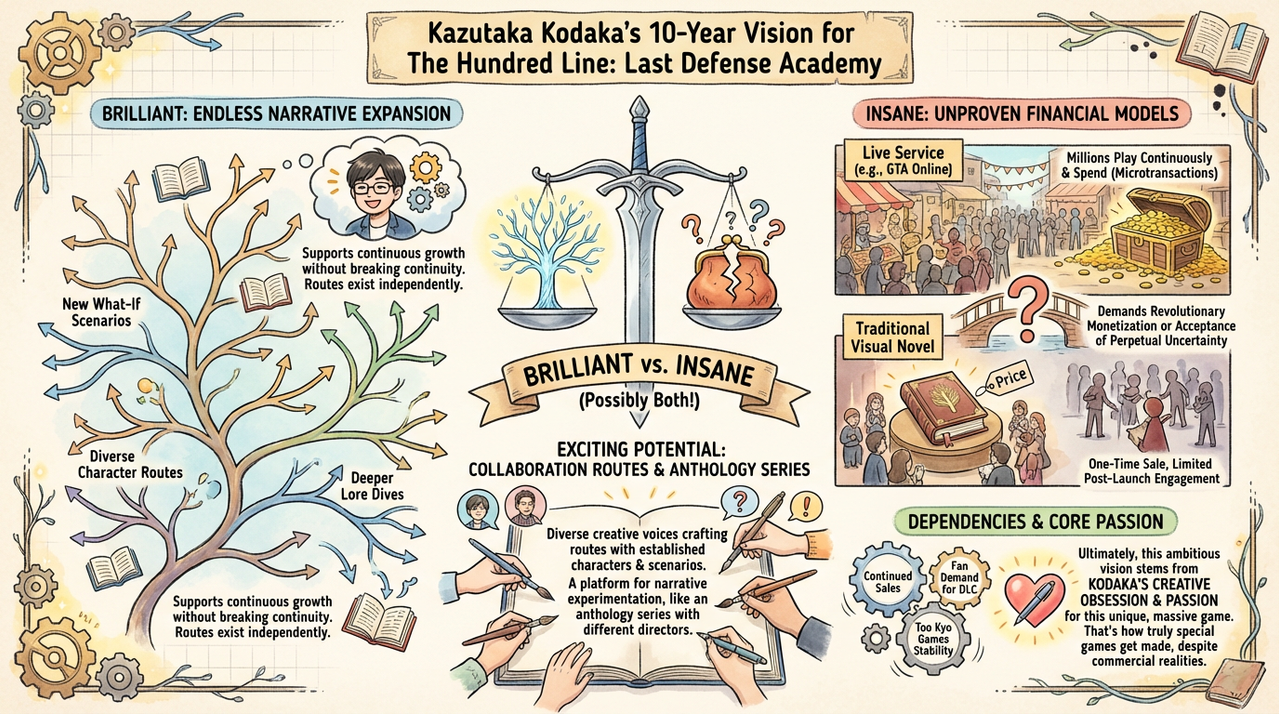
Kazutaka Kodaka’s vision for The Hundred Line: Last Defense Academy as a decade-long evolving platform is either brilliant or completely insane, possibly both simultaneously. On one hand, the game’s branching structure genuinely supports endless expansion without breaking continuity or requiring increasingly convoluted justifications. Each new route can explore different what-if scenarios, introduce new characters, or dive deeper into lore while existing independently from other paths. On the other hand, sustaining development for a niche visual novel over ten years requires financial models that haven’t been proven for the genre. Live service works for GTA Online because millions play continuously and spend money on microtransactions. Visual novels traditionally sell once with limited post-launch engagement beyond hardcore fans seeking 100% completion. Bridging that gap demands either revolutionary monetization approaches or accepting perpetual financial uncertainty. What makes Kodaka’s comments genuinely exciting is the potential for collaboration routes bringing diverse creative voices into The Hundred Line’s framework. Imagine your favorite visual novel or JRPG writers crafting routes using established characters and scenarios. That kind of narrative experimentation rarely happens because most games exist as singular creative visions rather than platforms for multiple authors. The Hundred Line could become gaming’s equivalent of anthology series where different directors helm episodes. Whether any of this actually materializes depends on factors Kodaka can’t fully control including continued sales, fan demand for DLC, and Too Kyo Games’ financial stability. But the mere fact that he’s thinking this ambitiously about a visual novel’s post-launch future shows how much passion he has for this weird, massive, utterly unique game that nearly bankrupted him. That kind of creative obsession is how truly special games get made, even if commercial realities eventually force compromises.