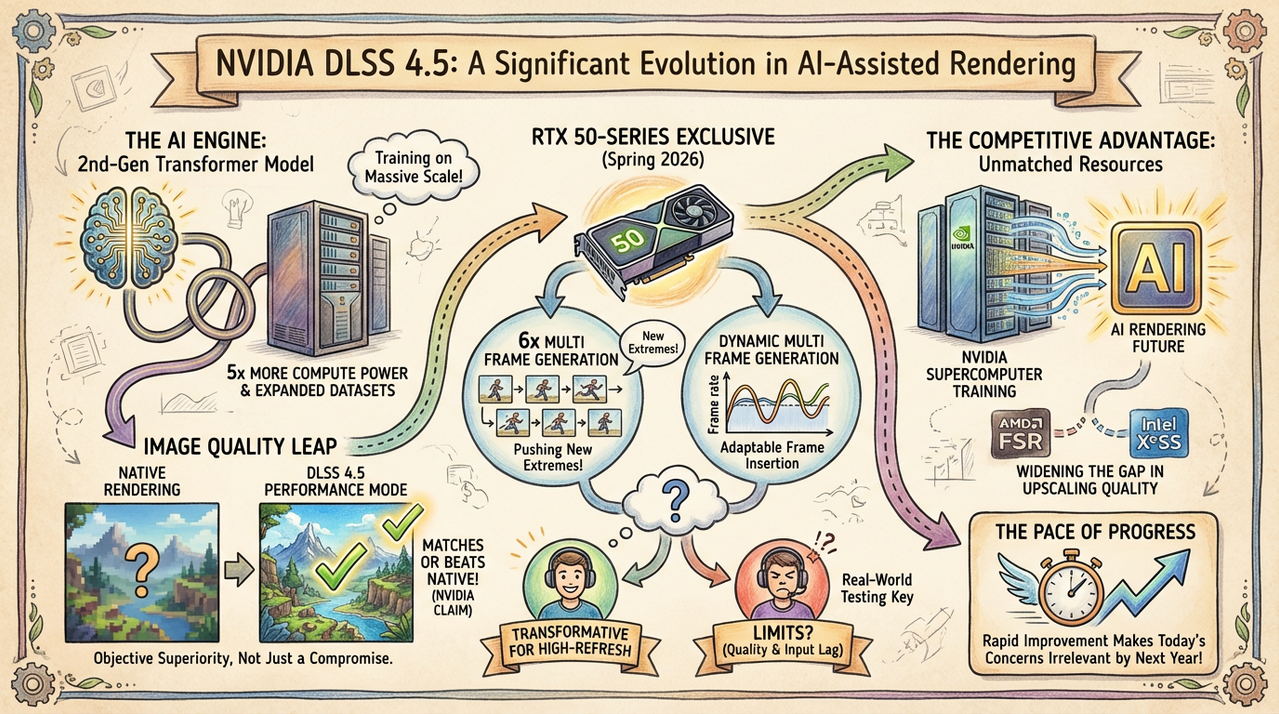
NVIDIA used its CES 2026 keynote on January 6 to announce DLSS 4.5, a substantial upgrade to its AI-powered upscaling technology that’s available right now for all GeForce RTX GPUs. The headline feature is a second-generation transformer model for Super Resolution that was trained on 5x more compute power than the first-generation transformer introduced with DLSS 4. According to NVIDIA, Performance mode at 4K now matches or even beats native image quality while Ultra Performance has evolved from barely usable to genuinely viable. Meanwhile, RTX 50-series owners will get Dynamic Multi Frame Generation with 6x frame gen support this spring, enabling 240Hz path-traced gaming at 4K with minimal latency.
- The 2nd Gen Transformer Changes Everything
- Performance Mode Now Beats Native Quality
- Available Now For All RTX GPUs
- 6x Multi Frame Generation Sounds Insane
- Dynamic Multi Frame Generation
- The Fake Frames Debate Continues
- Path Tracing Makes This Necessary
- CES 2026 Gaming Announcements
- What This Means For Gaming’s Future
- FAQs About NVIDIA DLSS 4.5
- Conclusion
The 2nd Gen Transformer Changes Everything
DLSS has gone through multiple architectural evolutions since launching in 2019. The original version used convolutional neural networks (CNNs) that were decent at analyzing big images but struggled with fine pixel details. DLSS 4 introduced transformer models borrowed from large language model technology, which excel at understanding context and focusing computational resources where they matter most. That architectural shift already improved image quality significantly.
DLSS 4.5’s second-generation transformer represents the first major upgrade to that architecture. It uses 5x the compute power of the original transformer model and was trained on a massively expanded high-fidelity dataset. According to NVIDIA VP of applied deep learning research Brian Catanzaro, the company runs a supercomputer “with many 1000s of our latest and greatest GPUs, that is running 24/7, 365 days a year improving DLSS.” That year of additional training focused specifically on finding and fixing failures where the model produced ghosting, flickering, or blurriness.
The technical improvement involves better contextual awareness and smarter pixel sampling. Transformer models use attention mechanisms that let them focus compute on challenging parts of images rather than treating every pixel equally. The second-gen version is more sophisticated about identifying what needs attention, resulting in better lighting reproduction, finer edge detail, and improved motion clarity. Crucially, it trains and infers directly in linear space (the game engine’s native format) rather than compressing data, allowing physically accurate light accumulation.
Performance Mode Now Beats Native Quality
The most significant claim NVIDIA makes is that Performance mode at 4K now matches or exceeds native 4K image quality. That’s a bold statement because Performance mode renders at 1080p then upscales to 4K, meaning the AI is reconstructing 75% of the image. For years, DLSS Performance was a compromise: you gained framerate but sacrificed visual fidelity. Quality mode was the sweet spot for people who wanted both improved performance and excellent image quality.
NVIDIA’s assertion that Performance now beats native changes that equation entirely. If accurate, there’s literally no reason to render at native 4K ever again because Performance delivers better visuals at higher framerates. The Ultra Performance mode, previously considered too blurry and artifact-ridden for serious use, has supposedly evolved into a viable option for 4K gaming, rendering at just 720p and reconstructing to 4K.
Independent testing will determine whether these claims hold up across different games and scenarios. But NVIDIA specifically called out improvements in Kingdom Come: Deliverance 2, The Elder Scrolls IV: Oblivion Remastered, and Indiana Jones and the Great Circle, suggesting confidence that the quality gains are noticeable even in challenging titles with complex rendering.

Available Now For All RTX GPUs
The DLSS 4.5 Super Resolution upgrade isn’t locked to RTX 50-series cards. Every GeForce RTX GPU from the RTX 20-series forward can use the improved model immediately by installing the GeForce 591.74 driver released January 6, 2026. The NVIDIA app (still in beta) gained the ability to automatically upgrade older DLSS versions in games, meaning over 400 supported titles can use DLSS 4.5 right away without waiting for developer patches.
That’s genuinely impressive backwards compatibility. NVIDIA could have easily restricted the new transformer model to RTX 50-series hardware to create artificial differentiation, but instead they’re delivering quality improvements to everyone with an RTX card. The catch is that older GPUs have less AI compute power, so performance characteristics will differ between an RTX 3060 and RTX 5090 even if both are using the same DLSS 4.5 model.
The DLSS Override feature in the NVIDIA app lets users force DLSS 4.5 in games that shipped with older versions. Developers can still optimize for DLSS 4.5 specifically with updated integrations, but the override ensures nobody is stuck with inferior versions just because a game hasn’t been patched recently.
6x Multi Frame Generation Sounds Insane
The other major DLSS 4.5 component is exclusive to RTX 50-series GPUs and won’t launch until spring 2026. Multi Frame Generation 6x mode generates five AI-created frames for every traditionally rendered frame, up from the three generated frames in DLSS 4’s 4x mode. Combined with the original rendered frame, that’s six total frames for every frame your GPU actually computes.
That sounds absolutely ridiculous on paper. You’re looking at an image where 83% of what you’re seeing is AI-generated rather than actually rendered by the game engine. Even people enthusiastic about frame generation technology might reasonably question whether that creates an acceptable visual experience or introduces too much latency to be playable.
NVIDIA’s betting that the improved temporal stability from the second-gen transformer model plus refinements to frame pacing will make 6x frame gen viable. The company demonstrated Black Myth: Wukong running at 246 fps on an RTX 5090 at 4K with full path tracing enabled, using DLSS 4.5 at 6x Multi Frame Generation. More impressively, they claim PC latency remained at just 53ms despite generating five frames for every rendered one. For context, that’s roughly equivalent to rendering natively at 60fps, which most people consider perfectly playable.

Dynamic Multi Frame Generation
Perhaps more interesting than the 6x ceiling is Dynamic Multi Frame Generation, which automatically adjusts how many frames get generated based on your target refresh rate. You set a goal (like 240fps for a 240Hz monitor) and your RTX 50-series GPU dynamically shifts between 2x, 3x, 4x, 5x, and 6x frame generation as the base framerate fluctuates.
In graphically intense scenes where your base framerate drops, the system upshifts to higher frame gen multipliers to maintain smooth 240fps output. In lighter scenes where you’re already hitting high base framerates, it downshifts to lower multipliers because you don’t need as many generated frames to hit your target. This prevents wasted computation generating unnecessary frames that add latency without visual benefit.
The concept mirrors third-party tool Lossless Scaling, which added adaptive frame generation back in March 2025. That tool proved the concept works, and now NVIDIA is implementing it officially with presumably better integration and optimization. The practical benefit is consistent framerates on high-refresh monitors without manually adjusting frame gen settings based on what you’re doing in-game.
The Fake Frames Debate Continues
No discussion of Multi Frame Generation is complete without acknowledging the controversy. A vocal segment of the PC gaming community despises frame generation, dismissing it as “fake frames” that don’t count toward real performance. The argument goes that generating frames via AI is cheating compared to actually rendering them, and that the technology enables GPU manufacturers to charge premium prices for cards that can’t truly handle demanding games at advertised framerates.
There’s legitimate concern buried in that criticism. If you generate five frames for every rendered one, you’re fundamentally playing a different experience than someone rendering natively. Input lag remains tied to base framerate regardless of how many frames get generated, meaning a game running at 40fps with 6x frame gen outputting 240fps will feel like 40fps despite looking like 240fps. For competitive shooters where every millisecond of latency matters, that’s potentially game-ruining.
NVIDIA’s counterargument is that frame generation combined with NVIDIA Reflex low latency technology minimizes input lag to acceptable levels even at high multipliers. They’re also positioning 6x frame gen specifically for 240Hz and 360Hz monitors where you need extreme framerates to match refresh rates. If your base framerate is already 60-80fps before frame gen, adding 6x gets you to that 240fps target while maintaining playable latency.
Path Tracing Makes This Necessary
The reason NVIDIA is pushing frame generation so aggressively is that full path tracing remains impossibly demanding even for RTX 5090. Path tracing simulates every light ray bouncing through a scene with physical accuracy, creating photorealistic lighting, reflections, and shadows. It’s the future of game graphics, but it’s also so computationally expensive that native 4K path tracing at 60fps is borderline impossible without massive visual compromises.
Cyberpunk 2077’s path tracing mode runs at maybe 20-30fps natively at 4K even on flagship GPUs. Indiana Jones and the Great Circle with full path tracing enabled is similarly punishing. NVIDIA’s pitch is that DLSS 4.5 Super Resolution plus Multi Frame Generation unlocks playable path-traced gaming at high framerates and resolutions that would otherwise require GPU horsepower that won’t exist for years.
Whether you consider that acceptable depends on your perspective. Purists argue the industry should optimize games to run natively rather than relying on AI crutches. Pragmatists note that path tracing is fundamentally unoptimizable beyond a certain point due to physics constraints, so AI-assisted rendering is the only path forward for real-time photorealism. Both positions have merit.
CES 2026 Gaming Announcements
DLSS 4.5 wasn’t NVIDIA’s only CES 2026 gaming announcement. The company confirmed DLSS 4 support for multiple upcoming titles including 007 First Light, Phantom Blade Zero, and Pragmata. RTX Remix, the modding tool that lets creators add ray tracing and DLSS to classic games, received updates with new logic features that remix graphics in response to real-time game events.
NVIDIA also announced G-Sync Pulsar monitor improvements claiming “over 1000Hz effective motion clarity” through enhanced backlight strobing. That’s not actual 1000Hz refresh rates, but rather motion blur reduction techniques that create visual clarity equivalent to much higher refresh rates. New GeForce Now apps for Linux and Amazon Fire TV expand the cloud gaming service to additional platforms.
The AI announcements extended beyond gaming with NVIDIA Ace bringing an AI advisor to Total War: Pharaoh for playtest in 2026. The LTX-2 AI video generation model now runs locally on RTX GPUs rather than requiring cloud processing, enabling faster video creation for content creators.

What This Means For Gaming’s Future
DLSS 4.5 represents NVIDIA doubling down on AI-assisted rendering as the future of gaming graphics. The second-generation transformer model’s improvements suggest the technology is maturing beyond early growing pains into genuinely compelling capabilities. If Performance mode truly matches or beats native quality while delivering substantially higher framerates, there’s little argument for not using it outside of competitive scenarios where every frame of latency matters.
The 6x frame generation push is more controversial and depends heavily on whether the visual quality and input latency hold up under real-world testing. NVIDIA’s controlled demos always look impressive, but community testing across diverse games and hardware configurations will reveal whether Dynamic Multi Frame Generation actually delivers on the promise of smooth 240Hz path-traced gaming without feeling laggy.
What’s undeniable is that NVIDIA has massive resources dedicated to improving DLSS continuously. That supercomputer training AI models 24/7 represents commitment that AMD and Intel struggle to match with FSR and XeSS respectively. The gap in AI upscaling quality between vendors continues widening as NVIDIA leverages its machine learning expertise and computational advantages.
FAQs About NVIDIA DLSS 4.5
When does NVIDIA DLSS 4.5 release?
DLSS 4.5 Super Resolution with the 2nd generation transformer model is available now for all GeForce RTX GPUs via the GeForce 591.74 driver released January 6, 2026. Dynamic Multi Frame Generation 6x launches spring 2026 for RTX 50-series only.
Which GPUs support DLSS 4.5?
All GeForce RTX GPUs from RTX 20-series forward support DLSS 4.5 Super Resolution. Dynamic Multi Frame Generation with 6x support is exclusive to RTX 50-series graphics cards.
How many games support DLSS 4.5?
Over 400 games and apps support DLSS 4.5 at launch through the NVIDIA app’s DLSS Override feature, which can automatically upgrade older DLSS versions to 4.5 without requiring developer patches.
Does DLSS 4.5 Performance mode really beat native quality?
NVIDIA claims Performance mode at 4K now matches or exceeds native 4K image quality thanks to the 2nd generation transformer model trained on 5x more compute. Independent testing will verify this across different games.
What is 6x Multi Frame Generation?
6x Multi Frame Generation generates five AI-created frames for every traditionally rendered frame, creating six total frames from one rendered frame. It’s exclusive to RTX 50-series GPUs and launches spring 2026.
Will 6x frame generation add input lag?
NVIDIA claims minimal latency impact when combined with NVIDIA Reflex technology. Their demo showed 53ms PC latency at 246fps with 6x frame gen, comparable to native 60fps rendering.
What is Dynamic Multi Frame Generation?
Dynamic Multi Frame Generation automatically adjusts frame gen multiplier (2x through 6x) based on your target refresh rate, generating only the frames needed to hit your monitor’s maximum refresh rate without wasting computation.
Can I use DLSS 4.5 in older games?
Yes, the NVIDIA app’s DLSS Override feature can force DLSS 4.5 in games that shipped with older DLSS versions, immediately upgrading over 400 titles without waiting for developer patches.
Conclusion
NVIDIA DLSS 4.5 represents a significant evolution in AI-assisted rendering that delivers tangible benefits for all RTX GPU owners immediately. The second-generation transformer model’s training on 5x more compute power and vastly expanded datasets has produced measurably better image quality, with NVIDIA boldly claiming Performance mode now matches or beats native rendering. If that assertion holds up under independent testing, it fundamentally changes the calculus around upscaling from a necessary compromise to an objectively superior option. The 6x Multi Frame Generation and Dynamic Multi Frame Generation features launching spring 2026 for RTX 50-series owners push frame generation technology to new extremes that will either prove genuinely transformative for high-refresh path-traced gaming or reveal the limits of how many AI-generated frames can be inserted before visual quality and input lag become unacceptable. NVIDIA’s controlled demos always look spectacular, but real-world performance across diverse games and hardware configurations will determine whether 6x frame gen becomes a feature enthusiasts enable automatically or a gimmick that stays disabled outside of benchmarking. What’s clear is that NVIDIA remains committed to AI rendering as gaming’s future with resources no competitor can currently match. That supercomputer training DLSS models continuously gives them massive advantages in upscaling quality that widen the gap between DLSS and alternatives like AMD’s FSR or Intel’s XeSS. Whether the gaming community fully embraces frame generation or continues viewing it skeptically as fake frames, the technology keeps improving at a pace that makes today’s concerns potentially irrelevant by next year.