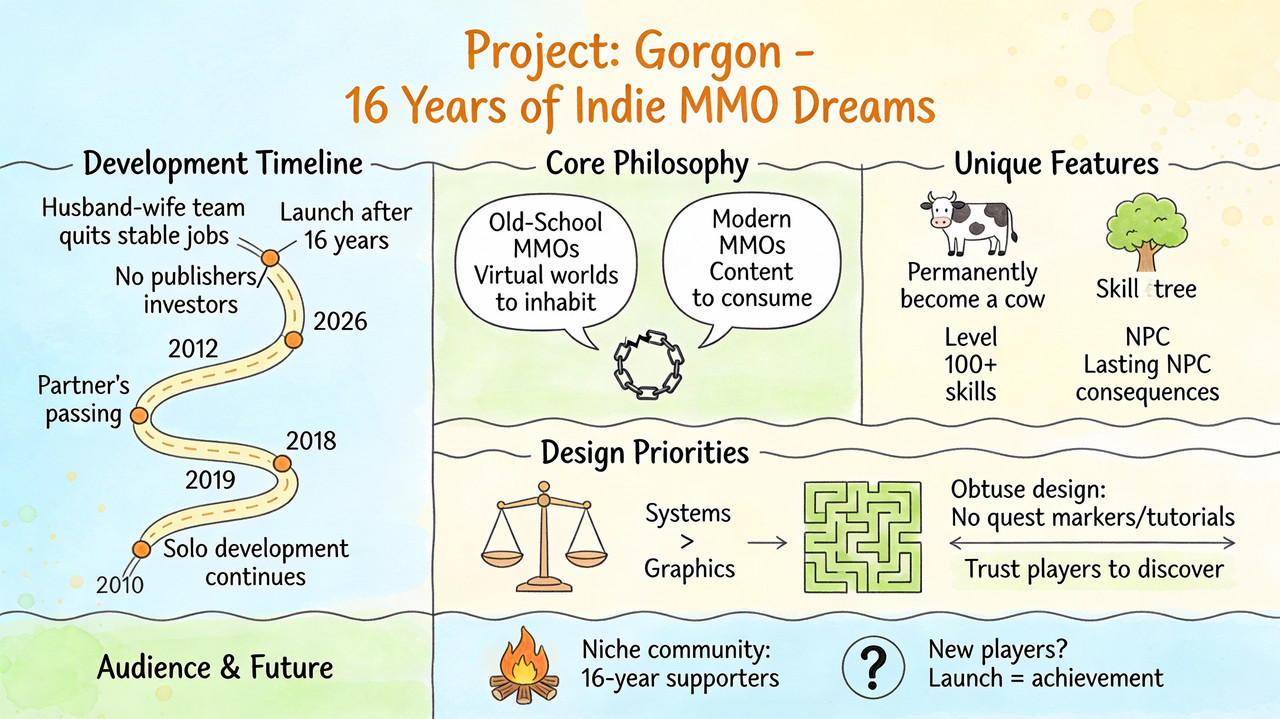
After 16 years of development and nearly 8 years in Steam Early Access, Project: Gorgon officially launches version 1.0 on January 28, 2026. Elder Game LLC, the husband-and-wife studio behind the deliberately old-school MMORPG, announced the launch date on January 5, finally putting a date on a game that’s become legendary in indie MMO circles for its uncompromising design philosophy. This is the MMO where you can get cursed to permanently become a cow or spider, radically changing your gameplay experience. Where NPCs remember if you’re rude to them and lock you out of quests. Where you can level hundreds of different skills including Carpentry, Poetry, Mushroom Farming, and Civic Pride. It’s absolutely bizarre, deliberately dated, and somehow still getting developed after one of its two creators passed away in 2022.
16 Years From Concept to Launch
Project: Gorgon began development in 2009 when industry veterans Eric Heimburg and Sandra Powers left mainstream game development to create their dream MMO. Heimburg previously worked as a senior engineer at Blizzard on World of Warcraft and at Turbine on Asheron’s Call 2. Powers worked at Electronic Arts and Monolith Productions. Both had shipped successful commercial games but wanted creative freedom to build something weird without corporate oversight demanding monetization hooks and mass-market appeal.
The game entered closed alpha testing around 2012, slowly building a small community of players willing to tolerate rough edges in exchange for innovative systems. A successful Kickstarter campaign in 2012 raised $74,781, enough to continue development without external funding or publishers. Project: Gorgon launched on Steam Early Access in March 2018 after nine years of sporadic development, featuring intentionally dated graphics that looked old-fashioned even then.
That Early Access period stretched nearly eight more years as the two-person team continued adding content, refining systems, and building out the world. Progress slowed significantly in 2022 when Sandra Powers passed away after a long battle with illness, leaving Eric Heimburg as the sole developer. The fact that he continued developing the game alone while grieving demonstrates either remarkable dedication or stubborn refusal to abandon what they built together.
What Makes Project Gorgon Different
Project: Gorgon deliberately rejects modern MMO conventions in favor of old-school design philosophies from Asheron’s Call, EverQuest, and early Ultima Online. There’s no quest hub breadcrumb trail. No minimap markers telling you where to go. NPCs don’t have giant exclamation points floating above their heads. You have to actually talk to people, read dialogue, and explore to discover content. It’s designed for players who miss when MMOs felt like virtual worlds to inhabit rather than theme parks to consume.
The skill system is Project: Gorgon’s defining feature. Instead of picking a class, you level individual skills by using them. Want to be a Fire Mage who’s also a skilled Blacksmith, competent Chef, and amateur Poet? You can do that. Skills aren’t mutually exclusive; you can theoretically master everything given enough time. This creates genuinely unique character builds based on what you enjoy doing rather than rigid class structures.
Combat uses a dual-skill system where you equip two combat skills simultaneously. Psychology and Fire Magic. Sword and Shield. Necromancy and Mentalism. The combinations create different playstyles with unique synergies and weaknesses. You’re not locked into one build forever; switching skills is encouraged for different situations, though you’ll be most effective with skills you’ve invested time leveling.

The Animal Transformation System
One of Project: Gorgon’s most infamous features is permanent animal transformations. Get hit by certain curses and you might turn into a cow, spider, pig, deer, or bat. This isn’t a temporary debuff you cleanse; you’re stuck as that animal until you complete specific challenging quests to lift the curse. And being a cow fundamentally changes how you play the game.
Cows can’t use conventional equipment. Your inventory management changes because you don’t have hands. NPCs react to you differently because you’re a talking cow. You gain access to cow-specific abilities like Moo of Determination and Tough Hoof. Some areas become harder to navigate. Others become easier because NPCs don’t perceive you as a threat. It’s not a gimmick; it’s a legitimate alternate gameplay path that completely transforms your experience.
Spider form lets you climb walls and access areas other players can’t reach, but you’re tiny and fragile. Deer form makes you incredibly fast but limits combat effectiveness. Bat form grants flight but restricts equipment even more severely than cow. Each transformation has meaningful trade-offs that create genuinely different ways to play rather than just cosmetic changes.
The Favor System and Permanent Consequences
NPCs in Project: Gorgon remember your interactions through a favor system that tracks your relationship with every named character. Be helpful and respectful, they offer better prices, teach you skills, and provide access to exclusive content. Be rude or ignore them, they refuse to trade with you or outright attack you on sight. Consequences are permanent unless you rebuild favor through difficult tasks.
This creates actual social gameplay where you can’t just treat NPCs as vending machines. That blacksmith you insulted? He won’t sell you anything until you complete his apology quest. The druid you helped? She’ll teach you Nature Magic for free. Your reputation spreads through connected NPCs, so making enemies in one town can lock you out of content in others.
The system extends to player-versus-player interactions. Players can mark others as “enemies,” affecting how guards and NPCs respond when that player visits towns. PvP isn’t free-for-all griefing; it’s constrained by social systems that create consequences for murderhoboing. You can’t just slaughter everyone without becoming persona non grata.

The Graphics Everyone Complains About
Project: Gorgon looks terrible by modern standards, and that’s intentional. Eric Heimburg and Sandra Powers deliberately chose dated graphics so they could focus development resources on systems and content rather than visual polish. Character models are stiff. Animations are basic. Textures look like they’re from 2005. Environmental art is functional but unimpressive.
This aesthetic choice divides potential players. Some appreciate the nostalgic throwback to early MMORPGs when graphics were secondary to gameplay systems. Others bounce off immediately because they can’t get past how dated everything looks compared to Final Fantasy XIV, Guild Wars 2, or even World of Warcraft. There’s no middle ground; you either accept the graphics or you don’t.
The December 2025 update added Character Creator v2, overhauling how players customize appearances. Eric Heimburg noted this is “basically the version we’ll launch with,” suggesting visual improvements before the January 28 release. But don’t expect a graphical revolution; Project: Gorgon will always prioritize systems over presentation.
What’s New For Launch
The path to 1.0 includes several major content additions. The December 2025 update added the path to Statehelm and the Rubywall area, expanding the world map significantly. The next update before launch adds Statehelm itself, a major city that’s been planned for years. Additional end-game content, including high-level dungeons and crafting recipes, will round out the experience for veteran players who’ve been testing for years.
The official Steam announcement notes that launch doesn’t mean development stops. Elder Game LLC plans continued updates with new zones, skills, and systems post-release. The January 28 date marks when Project: Gorgon is considered feature-complete enough to remove the Early Access label, not when development ends. Given that Eric Heimburg has been working on this game for 16 years, there’s little reason to believe he’ll stop now.

The Community That Kept It Alive
Project: Gorgon survives because of a small but dedicated community willing to support niche development. The playerbase is measured in hundreds rather than thousands, but they’re engaged in ways that massive MMOs can’t replicate. Players know each other by name. They help newcomers learn obtuse systems. They organize community events that developers officially recognize.
The game uses a hybrid free-to-play model where anyone can download and play, but subscribing for $9.99/month provides benefits like increased inventory space, additional character slots, and access to private islands for housing. This subscription model funds ongoing development without aggressive monetization or pay-to-win mechanics. Players who love the game support it; those who don’t can try it free.
Reddit and Discord communities surrounding Project: Gorgon demonstrate the passion this niche game inspires. When someone posted in the Project Gorgon subreddit asking if the game would ever leave Early Access back in January 2025, responses ranged from cautiously optimistic to resigned acceptance that it might never happen. The official launch announcement on January 5, 2026 shocked that community precisely because it finally provided a concrete date after years of “when it’s ready” non-answers.
Sandra Powers’ Legacy
Sandra Powers passing in 2022 fundamentally changed Project: Gorgon’s development trajectory. She handled art, design, and community management while Eric Heimburg focused on programming and systems. Losing her meant Eric had to take on responsibilities he wasn’t necessarily suited for while continuing technical development alone. The fact that Project: Gorgon continued at all, let alone reached a 1.0 launch, is testament to his determination to finish what they started together.
Eric hasn’t spoken publicly in detail about how her death affected the project, but the pace of development noticeably slowed. Updates that previously arrived every few months stretched to longer intervals. Some planned features got delayed or cut. Yet the game continued progressing toward launch, suggesting Eric views completing Project: Gorgon as honoring Sandra’s legacy and their shared vision.

Who Should Actually Play This
Project: Gorgon is absolutely not for everyone. If you value modern graphics, streamlined quest design, or hand-holding tutorials, you’ll hate it. If you expect World of Warcraft’s polish or Final Fantasy XIV’s production values, you’ll be disappointed. If you want immediate gratification and clear progression paths, you’ll bounce off the obtuse systems within hours.
But if you’re the kind of person who misses when MMOs felt like virtual worlds to inhabit rather than content treadmills to consume, Project: Gorgon might be your new obsession. If you appreciate games that trust players to figure things out without quest markers and minimap waypoints, you’ll find depth here. If you want genuinely unique character builds through skill-based progression rather than rigid class structures, the system delivers.
The comparison point is classic EverQuest, Asheron’s Call, or early Ultima Online before those games compromised their designs chasing mainstream audiences. Project: Gorgon is intentionally niche, targeting players who appreciate old-school design philosophies enough to forgive dated graphics and occasional jank. That audience exists but remains small, which is fine because Elder Game LLC isn’t trying to compete with World of Warcraft.
FAQs About Project Gorgon Launch
When does Project Gorgon leave Early Access?
Project: Gorgon officially launches version 1.0 on January 28, 2026, removing the Early Access label after nearly 8 years on Steam Early Access and 16 years total development.
Who developed Project Gorgon?
Elder Game LLC, founded by industry veterans Eric Heimburg (Blizzard, Turbine) and Sandra Powers (EA, Monolith). Sandra passed away in 2022, leaving Eric as the sole developer finishing the project.
How much does Project Gorgon cost?
The game is free-to-play with an optional $9.99/month subscription (VIP) that provides benefits like increased inventory space, additional character slots, and access to private housing islands.
Can you really become a cow permanently?
Yes, animal transformation curses can permanently turn you into cows, spiders, deer, pigs, or bats. You remain that animal until completing specific challenging quests to lift the curse, fundamentally changing gameplay.
What makes Project Gorgon different from other MMOs?
Skill-based progression with hundreds of levelable abilities, permanent animal transformations, NPC favor systems with lasting consequences, no quest markers or hand-holding, and deliberately old-school design rejecting modern MMO conventions.
Does Project Gorgon have good graphics?
No, graphics are intentionally dated looking like a game from 2005-2010. The developers prioritized systems and content over visual polish, which divides players between those who accept retro aesthetics and those who can’t.
Will development continue after launch?
Yes, Elder Game LLC confirmed that launch doesn’t mean development stops. They plan continued updates with new zones, skills, and systems post-release, treating January 28 as feature-complete rather than final.
How many people play Project Gorgon?
The playerbase is small, measured in hundreds rather than thousands. It’s a niche community of dedicated players who appreciate the game’s old-school design despite rough edges.
Conclusion
Project: Gorgon launching on January 28, 2026 after 16 years of development represents one of indie gaming’s most improbable success stories. A husband-and-wife team left stable industry jobs to build their dream MMO without publishers, investors, or corporate oversight demanding compromises. They rejected modern design conventions in favor of old-school philosophies from early MMORPGs when virtual worlds felt like places to inhabit rather than content to consume. One of them died partway through development, yet the surviving partner continued alone to finish what they started together. The result is genuinely unique in a genre dominated by World of Warcraft clones and free-to-play cash grabs. Project: Gorgon lets you permanently become a cow, level hundreds of different skills, and face lasting consequences for how you treat NPCs. It looks terrible by modern standards because the developers prioritized systems over graphics. It’s deliberately obtuse because they trust players to figure things out without quest markers and tutorials holding their hands. Will Project: Gorgon find mainstream success after launch? Absolutely not. It’s too niche, too dated, and too uncompromising to appeal to audiences raised on streamlined modern MMOs. But that’s perfectly fine because Elder Game LLC never chased mainstream audiences. They built this game for people who miss when MMOs were virtual worlds filled with discovery rather than theme parks optimized for efficient content consumption. For that specific audience, Project: Gorgon offers something genuinely special that you can’t find anywhere else. Whether the game survives long-term depends on whether enough players support development through subscriptions and word-of-mouth. The community that’s sustained it through 16 years of development will undoubtedly stick around. Whether launch attracts new players willing to embrace old-school design remains to be seen. Either way, Project: Gorgon launching is itself an achievement worth celebrating regardless of commercial success.