Microsoft is reportedly preparing for another devastating round of layoffs in January 2026, with projections suggesting between 11,000 and 22,000 positions could be eliminated during the third week of the month. The cuts would affect 5-10% of Microsoft’s approximately 220,000-person workforce, with the Xbox gaming division, Azure cloud teams, and global sales departments identified as primary targets. The information surfaced through anonymous employee warnings on Blind, the professional networking app where tech workers discuss internal company matters without attribution.
Microsoft has not officially confirmed these planned layoffs, but the reports align with CEO Satya Nadella’s recent comments describing the company’s massive size as a “disadvantage” in the race to build AI infrastructure. This would mark the fifth major wave of gaming-related job cuts in less than two years, following the elimination of over 15,000 employees throughout 2025 despite record revenue and profits exceeding $27 billion in a single quarter.
Xbox Gaming Division in the Crosshairs Again
The Xbox gaming unit faces particularly brutal prospects if the January layoffs materialize as described. Microsoft has systematically dismantled significant portions of its gaming division throughout 2025, starting with 1,900 layoffs in January 2024, followed by studio closures including Arkane Austin and Tango Gameworks in May 2024, another 650 cuts in September 2024, 6,000 eliminations in May 2025, and the catastrophic July 2025 wave that cut approximately 9,100 employees and canceled Perfect Dark and Everwild.
According to Blind users who claim to work at Microsoft, the January 2026 cuts will focus heavily on middle management positions and what executives view as “legacy product teams.” One detailed post breaking down projected cuts by department estimated around 3,300 gaming division roles could be eliminated, representing significant portions of teams at studios like 343 Industries, The Coalition, Turn 10 Studios, and others. The post noted that “active revenue roles” would be somewhat protected, but coordination roles, manual QA testers, and engineers working on deprecated products face the highest risk.
The AI Spending Trade-Off
What makes these layoffs particularly galling for employees is the direct connection to artificial intelligence spending. Microsoft increased capital expenditures to $34.9 billion in the first quarter of fiscal 2026, with total AI infrastructure spending expected to exceed $80 billion for the full fiscal year. According to sources who spoke to The Verge following the July 2025 layoffs, Microsoft executives “had the choice” between cutting thousands of jobs or reducing AI investment and chose the machines over people.
Satya Nadella hasn’t been shy about his priorities. During a December 2025 podcast, he characterized Microsoft’s workforce size as a “massive disadvantage” in competing with AI startups, signaling his preference for flatter organizational structures and faster decision-making powered by AI tools rather than human expertise. The company’s strategy appears to involve reallocating funds from payroll to AI datacenters and cloud infrastructure, with job cuts framed as necessary restructuring rather than cost-cutting for a company posting $75 billion in annual net income.

Return to Office Policy Adds Insult to Injury
Making the situation worse for remaining employees, Microsoft is implementing a strict return-to-office mandate effective February 23, 2026. The policy requires anyone living within 50 miles of a Microsoft office to work on-site at least three days per week. Some employees view this as a “soft layoff” tactic designed to encourage voluntary departures without paying severance packages, effectively reducing headcount through attrition rather than formal terminations.
The timing is suspicious. Implementing a harsh RTO policy immediately after massive layoffs creates an environment where surviving employees face the choice between relocating closer to offices, enduring long commutes, or quitting voluntarily. For a company claiming to prioritize flexibility and work-life balance in recruitment materials, the policy shift represents a dramatic reversal that employee morale has reportedly cratered as workers realize Microsoft’s public values statements don’t match internal reality.
Gaming Casualties From Previous Waves
To understand the scale of destruction Microsoft has inflicted on its gaming division, consider what’s already been lost. The July 2025 layoffs canceled Perfect Dark, the long-awaited reboot that The Initiative studio spent years developing with support from Crystal Dynamics. That studio is now completely shut down. Rare’s Everwild, announced in 2019 and positioned as a major new IP, was also canceled with significant team reductions at the legendary British studio.
Turn 10 Studios, developer of the Forza Motorsport franchise, reportedly lost over 70 employees in July 2025 alone. ZeniMax Online Studios saw its unannounced MMO Project Blackbird canceled, leading to the resignation of studio founder Matt Firor who stated the project “was the game I had waited my entire career to make.” King, the Candy Crush developer acquired as part of the Activision Blizzard deal, was “hit hard” according to IGN sources. Bethesda’s London office faced cuts. Raven Software, critical to Call of Duty development, was impacted.

The Organizational Flattening Strategy
Phil Spencer, head of Microsoft Gaming, has consistently framed layoffs as necessary for “sustainable business” operations and removing “layers of management to increase agility and effectiveness.” His memos to staff emphasize that decisions are made to “position Gaming for enduring success” and allow the division to “focus on strategic growth areas.” The corporate speak masks a brutal reality: Microsoft spent $69 billion acquiring Activision Blizzard in 2023, then systematically dismantled studios and teams throughout 2024 and 2025.
The “organizational flattening” strategy targets middle management specifically. According to Blind posts from alleged Microsoft employees, the company wants to increase the ratio of individual contributors to managers, eliminating coordination roles and pushing more responsibility onto fewer people. One detailed breakdown suggested that middle management faces cuts around 8,000 roles, with departments like HR, legal, marketing coordination, and program management bearing the heaviest losses.
Employee Morale Hits Rock Bottom
The human cost extends beyond those who lose jobs. Remaining employees describe working in constant fear, never knowing if the next wave will claim their position. Microsoft veteran Tom Sears, who spent 25 years at the company before leaving in 2023, posted on LinkedIn that “layoffs often get framed as restructuring, but what’s being lost is deeper: institutional memory, process clarity, and thoughtful leadership.” He concluded that “this is not your father’s or mother’s Microsoft.”
Another longtime employee stated “I am deeply saddened. I can’t believe how deep the cuts run.” On Blind, workers describe the environment as “living in fear” of mass layoffs while executives celebrate record profits and AI achievements. Diablo developers reportedly took action against Microsoft’s treatment of employees, stating they’re “ready to begin fighting for real change” after watching colleagues eliminated while the company posts quarterly earnings exceeding $27 billion.
The Bigger Picture
Microsoft’s approach reflects broader trends in the tech industry where AI investment takes priority over human capital. The company’s most significant workforce reduction before this period was 18,000 jobs cut in 2014 following the Nokia acquisition. What’s happening now dwarfs that. Between 2024 and 2026, Microsoft could eliminate over 35,000 positions if the January rumors prove accurate, all while revenue and profits reach historic highs.
The gaming industry specifically has been devastated by layoffs throughout 2024 and 2025, with over 20,000 jobs lost across all publishers and developers. Microsoft accounts for a substantial portion of that destruction despite Phil Spencer’s repeated statements that Xbox’s “platform, hardware, and game roadmap have never looked stronger.” The disconnect between executive optimism and employee reality has never been wider.
FAQs About Microsoft January 2026 Layoffs
How many Microsoft employees will be laid off in January 2026?
According to reports from Blind, between 11,000 and 22,000 Microsoft employees could be laid off during the third week of January 2026, representing 5-10% of the company’s approximately 220,000-person global workforce. Microsoft has not officially confirmed these numbers.
Which Microsoft divisions will be affected by January 2026 layoffs?
Reports indicate the Xbox gaming division, Azure cloud teams, and global sales departments are primary targets. Anonymous employee posts on Blind suggest middle management, legacy product teams, and coordination roles across all divisions face the highest risk of elimination.
Why is Microsoft laying off employees despite record profits?
Microsoft is prioritizing AI infrastructure spending, with over $80 billion allocated for fiscal 2026. Sources told The Verge that executives chose between reducing AI investment or cutting jobs and sided with AI spending. CEO Satya Nadella has characterized Microsoft’s workforce size as a disadvantage in competing with AI startups.
How many gaming layoffs has Microsoft done since 2024?
Microsoft has conducted four major rounds of gaming layoffs since January 2024: 1,900 in January 2024, studio closures and cuts in May 2024, 650 in September 2024, 6,000 in May 2025, and approximately 9,100 in July 2025. If January 2026 layoffs happen as reported, it would be the fifth wave affecting gaming.
What games has Microsoft canceled due to layoffs?
Microsoft canceled Perfect Dark (The Initiative), Everwild (Rare), and Project Blackbird (ZeniMax Online Studios) during the July 2025 layoffs. The company also closed studios including The Initiative, Arkane Austin, and Tango Gameworks throughout 2024 and 2025.
When will Microsoft announce the January 2026 layoffs officially?
According to Blind reports, the layoffs are expected during the third week of January 2026, likely around January 15-22. Microsoft typically announces major workforce reductions on Wednesdays, though the company has not confirmed any planned layoffs.
What is Microsoft’s return to office policy in 2026?
Effective February 23, 2026, Microsoft requires employees living within 50 miles of company offices to work on-site at least three days per week. Some employees view this as a “soft layoff” tactic to encourage voluntary departures without severance payments.
How much is Microsoft spending on AI instead of employees?
Microsoft spent $34.9 billion on AI infrastructure in the first quarter of fiscal 2026, with total fiscal year spending expected to exceed $80 billion. This represents a massive increase over previous years and directly correlates with workforce reductions across the company.
Conclusion
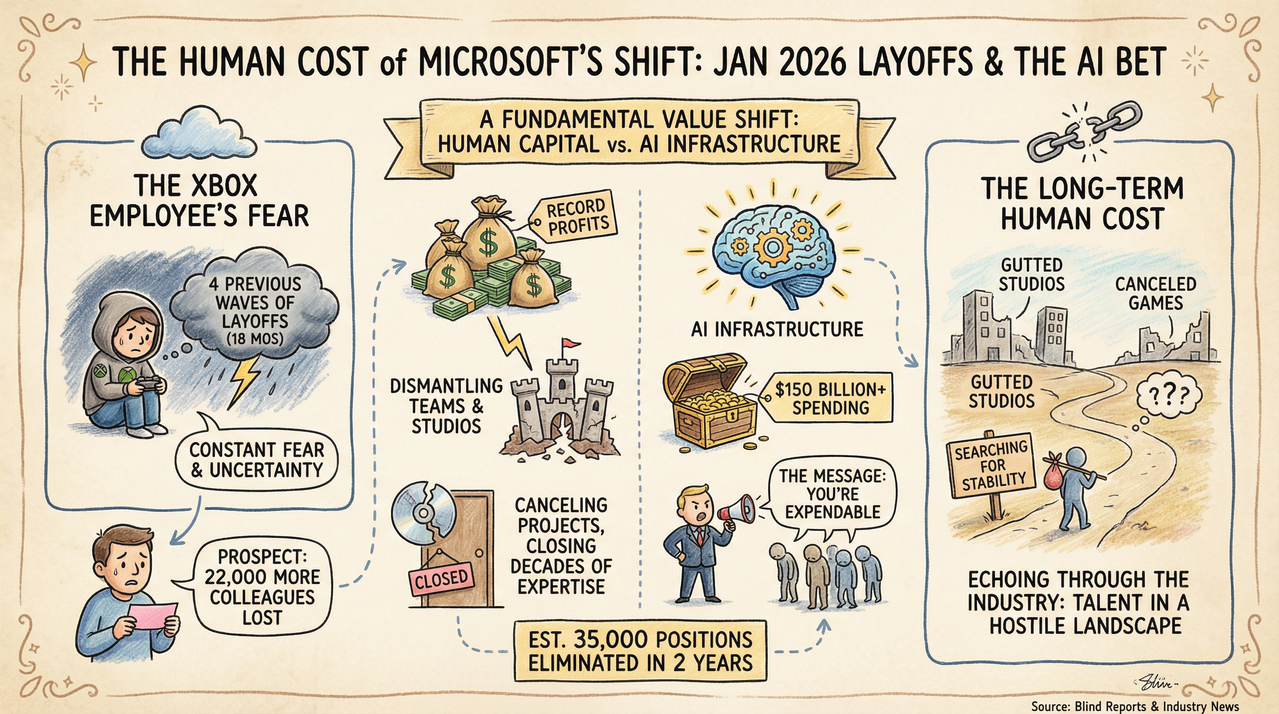
The reported January 2026 Microsoft layoffs represent more than just another round of job cuts. They symbolize a fundamental shift in how the tech giant values human capital versus artificial intelligence infrastructure. For Xbox employees who’ve survived four previous waves of layoffs in 18 months, the prospect of losing 22,000 more colleagues creates an environment of constant fear and uncertainty. Microsoft continues posting record profits while systematically dismantling the teams that built its gaming empire, canceling beloved projects, and closing studios with decades of industry expertise. The message to employees is clear: you’re expendable in the age of AI, regardless of performance, loyalty, or the company’s financial success. If the January layoffs happen as described on Blind, Microsoft will have eliminated roughly 35,000 positions in just two years while spending over $150 billion on AI. The human cost of this transformation will echo through the gaming industry for years to come, leaving behind gutted studios, canceled games, and thousands of talented developers searching for stability in an increasingly hostile corporate landscape.