NVIDIA just solved one of gaming’s most persistent visual problems. At CES 2026, the company unveiled an upgraded version of G-Sync Pulsar, a display technology that eliminates motion blur by strobing your monitor’s backlight in precise horizontal strips synchronized with pixel changes. The result is motion clarity equivalent to a theoretical 1000Hz display running at 1000 fps, but you only need a 360Hz monitor. Four new gaming monitors from Acer, AOC, Asus, and MSI featuring the updated Pulsar technology hit shelves on January 7, 2026, targeting competitive gamers who need every visual advantage.
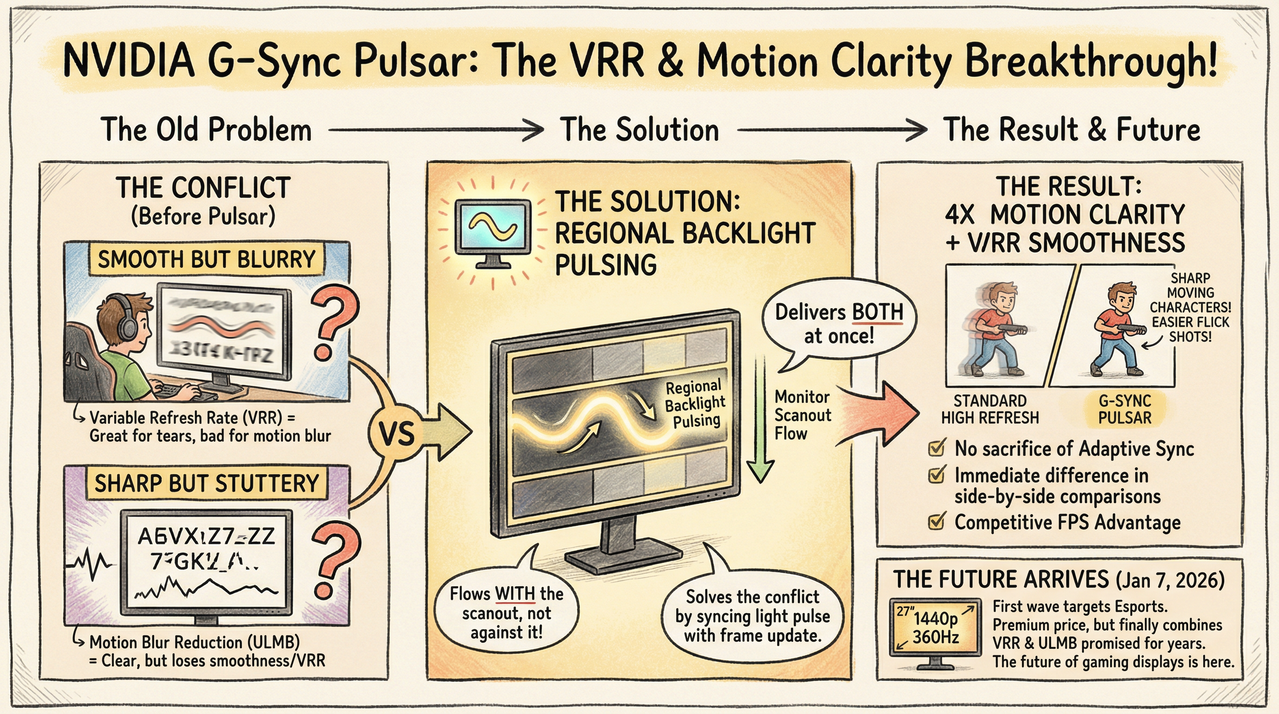
What makes this genuinely exciting is that Pulsar finally combines two features that couldn’t coexist before: variable refresh rate smoothness and ultra-low motion blur clarity. Previous technologies like ULMB and ULMB2 forced gamers to choose one or the other, but Pulsar delivers both simultaneously through clever engineering that pulses backlight strips just ahead of where pixels are updating on your screen.
How Regional Backlight Pulsing Actually Works
Understanding G-Sync Pulsar requires knowing why motion blur exists in the first place. When your monitor displays a frame, pixels hold that image until the next frame arrives. During fast motion, your retina retains the brightness and contrast from the previous position, causing moving objects to blend together visually. This is called sample-and-hold blur, and it affects every LCD panel regardless of refresh rate or pixel response time.
The original Pulsar, announced two years ago at CES 2024, addressed this by strobing the entire backlight off between frames, similar to ULMB technology. The upgraded version unveiled at CES 2026 takes a more sophisticated approach called Regional Backlight Pulsing. Instead of flickering the whole backlight, the new Pulsar divides the screen into ten horizontal strips and pulses each strip individually as your monitor scans out new frames row by row.
Think of it like a wave rolling down your screen. Your monitor refreshes from top to bottom, updating pixels one horizontal line at a time. The new Pulsar system pulses a backlight stripe exactly where pixels are about to change, flowing just ahead of the scanout process. According to NVIDIA, this reduces each frame’s visible time to just 25% of the frame duration, resulting in 4x smaller object hold time and 4x the effective motion clarity compared to standard displays.
The Technical Magic Behind the Scenes
Making regional backlight pulsing work with variable refresh rates requires incredible precision. When your framerate fluctuates between 200 fps and 360 fps during gameplay, Pulsar dynamically adjusts pulse timing and duration to match. The technology combines adaptive overdrive, which speeds up pixel transitions at different refresh rates, with pulse modulation that synchronizes backlight strobing to your GPU’s output.
NVIDIA’s engineering solves problems that plagued earlier strobing technologies. Traditional ULMB only worked at fixed refresh rates, forcing you to choose between smooth G-Sync VRR or motion clarity. Pulsar eliminates that trade-off. High-speed camera tests showed that at identical 360Hz settings, monitors with Pulsar activated displayed significantly sharper contours during motion compared to Pulsar disabled, all while maintaining G-Sync’s stutter-free smoothness.

The Gaming Experience Difference
PCMag hands-on testing at CES 2026 revealed the practical impact. In Counter-Strike 2 demonstrations running on identical 360Hz monitors with and without Pulsar enabled, the difference was immediately obvious. Without Pulsar, moving characters showed typical motion blur with trailing edges and softened details. With Pulsar active, those same characters remained razor sharp even during rapid movement across the screen.
PC Gamer’s Jeremy Laird went further, stating that seeing Pulsar in action “kinda ruined all other gaming monitors” for him. The enhanced clarity makes tracking enemies easier in competitive FPS games, where milliseconds determine wins and losses. Latency testing recorded average input lag of just 7.7 milliseconds after 100 shots in Counter-Strike 2, putting these monitors firmly in esports-grade territory.
The motion clarity advantage becomes most apparent during fast lateral movement, flick shots, and quick camera pans. Situations where traditional displays turn detailed textures into blurry smears. Pulsar maintains definition throughout, giving players clearer visual information to make split-second decisions. For competitive gamers, this represents a genuine hardware advantage beyond just higher framerates or lower latency.
The Monitors Launching with Pulsar
Four gaming monitors featuring the updated G-Sync Pulsar technology become available on January 7, 2026, all sharing the same core specifications: 27-inch IPS panels, 1440p resolution, and 360Hz refresh rates. Acer, AOC, Asus, and MSI are launching the first wave, with pricing and exact model numbers varying by manufacturer. These specifications target the competitive esports market where players prioritize speed and clarity over resolution or screen size.
NVIDIA also introduced Ambient Adaptive technology alongside Pulsar. This feature uses sensors to detect room lighting conditions and automatically adjusts monitor brightness and color temperature. In bright rooms, the display ramps up to 100% brightness with cooler white colors. In dark environments, it drops to 36% brightness with warmer tones to reduce eye strain. While not directly related to motion clarity, it shows NVIDIA’s focus on comprehensive gaming monitor features.
Pulsar vs Higher Refresh Rates
An interesting question emerges: how does a 360Hz monitor with Pulsar compare to a 540Hz monitor without it? NVIDIA claims Pulsar delivers motion clarity equivalent to 1440Hz by reducing visible frame time to 25% of normal. If that holds true in real-world use, a 360Hz Pulsar monitor should theoretically provide clearer motion than standard 540Hz displays, though direct comparisons haven’t been published yet.
The advantage of Pulsar over simply pushing refresh rates higher is efficiency. A 1000Hz monitor doesn’t exist commercially, and even if it did, you’d need a GPU capable of rendering 1000 fps consistently to benefit. Pulsar achieves similar perceived clarity at 360Hz, making it attainable with current hardware. For most gamers, hitting 360 fps in competitive titles like Counter-Strike 2, Valorant, or Overwatch 2 is realistic with modern GPUs.
The Catch and Limitations
G-Sync Pulsar isn’t without compromises. First, it only works on monitors with either NVIDIA’s proprietary G-Sync module or MediaTek scaler chips with G-Sync support. This limits availability and typically increases monitor prices compared to basic FreeSync displays. Second, Pulsar has a low FPS limit, defaulting to 90 fps. When framerates drop below this threshold, the backlight stops pulsing and motion blur returns to standard levels.
NVIDIA recommends keeping the low FPS limit at 90Hz, warning that lower values could cause visible flickering. Some testing suggests the backlight continues pulsing even slightly above the set limit, but the feature definitely needs consistent high framerates to function optimally. For competitive gamers maintaining 200+ fps this isn’t an issue, but casual players with weaker GPUs might not benefit as much.
There’s also the question of personal preference. Some users find backlight strobing uncomfortable or distracting, particularly those sensitive to flicker. The regional pulsing in the new Pulsar should minimize this compared to full-screen strobing, but individual tolerance varies. The good news is that Pulsar can be toggled on and off, so you’re not locked into using it if the effect doesn’t suit you.
FAQs About NVIDIA G-Sync Pulsar
What is NVIDIA G-Sync Pulsar?
G-Sync Pulsar is NVIDIA’s display technology that reduces motion blur by using regional backlight strobing synchronized with variable refresh rates. It pulses horizontal strips of the backlight just ahead of pixel changes, reducing visible frame time to 25% and delivering 4x better motion clarity compared to standard displays.
When do G-Sync Pulsar monitors launch?
The first gaming monitors featuring the updated G-Sync Pulsar technology launched on January 7, 2026. Models from Acer, AOC, Asus, and MSI are available, all featuring 27-inch IPS panels with 1440p resolution and 360Hz refresh rates targeting competitive gamers.
How is Pulsar different from ULMB and ULMB2?
ULMB and ULMB2 only work at fixed refresh rates, forcing users to choose between variable refresh rate smoothness or motion blur reduction. G-Sync Pulsar combines both, working seamlessly with variable refresh rates while providing motion clarity through regional backlight pulsing instead of full-screen strobing.
Does G-Sync Pulsar work with AMD or Intel graphics cards?
No, G-Sync Pulsar requires NVIDIA GeForce graphics cards to function. The technology is part of NVIDIA’s proprietary G-Sync ecosystem and won’t work with AMD Radeon or Intel Arc GPUs, even if you own a Pulsar-compatible monitor.
What framerate do you need for G-Sync Pulsar to work?
G-Sync Pulsar has a low FPS limit that defaults to 90 fps. When framerates drop below this threshold, the backlight stops pulsing and motion clarity returns to standard levels. NVIDIA recommends maintaining at least 90 fps for optimal Pulsar performance, though the feature works best at 200+ fps.
Is a 360Hz Pulsar monitor better than a 540Hz monitor?
NVIDIA claims a 360Hz monitor with Pulsar delivers motion clarity equivalent to 1440Hz by reducing visible frame time to 25% of normal. If accurate, this would make a 360Hz Pulsar display clearer than standard 540Hz monitors, though independent head-to-head comparisons haven’t been widely published yet.
Does G-Sync Pulsar increase input lag?
No, testing at CES 2026 showed average input latency of just 7.7 milliseconds in Counter-Strike 2 with Pulsar enabled, which is excellent for competitive gaming. The backlight strobing doesn’t add meaningful latency compared to standard G-Sync operation.
Can you turn off G-Sync Pulsar if you don’t like it?
Yes, G-Sync Pulsar can be toggled on and off in your monitor’s settings. If you find the backlight strobing uncomfortable or prefer standard display behavior, you can disable Pulsar and use the monitor like any other G-Sync display.
Conclusion
NVIDIA’s updated G-Sync Pulsar represents a legitimate breakthrough in display technology, solving the long-standing conflict between variable refresh rate smoothness and motion blur reduction. By using regional backlight pulsing that flows with your monitor’s scanout process, Pulsar delivers 4x better motion clarity without sacrificing the adaptive sync that makes modern gaming so smooth. For competitive FPS players who need every visual advantage, the difference is immediately obvious in side-by-side comparisons. Moving characters stay sharp, flick shots become easier to track, and the overall clarity during fast motion surpasses what standard high refresh rate displays can achieve. The first wave of Pulsar monitors launching January 7, 2026 targets esports enthusiasts with 27-inch 1440p 360Hz panels from major manufacturers. While pricing will likely carry a premium over basic gaming monitors, the technology finally delivers on the promise of combining VRR and ULMB that gamers have wanted for years. Whether Pulsar becomes the new standard for competitive gaming displays or remains a niche feature for hardcore players depends on pricing, availability, and whether the motion clarity advantage translates to measurable performance improvements. But after years of choosing between smooth framerates and sharp motion, having both simultaneously feels like the future of gaming displays has finally arrived.