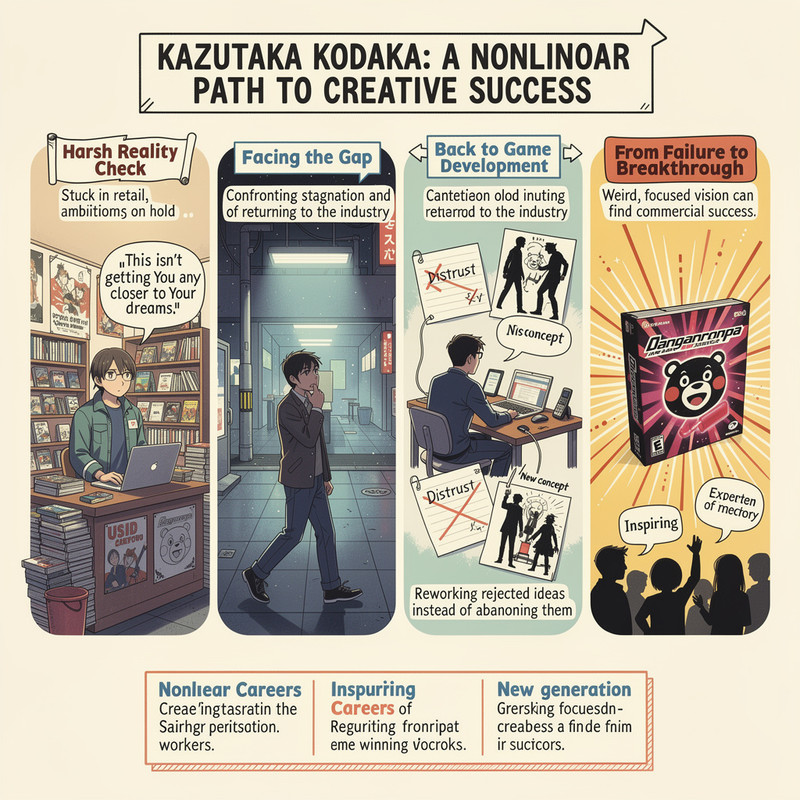
Kazutaka Kodaka, the creative mind behind Danganronpa and The Hundred Line: Last Defense Academy, became a game developer because a coworker at his part-time job selling used games essentially told him he was wasting his life. During the Computer Entertainment Developers Conference (CEDEC+KYUSHU 2025), Kodaka revealed that an argument while working at a second-hand game shop sparked the existential crisis that pushed him toward game development. After his underclassman coworker delivered a harsh reality check, Kodaka thought “What am I even doing,” which became his motivation to start “living properly” and pursuing original creative work.
This brutal wake-up call came at a pivotal moment in Kodaka’s life. He had left his job at Flagship, a game development company contracted by Nintendo, after just one year due to harsh working conditions. Despite studying film at university with dreams of becoming a screenwriter, Kodaka found himself stuck in retail while making indie films on the side. The coworker’s insult forced him to confront the gap between his creative ambitions and his current reality. He contacted a former colleague from his game development days, started a serious job hunt, and eventually landed at Spike where he would create Danganronpa, one of the most influential visual novel franchises of the 2010s.
The Three Eras of Kodaka’s Life
At CEDEC+KYUSHU 2025, Kodaka chronicled what he called the “three eras” of his life during a discussion about his approach to creating original content. The first era covered his childhood and student years, a period heavily influenced by his sister’s love of movies and anime. Kodaka grew up watching films and animation rather than exclusively playing video games, which would later inform his unique approach to game storytelling that prioritizes cinematic presentation and narrative surprise over traditional gameplay mechanics.
The second era began when Kodaka entered the game industry through Flagship, the Nintendo-contracted developer that worked on The Legend of Zelda: The Minish Cap and Four Swords Adventures. Despite landing a job at a company creating games for one of gaming’s most prestigious franchises, the working conditions proved unbearable. Kodaka left after roughly one year, a decision that sent him into the uncertain third era where he worked part-time at a game shop while pursuing his original passion for filmmaking through indie projects.
This transitional period between leaving Flagship and joining Spike represents the moment when Kodaka could have permanently exited game development. Working retail while making independent films kept him connected to creative work but offered no path toward the “original content” he desperately wanted to create. According to Denfaminicogamer’s coverage of the CEDEC presentation, Kodaka admitted to “borrowing” games from his part-time job during this period, presumably to stay current with industry trends and study what made successful games work.
The Reality Check That Changed Everything
The specific details of the argument with Kodaka’s coworker remain vague, but the impact was profound. In an interview referenced by Automaton Media, Kodaka revealed his coworker’s “rather shocking reply” during their confrontation made him deeply anxious about his future. The interaction forced him to acknowledge he was drifting without direction, working a dead-end retail job while his creative ambitions stagnated. For someone who studied film specifically to become a screenwriter and had already worked in game development, selling used games represented a massive step backward.
What makes this story fascinating is how common it feels. Many creative professionals experience similar crossroads where comfortable stagnation threatens to replace ambitious risk-taking. Kodaka’s coworker didn’t give him groundbreaking advice or reveal hidden truths, they simply held up a mirror showing him the reality he’d been avoiding. Sometimes that’s all it takes for someone’s entire trajectory to shift, though most people in Kodaka’s position would have simply found a different retail job rather than reentering an industry they’d already left due to harsh conditions.

From Distrust to Danganronpa
After rejoining the game industry at Spike, Kodaka proposed an idea called Distrust that would eventually become Danganronpa. The original concept featured a battle royale death game in a closed environment between high school students, but the pitch was rejected for being too gruesome and dark. Rather than abandoning the project, Kodaka retooled the concept by injecting the dark comedy, absurdist tone, and stylized presentation that would become Danganronpa’s signature elements. The killing game remained, but Monokuma’s theatrical villainy and the game’s self-aware humor made the violence feel less exploitative.
Kodaka faced another challenge: visual novels weren’t considered commercially viable, especially for a small company like pre-merger Spike. To get Danganronpa approved, he deliberately avoided calling it a visual novel in planning documents. Instead, he invented the genre label “high-speed detective action” and emphasized the shooting mechanics during class trials. By framing statements as bullets flying across the screen that players shoot down with evidence, Kodaka created what he called “a deliciously evil combo” combining intellectual mystery-solving with action game reflexes.
This approach proved successful. Danganronpa: Trigger Happy Havoc launched for PSP in 2010 in Japan and became an unexpected hit despite Spike’s modest marketing budget. The game distinguished itself from other visual novels through its gameplay mechanics, stylish presentation, and willingness to kill off major characters in shocking ways. According to Wikipedia’s article on Phoenix Wright: Ace Attorney, Danganronpa director Kazutaka Kodaka specifically cited Phoenix Wright’s North American success as proof that visual novels with strong gameplay mechanics could find international audiences, which informed his design philosophy.
The Influences Behind Danganronpa
While Kodaka’s origin story reveals how he became a game developer, understanding his influences explains why Danganronpa feels so unique. In a 2013 interview with Siliconera, producer Yoshinori Terasawa revealed that the Saw film franchise provided major inspiration during Danganronpa’s planning phase. The psychological horror elements, elaborate death traps, and moral dilemmas from James Wan’s films translated directly into Monokuma’s executions and the killing game premise that forces students to murder each other to escape.
Kodaka’s film studies background heavily influenced his approach to game storytelling. He cited David Lynch as a major inspiration, particularly Lynch’s approach to death and violence where killing requires meaningful motivation rather than existing purely for shock value. According to Game Informer’s 2015 interview, Kodaka stated “As opposed to being about death, these are games about playing for your life, since killing is much less purposeful without a motive to justify it.” This philosophy explains why Danganronpa spends so much time establishing characters before killing them and why executions often generate sympathy for murderers despite their crimes.
Japanese mystery authors also shaped Kodaka’s work. He named Edogawa Ranpo and Shinichi Hoshi as influences, particularly their focus on unexpected twists and contradictory testimony. The core gameplay loop of finding contradictions between witness statements and evidence comes directly from Phoenix Wright: Ace Attorney, which Kodaka openly acknowledged as inspiration. Game Informer’s interview confirmed that Danganronpa deliberately mixed “visual novel storytelling with intense courtroom trials akin to Ace Attorney,” though the high-speed bullet mechanics and emphasis on reflexes distinguished it from Capcom’s more methodical approach.

The Character Creation Philosophy
One of Kodaka’s defining principles is that every character must be strong enough to serve as a protagonist. In the 2015 Game Informer interview, he explained his character creation process starts with throwing out basic traits ranging from ultimate talents to personality quirks to visual style. These elements shape each character’s essence before he determines their role in the plot. This ensures characters feel like people rather than plot devices, even when their narrative function is to die horribly in chapter two.
Kodaka emphasized that he never worries about running out of ultimate talents despite creating dozens of characters across multiple games. “Even though the category of what they’re ultimate in might be similar, if you look at the characters themselves, it’s actually quite different,” he told Game Informer. He cited Sakura the Ultimate Martial Artist versus Peko the Ultimate Swordswoman as examples where similar combat-focused talents resulted in completely different personalities due to contrasting character designs and backstories.
His willingness to kill beloved characters stems from viewing death as integral to their narrative arc rather than wasteful tragedy. “Some characters will kill, some will be killed, and some will receive the execution. That’s part of their character and their role in the story, what they’re meant to do,” Kodaka explained. He approaches the elaborate punishment scenes as opportunities to generate sympathy for murderers, forcing players to question whether anyone truly deserves such grotesque deaths even when they committed murder. This moral ambiguity separates Danganronpa from simpler good-versus-evil narratives.
Life After Danganronpa
Kodaka left Spike Chunsoft in 2017 and co-founded Too Kyo Games with other former Spike Chunsoft staff, maintaining independence while still collaborating with his former employer. His post-Danganronpa work includes Master Detective Archives: Rain Code developed with Too Kyo Games and published by Spike Chunsoft, and The Hundred Line: Last Defense Academy which launched in 2024. Both games showcase Kodaka’s continued fascination with death games, mystery-solving, and stylized presentation while exploring different gameplay mechanics.
In 2022, Kodaka told Twinfinite he might return to Danganronpa someday but currently wants to focus on creating new original content. “It’s not like I don’t want to make another Danganronpa game, but I have a lot of ideas and want to create something new. Someday I may go back, maybe.” This mirrors his original motivation for becoming a game developer: the desire to create original work rather than simply participating in existing franchises or following established formulas.
However, Kodaka did return to Danganronpa for Danganronpa 2×2, an enhanced remake of Danganronpa 2: Goodbye Despair featuring a new “what if” story alongside the original game. In December 2025, he told GamesRadar that working with the characters from 10 years ago felt “nostalgic” and brought back memories. The project represents a middle ground between completely abandoning his most successful franchise and getting trapped exclusively making sequels.

The Lesson For Aspiring Creators
Kodaka’s origin story offers important lessons for creative professionals stuck in transitional periods. First, sometimes brutal honesty from unexpected sources provides the catalyst needed to change direction. The coworker who essentially called Kodaka out for wasting his life probably didn’t realize they were pushing him toward creating one of gaming’s most beloved franchises. Second, leaving a job due to poor working conditions doesn’t mean permanently abandoning that industry, returning with new perspective and connections can lead to better opportunities.
Third, studying fields outside your primary discipline creates unique perspectives. Kodaka’s film studies background directly influenced how he approaches game storytelling, prioritizing cinematic presentation, surprising twists, and thematic depth over traditional gameplay mechanics. If he’d studied game design instead of film, Danganronpa might never have achieved its distinctive identity that blends visual novel conventions with courtroom drama and high-speed action gameplay.
Finally, persistence in retooling rejected ideas often matters more than the initial pitch. Distrust was rejected for being too gruesome, but instead of abandoning the concept entirely, Kodaka adjusted the tone, added stylized elements, and reframed how he presented it to management. That willingness to iterate rather than give up transformed a rejected concept into a franchise that has sold millions of copies worldwide and inspired countless imitators in the visual novel and murder mystery genres.
FAQs About Danganronpa Creator’s Origin Story
Who created Danganronpa?
Kazutaka Kodaka created Danganronpa while working at Spike (later Spike Chunsoft). He developed the concept, wrote the scenario, and directed the first game which launched for PSP in 2010 in Japan and 2014 internationally. Kodaka left Spike Chunsoft in 2017 to co-found Too Kyo Games.
How did Kazutaka Kodaka become a game developer?
After leaving his first game development job at Flagship due to harsh working conditions, Kodaka worked part-time at a used game shop while making indie films. An argument with a coworker made him question what he was doing with his life, prompting him to contact former industry connections and ultimately land a job at Spike.
What inspired Danganronpa?
Kodaka cited the Saw film franchise, David Lynch’s approach to death and violence, Japanese mystery authors Edogawa Ranpo and Shinichi Hoshi, and Phoenix Wright: Ace Attorney as major influences. The class trial mechanics directly reference Ace Attorney’s contradiction-finding gameplay while adding high-speed shooting elements.
Was Danganronpa originally called Distrust?
Yes, Kodaka’s original pitch was called Distrust and featured a similar death game premise but was rejected for being too gruesome. After retooling the concept with dark comedy, stylized presentation, and Monokuma’s theatrical villainy, the revised pitch was approved and became Danganronpa.
Why did Kodaka call Danganronpa high-speed detective action?
Kodaka deliberately avoided calling Danganronpa a visual novel in planning documents because the genre wasn’t considered commercially viable. He invented the “high-speed detective action” label to emphasize the shooting mechanics and action elements during class trials, making it easier to get management approval.
Is Kazutaka Kodaka still making Danganronpa games?
Kodaka left Spike Chunsoft in 2017 and has focused on creating original games like Master Detective Archives: Rain Code and The Hundred Line: Last Defense Academy. However, he returned to work on Danganronpa 2×2, an enhanced remake with new content, and says he might make another Danganronpa game someday.
What was Kodaka’s first job in game development?
Kodaka’s first game industry job was at Flagship, a Nintendo-contracted developer that worked on The Legend of Zelda: The Minish Cap and Four Swords Adventures. He left after approximately one year due to harsh working conditions.
Did Kodaka study game design?
No, Kodaka studied film at university with plans to become a screenwriter. His film studies background heavily influenced his approach to game storytelling, prioritizing cinematic presentation, narrative surprise, and thematic depth over traditional gameplay mechanics.
Conclusion
Kazutaka Kodaka’s journey from struggling retail worker to celebrated game director proves that creative careers rarely follow straight paths. A harsh reality check from a coworker at a used game shop forced him to confront the gap between his ambitions and his stagnating reality, pushing him to reenter an industry he’d already left once due to poor working conditions. That decision to contact former connections and seriously pursue game development opportunities ultimately led to Danganronpa, a franchise that has influenced an entire generation of visual novel developers and proven that experimental, weird games can achieve commercial success when they nail their unique vision. The story also highlights how studying disciplines outside your primary field creates unique perspectives that distinguish your work from competitors. Kodaka’s film studies background gave him storytelling tools and cinematic instincts that other game developers lacked, allowing him to create something genuinely different rather than iterating on existing formulas. Most importantly, his willingness to retool rejected ideas rather than abandoning them transformed Distrust’s failure into Danganronpa’s success. For aspiring creators stuck in transitional periods wondering if they should give up on their ambitions, Kodaka’s origin story offers hope that sometimes all it takes is one honest conversation to trigger the change needed to pursue original work worth creating.