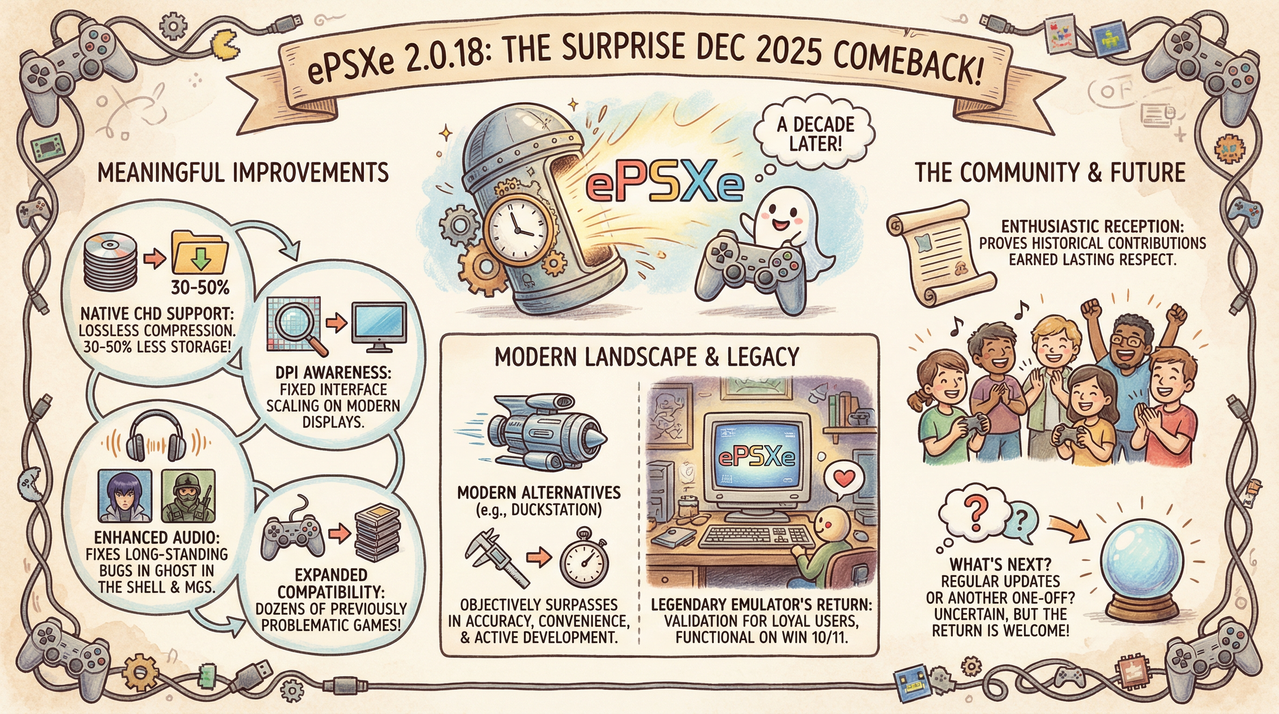
ePSXe, one of the oldest and most influential PlayStation emulators, released version 2.0.18 on December 22, 2025, marking its first major update in nearly a decade. The last significant release was version 2.0.5 in 2015-2016, making this 10-year gap one of the longest periods of inactivity for any actively maintained emulator. The surprise announcement on the official ePSXe website introduces native support for CHD (Compressed Hunks of Data) image files, which are significantly smaller than traditional ISOs while maintaining lossless quality. Additional improvements include DPI awareness for modern high-resolution displays, enhanced audio emulation fixing reverb and volume issues in games like Ghost in the Shell and Dino Crisis, plus expanded compatibility for titles including Metal Gear Solid Special Missions, Valkyrie Profile, and Samurai Shodown III.
The update arrived without warning, catching the emulation community by surprise after years of speculation that development had permanently ceased. TweakTown reported the news on December 29, noting that CHD support represents the headline feature since compressed formats dramatically reduce storage requirements without quality loss. Reddit’s emulation community expressed shock at the unexpected release, with users noting that ePSXe once dominated PlayStation emulation from 2000-2010 but had been largely superseded by more accurate modern alternatives like DuckStation and Mednafen. Despite this, ePSXe maintains a dedicated user base who appreciate its plugin system flexibility and lower hardware requirements compared to accuracy-focused competitors.
What Makes This Update Significant
The version 2.0.18 changelog reveals substantial technical improvements beyond just CHD support. The emulator core received multiple fixes addressing compatibility issues that plagued specific games for years. Audio improvements focus on SPUCORE (Sound Processing Unit Core) with better reverb and volume management fixing long-standing bugs in Ghost in the Shell, Dino Crisis 1 and 2, Wipeout, Dynasty Warriors 7, and Dragon Quest 4. These games suffered from audio glitches, incorrect reverb effects, or volume inconsistencies that made them suboptimal experiences on ePSXe despite otherwise functioning correctly.
DPI awareness support addresses a critical problem for modern Windows users with high-resolution displays. Without DPI awareness, applications scale incorrectly on 1440p and 4K monitors, creating blurry interfaces or text that’s either too small to read or weirdly sized. The update enables proper DPI scaling (activated in Options menu) so ePSXe’s interface renders correctly on modern displays without the visual artifacts that plagued previous versions. This seemingly minor feature dramatically improves usability for anyone running displays beyond 1080p resolution, which represents most gaming PCs in 2025-2026.
Compatibility improvements span numerous titles that previously experienced issues. Starfighter Sanvein, Need for Speed III/IV, Kagero Deception II, Captain Commando, Valkyrie Profile, Street Scooters, Metal Gear Solid Special Missions (specifically disc-changing functionality), V-Rally 2 Japanese version, and Samurai Shodown III all received specific fixes. Additionally, HLE BIOS support improvements benefit games like Thousand Arms, Harvest Moon Back to Nature, Tokimeki Memorial, and SimCity 2000 Japan. These fixes suggest the developers systematically addressed bug reports accumulated over the decade-long development hiatus.
The CHD Format Advantage
CHD (Compressed Hunks of Data) is a lossless compression format developed by MAME (Multiple Arcade Machine Emulator) that significantly reduces file sizes without quality degradation. PlayStation game ISOs typically range from 300MB to 700MB depending on how much of the disc capacity developers utilized. CHD compression can reduce these files by 30-50% depending on content, turning a 650MB ISO into a 325-400MB CHD file. For collectors maintaining libraries of hundreds of PS1 games, this space savings adds up to hundreds of gigabytes of freed storage.
The format’s lossless nature means no quality compromise compared to original ISOs. Unlike lossy compression that discards data to achieve smaller sizes, CHD preserves every byte while cleverly organizing data for efficient storage. This makes CHD ideal for preservation efforts where maintaining bit-perfect copies matters. Modern emulators increasingly support CHD natively, making it a community-standard format alongside traditional ISO/BIN/CUE formats that dominated for decades.

ePSXe’s Historical Context
Understanding ePSXe’s significance requires context about PlayStation emulation history. Released October 14, 2000, ePSXe revolutionized PS1 emulation by offering dramatically better compatibility and performance than competing emulators. Wikipedia notes that “when released, ePSXe was a revolution in the PlayStation emulation scene, boasting higher compatibility and performance than other emulators of the system at the time.” The plugin-based architecture borrowed from PSEmu Pro allowed specialized developers to create optimized GPU, SPU, and CD-ROM plugins that users could mix and match for best results on their specific hardware.
For nearly a decade, ePSXe dominated as the go-to PlayStation emulator. Retro Gamer called it “the best free PlayStation emulator,” while Techtree and Pcnexus echoed similar sentiments. The combination of high compatibility, good performance on modest hardware, and extensive plugin ecosystem made ePSXe the default choice for anyone wanting to play PS1 games on PC. Reddit user Scizzoman attributes “about 80% of my knowledge about PS1 JRPGs to that emulator,” reflecting how ePSXe enabled an entire generation to discover PlayStation’s extensive RPG library.
Development appeared to halt after version 1.6.0 released August 5, 2003, with speculation that source code was lost in a hard drive failure. However, developers revealed in April 2008 that they’d resumed work in summer 2007 due to user encouragement. Version 1.7.0 arrived May 24, 2008, followed by gradual updates through 2015’s version 2.0.5. The subsequent 10-year gap from 2015-2025 without updates led most users to assume development had permanently ceased, making December 2025’s version 2.0.18 release completely unexpected.
Why Alternatives Surpassed ePSXe
Despite ePSXe’s historical dominance, newer emulators eventually surpassed it in accuracy, convenience, and compatibility. DuckStation emerged as the modern gold standard for PlayStation emulation, offering superior accuracy, simpler setup without plugin hassles, and excellent performance. Mednafen provides cycle-accurate emulation prioritizing correctness over performance, making it the choice for preservation and competitive speedrunning where accuracy matters most. RetroArch’s Beetle PSX core (based on Mednafen) combines accuracy with RetroArch’s unified interface and features like save states, shaders, and achievement support.
ePSXe’s plugin system, once an advantage, became a liability as emulation matured. New users found configuring GPU, SPU, and CD-ROM plugins confusing compared to DuckStation’s simplified setup. The plugins themselves often had accuracy issues or compatibility quirks that modern integrated emulators avoided. Reddit noted that “it was quite challenging to persuade certain users to transition to other PS1 emulators, even when they started to outperform ePSXe, much like the way some individuals were reluctant to move away from ZSNES.” This ZSNES comparison references another aging emulator whose user base clung to familiarity despite objectively superior alternatives.
ePSXe’s closed-source nature also limited improvement compared to open-source competitors where communities collaboratively fix bugs and add features. Only the plugin API remained open, allowing third-party plugin development but preventing core emulator improvements. Modern emulators like DuckStation benefit from GitHub communities where anyone can submit bug fixes or feature additions, accelerating development beyond what small closed-source teams can achieve. The 10-year development gap perfectly illustrates this limitation, where closed-source projects die if original developers stop working while open-source projects attract new maintainers.
The Remaining User Base
Despite superior alternatives, ePSXe retains dedicated users for specific reasons. Lower hardware requirements mean it runs on older PCs where DuckStation might struggle. The plugin system, while complicated for newcomers, offers granular control that enthusiasts appreciate for specific use cases. Some users simply prefer sticking with familiar software rather than learning new interfaces. Reddit estimates “there are still a few hundred users who rely on it as their primary emulator today,” a small but loyal community.
Android users particularly favored ePSXe since mobile alternatives lagged behind. The Android version received updates more consistently than Windows builds, making mobile the platform where ePSXe remained competitive longest. However, even this advantage eroded as DuckStation released Android versions offering better performance and accuracy. The version 2.0.18 Windows update brings Windows builds closer to feature parity with Android, though whether this attracts users back from alternatives remains uncertain.
Technical Details of Version 2.0.18
The official changelog lists multiple technical improvements beyond headline features. Bug fixes address configuration reading errors that previously caused crashes when overclock values weren’t selected. HLE (High Level Emulation) BIOS support improvements increase compatibility for games like Thousand Arms, Harvest Moon, Tokimeki Memorial, and SimCity 2000 Japan that struggled with previous HLE implementations. These games can now run without requiring copyrighted official Sony BIOS files, improving accessibility for users in regions where obtaining legitimate BIOS dumps proves difficult.
Reddit discussions noted that version 2.0.18 was compiled using Visual Studio 2017 but lacks Windows XP compatibility despite relying on older APIs like OpenGL 2. This decision surprised some users who expected a project maintaining decade-old codebases to prioritize legacy OS support. The choice suggests developers targeting modern Windows 10/11 systems rather than catering to enthusiasts running ancient hardware. However, this inevitably positions ePSXe competing directly against DuckStation and other modern emulators optimized for current systems, where ePSXe’s accuracy limitations become more apparent.
Currently, only Windows received the version 2.0.18 update. Linux, macOS, and Android versions remain on older builds, creating fragmentation across platforms. Whether developers plan updating other platforms or focusing exclusively on Windows remains unclear. The Windows-only release suggests limited development resources, raising questions about long-term maintenance commitments. Will version 2.0.18 be another one-off update followed by years of silence, or does it signal resumed active development with regular releases?

Should You Use ePSXe in 2026
For most users, modern alternatives like DuckStation remain objectively superior choices in 2026. DuckStation offers better accuracy, simpler setup, active development with frequent updates, and excellent performance on modern hardware. The user experience is dramatically more polished with features like automatic game database lookups, built-in achievement support, and sophisticated upscaling options. Unless you have specific reasons preferring ePSXe, DuckStation represents the better starting point for anyone wanting to play PlayStation games on PC.
However, ePSXe retains niche advantages justifying its continued existence. If you’re running very old hardware where DuckStation struggles, ePSXe’s lower system requirements might make it the only viable option. Users with extensive existing ePSXe setups involving carefully configured plugins and save states might prefer updating to 2.0.18 rather than migrating entire libraries to new emulators. Android users on older devices might find ePSXe’s mobile version performs better than alternatives, though this gap has narrowed considerably.
The version 2.0.18 update makes ePSXe more viable for casual use than it was on version 2.0.5. DPI awareness fixes alone justify updating if you’re already using ePSXe, since proper scaling on modern displays dramatically improves usability. CHD support reduces storage requirements for anyone maintaining large game libraries. Audio fixes eliminate annoying bugs in specific games. These improvements won’t convince DuckStation users to switch back, but they make ePSXe acceptable for users who prefer sticking with familiar software rather than learning new emulators.
What This Means for Emulation Preservation
The unexpected ePSXe update highlights broader questions about emulation preservation and legacy software maintenance. When development ceases on popular emulators, do they become obsolete curiosities or valuable alternatives worth maintaining? ePSXe’s 10-year hiatus could have ended in permanent abandonment, with the codebase lost to time like countless other discontinued projects. Instead, the original developers returned with updates addressing modern compatibility, ensuring ePSXe remains functional on current operating systems.
This matters because emulation diversity benefits preservation. Relying exclusively on single emulators creates vulnerability if development stops or accuracy issues affect specific games. Having multiple emulators implementing PlayStation emulation differently provides backup options when one fails. ePSXe’s different approach compared to cycle-accurate alternatives means some games might work better on ePSXe despite overall lower accuracy. Preserving these alternatives maintains options for future users encountering edge cases where mainstream emulators struggle.
The update also demonstrates that even seemingly dead projects can revive. Emulation communities too quickly write off inactive emulators as permanently abandoned, only for surprise updates to arrive years later. This happened with ePSXe, and similar resurrections have occurred with other classic emulators whose developers returned after extended absences. Maintaining awareness of legacy emulators and celebrating updates when they arrive helps preserve emulation history and acknowledges the contributions these projects made to gaming preservation.

FAQs About ePSXe 2.0.18 Update
When was the last ePSXe update before version 2.0.18?
Version 2.0.5 released in 2015-2016, making version 2.0.18 the first major update in nearly 10 years. This extended gap led most users to assume development had permanently ceased before the surprise December 22, 2025 announcement.
What is CHD format and why does it matter?
CHD (Compressed Hunks of Data) is a lossless compression format that reduces PlayStation game file sizes by 30-50% without quality loss. A 650MB ISO might compress to 325-400MB as CHD, saving significant storage for collectors maintaining large game libraries.
Should I use ePSXe or DuckStation in 2026?
DuckStation is objectively superior for most users, offering better accuracy, simpler setup, and active development. However, ePSXe retains advantages for very old hardware requiring lower system requirements or users with extensive existing configurations who prefer not migrating to new emulators.
Does ePSXe 2.0.18 work on Windows XP?
No, despite using older APIs like OpenGL 2, version 2.0.18 was compiled using Visual Studio 2017 without Windows XP compatibility. The developers targeted modern Windows 10/11 systems rather than prioritizing legacy OS support.
What games got fixed in ePSXe 2.0.18?
Audio improvements fixed Ghost in the Shell, Dino Crisis 1 and 2, Wipeout, Dynasty Warriors 7, and Dragon Quest 4. Compatibility improvements addressed Starfighter Sanvein, Need for Speed III/IV, Kagero Deception II, Captain Commando, Valkyrie Profile, Metal Gear Solid Special Missions, V-Rally 2, and Samurai Shodown III.
Is ePSXe available for Linux and Mac?
Yes, but only Windows received the version 2.0.18 update as of January 2026. Linux, macOS, and Android versions remain on older builds. Whether developers plan updating other platforms hasn’t been announced.
Do I need PlayStation BIOS files for ePSXe?
Version 2.0.18 includes improved HLE BIOS support that mimics PlayStation BIOS functionality without requiring copyrighted Sony BIOS files. However, compatibility with official BIOS remains higher than HLE emulation for some games.
Why did ePSXe development stop for 10 years?
The developers never officially explained the hiatus. Previous gaps between 2003-2008 were attributed to hard drive failures potentially losing source code, though developers resumed work in 2007. The 2015-2025 gap’s cause remains unexplained.
Conclusion
ePSXe version 2.0.18’s surprise December 2025 release after a decade of inactivity represents one of emulation’s most unexpected comebacks, introducing meaningful improvements like native CHD support reducing storage requirements by 30-50% through lossless compression, DPI awareness fixing interface scaling on modern high-resolution displays, enhanced audio emulation addressing long-standing bugs in Ghost in the Shell and Metal Gear Solid, plus expanded compatibility for dozens of previously problematic games. While modern alternatives like DuckStation objectively surpass ePSXe in accuracy, convenience, and active development, the legendary emulator’s return demonstrates that even seemingly abandoned projects can revive when original developers find renewed motivation to address accumulated technical debt. For the few hundred dedicated users who never switched away from ePSXe despite superior alternatives, version 2.0.18 provides validation that their loyalty wasn’t misplaced and ensures the emulator remains functional on current Windows 10/11 systems. Whether this signals resumed active development with regular future updates or represents another one-off release before years of silence remains uncertain, but the emulation community’s enthusiastic reception proves that ePSXe’s historical contributions earned lasting respect regardless of its current competitive position against accuracy-focused successors.