NVIDIA just unveiled G-Sync Pulsar at CES 2026, and Digital Foundry wasted no time calling it the most significant advancement in gaming display technology in years. This isn’t just incremental improvement – Pulsar fundamentally changes how we perceive motion on LCD monitors through a technique called Regional Backlight Pulsing that works seamlessly with variable refresh rates.
How G-Sync Pulsar Actually Works
Traditional LCD monitors suffer from motion blur because pixels remain lit for the entire frame time while the screen refreshes row by row from top to bottom. Your eye tracks moving objects continuously, creating the perception that pixels linger in their old positions. G-Sync Pulsar solves this with a rolling scan that pulses the backlight in 10 horizontal strips, each timed precisely ahead of when pixels in that row need to change.
Think of it like a wave of light rolling down your screen just ahead of the image refresh. Each frame’s backlight stays on for only 25% of the frame time, giving pixels nearly a full frame to stabilize before lighting up. NVIDIA claims this delivers 4x the effective motion clarity – so running at 250 FPS with Pulsar gives you motion sharpness equivalent to a theoretical 1000Hz monitor at 1000 FPS.
Digital Foundry’s tests in Counter-Strike 2 showed dramatically sharper edges on moving objects compared to standard 360Hz displays. The improvement isn’t subtle – fast motion suddenly gains incredible definition without the usual trail of blur that plagues even high-end gaming monitors.
The Technical Breakthroughs
Pulsar combines three key innovations. First, Rolling Scan Compensation ensures pixels reach their target values before lighting up. Second, Compensation Pulse handles frame rate variations by adding brief secondary pulses. Finally, G-Sync Variable Overdrive dynamically adjusts based on expected frame timing.
The result eliminates the compromise between VRR smoothness and backlight strobing clarity. Previous technologies like ULMB2 caused severe flicker when paired with variable refresh rates. Pulsar maintains buttery smooth frame delivery while delivering esports-level motion precision.

Early monitors launching with Pulsar are 27-inch 1440p IPS panels from Acer, AOC, Asus, and MSI, all hitting 360Hz. These hit the sweet spot for competitive gaming where maximum clarity matters most. NVIDIA also introduced Ambient Adaptive technology that automatically adjusts brightness and color temperature based on room lighting.
Real-World Performance and Limitations
Digital Foundry noted immediate, obvious improvements in fast-paced titles. Combined with NVIDIA’s Multi-Frame Generation on RTX 40 and 50 series GPUs, Pulsar delivers unprecedented fluidity in demanding path-traced games. The tech shines brightest in competitive shooters where tracking enemies through chaotic motion makes the difference between victory and defeat.
However, Pulsar has limits. It automatically disables below 90Hz to avoid perceptible flicker, though users can force it down to 75Hz. NVIDIA mentioned ongoing work to enable 60Hz support, but early demos focused on high frame rate scenarios where the technology excels.
Variable refresh rate handling remains the true test. While 200+ FPS demos looked phenomenal, performance closer to the 90Hz floor will determine everyday usability. The tech’s success hinges on gracefully handling real gameplay frame rates rather than just peak performance demos.
Why This Matters for Gamers
Motion clarity has always been the Achilles heel of LCD gaming monitors. CRTs naturally avoided persistence blur, but LCD pixel response times and constant backlight illumination created unavoidable tradeoffs. G-Sync Pulsar finally closes this gap without requiring OLED-level pricing or the burn-in risk.

For competitive players, the difference could be transformative. Clearer enemy tracking, sharper weapon recoil patterns, and better visibility through particle effects directly translate to higher kill-death ratios. Casual gamers benefit too – fast camera pans in single-player titles suddenly reveal details previously lost to blur.
The Competition and Future Outlook
AMD’s FreeSync monitors will need equivalent technology to stay competitive. Higher refresh rate panels (540Hz+) might close the clarity gap through brute force, but Pulsar proves intelligence beats raw numbers. Monitor manufacturers face pressure to adopt the required MediaTek scaler chips across their lineups.
NVIDIA positions Pulsar as the ultimate esports display technology. With 30th anniversary of Age of Empires approaching and esports continuing to grow, crystal-clear motion could become the new standard for professional play. The real test comes when these monitors hit shelves and players put them through months of abuse.
FAQs
What exactly does G-Sync Pulsar improve?
Pulsar eliminates LCD motion blur by pulsing the backlight in precise horizontal strips synchronized with screen refresh, delivering 4x clearer motion while maintaining full VRR smoothness.
Does Pulsar reduce input lag?
No. Pulsar focuses purely on motion clarity, not latency. It complements high frame rates and NVIDIA Reflex for complete responsiveness.
What frame rate range does Pulsar support?
Default range is 90Hz+, manually adjustable down to 75Hz. NVIDIA is working on 60Hz support but early focus remains on competitive frame rates.
Will Pulsar work on my existing G-Sync monitor?
No. Pulsar requires new monitors with specific MediaTek scaler chips and the latest G-Sync module. It’s not a firmware upgrade for older displays.
Is Pulsar flicker-free like standard VRR?
Mostly. The rolling scan design minimizes flicker perception compared to global backlight strobing, but very low frame rates may show visible pulsing.
Does Pulsar only benefit esports?
No. Any fast motion benefits – from cinematic camera sweeps to action-packed single-player combat. Clarity improvements are visible across all genres.
What’s the difference between Pulsar and ULMB2?
ULMB2 couldn’t handle variable refresh rates without severe flicker. Pulsar combines strobing clarity with G-Sync VRR for both smoothness and sharpness.
When can I buy Pulsar monitors?
First 360Hz 1440p models from Acer, AOC, Asus, and MSI launch alongside the tech in early 2026. Broader adoption expected throughout the year.
The Dawn of Clarity
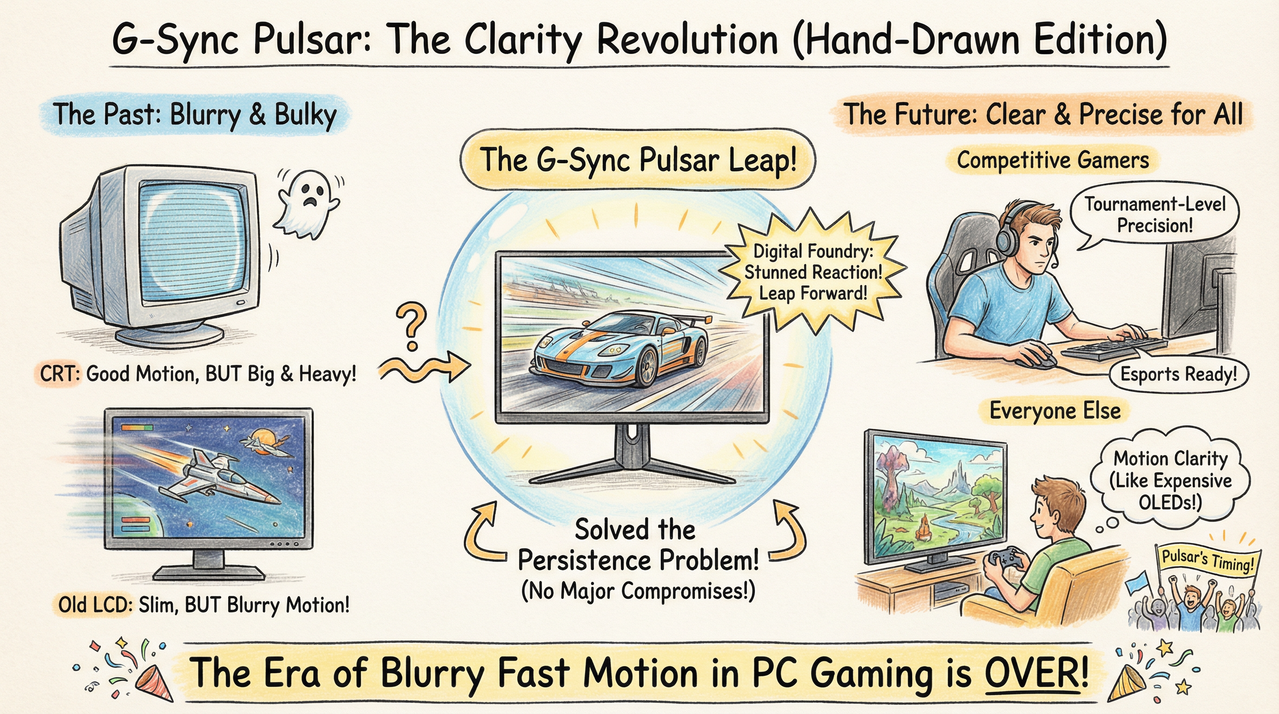
G-Sync Pulsar represents LCD gaming monitors finally matching CRT motion performance without the drawbacks. Digital Foundry’s stunned reaction underscores the leap forward – for the first time, display engineers solved the persistence problem without major compromises. Competitive gamers gain tournament-level precision, while everyone else enjoys motion clarity previously exclusive to expensive OLED panels. As esports grows and single-player visuals push boundaries, Pulsar’s timing couldn’t be better. The era of blurry fast motion in PC gaming might finally be over.