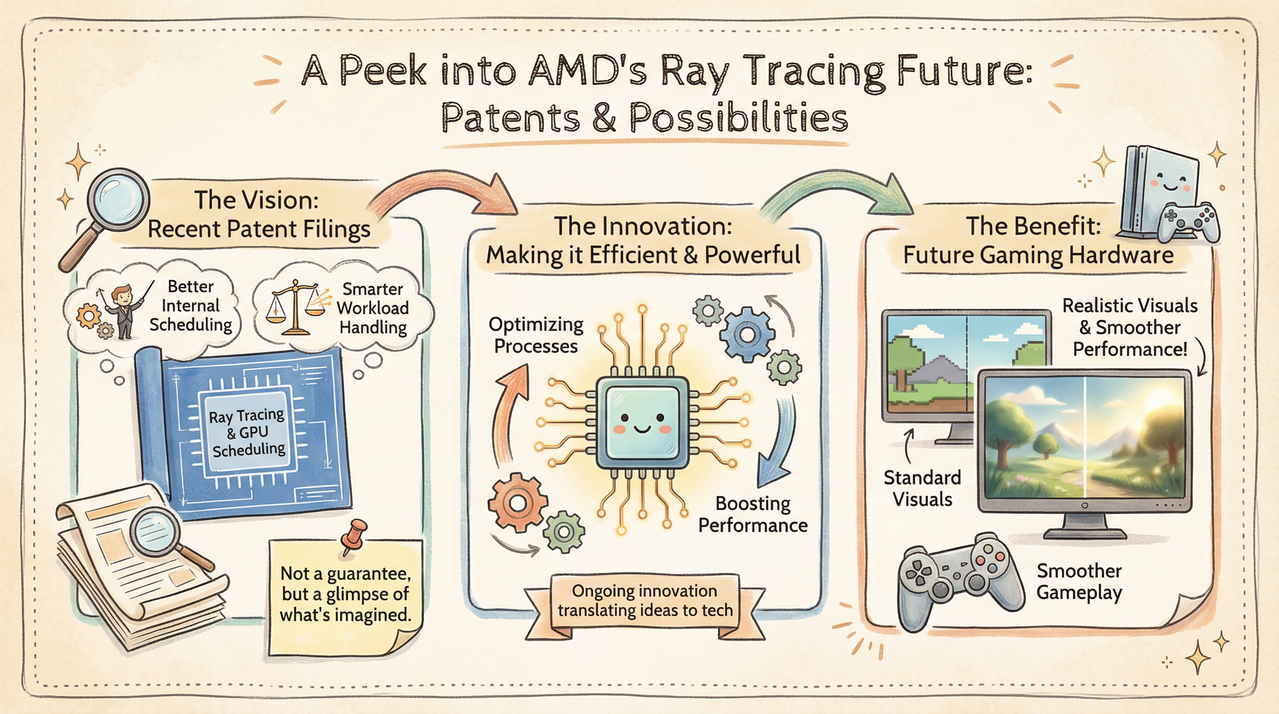
A wave of new AMD patent filings has gamers and hardware fans talking about what future graphics technology might look like. The patents cover a range of graphics processor improvements, with a strong focus on ray tracing performance and smarter task scheduling on GPUs. While patents do not guarantee features in future products, they often offer a hint at where a company is investing its engineering efforts.
What the Patents Are About
Several of the patents focus on improving ray traced rendering in graphics hardware. Ray tracing simulates how light interacts with objects to produce realistic lighting, reflections, and shadows. It is a demanding technique that has become a staple in many modern games but can be tough to run efficiently without hardware support.
One patent, for example, describes a method of scheduling ray tracing work in a way that reduces wasted effort and avoids overloading shared resources that would otherwise slow down the system. Another patent deals with how measurement and organization of geometry inside a scene can be done more efficiently, which is part of what GPUs do when they trace rays through a 3D world. These innovations aim to make ray tracing both faster and less resource hungry, which could improve performance in future gaming hardware.
Smarter Scheduling and Execution
Beyond just ray tracing, some of the patents deal with more general graphics processing scheduling. This means the GPU could manage tasks more intelligently, balancing workloads so that graphics shader units and other hardware components are not idle or overloaded. Better scheduling can lead to smoother gameplay and more efficient use of power and chip area. It’s a bit like having a smarter traffic controller inside the GPU that keeps everything moving without jams.
Why This Matters for Gaming
Ray tracing is one of the biggest visual leaps in recent gaming, but it has often leaned on brute force hardware power to work well. If these patent ideas make their way into future GPU architectures, it could help AMD close the gap with competitors in ray traced performance while keeping power use and chip size manageable. A faster, more efficient ray tracing pipeline could mean better lighting and reflections in games without as severe a performance hit.
Smarter GPU scheduling, meanwhile, could benefit not just ray traced games but all sorts of graphics and compute tasks. Better use of hardware resources often translates directly into higher frame rates and more stable performance in demanding titles.

How Patents Translate into Real Products
It’s important to remember that patents represent possibilities and ideas, not confirmed product features. Companies file patent applications to protect innovations and explore future directions. Some patents may never become part of real consumer hardware, while others could be a foundational part of next-generation graphics architectures.
Nevertheless, these filings show AMD is thinking deeply about ray tracing and efficient GPU scheduling. Analysts and fans often watch patent activity to get early signals of what might show up in next-gen GPUs or consoles. For example, improved ray tracing could find its way into future Radeon cards or next-gen consoles that use AMD based graphics subsystems.
Community Reaction
Gamers and hardware enthusiasts online have mixed reactions to patent leaks. Many are hopeful that AMD might finally close performance gaps in ray tracing compared to rival hardware. Others are cautious, noting that patents do not always mean finished features and that real measured performance in games will ultimately determine success. The talk around these filings highlights the continued interest in GPU evolution and what major improvements might be coming to gaming hardware.
Source: “+20 Ray Tracing, Scheduling, and other AMD patent grants and filings, hinting at future GPUs and gaming technologies” by u/MrMPFR on r/GamingLeaksAndRumours (Reddit), January 20, 2026.
FAQs
What is ray tracing?
Ray tracing is a rendering technique that simulates realistic lighting and reflections in games by tracing paths of light. It’s more computationally intensive than traditional rendering but produces more lifelike visuals.
Do these patents mean new GPUs will be released soon?
Not necessarily. Patents show research directions, but companies may take years to turn those ideas into working products.
Will this make games look better?
If implemented in hardware, improved ray tracing could enhance lighting and realism in games without as big a performance cost.
What is GPU scheduling?
GPU scheduling refers to how tasks are organized and executed inside a graphics processor. Smarter scheduling can make better use of hardware resources for smoother performance.
Are these ideas only for AMD products?
The patents come from AMD, but similar concepts could appear in competing hardware through separate innovation efforts.
Does this affect game developers?
Eventually, yes. If hardware supports new features, developers can add more advanced visual effects that take advantage of them.
Conclusion
The recent AMD patent filings covering ray tracing and GPU scheduling highlight ongoing innovation in graphics technology that could benefit future gaming hardware. While patents are not guarantees, they can offer a peek at what a company is envisioning, and these filings suggest that AMD is working on making ray tracing more efficient and powerful. Better internal scheduling and smarter handling of ray tracing workloads could translate to more realistic visuals and smoother performance in games once these ideas make it into actual products.