During AMD’s recent earnings call, CEO Lisa Su made waves by suggesting Microsoft’s next-generation Xbox could arrive in 2027. But before you mark your calendar, veteran gaming journalist Tom Warren from The Verge is pumping the brakes on that excitement. The reality behind chip development and console launches is more nuanced than a single timeline might suggest.
What AMD Actually Said About the 2027 Timeline
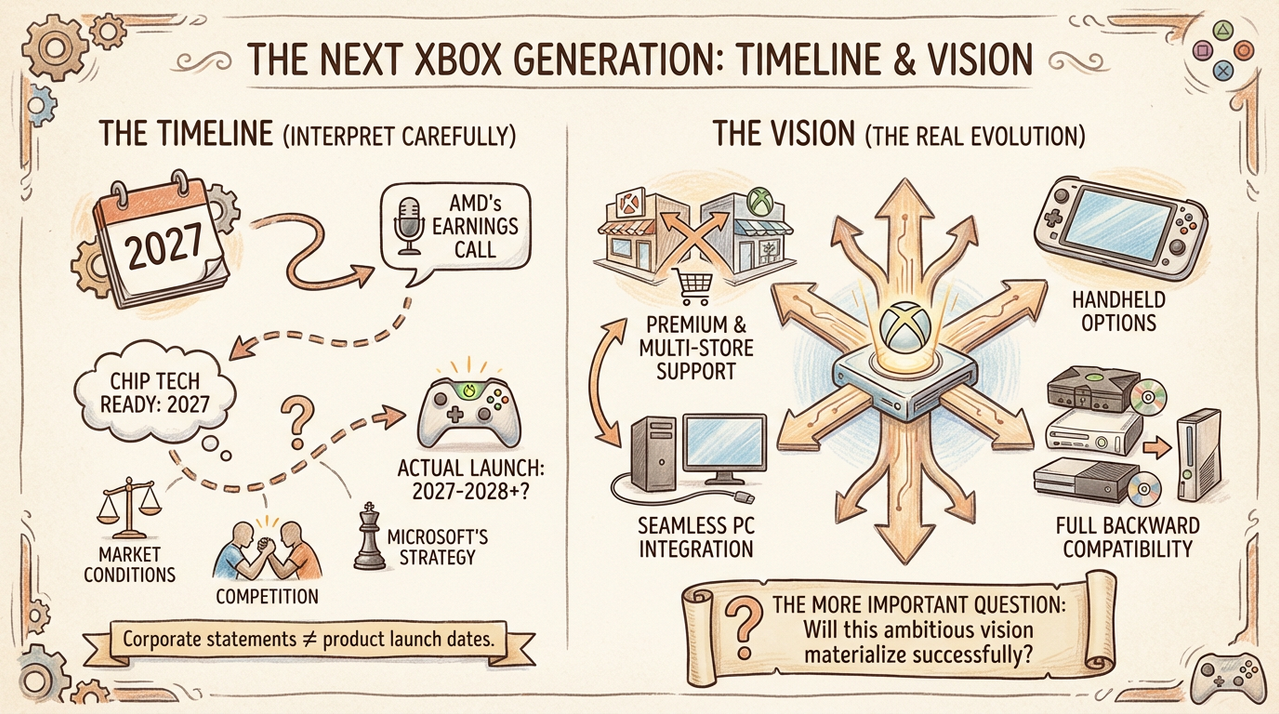
Lisa Su’s statement during the earnings call was specific but carefully worded. She mentioned that development of Microsoft’s next-gen Xbox featuring an AMD semi-custom system-on-chip is progressing well to support a launch in 2027. This marks the first concrete public timeline for the console that’s been in development since Microsoft announced its multi-year partnership with AMD back in June 2025.
AMD has been Microsoft’s chip partner since the Xbox One era, designing the custom processors that power every Xbox console including the current Series X and Series S. The partnership extends beyond traditional consoles too, covering the Xbox Ally handheld devices and cloud gaming servers. For the next generation, AMD is co-engineering silicon across Microsoft’s entire gaming device portfolio, promising next-level graphics, AI-powered experiences, and full backward compatibility with existing Xbox game libraries.
Tom Warren’s Important Clarification
Here’s where Tom Warren’s perspective becomes crucial. The veteran Microsoft and Xbox reporter clarified that AMD saying the chips will be ready to support a 2027 Xbox launch doesn’t necessarily mean the console will actually ship that year. There’s a significant difference between chip readiness and product availability.
Chip development typically runs on a different timeline than final product launches. AMD needs to have silicon ready well before Microsoft can manufacture, test, build inventory, coordinate with retailers, and execute a global launch. The fact that AMD’s custom processor will be ready by 2027 could mean the actual console hits shelves later, potentially in 2028 or beyond.
What We Know About the Next Xbox
Microsoft has been relatively tight-lipped about specific details, but several key facts have emerged. Xbox president Sarah Bond confirmed the console will target the premium, high-end market, describing it as a very curated experience. The system will feature AMD’s latest technology, likely including RDNA 5 graphics architecture and Zen 6 or Zen 7 CPU cores, depending on the final launch timing.
Perhaps most intriguingly, Microsoft has emphasized that the next Xbox won’t be locked to a single store or tied to one device. This suggests a significant shift toward a more PC-like ecosystem, potentially supporting multiple storefronts including Steam. The company appears to be moving away from the traditional closed console model toward a hybrid approach that blurs the lines between console and gaming PC.
Market Context and Competition
| Console | Expected Timeline | Key Features |
|---|---|---|
| Next-Gen Xbox | 2027-2028 | AMD chip, multi-store support, premium positioning |
| PlayStation 6 | 2028 | AMD partnership, potential handheld companion |
| Steam Machine | Early 2026 | AMD-powered, Valve’s console-style PC |
The timing of the next Xbox launch is particularly interesting given the broader gaming hardware landscape. Current-generation consoles, the PlayStation 5 and Xbox Series X/S, launched in late 2020 and are now over five years old. Sony released the PS5 Pro as a mid-generation refresh, but Microsoft opted not to pursue a similar upgrade, instead focusing resources on the next full generation.
Industry analysts have noted that 2027 might still be early for a true next-generation leap. The typical console generation spans seven to eight years, which would point toward 2028 as more natural timing. Additionally, external factors like RAM pricing and supply chain considerations could influence the final launch date. Some reports suggest Microsoft was originally targeting 2028 internally, with 2027 representing an accelerated timeline.
The Bigger Xbox Strategy Shift
Beyond hardware timelines, Microsoft’s broader gaming strategy is evolving dramatically. The company’s Play Anywhere vision encompasses traditional consoles, handheld devices, PC gaming, cloud streaming, and even first-party games appearing on PlayStation and Nintendo platforms. This multi-platform approach represents a fundamental departure from the console exclusivity wars of previous generations.
The partnership with AMD extends to portable gaming devices as well, with Microsoft exploring Xbox-branded handhelds. The existing Xbox Ally devices, manufactured by Asus but featuring optimized Xbox software, serve as testbeds for this approach. Future devices developed directly with AMD could offer even tighter integration between hardware and Xbox services.
Why Chip Readiness Doesn’t Equal Launch Readiness
Understanding the gap between chip availability and console launches requires looking at the broader product development cycle. Once AMD finalizes the custom processor design, Microsoft must complete numerous additional steps. These include developing the cooling system, designing the console chassis, finalizing firmware and system software, negotiating with component suppliers, setting up manufacturing partnerships, and building sufficient inventory for a global launch.
Previous console generations offer instructive examples. Development of custom chips typically begins three to four years before launch, with chip finalization happening 12 to 18 months ahead of retail availability. This lead time allows for the integration work, testing, certification, and production ramp-up necessary for a successful launch. AMD stating readiness for 2027 likely means final silicon will be available by early to mid-2027, pointing toward a late 2027 launch at the absolute earliest, with 2028 being more realistic.
What This Means for Gamers
For Xbox owners wondering about upgrade timing, the message is clear: don’t expect new hardware immediately. Your current Xbox Series X or Series S will remain the primary Microsoft console for at least another year, possibly two. Microsoft continues supporting current-generation hardware with new games and services, including major 2026 releases like the Halo Combat Evolved remaster and Forza Horizon 6.
The more open platform approach Microsoft is promising could prove more significant than the hardware itself. If the next Xbox truly supports multiple storefronts and operates more like a specialized gaming PC, it could offer unprecedented flexibility for players who want console simplicity with PC-style openness. However, the details of how this will work in practice remain unclear.
Frequently Asked Questions
When will the next Xbox actually launch?
While AMD suggested 2027, most industry observers including Tom Warren believe late 2027 at the earliest or 2028 is more realistic. Chip readiness doesn’t guarantee console availability, as Microsoft needs additional time for final development, manufacturing, and launch preparation.
Will the next Xbox be backward compatible?
Yes. Microsoft has explicitly confirmed that the next-generation Xbox will maintain full compatibility with existing Xbox game libraries, continuing the backward compatibility commitment from the current generation.
What makes the next Xbox different from current consoles?
The next Xbox is described as a premium, high-end experience that won’t be locked to a single store or device. This suggests a more open ecosystem, potentially supporting storefronts like Steam alongside the Xbox Store, representing a significant departure from traditional console models.
Who is making the processor for the next Xbox?
AMD is co-engineering the custom silicon for Microsoft’s next-generation Xbox through a multi-year partnership announced in June 2025. AMD has powered every Xbox console since the Xbox One and will continue this relationship with next-generation hardware.
Will there be an Xbox handheld console?
Microsoft’s partnership with AMD covers a portfolio of devices including consoles for the living room and handheld devices. While specific Xbox-branded handhelds haven’t been fully revealed, Microsoft is clearly exploring portable gaming options as part of its broader hardware strategy.
How powerful will the next Xbox be?
Specific specifications haven’t been revealed, but the console is expected to feature AMD’s latest technology, likely RDNA 5 graphics architecture and advanced CPU cores. Microsoft has promised next-generation graphics innovation, deeper visual quality, and AI-powered experiences.
Should I wait to buy an Xbox Series X or buy one now?
With the next generation at least 18-24 months away, buying a current Xbox Series X or Series S remains a solid choice. These consoles will continue receiving new games and support for years, and Microsoft’s backward compatibility ensures your game library will carry forward.
The Bottom Line
AMD’s earnings call provided the first concrete timeline for Microsoft’s next Xbox generation, but Tom Warren’s clarification reminds us to interpret corporate statements carefully. Chip development timelines don’t directly translate to product launches. While 2027 represents when AMD’s technology will be ready, the actual console could arrive later depending on numerous factors including market conditions, competition, and Microsoft’s strategic timing.
What’s perhaps more interesting than the specific date is what Microsoft is planning for the platform itself. A premium console that supports multiple stores, integrates seamlessly with PC gaming, offers handheld options, and maintains full backward compatibility would represent a genuine evolution of what an Xbox can be. Whether this vision materializes successfully remains the more important question than whether the hardware ships in 2027 or 2028.