Ever wonder why your ARC Raiders lobbies feel so different from what your friends describe? Turns out there’s a reason. Embark Studios CEO Patrick Söderlund just confirmed what the community has been speculating for weeks: the game uses aggression-based matchmaking that analyzes your playstyle and pairs you with similar players. If you prefer cooperative PvE gameplay and avoid shooting other raiders, you’ll get matched with other friendly players. If you shoot on sight and thrive on PvP chaos, the game throws you into lobbies with equally aggressive players.
How the System Actually Works
In an interview with GamesBeat, Söderlund explained the matchmaking breakdown. The system starts with skill-based matchmaking to ensure fair fights. Then it separates players into solo, duo, and trio queues. But here’s where it gets interesting. About a week before his interview in early January 2026, Embark added another layer that tracks whether you’re prone to PvP or PvE behavior.
Söderlund’s exact words: “So if your preference is to do PvE and have less conflict with players, you’ll get more matched up with those players. Obviously it’s not a full science.” When the interviewer asked if this was aggression-based matchmaking, Söderlund confirmed: “That’s exactly what it is.” The system doesn’t look at your kill-death ratio or competitive rankings. Instead, it observes how you actually play across multiple matches.
Do you ignore other players and head straight for objectives? The game notices. Do you regularly engage in firefights with other raiders? The algorithm adjusts. According to Beebom, the system studies behavioral patterns rather than traditional performance metrics. That means even skilled players who prefer cooperative gameplay can enjoy relaxed lobbies, while aggressive players get matched against others who want constant PvP action.

The YouTuber Who Tested It
Before Söderlund’s confirmation, content creator Domi decided to test whether aggression-based matchmaking existed. They created two separate ARC Raiders accounts with completely different playstyles. One account played aggressively, shooting other players on sight and prioritizing PvP combat. The second account focused entirely on PvE, avoiding conflict with other raiders and cooperating whenever possible.
The results were dramatic. The aggressive account consistently matched with hostile players. Domi even asked an opponent mid-fight if they also attacked people first, and after confirming the theory, they naturally fought to the death. Meanwhile, the friendly account encountered nine cooperative players in a row. “Everyone is being chill and nice,” Domi reported. “No one shot me. No one even tried to shoot me.”
Prior to the CEO’s confirmation, Embark’s art director Robert Sammelin told PC Gamer that matchmaking “is quite complex, so we do analyze behavior and match accordingly.” He hinted that other factors like loadout might play a role, but behavioral analysis is clearly the primary driver. Your actions have consequences, and those consequences determine who you play with.
Why This Matters for Extraction Shooters
Extraction shooters have always struggled with player behavior. Games like Escape from Tarkov, The Cycle: Frontier, and Dark and Darker attract wildly different player types. Some want tense PvP battles where betrayal and ambushes create adrenaline-pumping moments. Others prefer cooperative PvE experiences where players team up against environmental threats and AI enemies. Forcing both groups into the same lobbies creates friction.
Traditional extraction shooters use server browsers or basic matchmaking that doesn’t account for playstyle preferences. DayZ lets you pick servers with different rules, but you’re still rolling dice on player behavior. The Division’s Dark Zone attempted to balance PvP and PvE but ended up frustrating both groups. ARC Raiders’ approach solves this by letting the game observe and adapt to how you actually play rather than forcing you to choose a mode.
The system particularly helps solo players. Playing alone in aggressive lobbies means getting jumped by coordinated squads. But in friendly lobbies, solo players report other raiders sharing weapons, dropping blueprints they’ve already learned, and working together against the AI-controlled ARC machines. That cooperative spirit transforms the experience from stressful to genuinely enjoyable.

The Massive Success Behind It
ARC Raiders launched in October 2025 between Call of Duty: Black Ops 7 and Battlefield 6, a release window Söderlund himself called “insanity.” But the gamble paid off spectacularly. The game peaked at 481,966 concurrent players on Steam and has sold over 7 million copies. It won Best Multiplayer Game at The Game Awards 2025 and Most Innovative Gameplay at The Steam Awards 2025.
What makes those numbers more impressive is player retention. According to data from Khelnow, ARC Raiders maintained 86% of its player base weeks after launch, with concurrent players still hitting 439,118. That kind of retention is almost unheard of for live-service games. For comparison, many extraction shooters see massive drop-offs within days as frustrated players abandon the genre’s typically punishing nature.
Reviews praise the game’s polished gunplay, beautiful maps built in Unreal Engine 5, and deep crafting system. IGN wrote that ARC Raiders “sets a new standard for extraction shooters,” while PC Gamer highlighted its “genuinely enjoyable” PvPvE encounters. But much of the positive buzz comes from the surprisingly helpful community, which is directly influenced by the matchmaking system separating toxic players from cooperative ones.
Can You Game the System?
Some players immediately asked whether they could exploit aggression-based matchmaking to farm easy PvE lobbies. The answer is complicated. According to community discussions on the ARC Raiders subreddit, some players successfully shifted their matchmaking by avoiding PvP for 15 consecutive matches and selecting “dislike PvP” in post-match surveys.
However, the system isn’t instantly manipulable. It tracks behavior across multiple sessions and adjusts gradually. If you suddenly start attacking other players after establishing a friendly pattern, the algorithm notices and begins matching you with more aggressive lobbies. Players report that defending yourself doesn’t immediately throw you into kill-on-sight matches, but repeatedly initiating combat will.
There’s also the question of duos and trios. Multiple players noted that squad matchmaking tends more aggressive regardless of individual playstyles. When you’re in a group, the game assumes you’re more prepared for PvP encounters. Solo queue remains the most reliably friendly environment for PvE-focused players, while duos and trios attract squads looking for team fights.
The Titanfall 2 Shadow
Söderlund’s confidence about ARC Raiders’ crowded launch window carries extra weight given his history. He was EA’s executive vice president when Titanfall 2 launched in October 2016 between Battlefield 1 and Call of Duty: Infinite Warfare. That catastrophic release timing killed a beloved game’s momentum, with EA often blamed for sabotaging Respawn’s shooter.
When asked about repeating that situation with ARC Raiders launching between two massive shooters, Söderlund acknowledged the risk. “I know that people may look at that and say, ‘What the hell are they doing?’ We have spent a lot of time looking at this from multiple angles, and for right or wrong we’ve decided that we believe the game can launch there. This is the start of a long-term journey.”
The difference is scale and approach. EA and Activision have massive marketing budgets and established franchises. Embark Studios has about 300 employees and relied on viral word-of-mouth. Their technical test in spring 2025 exploded organically, with players spreading the word without massive marketing campaigns. That grassroots enthusiasm carried into launch, proving innovation and quality can compete with blockbuster budgets.
What This Means for Future Games
Aggression-based matchmaking could become standard for extraction shooters and PvPvE games. The system addresses fundamental problems that have plagued the genre since its inception. Players want different experiences, and forcing everyone into identical lobbies satisfies no one. By observing behavior and matching accordingly, developers can accommodate diverse playstyles without splitting the player base with separate modes.
Other games have attempted similar solutions. Dune: Awakening announced in June 2025 that its Deep Desert endgame zone would add PvE-focused areas after complaints from players locked out of top-tier content. But that approach requires designing separate content rather than using smart matchmaking. ARC Raiders’ solution is more elegant and scalable.
The challenge is transparency. Embark kept the system secret initially, letting players speculate before finally confirming it existed. That created conspiracy theories and frustration. Future implementations would benefit from being upfront about behavioral matchmaking while keeping specific details vague enough to prevent exploitation. Players deserve to know their actions have matchmaking consequences without getting a roadmap to game the system.
Frequently Asked Questions
What is aggression-based matchmaking in ARC Raiders?
Aggression-based matchmaking analyzes your playstyle across multiple matches and pairs you with similar players. If you avoid PvP and focus on cooperative PvE gameplay, you’ll match with other friendly players. If you regularly engage in combat with other raiders, the system places you in more aggressive lobbies.
When was aggression-based matchmaking added to ARC Raiders?
According to CEO Patrick Söderlund in early January 2026, the system was added approximately one week before his interview with GamesBeat. This means the feature launched in late December 2025, though behavioral analysis may have been tracked earlier.
Does ARC Raiders use skill-based matchmaking?
Yes. Söderlund confirmed that matchmaking starts with skill-based pairing, then separates players into solo, duo, and trio queues, and finally applies aggression-based matching based on PvP versus PvE preferences. All three systems work together.
Can you trick the matchmaking system?
Not easily. The system tracks behavior across multiple matches and adjusts gradually. Some players report successfully shifting their matchmaking by avoiding PvP for 15+ consecutive matches and selecting relevant post-match survey options, but suddenly changing playstyles after establishing a pattern will cause the algorithm to readjust.
How successful has ARC Raiders been?
The game has sold over 7 million copies since its October 2025 launch, peaked at 481,966 concurrent players on Steam, and won Best Multiplayer Game at The Game Awards 2025. It maintains an 86% player retention rate, which is exceptional for live-service games.
Who made ARC Raiders?
Embark Studios, founded by Patrick Söderlund after leaving EA. The Swedish studio has about 300 employees and previously developed The Finals. ARC Raiders is published by Nexon and launched on PlayStation 5, Xbox Series X/S, and PC.
Is ARC Raiders only PvP?
No. ARC Raiders is a PvPvE extraction shooter, meaning it combines player-versus-player combat with player-versus-environment challenges against AI-controlled ARC machines. The aggression-based matchmaking system allows players who prefer PvE to avoid constant PvP encounters.
What platforms is ARC Raiders available on?
ARC Raiders launched on PlayStation 5, Xbox Series X/S, and PC via Steam in October 2025. The game uses Unreal Engine 5 and targets current-generation hardware.
The Future of Fair Matchmaking
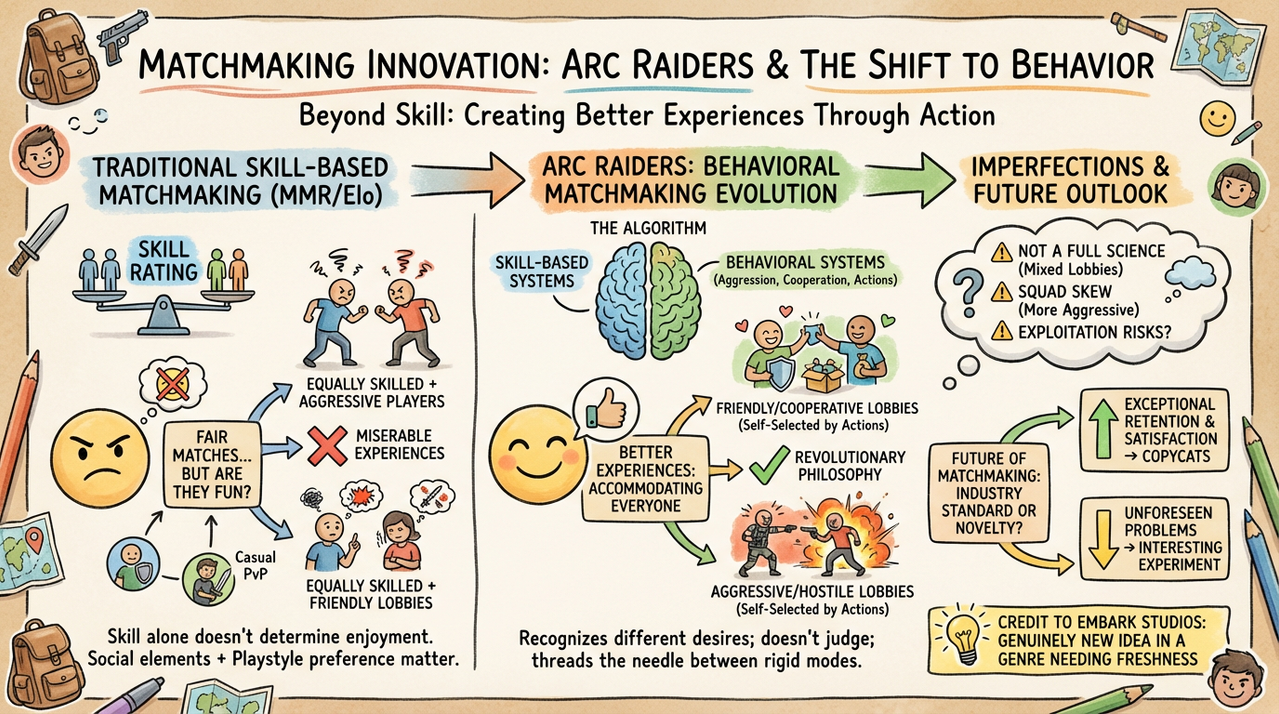
Traditional matchmaking has focused on skill rating for decades. Whether it’s Elo systems, MMR, or hidden rankings, games tried to create fair matches by pairing players of similar ability. But skill alone doesn’t determine enjoyment, especially in games with social elements. A highly skilled player who wants to cooperate has a miserable time in lobbies full of equally skilled but aggressive players. A casual player looking for intense PvP feels bored in friendly lobbies even if everyone matches their skill level.
ARC Raiders proves that behavioral matchmaking can work alongside skill-based systems to create better experiences. The algorithm doesn’t judge whether PvP or PvE is correct. It simply recognizes that different players want different things and tries to accommodate everyone. That philosophy feels revolutionary in an industry that often forces players into rigid modes and playstyles.
The system isn’t perfect. Söderlund himself admitted “it’s not a full science,” and players report mixed lobbies that combine friendly and hostile raiders. Squad matchmaking skews more aggressive regardless of individual preferences. There’s also the question of whether players will eventually figure out exploitation methods that undermine the system’s effectiveness.
But even imperfect, aggression-based matchmaking represents meaningful innovation. Extraction shooters have struggled to build sustainable audiences because the genre’s inherent tension between cooperation and betrayal creates toxic experiences that drive away casual players. By letting players self-select into appropriate lobbies through their actions rather than explicit mode choices, ARC Raiders threads that needle better than any previous attempt.
Whether this becomes industry standard or remains an ARC Raiders novelty depends on how other developers respond. If the system contributes to the game’s exceptional retention and player satisfaction, expect copycats. If it creates unforeseen problems that emerge over time, it might remain a interesting experiment. Either way, Embark Studios deserves credit for trying something genuinely new in a genre that desperately needed fresh ideas. Sometimes the best innovations aren’t flashy features or cutting-edge graphics. Sometimes they’re smart systems that recognize players are different and treat them accordingly.