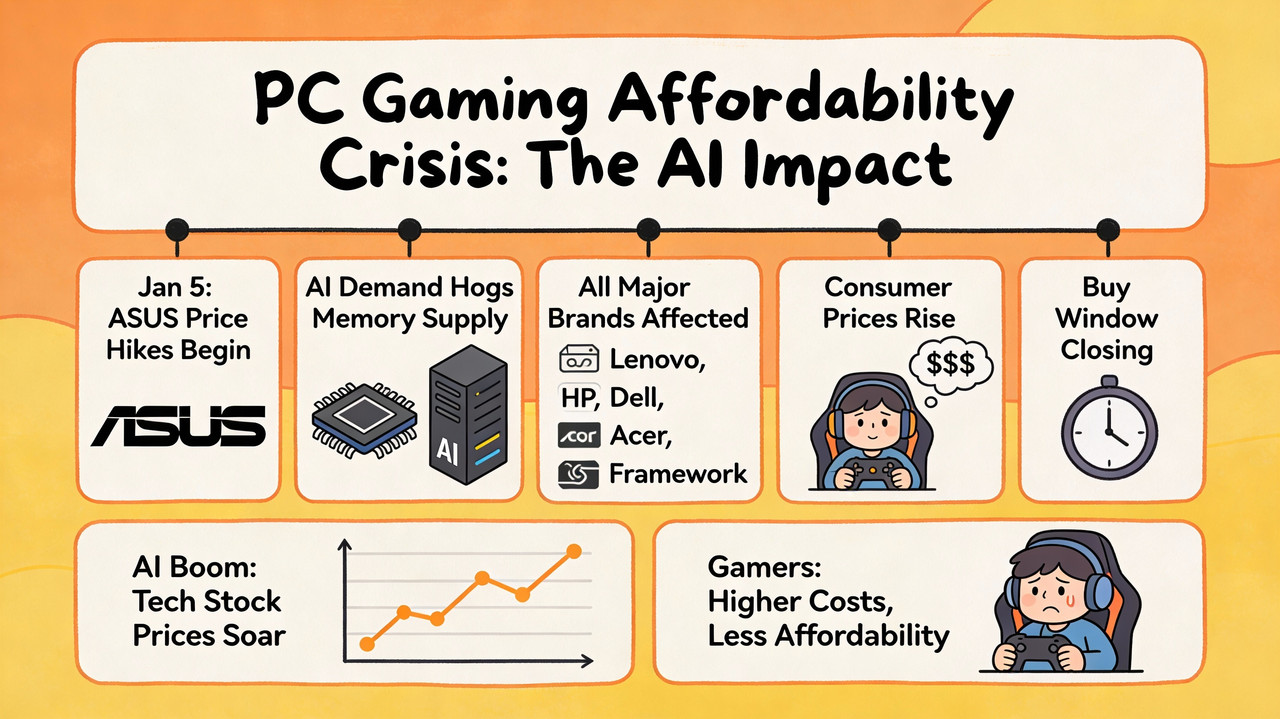
If you were planning to buy an ASUS laptop, motherboard, or any gaming hardware from the company, you have exactly two days left to do it at current prices. On January 5, 2026, ASUS will implement what it’s calling “strategic price adjustments” across select product portfolios. Translation: things are getting more expensive, and the culprit is the same thing ruining everything else in tech right now – artificial intelligence’s insatiable appetite for computer memory.
What’s Getting More Expensive
ASUS hasn’t released an exhaustive list of every product affected by the price hikes, but according to reports from Digitimes and TrendForce, the increases will primarily hit anything that uses RAM and storage. That means laptops, prebuilt gaming PCs, motherboards with onboard memory, and potentially even storage drives under the ASUS brand. The company’s Republic of Gamers lineup – already expensive gaming hardware – is expected to see price increases as well.
In a letter to partners and customers dated December 30, ASUS executive Liao Yi-Xiang explained that the changes “reflect shifts in capacity allocation by upstream suppliers, higher investment costs for advanced manufacturing processes, and structural supply gaps created by rising AI compute demand.” In other words, the companies that make DRAM, NAND, and SSD components are prioritizing AI data centers over consumer products because that’s where the money is.
The AI Memory Crisis
Here’s the situation in plain terms. Tech giants like Microsoft, Google, Amazon, and Meta are building massive AI data centers that require staggering amounts of high-bandwidth memory. These companies are willing to pay premium prices to secure supply, which means memory manufacturers are diverting production capacity away from consumer products toward enterprise AI solutions. The same DRAM chips that would go into your gaming laptop are instead going into servers running ChatGPT or whatever other generative AI nonsense is popular this week.
This isn’t just affecting ASUS. Lenovo, HP, Dell, and Acer have all warned customers about imminent price hikes. Dell reportedly plans to raise prices by up to 30 percent on some products. Framework, the modular laptop company, has already raised RAM prices twice and announced it’s stopping standalone memory kit sales entirely. Even Micron, one of the world’s largest memory manufacturers, shut down its consumer brand Crucial due to ongoing shortages. CEO Sanjay Mehrotra warned these conditions could persist “beyond calendar 2026.”
| Company | Price Increase Timeline |
|---|---|
| ASUS | January 5, 2026 – select products, percentage unspecified |
| Dell | December 17, 2025 – up to 30% |
| Lenovo | January 1, 2026 – all quotes expired, new pricing |
| HP & Acer | Early 2026 – percentages not disclosed |
| Framework | Ongoing – stopped selling standalone RAM kits |
How Bad Could It Get
Industry analysts are predicting this will get significantly worse before it gets better. HP estimates that memory accounts for 15 to 18 percent of the cost of a standard PC, meaning even modest memory price increases create substantial ripple effects on final retail prices. CEO Enrique Lores has specifically warned that the second half of 2026 will be particularly challenging from a pricing perspective.
Some reports suggest laptop sales could drop 10 percent year-over-year in Q1 2026 in response to these January price hikes, with another potential 10 to 20 percent decline in Q2. TrendForce expects overall PC shipments to contract by 5.4 to 10.1 percent. IDC models estimate a 5 percent drop in moderate scenarios and up to 9 percent in worst-case scenarios. When products get too expensive, people simply stop buying them.
GPU Prices Could Double
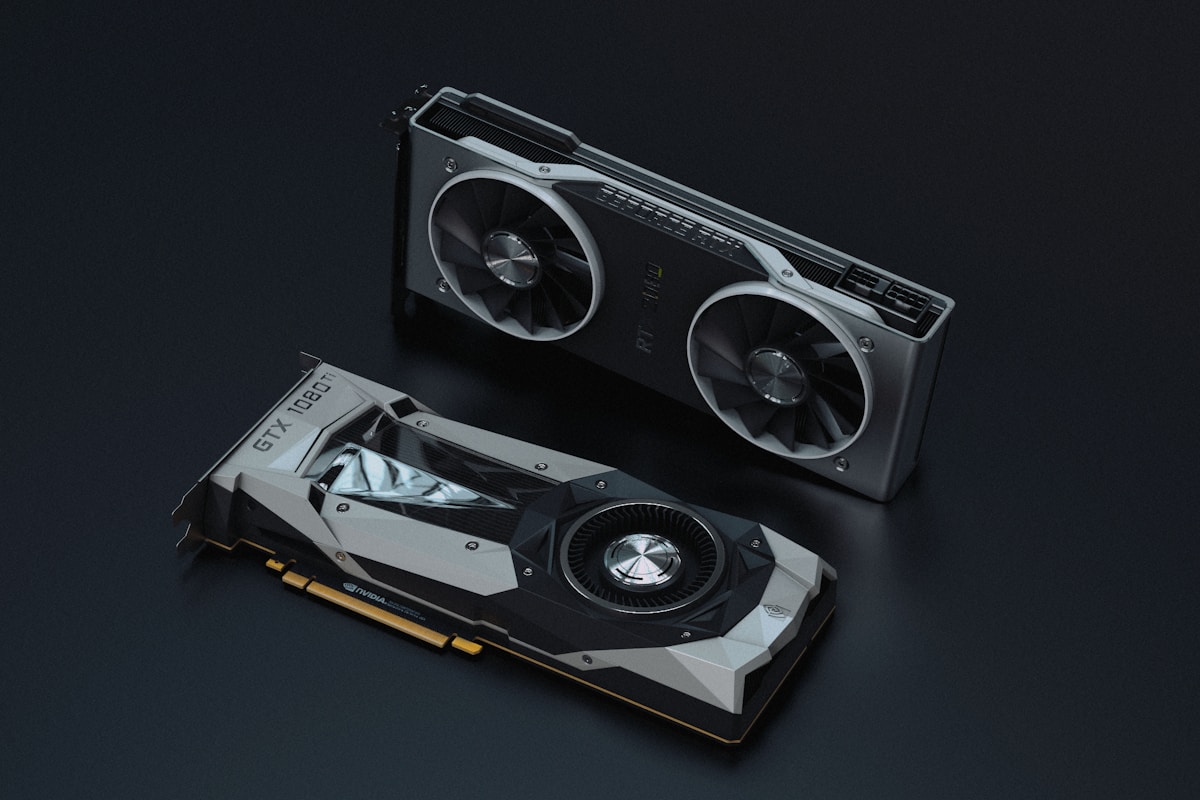
Memory shortages aren’t even the scariest part. According to reports from South Korean outlet Newsis, Nvidia and AMD are looking at significantly increasing GPU prices in 2026. The most eye-popping claim is that graphics cards like the $2,000 RTX 5090 could more than double in price to $5,000 by the end of the year. Even if that specific number proves exaggerated, smaller increases of a few hundred dollars would still make PC gaming’s affordability crisis spiral completely out of control.
There are already whispers that hardware shortages could delay next-generation console launches. Insider Gaming reported in December that console manufacturers are debating whether PlayStation 6 and the next Xbox should be pushed back from their intended 2027-2028 release window, hoping that memory manufacturers will build out infrastructure to increase production and lower prices. If consoles – products sold at razor-thin margins with massive economies of scale – can’t afford current memory prices, what chance do consumer PCs have?
The ROG Ally Timing
The timing of ASUS’s announcement is particularly awkward given that the company just launched the Xbox ROG Ally X in October at $999.99 for the 1TB model. That’s already an extremely premium price point for a handheld gaming PC. If ASUS implements price increases on future production runs or refreshed models, we could be looking at handheld gaming PCs crossing the $1,000 barrier as standard rather than exception.
Microsoft and ASUS reportedly struggled with pricing the ROG Ally devices, with Microsoft executive Jason Ronald citing “macro-economic climate” challenges. The company delayed announcing prices for as long as possible while evaluating tariff impacts and market conditions. Now, just months after launch, the situation has deteriorated further. Anyone thinking about grabbing a ROG Ally should probably do it before January 5 if they don’t want to risk paying more.
What ASUS Is Actually Saying
ASUS’s official statement emphasizes that the company has “absorbed these pressures for as long as possible” but can no longer sustain current pricing without passing costs to consumers. The adjustments are meant to “ensure stable supply, maintain product quality and service levels, and continue supporting customers’ long-term planning for key IT investments.” Corporate speak aside, what they’re really saying is: we can’t get enough memory components at reasonable prices, so you’re going to pay more.
Interestingly, ASUS noted that component products under other business units may not be affected by this announcement, suggesting the price hikes target complete systems like laptops and prebuilts rather than individual components like standalone motherboards. But given that the entire industry is facing the same supply constraints, it’s probably only a matter of time before those see increases too.
The CES Timing
ASUS chose to drop this news right before CES 2026, the annual Consumer Electronics Show in Las Vegas that kicks off on January 6. That’s where companies typically showcase new products and innovations. Instead, ASUS will be attending CES while simultaneously raising prices on existing products. The optics aren’t great – announcing fancy new tech while making current products more expensive feels tone-deaf at best.
Some suspect ASUS wanted to get the bad news out before CES rather than have it overshadow whatever announcements they’re planning for the show. The company has teased updates to its AM5-based Neo lineup of motherboards, and there will likely be other reveals. But it’s hard to get excited about new products when you know they’re going to be more expensive than the generation they’re replacing.
FAQs
When do ASUS price increases start?
ASUS will implement price adjustments on select products starting January 5, 2026. If you want to buy at current prices, you have until January 4.
Which ASUS products are getting more expensive?
ASUS hasn’t released a complete list, but products containing DRAM and storage are primarily affected. This includes laptops, prebuilt gaming PCs, and potentially Republic of Gamers hardware.
How much will prices increase?
ASUS hasn’t specified exact percentage increases. However, other manufacturers like Dell have announced hikes up to 30 percent, suggesting ASUS increases could be substantial.
Why is AI causing memory shortages?
Tech companies building AI data centers are buying massive amounts of high-bandwidth memory at premium prices. Memory manufacturers are prioritizing these lucrative enterprise contracts over consumer products.
Are other companies raising prices too?
Yes. Lenovo, HP, Dell, Acer, and Framework have all warned of or implemented price increases. Micron even shut down its consumer brand Crucial due to shortages.
When will memory prices stabilize?
Micron’s CEO warned shortages could persist “beyond calendar 2026.” Some predict potential stabilization in late 2026, but there’s no guarantee given continued AI demand growth.
Will GPU prices also increase?
Reports suggest Nvidia and AMD may raise GPU prices in 2026, with some claims that high-end cards like the RTX 5090 could double in price to $5,000, though this remains unconfirmed.
Should I buy now or wait?
If you’re planning to purchase ASUS hardware and can afford it now, buying before January 5 will lock in current pricing. Waiting will likely mean paying more, potentially significantly more.
Conclusion
ASUS’s January 5 price hikes represent just the beginning of what could be a brutal year for PC gaming affordability. When one of the industry’s biggest manufacturers openly blames AI demand for forcing price increases two days before one of tech’s biggest trade shows, that’s not a good sign. The fact that every major PC manufacturer is facing the same problem – Lenovo, HP, Dell, Acer, Framework – means there’s no escaping it by switching brands. Memory prices are going up industry-wide because AI companies are hogging supply, and consumers are the ones paying the price. If you need new gaming hardware and you’ve been on the fence, the window to buy at current prices is closing fast. Come January 5, PC gaming gets more expensive, and based on everything we’re hearing from manufacturers and analysts, it’s only going to get worse from there. The AI boom is great for tech companies’ stock prices, but it’s absolutely terrible for anyone who just wants to play games without taking out a second mortgage.