The Blood of Dawnwalker is officially launching in 2026. Rebel Wolves celebrated the new year with a seven-minute Launch Year Special video that recaps 2025, thanks the community, and reveals the game’s hauntingly beautiful main theme. While an exact release date remains unannounced, the studio made it clear that this is the year we finally get to play as Coen, the human-vampire hybrid caught between daylight and darkness. For fans who’ve been following this project since the January 2025 reveal, the wait is almost over.
What the Launch Year Special Revealed
The video opens with a look back at 2025, highlighting the game’s official reveal in January, the first gameplay trailer at Xbox Games Showcase in June, and the extended 45-minute deep dive in the summer. Rebel Wolves founder Konrad Tomaszkiewicz, the man who directed The Witcher 3, appears alongside his team to thank fans for their overwhelming support. The enthusiasm surrounding the game has apparently exceeded their expectations, with millions of views across trailers and passionate community discussions.
But the real highlight comes at the three-minute mark when the video transitions to the game’s main theme. Composed by Piotr Musiał, who previously worked on Witcher 3 expansions and Cyberpunk 2077, the music perfectly captures the dual nature of being a Dawnwalker. Haunting strings build into powerful orchestral swells, blending melancholy with epic grandeur. It’s the kind of soundtrack that instantly transports you to a dark medieval world where vampires rule and humanity struggles to survive.
The video closes with brief glimpses of new footage showing Coen traversing stunning environments at the 6:57 mark. Stone bridges stretch across misty valleys, gothic architecture looms in the distance, and the lighting creates an atmosphere that feels both beautiful and oppressive. According to Reddit comments, these brief environmental shots generated more excitement than anything shown previously. There are also teases of two new female characters who will play important roles in Coen’s journey, though their identities and relationships remain mysterious.

The Witcher Connection You Can’t Ignore
Understanding why The Blood of Dawnwalker matters requires understanding who’s making it. Konrad Tomaszkiewicz didn’t just work on The Witcher 3, he directed it. He guided the game that many consider the greatest RPG ever made, then served as co-director on Cyberpunk 2077 before leaving CD Projekt Red in 2022 to found Rebel Wolves. He brought several key Witcher veterans with him, including design director Daniel Sadowski from Witcher 1, narrative director Jakub Szamalek who wrote for Witcher 3 and Cyberpunk 2077, and art director Bartlomiej Gawel who worked across the entire Witcher trilogy.
In interviews with PC Gamer, Tomaszkiewicz explained why he left an established studio where he’d achieved massive success. He wanted to change the rules of RPG design with crazy ideas that would be too risky for a major publisher to greenlight. Large companies need proven concepts and established IPs. Tomaszkiewicz wanted creative freedom to experiment with a smaller team where communication flows easier and the creative fire burns hotter.
The specific idea he couldn’t sell to a big studio? A narrative sandbox RPG where time is a resource, every quest advances the clock, and player choice isn’t about good versus evil but about what you’re willing to sacrifice. Mix that with a protagonist who transforms from human to vampire depending on whether it’s day or night, and you get something too weird and ambitious for corporate boardrooms. But for a studio of passionate developers willing to take risks? That’s exactly the kind of project worth building from scratch.
What Makes This Different From Witcher
Despite the talent overlap, The Blood of Dawnwalker isn’t trying to be Witcher 4. The setting is grounded in 14th-century Southeast Europe during the Black Death, specifically a fictional kingdom called Vale Sangora located somewhere in the Carpathians. Instead of monster hunting, you’re navigating a world where vampires have seized control after humanity was weakened by plague and war. The power dynamic is flipped. Humans are the oppressed underclass, and vampires aren’t automatically evil villains.
The game’s vampire lore deliberately avoids the Victorian gothic aesthetic that dominates pop culture. Rebel Wolves drew from global folklore, particularly Eastern European and Slavic traditions, to create bloodsuckers that feel simultaneously elegant and unsettling. Some vampires can heal the sick, introducing moral complexity where drinking blood might actually save lives rather than destroy them. The aristocratic vampire hierarchy mirrors feudal society, with ancient bloodlines, political alliances, and power struggles that trap humans in the middle.
Combat and exploration also differ dramatically. Coen has limited vampiric abilities during the day but transforms at night, gaining supernatural mobility through the Shadowstep ability that functions like Dishonored’s Blink. He can scale buildings, leap between rooftops, and traverse environments in ways that feel closer to parkour action games than Witcher’s methodical swordplay. Design director Daniel Sadowski explained that vampires prioritize mobility and speed, making nighttime gameplay feel fundamentally different from daytime encounters.

The Time Mechanic That Changes Everything
Here’s where Dawnwalker gets genuinely innovative. The game gives you 30 days and 30 nights to save Coen’s family from the vampire lord Brencis. But there’s no traditional clock ticking down in real-time. Instead, every quest has a time cost. Completing main story missions might advance time by a full day. Side activities might cost a few hours. Exploration doesn’t move time forward at all.
This creates strategic tension where you can’t do everything in a single playthrough. Help this village defend against raiders? That’s two days you can’t spend investigating the conspiracy in the capital. Pursue a romance subplot? Time spent building relationships is time not spent preparing for the final confrontation. The game doesn’t end after 30 days, but Coen’s family suffers consequences if you waste time. Rebel Wolves confirmed that the system always telegraphs how much time each activity costs, so players can make informed decisions.
Creative director Mateusz Tomaszkiewicz explained that this approach maximizes player freedom while creating meaningful consequences. In most open-world RPGs, you can complete every quest, explore every location, and max out every character relationship without tradeoffs. Dawnwalker forces prioritization. You can’t save everyone or solve every problem. That constraint mirrors the game’s central theme about sacrifice and what you’re willing to lose to protect those you love.
Why 2026 Makes Sense
Rebel Wolves has been teasing progress for months. The gameplay trailer at Xbox Games Showcase in June 2025 showed pre-beta footage that already looked remarkably polished. Environments rendered in Unreal Engine 5 demonstrated impressive lighting and detail. Character animations during combat felt smooth. The cinematic presentation matched AAA standards despite coming from a relatively small studio of about 300 people published by Bandai Namco Entertainment.
Between June and January, the team has presumably been refining systems, adding content, optimizing performance, and preparing for launch. A 2026 release window suggests the game is far enough along that delays are unlikely barring catastrophic problems. Given that Rebel Wolves consists of veteran developers who shipped The Witcher 3 and Cyberpunk 2077, they understand the production pipeline for massive RPGs.
The strategic timing also matters. Launching in 2026 means avoiding direct competition with The Witcher 4, which likely won’t arrive until 2027 or later. It establishes Rebel Wolves as a studio capable of delivering before their former employer, proving they didn’t need CD Projekt Red’s resources to create something special. And it fills the dark fantasy RPG void left by years without major genre entries, capitalizing on hunger for Witcher-style experiences.
The Community Response
Reddit reactions to the Launch Year Special have been overwhelmingly positive. The announcement thread on r/Games garnered 193 upvotes with 46 comments, most expressing excitement about the environmental footage and confirmation that vampires aren’t one-dimensional villains. One user noted that seeing vampires govern humans with their own culture and lineage feels refreshing, especially when some vampires use their powers to heal rather than harm.
The main theme reveal particularly resonated. Multiple YouTube channels have already uploaded extended versions and reaction videos. Fans of Piotr Musiał’s previous work on Witcher 3 expansions like Hearts of Stone and Blood and Wine immediately recognized his compositional style. The music manages to feel epic without sacrificing intimacy, matching the game’s focus on personal stakes within world-altering events.
Some skepticism remains about whether Rebel Wolves can deliver on ambitious promises with their first game as an independent studio. Creating a narrative sandbox with meaningful time mechanics, dual day-night gameplay systems, and branching storylines is extraordinarily difficult. Even CD Projekt Red struggled with similar ambitions in Cyberpunk 2077. But the team’s pedigree and the quality of footage shown so far suggest they understand the challenges and have solutions.
Frequently Asked Questions
When does The Blood of Dawnwalker release?
Rebel Wolves confirmed the game will release sometime in 2026 on PlayStation 5, Xbox Series X/S, and PC via Steam. An exact release date has not been announced, but the studio promised more updates throughout the year.
Who is making The Blood of Dawnwalker?
Rebel Wolves, a studio founded by former Witcher 3 director Konrad Tomaszkiewicz in 2022. The team includes multiple veterans from CD Projekt Red who worked on The Witcher trilogy and Cyberpunk 2077, with Bandai Namco Entertainment as publisher.
What is the Blood of Dawnwalker about?
The game is set in 14th-century Europe where vampires have taken control after humanity was weakened by the Black Death. You play as Coen, a Dawnwalker who is human by day and vampire by night, with 30 days to save your family from the vampire lord Brencis.
How does the time mechanic work?
The game operates on a day-night cycle where every quest costs a specific amount of time. You have 30 days and nights to complete the main objective. Exploration doesn’t advance time, but quests do. The system always shows how much time activities cost so players can plan accordingly.
Is this similar to The Witcher?
While made by Witcher 3 veterans, The Blood of Dawnwalker features different gameplay systems including a narrative sandbox approach, time-as-resource mechanics, and dual day-night transformations. Combat emphasizes vampire mobility and supernatural abilities rather than Witcher-style monster hunting.
Who composed the Blood of Dawnwalker soundtrack?
Piotr Musiał, who previously worked on The Witcher 3 expansions Hearts of Stone and Blood and Wine, as well as Cyberpunk 2077. The main theme was revealed in the Launch Year Special video released in early January 2026.
Will there be multiple endings?
Rebel Wolves has confirmed the narrative sandbox approach allows for different outcomes based on player choices. The time mechanic means you can’t complete everything in one playthrough, suggesting multiple endings and significant branching paths.
What platforms will it be available on?
The Blood of Dawnwalker launches on PlayStation 5, Xbox Series X/S, and PC via Steam. The game uses Unreal Engine 5 and targets current-generation hardware only.
Why This Matters
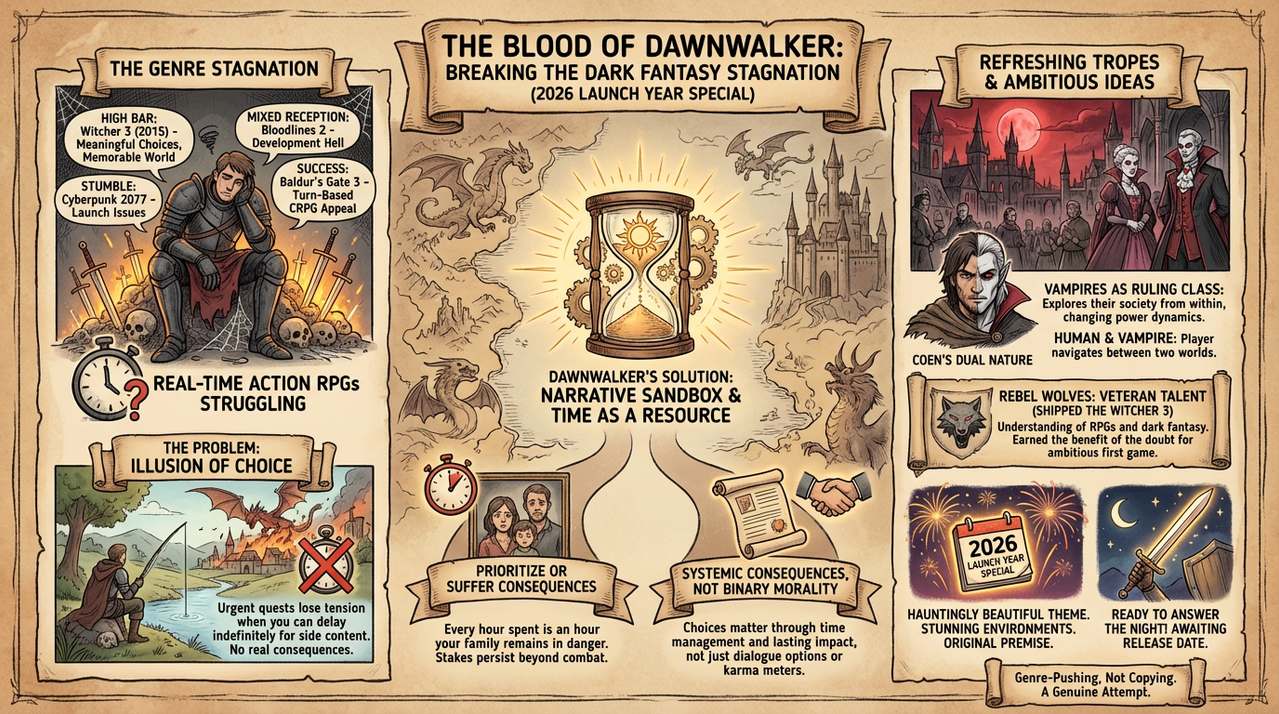
The dark fantasy RPG genre has felt stagnant lately. The Witcher 3 set an impossibly high bar in 2015, and few games have matched its combination of meaningful choices, memorable characters, and beautifully realized worlds. Cyberpunk 2077 attempted something different but stumbled at launch. Vampire: The Masquerade – Bloodlines 2 went through development hell before finally launching to mixed reception. Baldur’s Gate 3 proved turn-based CRPGs still have massive appeal, but real-time action RPGs have struggled to find their footing.
The Blood of Dawnwalker represents a genuine attempt to push the genre forward rather than just copying what worked before. The narrative sandbox concept addresses a fundamental problem with modern open-world RPGs: the illusion of choice. Most games let you delay the main quest indefinitely to complete side content with no consequences. Urgent storylines lose tension when you can spend 100 hours gathering collectibles while the world supposedly teeters on the brink of destruction.
By making time a resource and forcing players to prioritize, Dawnwalker creates stakes that persist beyond individual combat encounters. Your choices matter not because dialogue options change an ending cutscene, but because every hour spent helping strangers is an hour your family remains in danger. That systemic approach to consequence feels more meaningful than binary morality meters or karma systems.
The vampire angle also refreshes familiar fantasy tropes. Medieval Europe settings usually default to humans versus monsters. Making vampires the ruling class and exploring their society from within changes the power dynamics in interesting ways. Coen’s dual nature as both human and vampire mirrors the player’s position, navigating between two worlds without fully belonging to either.
Whether Rebel Wolves can execute these ambitious ideas remains to be seen. Creating a first game as an independent studio is extraordinarily difficult even with veteran talent. But the team has earned the benefit of the doubt. They shipped The Witcher 3, one of gaming’s greatest achievements. They understand what makes RPGs work and what players want from dark fantasy experiences. If anyone can pull this off, it’s them.
The Launch Year Special confirms we won’t have to wait much longer to find out. 2026 is here, and with it comes The Blood of Dawnwalker. The main theme is hauntingly beautiful. The environments look stunning. The premise is genuinely original. Now we just need that exact release date so we can mark our calendars and prepare to become the Dawnwalker. The night is calling, and this time, we’re ready to answer.