Boston Game Dev, the nonprofit organization supporting Massachusetts-area game developers, just dropped their 2025 Year in Review video highlighting what turned out to be one of the region’s most productive years for game releases in over a decade. While the gaming press focused on California, Japan, and Poland, studios scattered across Massachusetts quietly shipped an impressive lineup of critically acclaimed titles that deserve way more attention than they received.
Why Boston Game Development Matters
Boston has deep roots in the gaming industry that get overlooked when people talk about major development hubs. Irrational Games, the legendary studio behind BioShock and System Shock 2, was based in Boston before its controversial closure in 2014. Harmonix, creators of Guitar Hero and Rock Band, operates out of nearby Cambridge. Turbine developed Lord of the Rings Online from their Boston offices before becoming Warner Bros. Games Boston. The Massachusetts scene has always punched above its weight, producing influential titles despite lacking the massive studio presence of Los Angeles or Seattle.
The region’s game development community is organized around three interconnected groups under the Boston Game Dev umbrella. Boston Post Mortem serves as the local chapter of the International Game Developer’s Association and has hosted meetups since the early 2000s. Boston Indies supports independent developers across the spectrum from hobbyists to professionals. Game Audio Boston focuses specifically on sound design and music professionals. Together, these organizations create a support network that helps smaller studios survive and thrive.
The 2025 Release Explosion
According to the Year in Review video, 2025 saw Massachusetts-connected studios ship more games than any recent year. While the video doesn’t provide an exhaustive list of every title, several standout releases demonstrate the breadth and quality coming from the region. These games span genres from tactical RPGs to narrative adventures, proving Boston developers aren’t locked into any single style or niche.
The most visible success might be Demonschool from Necrosoft Games, a tactics RPG that completely reimagined how the genre handles movement and combat. Instead of traditional grid-based targeting, Demonschool has characters interact contextually with their environment, striking enemies or moving objects based on their path. The game blends 2D sprites for the human world with 3D graphics for demons and demon-affiliated objects, creating a striking visual distinction between dimensions. Critics praised its innovation while noting it takes familiar Advance Wars and Final Fantasy Tactics concepts and remixes them into something genuinely fresh.
AdHoc Studio’s Breakout Year
While not exclusively a Boston studio, AdHoc Studio has strong Massachusetts connections through its founding team of former Telltale Games developers. Their superhero workplace comedy Dispatch became one of 2025’s surprise hits, selling over 3 million copies and proving that narrative adventure games never actually died. The game features an all-star voice cast including Aaron Paul and Laura Bailey, telling a story about a washed-up superhero working as a dispatcher for reformed supervillains.
Dispatch’s success matters for the broader Massachusetts indie scene because it demonstrates that mid-budget narrative games can still find massive audiences when executed properly. The game’s eight-episode structure released over three weeks starting in October, creating a weekly event that dominated streaming platforms. The fact that a studio founded by developers who cut their teeth at Telltale could achieve this level of success validates the region’s talent pool and creative vision.
PAX East and the Festival Scene
Boston’s position as the home of PAX East gives local developers a massive advantage for showcasing their work. The convention moved to May 2025 from its traditional March slot, creating some awkward timing that led to fewer AAA publishers attending. However, this actually benefited indie developers who suddenly had more spotlight without competing against huge corporate booths. Kotaku’s PAX East coverage specifically noted that while big names were scarce, the indie game selection was exceptional.
The Boston Festival of Indie Games (BostonFIG) celebrated its return in December 2025 at the Cyclorama, featuring dozens of independently developed video and tabletop games. The festival includes the Figgie Awards, where finalists selected by expert curators compete for recognition. BostonFIG operates as a family-friendly and inclusive event designed to connect players, developers, and enthusiasts in a welcoming environment. For Massachusetts developers, it represents a crucial opportunity to gather feedback, network with peers, and showcase projects to local audiences before pursuing broader distribution.
The Studios Still Standing
Boston’s AAA presence has diminished significantly since the glory days of Irrational Games. When Ken Levine announced in 2014 that Irrational would downsize from approximately 90 employees to a tiny narrative-focused team, it sent shockwaves through the Massachusetts development community. BioShock Infinite had sold 4 million copies and earned critical acclaim, yet the studio still couldn’t sustain itself under the pressures of AAA development cycles.
The Irrational closure revealed the tensions inherent in big-budget game development. Former employees later discussed the tumultuous production of BioShock Infinite, including delays, budget overruns, leadership changes, and crunch periods that pushed the team to breaking points. Despite the commercial and critical success, the human cost was enormous, and 90% of employees suddenly found themselves jobless. The aftermath scattered talented developers across other studios while teaching harsh lessons about unsustainable production practices.
Today, the Massachusetts scene consists primarily of smaller indie studios, specialized teams, and remote developers working for companies headquartered elsewhere. CD Projekt Red opened a Boston office specifically to lead development on the Cyberpunk 2077 sequel, bringing Polish studio experience to Massachusetts talent. Warner Bros. Games Boston continues operating the Lord of the Rings Online servers and supporting other Warner Bros. titles. However, the region lacks the major first-party studios or massive publishers that define development hubs like California or Washington.
Why Small Works Better
The shift toward smaller studios and indie development might actually be healthier for the Massachusetts scene long-term. Demonschool, Dispatch, and other 2025 releases demonstrate that mid-budget games can achieve both critical and commercial success without requiring hundreds of employees or budgets approaching $100 million. These projects operate on sustainable timelines with manageable scope, allowing developers to maintain work-life balance instead of enduring endless crunch.
Boston Game Dev Week, which coincides with PAX East, exemplifies this community-focused approach. The slate of events emphasizes learning, networking, and building relationships rather than chasing blockbuster success. Developers can attend portfolio reviews, hear from industry professionals, or simply hang out with peers facing similar challenges. This supportive infrastructure helps prevent the isolation and burnout that plague larger studios operating in competitive pressure-cooker environments.

Looking Ahead to 2026
The momentum from 2025 positions Massachusetts studios well for continued growth. Several projects announced or teased during the year should release in 2026, and the success of titles like Dispatch proves that publishers and platforms are paying attention to the region’s output. The challenge will be maintaining this energy without succumbing to the pressures that destroyed studios like Irrational.
Boston’s academic institutions provide a steady stream of new talent through programs at schools like MIT, Northeastern, and Worcester Polytechnic Institute. These graduates often stick around the Boston area after completing their degrees, drawn by the city’s quality of life and established developer community. Unlike California where cost of living pushes developers to remote work, Massachusetts offers reasonable housing costs (by tech industry standards) and strong public transit that makes studio collaboration feasible.
The region also benefits from proximity to New York’s publishing and media industries without the astronomical costs of Manhattan real estate. Developers can easily travel for meetings with publishers, attend industry events, and collaborate with narrative writers or voice actors based in New York, all while maintaining offices in more affordable Massachusetts locations.
Frequently Asked Questions
What major game studios are based in Boston?
Boston’s AAA presence is limited compared to its indie scene. Warner Bros. Games Boston operates the Lord of the Rings Online, CD Projekt Red opened a Boston office for Cyberpunk 2077’s sequel, and Harmonix (Guitar Hero, Rock Band) operates nearby in Cambridge. The region is primarily known for indie studios like Necrosoft Games.
What happened to Irrational Games?
Irrational Games, the Boston studio behind BioShock and System Shock 2, dramatically downsized in 2014 after BioShock Infinite’s release. Creative Director Ken Levine reduced the team from 90 employees to a small narrative-focused group, leaving most staff jobless despite the game’s critical and commercial success.
What is Boston Game Dev?
Boston Game Dev is a 501(c)3 nonprofit supporting Massachusetts-area game developers. It operates through three organizations: Boston Post Mortem (IGDA chapter), Boston Indies (independent developer community), and Game Audio Boston (audio professionals). They host events, meetups, and the annual Boston Festival of Indie Games.
What games came out of Boston in 2025?
Notable 2025 releases from Massachusetts-connected studios include Demonschool (Necrosoft Games), a tactical RPG with innovative movement mechanics, and Dispatch (AdHoc Studio with Massachusetts ties), which sold over 3 million copies. The Boston Game Dev Year in Review video showcases additional titles.
When is PAX East held in Boston?
PAX East moved to May in 2025 from its traditional March slot. The convention takes place at the Boston Convention and Exhibition Center and is one of the largest gaming events on the East Coast, giving local developers significant exposure opportunities.
What is the Boston Festival of Indie Games?
BostonFIG is an annual event showcasing independent video and tabletop games from Massachusetts developers. Held in December at the Cyclorama, it features the Figgie Awards, developer booths, activities for all ages, and opportunities to play unreleased games. The 2025 festival took place on December 7.
Is Boston a good place to start a game studio?
Boston offers advantages including strong academic institutions producing talent, reasonable cost of living compared to California, proximity to New York media industries, and a supportive developer community through Boston Game Dev. However, it lacks the massive publisher presence and AAA studios found in California or Washington.
The Region That Refuses to Quit
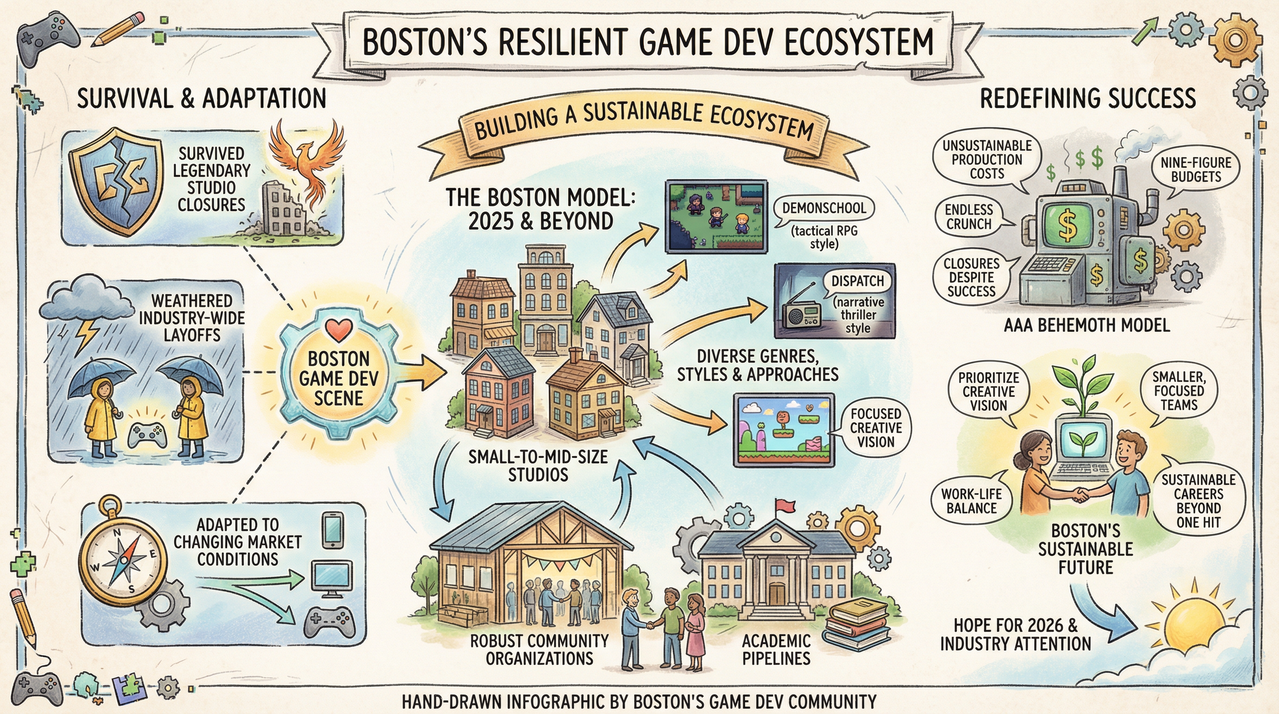
Boston’s game development scene has survived the closure of legendary studios, weathered industry-wide layoffs, and adapted to changing market conditions that destroyed less resilient communities. The 2025 release slate proves that Massachusetts developers continue producing quality work even without the institutional support of major publishers or first-party platform holders. What makes this achievement remarkable isn’t just the number of games shipped, but the diversity of genres, styles, and approaches represented. Boston isn’t trying to be the next Los Angeles or Tokyo. It’s building something different – a sustainable ecosystem of small-to-mid-size studios supported by robust community organizations and academic pipelines.
The success stories from 2025 like Demonschool and Dispatch demonstrate what’s possible when developers prioritize creative vision over chasing blockbuster budgets. These games found audiences by being excellent at what they attempted rather than trying to compete directly with AAA behemoths. As the gaming industry continues grappling with unsustainable production costs, endless crunch, and studios closing despite commercial success, the Boston model of smaller teams making focused games deserves serious attention. Maybe the future of game development doesn’t require hundreds of employees and nine-figure budgets. Maybe it looks more like what Massachusetts has been building all along – passionate developers creating memorable experiences while maintaining the kind of work-life balance that makes careers sustainable beyond a single hit title. Here’s hoping 2026 brings even more success to the Boston game development scene, and that the rest of the industry finally starts paying attention to what they’ve been accomplishing.