Carnedge, a dark fantasy inventory management roguelite strategy RPG from indie developer OneShark, launches on Steam January 19, 2026, after revealing its gameplay trailer on January 6. The game centers on a grim pilgrimage ritual where each year, a lone warrior carries the Lantern of Eternal Flame across a decaying, corrupted world to reach a distant lighthouse and keep hope alive. Nobody has ever returned from this journey, yet the light keeps burning as long as the Lantern stays in your hands. Players assemble formidable decks choosing cards, equipping powerful items and relics, then navigate a massive world map deciding which paths to take through story nodes, quest encounters, and boss fights while corruption creeps in threatening to end your run before reaching the lighthouse.
Turn Based Lovers called it “a dark fantasy pilgrimage RPG roguelite” where death isn’t the end as long as the Lantern remains lit, creating a thematic framework that justifies the roguelike loop. Indie Games EU notes that Carnedge “blends card strategy with chaotic RPG battles,” describing the core gameplay as status-driven chaos where enemies burn, freeze, shatter, and melt while your hero and summoned helpers tear through corrupted monsters. The game emphasizes build flexibility, with examples ranging from lone tank builds to swarm-summoning shaman configurations, leaving space for hybrid approaches depending on which cards, items, and relics you acquire during your pilgrimage.
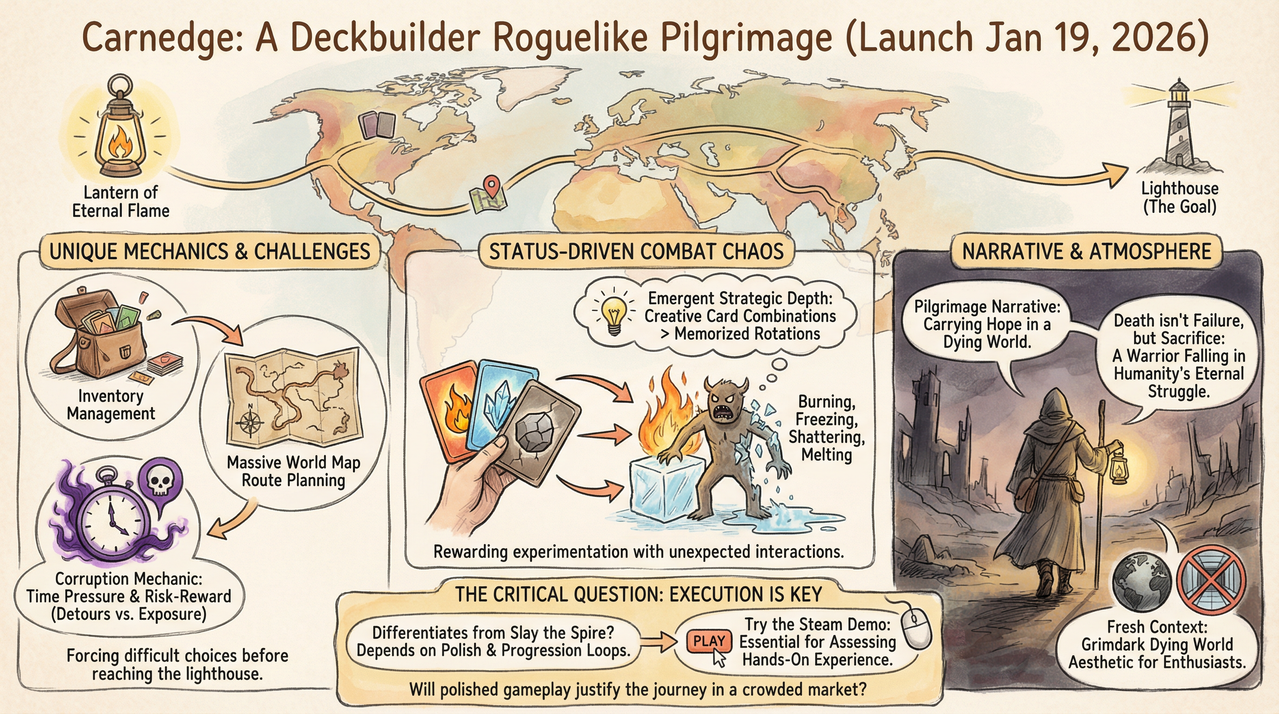
The Pilgrimage That Nobody Survives
Carnedge’s narrative premise establishes a world slowly dying from corruption, where humanity clings to the hope symbolized by the Lighthouse’s eternal flame. Once annually, a warrior volunteers to carry the Lantern of Eternal Flame across twisted lands to reach the lighthouse and refresh its light. The ritual’s success maintains hope even though every pilgrim dies attempting the journey. This setup creates meaningful stakes beyond just winning roguelike runs, since each attempt represents another year where humanity’s hope hangs in the balance depending on whether you reach the lighthouse before corruption consumes you.
The corrupted lands you traverse aren’t just aesthetic window dressing; corruption mechanically affects gameplay as it creeps in throughout your run. Turn Based Lovers explains that “corruption keeps creeping in as the player pushes through twisted lands,” suggesting a ticking clock element where you can’t simply grind safe encounters indefinitely. Route planning becomes resource management as you balance risks against rewards, deciding whether detours for better loot justify exposure to additional corruption or if pushing directly toward the lighthouse minimizes risk despite weaker builds.
The Lantern itself serves as both narrative centerpiece and gameplay anchor. As long as you hold it, death doesn’t end the cycle; another pilgrim takes up the journey in the next run. This framing device elegantly justifies roguelike meta-progression where knowledge and unlocks persist between attempts while individual runs remain mortal. It also creates thematic weight where each death isn’t just failure but sacrifice, another warrior falling in the eternal struggle to maintain humanity’s last flicker of hope against encroaching darkness.
Building Your Warrior
Each pilgrimage begins with deck construction choices that define your warrior’s capabilities. Cards represent abilities, attacks, and tactical options that determine what your hero can do during combat encounters. Items and relics modify these base abilities, creating synergies that push builds toward specialized archetypes or hybrid configurations. IGN’s trailer description notes that players “assemble formidable decks to take on a suite of dungeons with the aid of unique allies,” suggesting companion characters join your journey with their own abilities complementing your chosen strategy.
The game emphasizes flexibility within each run rather than locking you into predetermined classes. Indie Games EU quotes the store description mentioning builds ranging from “a lone tank to a swarm-summoning shaman, with the in-between space left open for hybrids.” This design allows adapting strategy based on which cards and items you find rather than committing to rigid archetypes before understanding what the run offers. If you find powerful summoning cards early, lean into swarm strategies. If defensive relics appear frequently, pivot toward tank builds that outlast enemies through attrition.

Status-Driven Chaotic Combat
Carnedge’s combat revolves around status effects creating cascading interactions between your abilities and enemy vulnerabilities. Indie Games EU describes “status-driven chaos as a big part of the feel, with enemies burning, freezing, shattering, and melting while the hero and summoned helpers tear through corrupted monsters.” This suggests combat rewards players who understand status interactions, like freezing enemies then shattering them with follow-up attacks or applying burns that spread through clustered foes.
The summoned helpers mentioned in descriptions indicate companion management as another combat layer. Whether these allies function as persistent party members throughout runs or temporary summons activated through cards remains unclear from available information. If persistent, managing ally positioning and abilities alongside your own cards creates tactical depth where optimal plays require coordinating multiple units. If temporary summons, then cards that generate helpers become resource management decisions about when flooding the battlefield with allies justifies spending valuable card draws.
Turn Based Lovers notes that “you are shaping a rules engine for your hero, then watching it collide with enemies that want to ruin your run,” framing combat as emergent systems interaction rather than simple attack-and-defend exchanges. This philosophy suggests that creative card combinations can exploit status interactions in ways the developers didn’t explicitly design, rewarding experimentation and system mastery over memorizing optimal rotations.
The Massive World Map
Unlike linear roguelikes that progress through predetermined stage sequences, Carnedge features what Turn Based Lovers describes as “a massive world map where the player chooses paths through story nodes, takes on quests, fights bosses, then keeps pushing toward the lighthouse.” This node-based progression system creates strategic route planning where path choices determine what encounters, rewards, and challenges you face before reaching the lighthouse.
Route selection isn’t just about difficulty; it’s about build needs. Turn Based Lovers explains: “A path choice is not just about difficulty; it is about what kind of rewards a build needs right now. More cards can mean more options, but gear upgrades might be the real power spike if your deck already has a plan.” This design encourages evaluating your current build’s strengths and weaknesses then choosing paths offering rewards that address gaps or double down on advantages. If your deck has excellent card synergy but weak gear, prioritize paths offering item upgrades. If gear is strong but your deck lacks key cards, route through areas with card rewards.
The corruption mechanic adds pressure to route planning. Turn Based Lovers notes: “When a run is built around corruption creeping in, route planning can become its own resource management problem. You are not only surviving fights. You are deciding what risks are worth taking before the build locks into place.” Long detours for better rewards expose you to more corruption, potentially killing your run before reaching the lighthouse. Direct paths minimize corruption exposure but leave your build weaker for final encounters. This risk-reward calculation creates meaningful decisions where optimal routing depends on corruption tolerance, current build strength, and confidence in reaching the lighthouse with minimal upgrades.

Story Nodes and Quest Encounters
The world map includes story nodes and quest encounters beyond standard combat, suggesting narrative elements interwoven with mechanical progression. Whether these story nodes offer branching choices affecting run outcomes or simply provide lore context remains unclear from available information. Quest encounters might function as optional challenges offering superior rewards for higher risk, or they could trigger special events that modify run conditions in ways standard combat doesn’t.
Boss fights represent major milestones on the pilgrimage according to descriptions. These presumably serve as difficulty gates testing whether your build has achieved sufficient power to progress further. Boss encounters in deckbuilders often require specific strategies that generalist builds struggle against, potentially forcing players to specialize enough that bosses become manageable while maintaining flexibility for varied normal encounters. The balance between specialization and flexibility becomes crucial when boss fights demand specific answers your deck must provide.
Inventory Management Mechanics
IGN’s description calls Carnedge “a dark fantasy inventory management roguelite strategy RPG,” explicitly highlighting inventory management as a core pillar. This suggests limited carrying capacity forces decisions about which items, cards, and relics to keep versus discard. Unlike roguelikes where you simply accumulate everything you find, inventory-limited games create opportunity costs where taking one powerful item means leaving behind another potentially valuable piece.
Inventory management intersects with build planning when space constraints force committing to strategies early. If you’re building toward summoner archetype but find a powerful tank relic, does it warrant keeping despite not fitting your plan, or do you maintain focus by leaving it behind? These decisions become more painful when you don’t know what future encounters offer. That tank relic might have saved you against a boss three zones later, but you couldn’t know that when deciding whether to drop summoning cards to make room for it.
The system likely also affects consumables and resources. Many inventory-managed roguelikes force rationing healing items, buff consumables, or crafting materials because you can’t carry unlimited supplies. This creates risk mitigation decisions about when using limited resources justifies their permanent loss versus saving them for harder encounters that may never appear. These systems work best when they create meaningful decisions rather than just tedious micromanagement, so Carnedge’s success partially depends on whether inventory constraints enhance strategic depth or simply annoy players forced to constantly optimize limited space.

Demo Available Now
A playable demo is currently available on Steam according to Turn Based Lovers, allowing potential players to test Carnedge’s mechanics before the January 19 launch. Demos represent smart strategy for indie roguelikes since the genre’s appeal depends heavily on whether core gameplay loops feel satisfying. Marketing materials can showcase visuals and concepts, but only hands-on experience reveals whether card synergies feel rewarding, combat pacing stays engaging across multiple runs, and progression systems provide satisfying meta-progression between attempts.
The demo’s availability ahead of launch suggests OneShark feels confident in their core gameplay and wants players discovering Carnedge organically through word-of-mouth rather than relying exclusively on marketing. Strong demos convert interested players into buyers while filtering out poor fits who realize the game isn’t for them before wasting money on disappointing purchases. This benefits everyone: developers get sales from players who’ll enjoy their game, while players avoid buyer’s remorse from impulse purchases that don’t match their tastes.
Competitive Context
Carnedge launches into a crowded deckbuilder roguelike market dominated by Slay the Spire, which defined modern expectations for the genre. Subsequent successful entries like Monster Train, Griftlands, and Inscryption proved the genre’s viability but also raised the bar for what constitutes compelling deckbuilding mechanics. Rogueliker’s January 2026 roundup lists Carnedge alongside numerous other roguelikes launching the same month, illustrating the competitive environment where even quality games struggle for visibility among constant new releases.
Carnedge’s differentiators include the pilgrimage narrative framing, inventory management focus, and massive world map with route planning decisions. Whether these features sufficiently distinguish it from competitors depends on execution quality. Many roguelikes have interesting concepts that don’t translate into satisfying gameplay loops. The status-driven combat chaos could be emergent strategic depth or confusing mess depending on how clearly the game communicates interactions. The corruption mechanic creating time pressure could add urgency or just frustrate players who want to explore thoroughly. Route planning could be engaging strategic layer or tedious optimization where optimal paths become obvious after a few runs.
The game’s art direction appears to favor dark, moody aesthetics fitting the dying world premise. Screenshots and trailer footage show grimdark color palettes with corrupted monsters and decaying environments. This visual style suits the tone but risks blending into the sea of dark fantasy roguelikes that flood Steam monthly. Standing out requires either exceptional mechanical innovation or presentation polish that elevates familiar concepts through superior execution. Whether OneShark achieved either remains to be seen when the game launches January 19.

FAQs About Carnedge
When does Carnedge release?
Carnedge launches on Steam for PC on January 19, 2026. A free demo is currently available on the Steam store page for players wanting to try the game before purchasing.
What type of game is Carnedge?
Carnedge is a dark fantasy inventory management roguelite strategy RPG combining deckbuilding mechanics with status-driven combat. Players build decks, recruit allies, and navigate a massive world map making route choices while corruption creeps in threatening their pilgrimage.
What is the story of Carnedge?
You play as a warrior making an annual pilgrimage to carry the Lantern of Eternal Flame across a corrupted, decaying world to reach a lighthouse and keep hope alive. Nobody has ever returned from this journey, but the light keeps burning as long as the Lantern remains lit.
Does Carnedge have permadeath?
Yes, as a roguelite, Carnedge features permadeath where individual runs end when you die. However, the narrative frames death as part of the cycle, with another warrior taking up the Lantern in the next run while meta-progression and unlocks persist between attempts.
What makes Carnedge different from other deckbuilders?
Carnedge emphasizes inventory management requiring decisions about which items to keep versus discard, features a massive world map with route planning affecting rewards and corruption exposure, and uses status-driven combat where enemies burn, freeze, shatter, and melt creating cascading interactions.
Can you play Carnedge co-op or multiplayer?
Based on available information, Carnedge appears to be single-player only. The game focuses on solo pilgrimage where one warrior carries the Lantern, with recruited allies functioning as AI companions rather than player-controlled characters.
Who is developing Carnedge?
OneShark, an indie developer, is creating Carnedge. Limited information is available about the studio, though Turn Based Lovers refers to “Carnedge Team” suggesting OneShark might be the studio name while a specific team handles this project.
What platforms will Carnedge be on?
Carnedge is launching exclusively on PC via Steam on January 19, 2026. No announcements have been made regarding console ports or other PC storefronts like Epic Games Store or GOG.
Conclusion
Carnedge’s January 19, 2026 launch offers another entry in the crowded deckbuilder roguelike market, distinguishing itself through inventory management mechanics, massive world map route planning, and a pilgrimage narrative where you carry the Lantern of Eternal Flame across a dying world knowing nobody has ever returned alive. OneShark’s focus on status-driven combat chaos with enemies burning, freezing, shattering, and melting creates potential for emergent strategic depth where creative card combinations exploit interactions the developers didn’t explicitly design, rewarding experimentation over memorized optimal rotations. The corruption mechanic adds time pressure preventing infinite grinding while forcing risk-reward calculations about whether detours for better loot justify additional corruption exposure before reaching the lighthouse. Whether these features meaningfully differentiate Carnedge from Slay the Spire and countless imitators depends on execution quality that only hands-on experience reveals, making the available Steam demo essential for anyone considering purchase. The pilgrimage framing elegantly justifies roguelike loops where death isn’t failure but sacrifice, another warrior falling in humanity’s eternal struggle to maintain hope’s last flicker against encroaching darkness, creating thematic weight that elevates mechanical systems beyond just optimizing builds for efficiency. For deckbuilder enthusiasts exhausted by medieval fantasy settings or sci-fi corridors, Carnedge’s grimdark dying world aesthetic and lantern-bearing pilgrim premise offer fresh narrative context for familiar card-slinging combat, though whether that’s enough to justify full price over established alternatives remains the critical question OneShark must answer through polished gameplay and satisfying progression loops that keep players returning for one more pilgrimage attempt.