David Rosen, one of the founding fathers of Sega and a transformative figure in gaming history, died peacefully on December 25, 2025, at his home in the Hollywood Hills section of Los Angeles. He was 95 years old. According to his spokesman Brad Callaway, Rosen was surrounded by family members when he passed. The New York native who served in the U.S. Air Force during the Korean War went on to co-found one of gaming’s most iconic companies, pioneering the Japanese arcade industry and helping establish Sega as a household name that would compete with Nintendo throughout the console wars of the 1990s.
From Airman to Entrepreneur
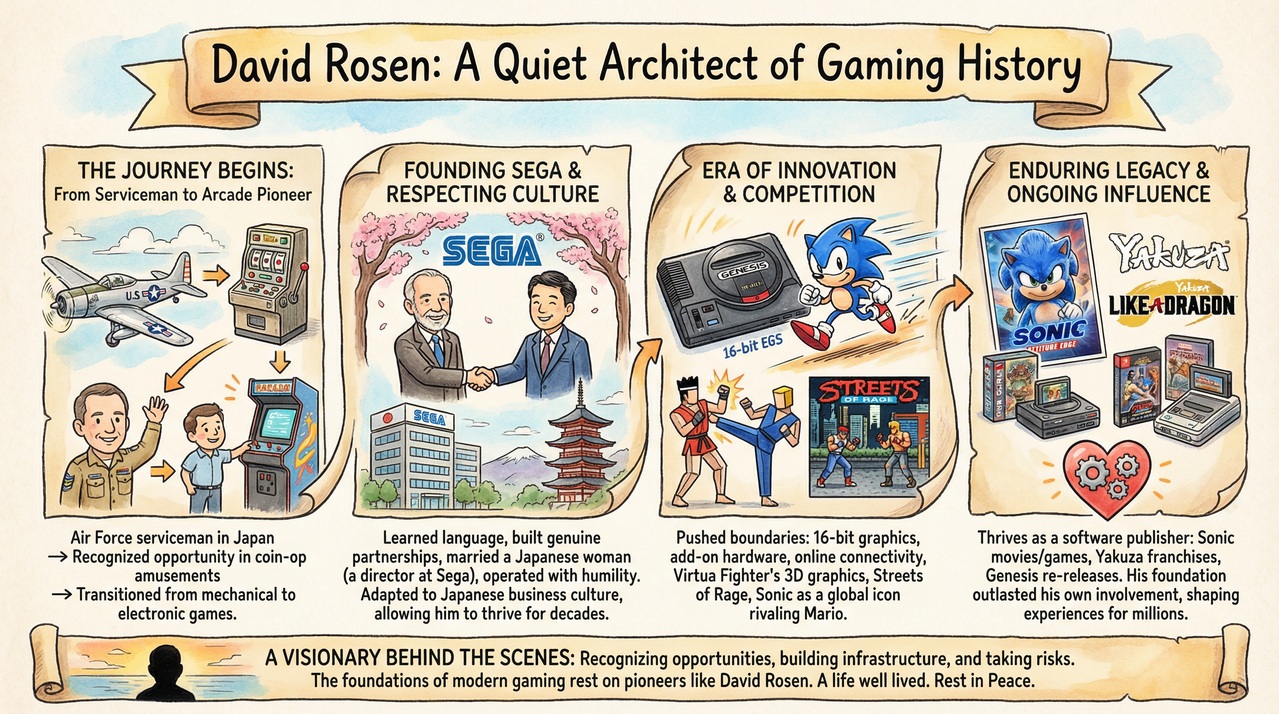
David M. Rosen was born on January 22, 1930, in New York City. He served in the United States Air Force from 1948 to 1952, stationed in Japan and the Far East during the Korean War. What began as military service transformed into a life-changing opportunity when Rosen recognized the potential in post-war Japan’s rebuilding economy. After his service ended in 1952, the 24-year-old veteran made the bold decision to remain in Japan rather than return home.
In 1954, Rosen established Rosen Enterprises, starting with ventures that capitalized on Japan’s economic recovery. His first business exported portraits painted from photos by Japanese artists, offering them to Americans for a fraction of what domestic artists charged. He then opened a series of photo booths providing inexpensive identification photos needed for work and travel documents. These seemingly modest beginnings taught Rosen invaluable lessons about Japanese business culture and consumer behavior that would serve him throughout his career.
As American military operations brought more money into Japan and the economy stabilized, Rosen saw opportunity in entertainment. He recognized growing disposable income among Japanese consumers and decided it was time for fun. In the late 1950s, he began importing coin-operated amusement machines from North America, securing a license from the Japan Ministry of International Trade and Industry to do so. The success was immediate and dramatic.

Building an Arcade Empire
Rosen’s coin-operated amusement venture proved tremendously successful. In a 1996 interview with Next Generation Magazine, he recalled with embarrassment just how profitable the imported machines were: “Right off the bat, the machines were tremendously successful. It’s embarrassing to say this, but the return generally came in less than two months,” despite facing import fees of 200%. The rapid return on investment allowed Rosen to expand aggressively, opening arcades featuring shooting and hunting games throughout Japan.
By the early 1960s, Rosen Enterprises had become a dominant force in Japan’s growing amusement industry. “By the time I left, there wasn’t a city in Japan that didn’t have one of our arcades,” Rosen told Next Generation. His success didn’t go unnoticed by competitors. Other companies began seeking their own licenses to import coin-operated machines, recognizing the lucrative market Rosen had pioneered.
The Birth of Sega
Two companies in particular watched Rosen’s success closely: Taito and Nihon Goraku Bussan, the latter operating under the brand name “Sega” (derived from Service Games Japan). Nihon Goraku Bussan had been founded by American expatriates including Marty Bromley, Ray Lamaire, and Dick Dodderer, initially focusing on jukeboxes and slot machines located on U.S. military bases.
In 1965, Rosen Enterprises merged with Nihon Goraku Bussan to create Sega Enterprises, Ltd. The merger combined Rosen’s business acumen and established arcade network with Service Games’ manufacturing capabilities and brand recognition. Though Nihon Goraku Bussan was the larger company, David Rosen became CEO, president, and managing director of the newly formed Sega Enterprises. His wife Masako also took a director role. The companies agreed to drop slot machine manufacturing to distance themselves from any association with illegal gambling that had plagued Service Games in the past.
The name Sega Enterprises combined the already-recognized “Sega” brand from Service Games with “Enterprises” from Rosen Enterprises. It was the beginning of a company that would become one of gaming’s most influential forces for the next five decades.

Periscope and Innovation
In 1966, under Rosen’s direction, Sega Enterprises created its first original arcade game: Periscope. The submarine-themed shooting game was a colossal machine, nearly ten feet deep and six feet wide. It cost twice as much to play as competing arcade machines, but audiences and arcade operators agreed it was worth it. The immersive experience justified the 25-cent price point, doubling the industry standard and changing what operators could charge for premium experiences.
Periscope became so successful that Sega began exporting games to America, establishing the company as an international operation with a Japanese manufacturing base. This marked the beginning of Sega’s identity as a prolific game creator rather than just an importer and operator. The game’s success demonstrated Rosen’s philosophy that innovation and quality experiences could command premium prices in the coin-operated amusement industry.
In 1967, Rosen co-founded the Japan Amusement Association and was elected as its chairman, cementing his role as a leading figure in establishing standards and practices for Japan’s burgeoning arcade industry. His influence extended beyond just Sega, shaping how the entire sector operated and grew.
Gulf and Western Years
In 1969, as Sega continued growing, the company was sold to Gulf and Western Industries, a massive American conglomerate. Rosen remained on board as CEO of the Sega division, helming the ship through continued expansion. The game industry was booming and Sega along with it, but Rosen demonstrated prescience about looming troubles.
Before the video game crash of 1983, Rosen urged the arcade business to reform and start offering conversion kits that would allow operators to inexpensively upgrade machines with new games rather than purchasing entirely new cabinets. This “Convert-A-Game” concept would later help the arcade industry begin its second life after the crash, but at the time, his remarks were met with boos and jeers from an industry unwilling to face uncomfortable realities.
When the crash came and media scared everyone into believing video games were a passing fad, Gulf and Western suffered buyer’s remorse. Following the death of company boss Charles Bluhdorn in 1983, Gulf and Western decided to sell off many of its assets, including Sega. They offered Rosen a chance to buy back the company he helped found.
The Buyout and New Beginning
The $38 million price tag was too hefty for Rosen alone, but he knew Sega had a future despite industry pessimism. The company had earned $214 million in 1983, demonstrating its value. Rosen partnered with Hayao Nakayama, a Japanese arcade magnate, assembling a group of backers including CSK Holdings, led by Isao Okawa. In 1984, they purchased Sega’s Japanese assets, creating Sega Ltd.
Nakayama was named CEO of the newly independent Japanese company, while Rosen, who had relocated his family to Los Angeles and didn’t want to return to Japan full-time, agreed to establish Sega of America and oversee U.S. and overseas operations. He became chairman of Sega of America, headquartered in Los Angeles, while remaining a director of Sega Japan.
Rosen and Nakayama formed a unique partnership that would shape Sega’s best years. Rosen was by most accounts a quiet, contemplative man who served as the company’s architect. Nakayama was fearless, passionate, and ruthless. The two were known to be competitive, even when their goals aligned, but they held deep respect for each other at all times. This dynamic leadership drove Sega through the console wars that would define the 1990s.
The Console Wars Era
Under Rosen and Nakayama’s partnership, Sega launched the Genesis (known as Mega Drive outside North America) in 1989. The 16-bit console would become Sega’s most successful hardware, competing directly with Nintendo’s dominance throughout the early 1990s. Rosen oversaw Sega of America during this crucial period, helping establish the aggressive marketing strategy that positioned Sega as the cooler, edgier alternative to Nintendo’s family-friendly approach.
The creation of Sonic the Hedgehog in 1991 gave Sega its own iconic mascot to rival Nintendo’s Mario. The blue blur became synonymous with Sega’s brand identity and represented the company’s speed-focused, attitude-driven approach that contrasted with Nintendo’s more traditional values. Rosen’s Sega of America played crucial roles in marketing Sonic and establishing the character as a cultural phenomenon in the West.
Rosen remained with Sega through the launches of major consoles including the Sega CD, 32X, and Saturn. He witnessed Sega’s peak years when the company genuinely challenged Nintendo’s market dominance, capturing significant market share and mindshare among gamers. The phrase “Genesis does what Nintendon’t” became a rallying cry for a generation of gamers who chose Sega.

Retirement and Legacy
In July 1996, David Rosen retired from Sega, resigning from both Sega of America and his director role at Sega Japan. He was 66 years old and had spent over 40 years building and shaping the company from a coin-operated amusement business into one of gaming’s most recognizable brands. His retirement came as Sega prepared for the Dreamcast launch, the final console the company would produce before transitioning to become a third-party software publisher.
Rosen lived in Los Angeles throughout his retirement, remaining in the Hollywood Hills home where he would eventually pass away 29 years later. His contributions earned him induction into the AAMA Hall of Fame, and he was celebrated by that association’s Charitable Foundation as Man of the Year at a dinner in Las Vegas. These honors recognized not just his business success, but his role in establishing standards and legitimacy for the coin-operated amusement industry.
His funeral was held on January 2, 2026, at Inglewood Park Cemetery. Industry figures, former colleagues, and family members gathered to honor a man who transformed entertainment in Japan and helped create a company that would bring joy to hundreds of millions of gamers worldwide.
Impact on Gaming History
David Rosen’s contributions to gaming extend far beyond co-founding Sega. He pioneered the Japanese arcade industry at a time when coin-operated amusements barely existed in the country. His business model of importing machines, opening arcades, and eventually manufacturing original games created the template that countless others would follow. Without Rosen’s early work establishing Japan’s arcade culture, the country’s gaming industry might have developed very differently.
The premium pricing model Periscope established, charging 25 cents instead of the standard dime, demonstrated that quality experiences could command higher prices. This philosophy influenced how the industry valued innovation and production quality. Operators learned they could charge more for better games, incentivizing manufacturers to invest in increasingly sophisticated experiences.
His Convert-A-Game concept, though initially rejected, eventually became standard practice. The ability to upgrade arcade cabinets with new PCBs rather than purchasing entirely new machines saved operators massive amounts of money while extending the lifespan of arcade hardware. This innovation helped the arcade industry survive and thrive through multiple technological generations.
Perhaps most importantly, Rosen demonstrated that Americans could succeed in Japanese business culture through respect, adaptation, and genuine partnership. His decades-long collaboration with Japanese partners like Hayao Nakayama showed that cross-cultural business relationships could drive innovation and success when built on mutual respect and shared vision.
Frequently Asked Questions
When did David Rosen pass away?
David Rosen died peacefully on Christmas Day, December 25, 2025, at his home in the Hollywood Hills section of Los Angeles, surrounded by family members. He was 95 years old.
How did David Rosen found Sega?
Rosen established Rosen Enterprises in 1954, importing coin-operated amusement machines to Japan. In 1965, his company merged with Nihon Goraku Bussan (Service Games) to create Sega Enterprises, Ltd., with Rosen serving as CEO.
What was David Rosen’s most important contribution to gaming?
Rosen pioneered Japan’s arcade industry, created the premium pricing model with Periscope, developed the Convert-A-Game concept, and co-founded Sega, which became one of gaming’s most influential companies through the Genesis era.
How long did David Rosen work at Sega?
From Sega’s founding in 1965 until his retirement in 1996, Rosen spent over 30 years with Sega in various leadership roles including CEO, chairman of Sega of America, and director of Sega Japan.
Did David Rosen serve in the military?
Yes, Rosen served in the United States Air Force from 1948 to 1952, stationed in Japan and the Far East during the Korean War. This military service introduced him to Japan, where he would build his business empire.
What was Rosen Enterprises before it became Sega?
Rosen Enterprises started by exporting portraits painted by Japanese artists, then operated photo booth machines for identification photos, before transitioning to importing and operating coin-operated amusement machines.
Who were David Rosen’s key partners at Sega?
Rosen’s most important partnership was with Hayao Nakayama, who served as CEO of Sega Japan after the 1984 buyout. Isao Okawa, who backed the buyout through CSK Holdings, was also crucial to Sega’s later success.
What happened to Sega after David Rosen retired?
After Rosen’s 1996 retirement, Sega launched the Dreamcast console in 1998. The system was discontinued in 2001, and Sega transitioned from hardware manufacturer to third-party software publisher.
Where was David Rosen’s funeral held?
Rosen’s funeral service was held on January 2, 2026, at Inglewood Park Cemetery in California.
What honors did David Rosen receive?
Rosen was inducted into the AAMA Hall of Fame and was celebrated as Man of the Year by the AAMA Charitable Foundation at a dinner in Las Vegas, recognizing his contributions to the coin-operated amusement industry.
Final Thoughts
David Rosen’s death marks the end of an era for gaming history. He was among the last surviving figures from the absolute beginning of the modern video game industry, when coin-operated amusements transitioned from mechanical games to electronic entertainment. His journey from Air Force serviceman to arcade pioneer to co-founder of one of gaming’s most iconic companies represents an American success story played out on Japanese soil.
What makes Rosen’s legacy particularly remarkable is how he succeeded by adapting to and respecting Japanese business culture rather than imposing American practices. He learned the language, married a Japanese woman who became a director at Sega, built genuine partnerships with Japanese executives, and operated with humility despite his success. This approach allowed him to thrive in a foreign country for decades while many other Western businesspeople failed.
The company he co-founded became synonymous with innovation and competition throughout gaming’s most transformative decades. Sega pushed technological boundaries with 16-bit graphics, add-on hardware, and online connectivity before competitors. The brand represented attitude and edge that appealed to older gamers seeking alternatives to Nintendo’s family-friendly approach. Sonic the Hedgehog became a cultural icon recognizable worldwide, rivaling even Mario in popularity during Sega’s peak years.
Though Sega eventually left the hardware business after the Dreamcast, the company Rosen helped build continues thriving as a software publisher. Sonic remains relevant through movies, games, and merchandise. Classic Sega franchises like Yakuza (now Like a Dragon) find new audiences. The Genesis library gets celebrated through re-releases and mini consoles. Rosen’s influence persists through the company’s ongoing legacy.
For anyone who ever played Streets of Rage, marveled at Virtua Fighter’s 3D graphics, collected Sonic rings, or simply enjoyed an arcade game in Japan over the past 60 years, David Rosen’s contributions shaped those experiences. He was a quiet architect working behind the scenes, letting products and partnerships speak louder than personal publicity. That humility, combined with sharp business instincts and genuine respect for Japanese culture, allowed him to build something that outlasted his own involvement by decades.
Gaming history is filled with famous designers, charismatic executives, and brilliant engineers. But the industry also needed visionaries like David Rosen who recognized opportunities, built infrastructure, established business practices, and created companies where creative people could make the games we love. His passing reminds us that the foundations of modern gaming rest on the work of pioneers who took enormous risks in uncertain times. David Rosen served his country in war, then helped rebuild the nation where he’d been stationed by bringing joy through entertainment. That’s a life well lived. May he rest in peace.