Every gamer has that one franchise they loved growing up that just vanished without explanation. Maybe the studio shut down, or the publisher decided the series wasn’t profitable enough, or it simply fell victim to the dreaded curse of disappointing sequels. Whatever the reason, gaming history is littered with beloved franchises that died before their time, leaving fans wondering what could have been.
- Why Do Great Games Get Abandoned
- Dino Crisis: The Survival Horror Franchise That Capcom Keeps Trying to Revive
- Titanfall: When a Perfect Game Gets Sacrificed for Battle Royale Money
- Legacy of Kain Finally Gets Some Love
- The Franchises Stuck in IP Limbo
- What Xbox Wants to Bring Back
- Genre-Specific Casualties
- Frequently Asked Questions
- The Business Reality Nobody Wants to Hear
- What Gamers Can Actually Do
Why Do Great Games Get Abandoned
The harsh reality is that video game development is a business, and businesses care about profit margins more than nostalgia. A franchise might have passionate fans, critical acclaim, and innovative gameplay, but if it doesn’t move enough units to justify development costs, publishers pull the plug. Sometimes it’s not even about poor sales. A studio might get absorbed by a larger company, key creative talent leaves, or market trends shift toward different genres entirely.
The good news is we’re living in an era where revivals are actually happening. Capcom recently announced both Okami 2 and a new Onimusha game after decades of silence, proving that dormant franchises can spring back to life when the timing is right. The company even stated on its official website that it plans to focus on reactivating more dormant intellectual properties alongside releasing new games. That announcement alone sparked hope across gaming communities that their favorite dead series might get a second chance.
Dino Crisis: The Survival Horror Franchise That Capcom Keeps Trying to Revive
If there’s one dead franchise that comes up in every single discussion about deserving revivals, it’s Dino Crisis. Shinji Mikami’s 1999 survival horror masterpiece put players in the boots of Regina, a special forces agent fighting for survival against dinosaurs pulled into the present through a science experiment gone wrong. Think Resident Evil but replace zombies with velociraptors and you’ve got the basic concept, though Dino Crisis had its own unique flavor and gameplay innovations.
The kicker is that Capcom has actually tried to bring Dino Crisis back multiple times and keeps failing. According to reliable Capcom leaker Dusk Golem, the publisher attempted a remake at Capcom Vancouver before that studio was shut down in 2018. Another attempt by an unnamed studio was canceled because it reportedly wasn’t turning out well. In March 2025, Capcom renewed the Dino Crisis trademark, sparking fresh speculation that maybe, just maybe, the dinosaur survival horror franchise might finally return.
The timing couldn’t be better for a Dino Crisis revival. Capcom’s RE Engine has proven itself capable of delivering stunning graphics and tense gameplay through the recent Resident Evil remakes. Monster Hunter’s success shows players still love fighting giant creatures. A new Jurassic World movie is on the horizon. All the pieces are in place, yet Capcom continues to struggle with figuring out what they want to do with the IP. Dino Crisis even topped Capcom’s own internal poll asking fans which dormant franchise they most wanted revived.
Most Requested Dead Franchises
| Franchise | Last Release | Why Fans Want It Back |
|---|---|---|
| Dino Crisis | 2003 | Unique survival horror with dinosaurs, perfect for RE Engine |
| Titanfall | 2016 | Best mech shooter ever made with incredible movement |
| Legacy of Kain | 2003 | Dark gothic storytelling and innovative world design |
| SSX | 2012 | Extreme sports arcade action with personality |
| Splinter Cell | 2013 | Tactical stealth gameplay missing from modern gaming |
Titanfall: When a Perfect Game Gets Sacrificed for Battle Royale Money
Few gaming deaths hurt more than Titanfall’s slow execution at the hands of Electronic Arts. Titanfall 2, released in 2016, is widely considered one of the best first-person shooters ever made. The single-player campaign bursts with creative ideas, the multiplayer perfectly balanced fast-paced pilot combat with earth-shaking titan battles, and the movement mechanics felt absolutely incredible. Then EA sandwiched it between Battlefield 1 and Call of Duty: Infinite Warfare at launch, essentially guaranteeing poor sales.
What followed was even more frustrating. Instead of making Titanfall 3, Respawn Entertainment pivoted to Apex Legends, a free-to-play battle royale set in the Titanfall universe but without any of the titan combat that made the series special. Apex became EA’s golden goose, generating massive revenue through microtransactions and completely overshadowing its predecessor. Reports throughout 2025 indicated EA canceled multiple Titanfall-related projects including an extraction shooter and potentially even a proper Titanfall 3.
The community response has been a mixture of grief and determination. One indie studio even raised $500,000 after EA’s latest cancellation specifically to build their own spiritual successor, declaring “we built our own” since EA refused to give fans what they wanted. Titanfall 2 remains active on PC with a dedicated player base keeping the dream alive, but it’s increasingly clear that EA sees more value in monetizing Apex Legends than investing in premium single-player experiences with limited live service potential.
Legacy of Kain Finally Gets Some Love
Not every story ends in disappointment. Legacy of Kain: Soul Reaver 1 and 2 Remastered launched in December 2024, bringing Raziel’s quest for revenge against his former master Kain to modern platforms with updated visuals and quality of life improvements. The remaster received strong reviews, with GameSpot awarding it an 8/10 and praising how it preserved the dark gothic aesthetic while improving character models, textures, lighting, and shadows.
What makes these remasters special is the wealth of bonus content included. Players get access to cut levels that were removed from the original games due to time or budget constraints, behind-the-scenes development footage, recording session outtakes, concept art, and a music player. It functions like an interactive museum celebrating one of the most beloved action-adventure series from the PlayStation era, giving fans both nostalgia and new insights into the game’s creation.
The real question is whether this remaster leads anywhere beyond preservation. Legacy of Kain’s last mainline entry released over 20 years ago in 2003, leaving multiple storylines unresolved and fans desperate for closure. If the remasters sell well, it could convince publisher Square Enix that there’s commercial viability in creating new Legacy of Kain content. The series’ sophisticated vampire lore, philosophical storytelling, and innovative realm-shifting mechanics deserve more than just a remaster, they deserve a proper sequel that takes advantage of modern gaming technology.
The Franchises Stuck in IP Limbo
Some dead franchises face challenges beyond just commercial viability. Sly Cooper, Sucker Punch’s beloved PlayStation 2 platformer series, ended on a cliffhanger with Sly Cooper: Thieves in Time in 2013. The developer has since moved on to creating Ghost of Tsushima and has no apparent interest in returning to the anthropomorphic raccoon thief. The franchise isn’t necessarily dead, but it’s trapped in limbo with no clear path forward and fans left wondering if they’ll ever get closure.
Similar situations plague franchises like Killzone, Resistance, and other first-party PlayStation exclusives that helped define the PS2 and PS3 eras. These games sold decently and built passionate fanbases, but Sony seems content to let them gather dust while focusing resources on proven franchises like God of War, The Last of Us, and Horizon. The shift toward fewer, bigger blockbuster releases means mid-tier franchises get abandoned even when they could potentially find audiences.
Licensed games present their own unique problems. The Transformers Cybertron games, Marvel: Ultimate Alliance, and multiple Lord of the Rings titles have been delisted from digital storefronts because licensing agreements expired. These games can’t be sold anymore even if there’s demand, creating a preservation nightmare where entire generations of players have no legal way to experience them. In some cases, dedicated fan communities have found workarounds, but the average player has simply lost access forever.
What Xbox Wants to Bring Back
Phil Spencer, head of Xbox, has been remarkably vocal about his interest in reviving dormant franchises under Microsoft’s control. He name-drops Hexen constantly, repeatedly expressing hope that someone within Xbox Game Studios will pitch a new entry in the classic first-person shooter series. At Tokyo Game Show, Spencer also mentioned wanting a MechAssault revival, while fellow Xbox executive Sarah Bond acknowledged fan requests to bring back Blizzard’s StarCraft series.
The Activision Blizzard acquisition gives Microsoft control over massive catalogs of dormant IP including Guitar Hero, Tony Hawk’s Pro Skater, Crash Bandicoot, and Spyro the Dragon. Fans immediately created wishlists when the acquisition was announced, hoping Microsoft would greenlight revivals for franchises Activision had abandoned in favor of endless Call of Duty sequels. Spencer stated he’s “all in” on Xbox studios revisiting older owned IP, though he emphasized the teams working on these projects need genuine passion rather than cynical cash-grab motivations.
The challenge Microsoft faces is balancing nostalgia with innovation. Simply remaking old games might satisfy longtime fans but won’t necessarily attract new audiences. Meanwhile, changing too much risks alienating the very people who loved these franchises in the first place. It’s a delicate balancing act that requires understanding what made these games special originally while evolving the formula for modern sensibilities and expectations.
Genre-Specific Casualties
Certain genres have been hit particularly hard by the shift in gaming trends. Turn-based JRPGs like Breath of Fire, Suikoden, and Chrono Trigger defined the PlayStation era but fell out of favor as action RPGs and live service games dominated the market. The recent success of Metaphor: ReFantazio and Clair Obscur: Expedition 33 proves there’s still appetite for classic turn-based combat with high-quality storytelling and modern visuals, yet many beloved franchises remain dormant.
Extreme sports games suffered even worse fates. SSX, Burnout, Tony Hawk’s Pro Skater, and even the Skate series all disappeared as publishers decided realistic sports simulations and racing sims were more profitable. The occasional remaster or revival happens, but nothing close to the golden age of extreme sports titles that dominated the early 2000s. EA owns the SSX franchise and could easily bring it back, but apparently sees better returns investing in FIFA and Madden instead.
Stealth action games represent another vanishing genre. Splinter Cell hasn’t had a new entry since 2013, Metal Gear Solid effectively ended with The Phantom Pain in 2015, and Thief disappeared entirely. Ubisoft announced a Splinter Cell remake years ago but has gone radio silent on development progress. The market for methodical, patient stealth gameplay apparently doesn’t justify AAA budgets when open-world action games generate more excitement and engagement.
Frequently Asked Questions
Why do game companies abandon successful franchises?
Even successful franchises get abandoned if they don’t meet profit expectations relative to development costs. Publishers compare potential returns against investing those resources in more profitable franchises or new IP. Studio closures, key talent departures, and shifting market trends also contribute. Sometimes a franchise sold well but not well enough to justify continued investment in an increasingly expensive industry.
Which dead franchise is most likely to return?
Dino Crisis appears most likely based on Capcom’s repeated attempts to remake it, recent trademark renewals, and the company’s stated commitment to reviving dormant IP after announcing Okami 2 and new Onimusha. The franchise topped Capcom’s internal fan poll, and modern gaming technology like the RE Engine could deliver the survival horror with dinosaurs experience fans have waited over 20 years to see.
Will there ever be a Titanfall 3?
Unlikely in the near future. EA has repeatedly canceled Titanfall-related projects including an extraction shooter and potentially a proper Titanfall 3, choosing instead to focus resources on Apex Legends which generates significantly more revenue through microtransactions. Developer Respawn Entertainment’s attention remains on Apex updates and the Star Wars Jedi series, leaving little hope for Titanfall’s return despite the passionate fanbase.
What happened to Legacy of Kain?
Legacy of Kain received a remaster collection of Soul Reaver 1 and 2 in December 2024, marking the series’ first release in over 20 years. The remasters include updated visuals, bonus content, and cut levels. Whether this leads to new Legacy of Kain games depends on commercial performance. Square Enix owns the IP but hasn’t committed to continuing the series beyond preservation of the original games.
Are licensed games gone forever when they get delisted?
Generally yes, once licensing agreements expire. Games like Transformers Cybertron series, Marvel: Ultimate Alliance, and various Lord of the Rings titles can’t be sold legally after delisting. Players who purchased them before delisting can usually still download and play them, but new buyers have no legal access. Some dedicated communities create preservation methods, but for most players these games are effectively lost.
Which company is best at reviving old franchises?
Capcom has the strongest track record recently, announcing both Okami 2 and new Onimusha while successfully reviving Resident Evil, Devil May Cry, and Monster Hunter in the past decade. The company explicitly stated plans to reactivate more dormant IP. Nintendo also deserves credit for periodic revivals of franchises like Metroid and Kid Icarus, though they’re selective about which series get second chances.
Why don’t more indie studios make spiritual successors?
Many do, but without major publisher marketing budgets they struggle to gain visibility. Games like Yooka-Laylee for Banjo-Kazooie fans, Bloodstained for Castlevania fans, and Mighty No. 9 for Mega Man fans all attempted this approach with mixed results. Creating a spiritual successor that captures what made the original special while standing on its own merits is incredibly difficult, and crowd funding doesn’t guarantee quality development.
The Business Reality Nobody Wants to Hear
Here’s the uncomfortable truth about dead franchises. Most of them stay dead because bringing them back doesn’t make financial sense for publishers looking at spreadsheets. A Dino Crisis remake might satisfy longtime fans and generate decent sales, but would it sell 5 million copies like Resident Evil 4 Remake? Probably not. Would a new Titanfall generate the consistent revenue stream of Apex Legends? Absolutely not. Publishers make calculated business decisions based on return on investment, not nostalgia.
The gaming industry has fundamentally changed over the past decade. Rising development costs mean publishers take fewer risks on unproven concepts or franchises with uncertain commercial potential. Live service games that generate ongoing revenue through microtransactions receive priority over traditional single-player experiences with finite earning potential. This shift explains why so many beloved franchises from the PS2 and Xbox 360 era never made the jump to current generation consoles.
That doesn’t mean hope is lost. The success of remasters and remakes has shown publishers there’s money in revisiting classic franchises with modern technology. Indie developers continue creating spiritual successors that capture the essence of abandoned series. And occasionally, when the stars align, a passionate development team convinces executives to greenlight a proper revival that introduces beloved franchises to new audiences while satisfying longtime fans.
What Gamers Can Actually Do
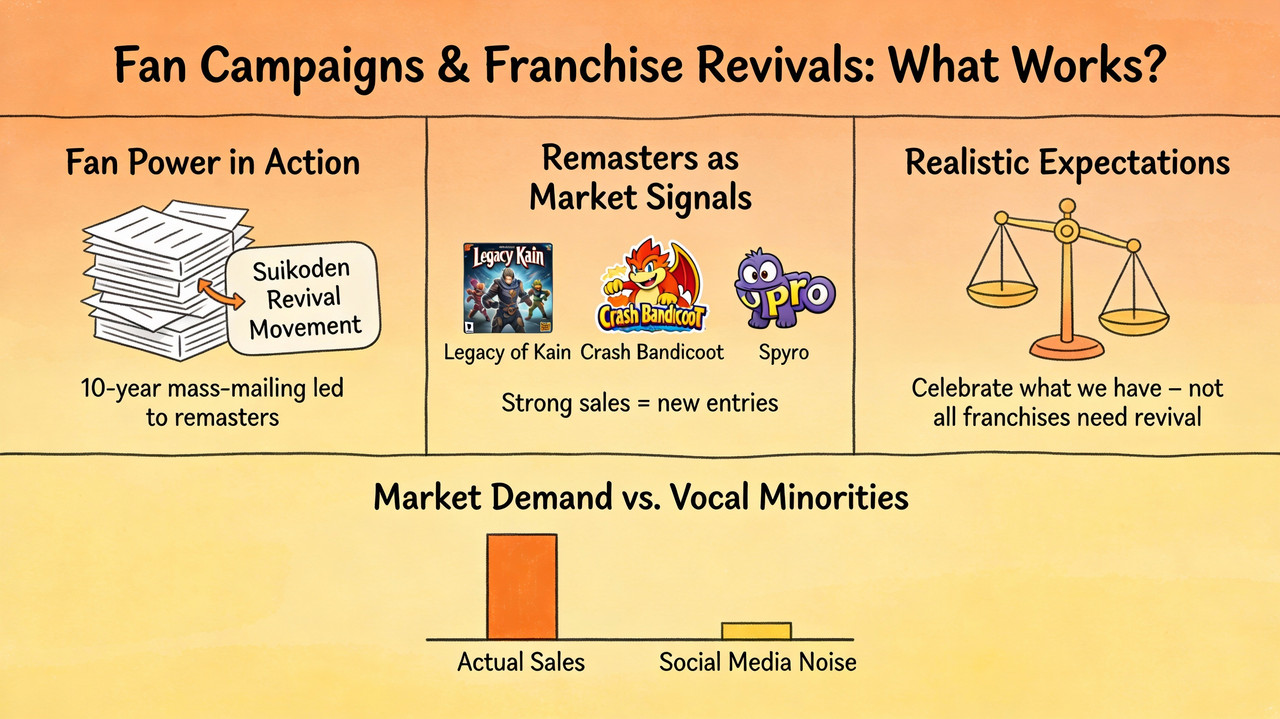
Fan campaigns do occasionally work, though results vary. The Suikoden Revival Movement spent a decade organizing mass-mailing initiatives, sending physical letters and testimonials to Konami before finally getting remasters announced. Whether their efforts directly influenced the decision or Konami simply saw an opportunity after the success of similar projects remains unclear, but sustained community pressure kept the franchise in conversation.
Supporting remasters and rereleases sends clear signals to publishers that dormant franchises have commercial viability. The Legacy of Kain remasters performing well could convince Square Enix to invest in new entries. Strong sales for Crash Bandicoot and Spyro remasters led to new games in both franchises. Publishers pay attention to data, and data shows whether there’s actual market demand beyond vocal minorities on social media.
The most realistic approach is managing expectations while celebrating the games we got to experience. Not every franchise needs or deserves revival. Some ended at natural stopping points and should remain untouched as products of their time. Others had flawed premises that wouldn’t translate well to modern gaming. But for those special franchises that truly deserve second chances, keeping the conversation alive, supporting related releases, and demonstrating genuine market demand gives them the best shot at resurrection in an industry obsessed with profitability over preservation.