Dead or Alive Dimensions launched May 24, 2011 as Team Ninja’s bold Nintendo 3DS debut, packing 25 fighters, stereoscopic 3D combat, and Chronicle Mode’s ambitious narrative spanning DOA1-DOA4 into portable perfection. Now fifteen years later, the title endures as the 3DS’s definitive fighter despite series creator Tomonobu Itagaki’s departure and shifting genre tastes.
The 3DS Technical Showcase
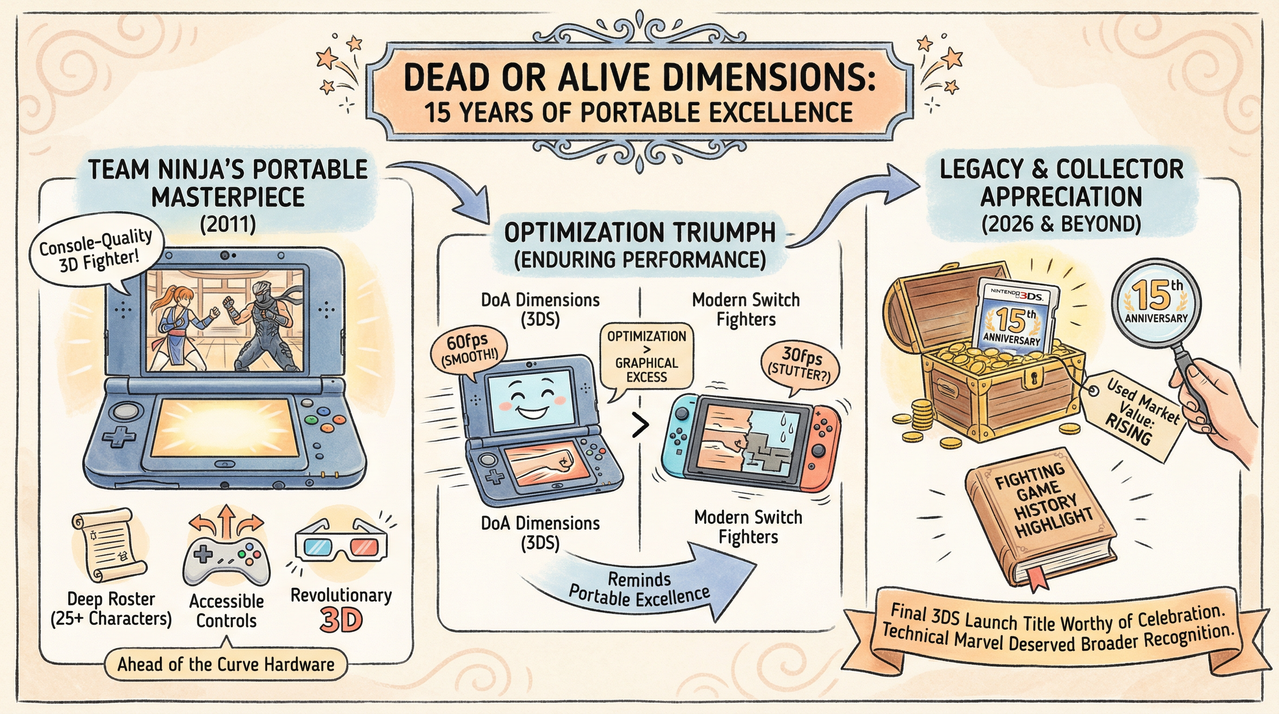
Dimensions pushed launch 3DS hardware to limits with fluid 60fps combat, stereoscopic 3D depth without glasses, and interactive arenas featuring destructible elements. Team Ninja optimized famously demanding engine for dual-screen play – top screen handled 3D action while bottom touchscreen offered simplified controls for newcomers alongside traditional inputs. The result delivered console-quality presentation in pocket form.
25-character roster spanned DOA history from original Kasumi to DOA4 newcomer Lao Gui, with free daily DLC costumes via SpotPass keeping content fresh through summer 2011. Chronicle Mode compiled franchise narrative across 200+ animated cutscenes, creating perfect entry point for newcomers while satisfying series veterans craving story context.
Gameplay That Defined Portable Fighting
Core fighting engine retained DOA’s hallmark counter-rockets, environmental interactions, and cliffhanger finishes optimized for handheld thumb positioning. Power Blow system leveraged 3DS analog nub for cinematic super moves, while Tag Team battles supported wireless multiplayer without cartridges. Touch controls lowered execution barrier without compromising competitive depth.
Critical reception praised technical achievement – GameSpot awarded 7.5/10 calling it ‘impressive 3DS debut,’ IGN scored 8.5 highlighting ‘portable fighting perfection.’ Commercial performance hit respectable 300K+ units despite crowded 2011 launch window competing against Street Fighter IV 3D and Marvel vs. Capcom 2 ports.

Last Game Before Itagaki’s Exit
Dimensions marked final DOA title overseen by series creator Tomonobu Itagaki before his dramatic 2010 Team Ninja departure. New director Yosuke Hayashi took production reins, maintaining series DNA while adapting for Nintendo partnership. Development delays from Japan’s March 2011 earthquake pushed launch from 3DS debut to May, testing Team Ninja’s portable optimization skills.
Post-Dimensions, DOA series shifted toward free-to-play arena with Ultimate and Last Round iterations. Handheld experiment never repeated despite technical success, leaving Dimensions as DOA’s sole portable entry and final mainline console release before mobile pivot.
Legacy Fifteen Years Later
2026 finds used copies commanding $80+ premiums as 3DS market appreciates. Online communities preserve competitive scene through local play, while modders extract unused costumes and stages via homebrew. Retrospective appreciation grows as definitive ‘pure DOA’ entry before gacha monetization dominated franchise direction.
Technical achievements remain impressive – modern Switch ports of contemporaries like Street Fighter 30th Anniversary Collection fail matching Dimensions’ native 3D fluidity. Fifteen years proves portable fighting viability when developers prioritize optimization over graphical excess.

Technical Breakdown
| Feature | Implementation | Modern Context |
|---|---|---|
| Stereoscopic 3D | Native 60fps | Switch lacks equivalent |
| Interactive arenas | Full destruction | Matches PS5 titles |
| Touch controls | Full move execution | Revolutionary 2011 |
| Character depth | 25 roster, 200+ movies | Modern game scope |
Frequently Asked Questions
Why no sequel or Switch port?
DOA pivoted free-to-play post-Dimensions while 3DS lifecycle focused Mario Kart/Luigi’s Mansion sequels. Handheld fighter niche proved commercially marginal despite critical success.
Still playable online 2026?
Nintendo Network shutdown ended official servers, though local wireless remains functional. Homebrew communities preserve online functionality via custom servers.
Best way to play today?
Complete-in-box copies retail $80-120 USD. Citra emulator offers 4K enhancements and shader caches matching modern hardware capabilities.
Metroid crossover rumors true?
Samus Aran unlockable confirmed – complete Survival Mode unlocks Zero Suit Samus costume for Kasumi. Clever Nintendo marketing tie-in.
Story mode worth experiencing?
Chronicle Mode compiles DOA1-DOA4 narratives with 200+ animated cutscenes. Definitive franchise overview despite melodramatic plots.
Value fifteen years later?
Premium pricing reflects technical showcase status. Modern fighting games rarely match native 3D implementation or roster depth.
Team Ninja’s portable legacy?
Dimensions remains high water mark. Later mobile DOA titles sacrificed depth for monetization, diminishing handheld series presence.
Handheld Fighting Pinnacle
Fifteen years proves Dead or Alive Dimensions’ enduring achievement. Team Ninja delivered console-quality fighter with revolutionary 3D, deep roster, and accessible controls ahead of hardware curve. When modern Switch fighters stutter at 30fps, Dimensions reminds portable excellence through optimization triumphs over graphical excess.
Final 3DS launch title worthy of anniversary celebration. Used market prices reflect collector appreciation for technical marvel that deserved broader recognition. Team Ninja’s portable swansong remains fighting game history highlight.