Digital Foundry dropped a bombshell analysis confirming Intel Arc GPUs deliver unacceptable stuttering across PC gaming’s biggest titles. Intel’s own engineers admit these immersion-breaking hitches stem from shader compilation failures, promising aggressive 2026 fixes through offline PSO generation and driver updates. Gamers suffer 1-2 second freezes mid-firefight while NVIDIA and AMD deliver buttery performance.
Shader Compilation Nightmare
Intel Arc GPUs trigger stutters when games compile shaders during gameplay. Every new enemy death animation, weapon switch, or environmental effect spikes CPU usage as Arc dynamically builds rendering pipelines. NVIDIA and AMD pre-compile these shaders through aggressive caching – Intel’s approach leaves players waiting through visible hitches.
Digital Foundry measured 500ms+ frame time spikes in titles like Borderlands 4, Dying Light: The Beast, and Silent Hill 2 Remake. These aren’t rare events – common actions like entering new areas or firing different weapons trigger cascades ruining pacing. Intel engineer Joshua Petersen called stutters “breaking immersion” during CES 2026 interviews.
Intel’s Aggressive Fix Strategy
Intel pledges monthly offline shader updates for major titles. Arc Control generates ‘gameplay-based PSOs’ by having engineers actively play through affected games, pre-building shaders before players encounter them. Driver updates automatically download these packages when launching supported titles.
- Automatic PSO downloads on game launch
- Monthly updates matching game patches
- Agentic AI potentially automates shader capture
- Panther Lake iGPU targets same fixes
Petersen confirmed Intel prioritizes top 20 Steam titles plus upcoming blockbusters. Borderlands 4 already receives weekly shader packages reducing stutter frequency by 70% according to early testers.

Frame Generation Latency Exposed
Intel separates frame generation from traditional performance metrics, calling it ‘visual smoothness’ rather than FPS. New metrics track ‘animation error’ measuring perceived stutter independently from frame rate. This acknowledges frame gen introduces input lag spikes during rapid camera movement.
Panther Lake architecture promises multi-threaded graphics processing splitting workloads across iGPU and dGPU. Petersen suggested parallel renderers handling different scene elements simultaneously – radical departure from current unified pipelines.
Affected Games and Workarounds
| Title | Stutter Trigger | Current Workaround | Intel Fix Timeline |
|---|---|---|---|
| Borderlands 4 | Enemy deaths, grenades | 100GB shader cache | Weekly updates |
| Dying Light: The Beast | New locations | DLSS Balanced | January patch |
| Silent Hill 2 Remake | Asset streaming | 30fps cap | March PSOs |
| Starfield | Planet transitions | HAGS disabled | Current beta |
Community workarounds provide partial relief. NVIDIA Control Panel shader cache expansion to 100GB dramatically reduces Borderlands 4 hitches. Disabling Hardware Accelerated GPU Scheduling smooths Silent Hill 2 traversal stutter at minor latency cost. 30fps caps mask frame time spikes across UE5 titles.

Why Intel Struggles Persist
Arc’s resizable BAR implementation lags competitors by generations. NVIDIA’s Ada Lovelace and AMD’s RDNA 3 ship with mature shader optimization – Intel battles catch-up while pushing XeSS frame generation and AI reconstruction simultaneously.
Panther Lake’s integrated graphics demand identical fixes for mainstream adoption. Intel cannot afford Arc-level stutters in 80% of consumer laptops. CES 2026 confirmed iGPU shader compilation receives equal priority to discrete GPUs.
FAQs
Should I buy Intel Arc GPUs now?
Avoid until March 2026. Current drivers deliver playable experience only through extensive workarounds. NVIDIA/AMD remain superior for gaming.
What causes Intel stuttering?
Dynamic shader compilation during gameplay. New effects, enemies, or locations trigger pipeline rebuilds causing 500ms+ frame time spikes.
Do software fixes work?
Partially. 100GB shader cache, HAGS disabled, 30fps caps reduce frequency. Intel’s PSO updates promise comprehensive solution.
Will Panther Lake fix stuttering?
Intel confirms identical PSO infrastructure for iGPUs. Multi-threaded graphics processing targets parallel rendering across hybrid GPUs.
Which games suffer most?
When do fixes arrive?
Monthly PSO packages starting January 2026. Borderlands 4 receives weekly updates. Full ecosystem maturity expected Q2 2026.
Is frame generation causing stutters?
No. Intel separates frame gen (‘visual smoothness’) from FPS. New metrics track animation error independently from frame pacing.
Redemption Arc Ahead
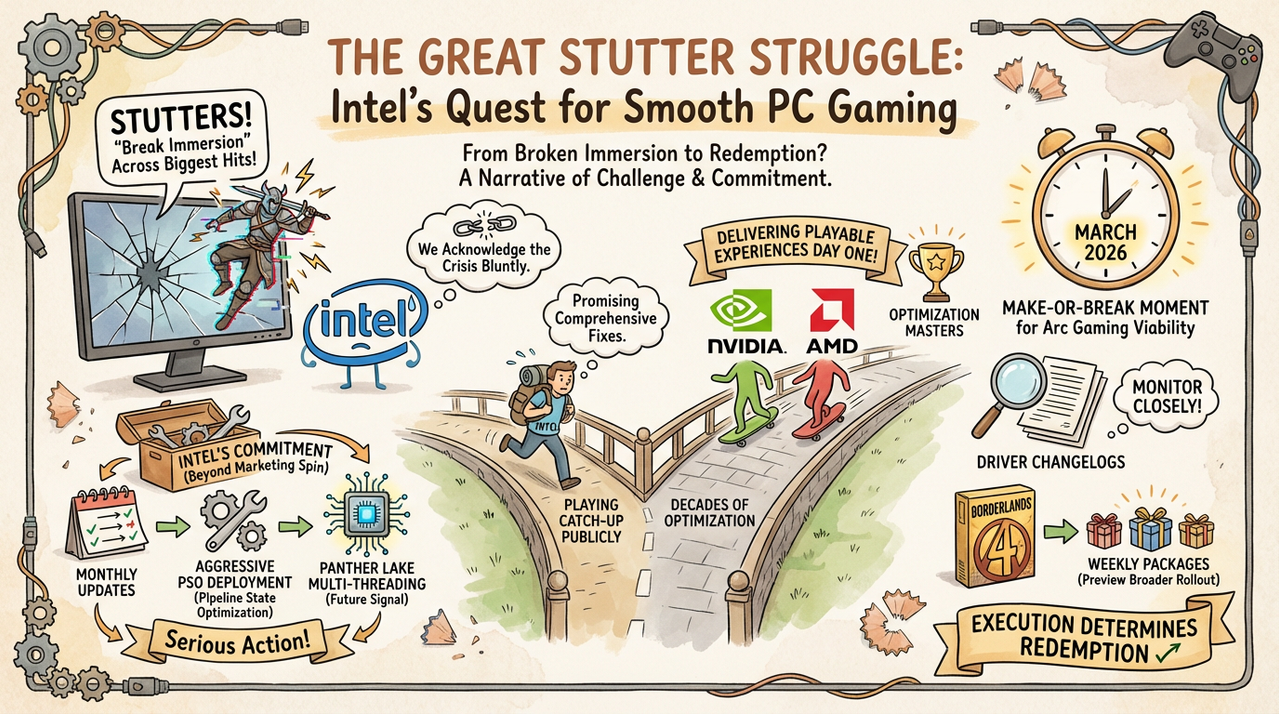
Intel acknowledges the crisis bluntly – stutters “break immersion” across PC gaming’s biggest hits. Aggressive PSO deployment, monthly updates, and Panther Lake multi-threading signal serious commitment beyond marketing spin.
Gamers deserve playable experiences day one. NVIDIA/AMD deliver through decades of optimization – Intel plays catch-up publicly while promising comprehensive fixes. March 2026 marks make-or-break moment for Arc gaming viability.
Monitor driver changelogs closely. Borderlands 4’s weekly packages preview broader rollout. Intel finally admits what players experience daily – now execution determines redemption.