Remember making PowerPoint presentations in school and thinking “this would be way more fun if I was building automated factories instead of bullet points about the Civil War”? Developer Macrobit Interactive apparently had that exact thought and spent years turning it into Factory 95, an automation puzzle game that takes place entirely within Windows 95-style presentation software. You’re not just building factories, you’re building factories that create slideshow presentations using the tools and aesthetic of late-90s office software. Paint buckets change slide colors. Text tools add content. Transition effects need proper sequencing. And yes, you absolutely need to worry about the Y2K bug potentially destroying everything you’ve built. It’s simultaneously the most absurd and most brilliant premise for a factory builder in years.
PowerPoint as Game Engine
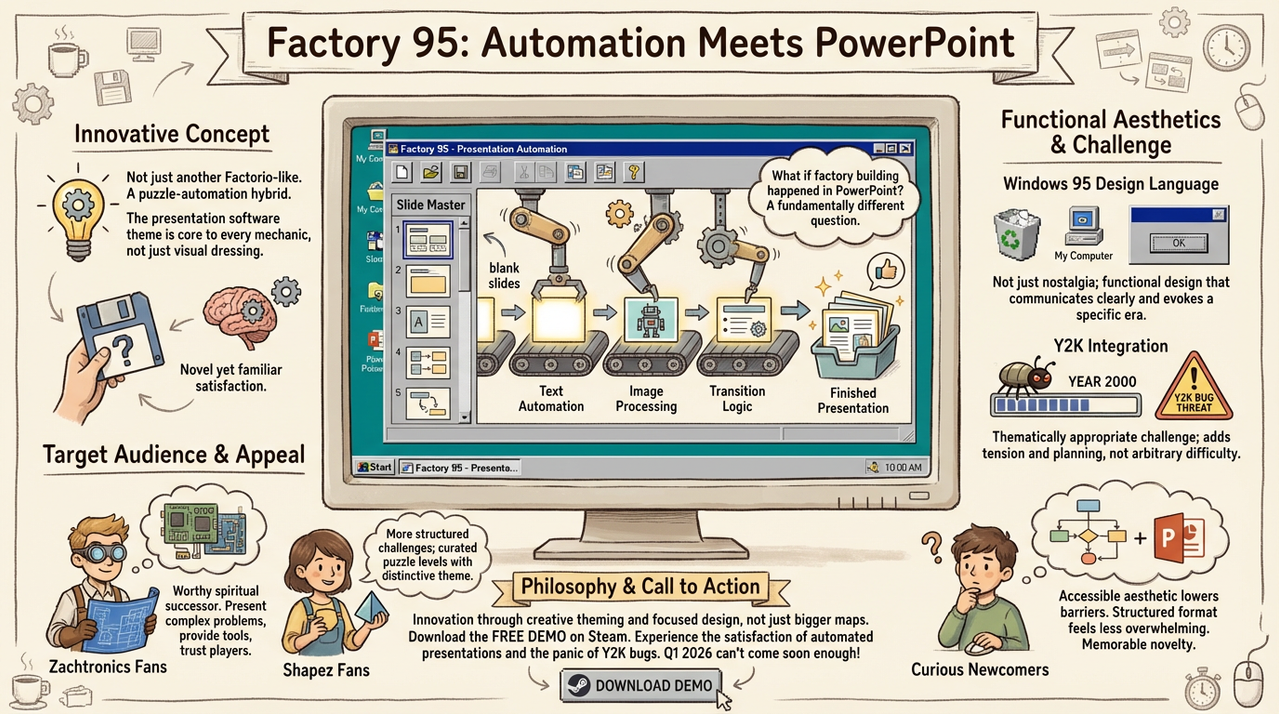
Factory 95’s core concept sounds like a joke until you see it in action. The entire game takes place within a fictional presentation software interface styled after Windows 95 and early PowerPoint. Your workspace is a slideshow canvas where you place factory components that process, modify, and output presentation slides. Resources aren’t iron ore or petroleum, they’re blank slides, colored backgrounds, text elements, images, and transition effects. Your goal isn’t manufacturing products for consumers, it’s fulfilling increasingly complex slide orders that require precise automation.
The genius is how naturally factory building translates to presentation software. Conveyor belts become slide transitions moving content between frames. Machines become tools from the presentation toolbar: paint bucket for coloring backgrounds, text tool for adding content, image inserters for graphics. Mergers combine multiple slide elements into finished presentations. Splitters route slides to different processing paths. The factory components feel native to the setting rather than forced abstractions.
This presentation-software framing creates unique spatial constraints. You’re building factories on individual slides within a presentation deck, meaning workspace is inherently limited and precious. You can’t just expand infinitely across open terrain like Factorio or Satisfactory. Every component placement requires considering how it fits within the slide boundaries and how slides connect within the broader presentation structure. This constraint forces creative problem-solving and efficient designs that maximize limited space.

The Y2K Threat
Factory 95 embraces its late-90s setting completely, including one of that era’s defining anxieties: the Y2K bug. As you progress through the game, the millennium approaches and your presentation factories face the threat of catastrophic failure when the calendar rolls from 1999 to 2000. This isn’t just narrative flavor, it’s a mechanical challenge requiring preparation and contingency planning.
The Y2K integration adds time pressure and risk management to what could otherwise be purely spatial puzzles. You can’t just optimize for efficiency, you need redundancy systems, backup processes, and failsafes against potential system crashes. This transforms later levels from straightforward “build the thing” challenges into “build the thing that survives digital apocalypse” scenarios. It’s factory building meets disaster preparedness, all themed around genuine historical tech anxiety.
Zachtronics DNA
Developer Liam from Macrobit Interactive explicitly cites Zachtronics titles as primary inspiration, and it shows immediately. Like SpaceChem, Infinifactory, and their siblings, Factory 95 presents engineering puzzles where the satisfaction comes from designing elegant systems rather than just completing objectives. Multiple solutions exist for every challenge, creating optimization opportunities where players compete for efficiency, speed, or minimal component counts.
The Zachtronics influence appears most clearly in how Factory 95 presents problems. You receive orders specifying exact slide requirements: specific colors, text arrangements, image placements, transition sequences. Your job is architecting the automated systems that fulfill those requirements using available tools and workspace. There’s no hand-holding about optimal approaches. The game provides tools and constraints, then trusts players to experiment, iterate, and discover solutions through creative engineering.
This design philosophy means Factory 95 rewards the same mindset as classic Zachtronics games. Players who enjoy breaking down complex problems into component steps, visualizing data flow, and iteratively refining systems will find familiar satisfaction. The presentation software theme provides fresh context for these familiar puzzles, making the engineering feel novel even as the underlying problem-solving follows established patterns.

Shapez Simplicity
The other major inspiration Liam mentions is Shapez, the minimalist factory builder about processing geometric shapes. That influence manifests in Factory 95’s visual clarity and accessible complexity curve. Where games like Factorio can overwhelm with hundreds of interconnected systems, Factory 95 maintains focus on core automation concepts presented through clean, readable interfaces.
The minimalist aesthetic serves both thematic and gameplay purposes. Thematically, it captures how presentation software from the Windows 95 era prioritized function over visual flourish. Simple geometric shapes, flat colors, and clean lines defined that design language. Gameplay-wise, the minimalism ensures players can easily read factory states at a glance. You’re never squinting to determine what’s happening or lost in visual noise obscuring important information.
This marriage of Zachtronics’ engineering puzzles with Shapez’s accessible minimalism creates a unique position in the automation genre. Factory 95 offers depth for players seeking complex optimization challenges while remaining readable and approachable for newcomers intimidated by Factorio’s overwhelming scope or Zachtronics’ sometimes obtuse interfaces.
The Windows 95 Aesthetic
Factory 95 commits completely to its retro computing aesthetic. Everything from UI elements to sound design evokes the Windows 95 era with loving attention to period-accurate details. Dialog boxes use the classic gray window chrome with blue title bars. Buttons have that beveled 3D appearance. Even the color palette feels lifted directly from mid-90s operating systems, all beiges and grays punctuated by primary colors.
This aesthetic choice taps into powerful nostalgia for anyone who used computers during that era. Windows 95 represented a pivotal moment when personal computing transitioned from enthusiast hobby to mainstream necessity. The interface became instantly recognizable globally, appearing in offices, schools, and homes worldwide. Factory 95’s recreation of that visual language triggers immediate recognition and fondness for many players.
Beyond nostalgia, the Windows 95 theme provides strong visual identity. Where countless factory builders adopt industrial, sci-fi, or fantasy aesthetics, Factory 95 stands out immediately through its office software presentation. Screenshots are instantly distinctive, communicating the game’s unique premise before you even read descriptions. In a crowded genre, that visual differentiation matters enormously for attracting attention.
Demo Available Now
Macrobit Interactive released a playable demo on Steam in December 2025, offering substantial preview of Factory 95’s core gameplay loop. The demo includes multiple levels showcasing progression from simple slide creation to complex multi-stage automation. Players can experience the full presentation software interface, experiment with different factory designs, and determine whether the puzzle-automation hybrid appeals before committing to the full game.
Steam reception to the demo has been enthusiastically positive based on early discussions. Players appreciate the creative premise executed with polish and clarity. The Zachtronics comparisons feel earned rather than aspirational, with Factory 95 delivering genuine engineering puzzles wrapped in unique presentation. Critics praise how naturally the factory building mechanics translate to the slideshow software framework rather than feeling forced or gimmicky.
IGN featured Factory 95 in their demo trailer coverage, highlighting it among notable upcoming puzzle games. This mainstream gaming media attention for a debut indie title suggests strong concept appeal beyond just niche automation enthusiasts. The accessible aesthetic and creative premise give Factory 95 broader appeal than hardcore-focused titles in the genre.
Q1 2026 Release Window
The full version of Factory 95 targets Q1 2026 release on PC via Steam, with Windows and macOS support confirmed. Pricing hasn’t been announced yet, though similar automation puzzle games typically launch in the $10-20 range depending on content scope. The Q1 window gives Macrobit Interactive time to incorporate demo feedback, add polish, and expand the campaign with additional levels and mechanics.
The development timeline suggests careful planning and iteration. Factory 95 appeared at various demo events and showcases throughout 2025, gathering community feedback before the commercial release. This approach mirrors successful indie development strategies where demos build audiences and inform final design decisions rather than launching blindly into uncertain markets.
What Makes It Work
Factory 95 succeeds because the presentation software theme isn’t just visual dressing on generic automation gameplay. The mechanics emerge organically from the setting. Slides as resources, presentation tools as machines, workspace constraints from canvas limitations, Y2K bugs as threats, all these elements feel native to the concept rather than arbitrary game mechanics wearing PowerPoint costumes.
This thematic cohesion creates immersion despite the absurd premise. You’re genuinely building slideshow factories using presentation software logic. The metaphor remains consistent throughout rather than breaking down as complexity increases. Later challenges involving complex slide sequences and transition management feel like natural extensions of early lessons about basic slide coloring, maintaining the conceptual framework from tutorial through endgame.
The game also respects player intelligence by avoiding heavy-handed tutorials or restrictive early levels. Like Zachtronics titles, Factory 95 provides tools and constraints, then trusts players to experiment and discover optimal approaches. This design philosophy attracts audiences who enjoy creative problem-solving over following prescribed solutions. The satisfaction comes from designing systems that work rather than completing steps in predetermined sequences.

Standing Out in Automation Genre
The factory building and automation genre has exploded in popularity over the past decade. Factorio established the template, Satisfactory added first-person 3D exploration, Dyson Sphere Program went cosmic scale, and countless others iterated on the formula. Factory 95 differentiates itself through radical aesthetic and thematic departure from industrial settings that dominate the genre.
Where most automation games involve mining, manufacturing, and machinery, Factory 95 transposes those concepts into office software creating digital content. The core loop remains similar, design systems that efficiently transform inputs into desired outputs, but the presentation software framing makes familiar mechanics feel fresh. Players who’ve built countless Factorio bases might find new engagement building PowerPoint factories precisely because the visual and thematic context differs so dramatically.
The puzzle focus also distinguishes Factory 95 from open-ended sandbox automation games. Rather than infinite expansion across procedural terrain, Factory 95 offers curated challenges with defined objectives and spatial constraints. This structured approach appeals to players who want clearly defined problems to solve rather than open-ended optimization sandboxes that can feel aimless without self-imposed goals.
Frequently Asked Questions
When does Factory 95 release?
The full game is scheduled for Q1 2026 (January-March) release on PC via Steam. A free demo is available now.
What platforms will Factory 95 be available on?
Windows and macOS are confirmed. Linux support has not been officially announced but may be possible given the game’s design.
Who is developing Factory 95?
Macrobit Interactive, led by developer Liam Flannery, is creating Factory 95.
Is it similar to Zachtronics games?
Yes, explicitly. The developer cites Zachtronics titles like SpaceChem and Infinifactory as primary inspiration, with similar engineering puzzle design philosophy.
What is the Y2K mechanic?
As the game progresses toward the year 2000, the Y2K bug becomes a threat requiring preparation and failsafe systems to prevent factory crashes.
Do you need PowerPoint knowledge to play?
No. The game uses presentation software as thematic framing, but understanding factory building mechanics matters more than actual PowerPoint expertise.
Is it a relaxing or challenging game?
Challenging, like Zachtronics puzzles. It offers satisfying problem-solving rather than zen-like relaxation, though the pacing allows thoughtful experimentation.
How long is the demo?
The demo includes multiple levels showcasing core mechanics and progression, taking approximately 1-2 hours to experience the available content.
Can you play casually or is it hardcore?
The minimalist design and clear presentation make it more accessible than hardcore Zachtronics titles, but optimization challenges offer depth for experienced players.
Is there a campaign or just sandbox mode?
Factory 95 features structured puzzle levels with specific objectives rather than pure sandbox. The campaign provides curated challenges with increasing complexity.
Final Thoughts
Factory 95 represents exactly the kind of creative risk-taking that makes indie development exciting. Instead of creating another Factorio-like with slight mechanical tweaks or aesthetic variations, Macrobit Interactive asked a fundamentally different question: what if factory building happened in PowerPoint? The answer is a puzzle-automation hybrid that feels genuinely novel while delivering familiar satisfactions.
The presentation software theme works because Liam and the team committed fully rather than treating it as superficial visual dressing. Every mechanic emerges from the slideshow creation context. The Windows 95 aesthetic isn’t just nostalgic pastiche, it’s functional design language that communicates information clearly while evoking specific era. The Y2K integration isn’t arbitrary difficulty spike, it’s thematically appropriate challenge extension that adds tension and planning requirements.
For Zachtronics fans missing new engineering puzzles since that studio closed, Factory 95 offers worthy spiritual successor. The design philosophy remains intact: present complex problems, provide tools, trust players to engineer solutions. The presentation software setting provides fresh context for familiar satisfaction. For Shapez fans wanting more structured challenges than endless sandbox optimization, the curated puzzle levels deliver exactly that experience with distinctive theme.
Even players who don’t typically enjoy automation games might find Factory 95 appealing through sheer novelty. The PowerPoint premise is memorable enough to overcome genre hesitation. The accessible aesthetic lowers intimidation barriers compared to complex industrial interfaces. The structured puzzle format feels less overwhelming than sprawling open-world factory builders where you never know if you’re done optimizing.
Download the free demo from Steam and spend an hour building slideshow factories. Experience the satisfaction of watching automated systems transform blank slides into perfectly sequenced presentations. Feel the panic when Y2K bugs threaten your carefully constructed assembly lines. Appreciate how naturally factory building translates to office software when developers think creatively about thematic integration.
In a genre increasingly dominated by scale and complexity, Factory 95 proves you can innovate through creative theming and focused design. You don’t need bigger maps or more complex resource chains to create compelling automation gameplay. Sometimes you just need to ask “what if PowerPoint was a factory?” and commit completely to exploring that absurd premise with polish and intelligence. Macrobit Interactive did exactly that, and Q1 2026 can’t come soon enough for anyone who’s ever suffered through creating actual PowerPoint presentations and wished they were building automated factories instead.