The year 2025 just ended, and gaming communities across Reddit, forums, and achievement tracking sites are sharing their completion lists. What’s fascinating isn’t just which games people played, but which ones they actually finished. The data reveals a massive shift in what players want from games, and it’s forcing the industry to rethink the bigger-is-better mentality that dominated the last decade.
The Most Completed Game of 2025
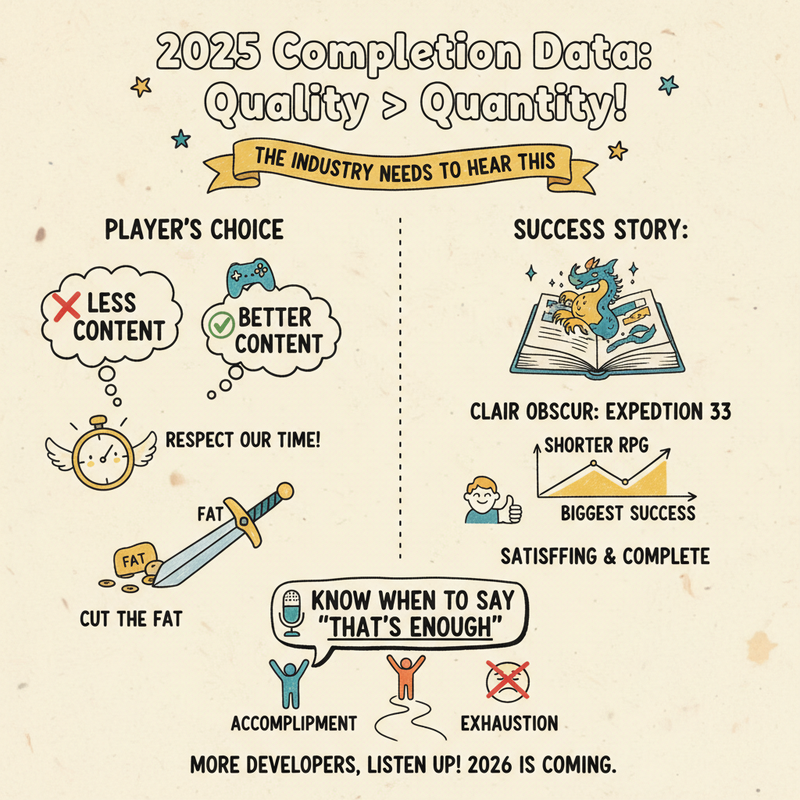
According to HowLongToBeat, the service where gamers track their playtime and completion status, Clair Obscur: Expedition 33 dominated 2025 as the most completed game of the year. This French indie RPG from developer Sandfall Interactive didn’t just sell well with over 6.1 million copies moved, it actually got finished by an astonishing 40-45% of players who started it. To put that in perspective, most games see completion rates between 10-30%, and many AAA blockbusters struggle to break 20%.
The rest of HowLongToBeat’s top 10 most completed games reveals an interesting pattern. Hollow Knight: Silksong took second place after its eight-year wait finally ended. Doom: The Dark Ages claimed third, followed by Donkey Kong Bananza, Dispatch, Monster Hunter Wilds, Mario Kart World, Silent Hill f, South of Midnight, and Hades 2 rounding out the list. What do most of these have in common? They respect your time.
Why Expedition 33 Connected
Clair Obscur: Expedition 33 can be completed in roughly 25-30 hours if you focus on the main story, with completionists pushing that to around 45 hours for everything. That’s short by modern RPG standards, and creative director Guillaume Broche says that was entirely intentional. In interviews following the game’s breakout success, he explained the team deliberately avoided padding the experience with filler content.
The game launched with 12 nominations at The Game Awards including Game of the Year, ultimately winning Best Independent Game. More importantly for this discussion, players actually stuck with it through the ending credits. Steam achievement data shows roughly 25% of PC players finished the main quest, which sounds low until you realize that’s actually exceptional compared to other lengthy RPGs. The Elder Scrolls IV: Oblivion Remastered, which also released in 2025, was completed by a depressing 2.77% of players despite being a highly anticipated remake.
The Death of the 100-Hour Grind
Former Starfield lead quest designer Will Shen recently spoke about what he calls the growing “fatigue” with games that demand 100-plus hours of your life. Speaking on the Kiwi Talkz podcast, he half-jokingly apologized for his role in popularizing these massive experiences, noting that the success of games like Skyrim and Fallout 4 convinced the industry that bigger automatically meant better.
The problem is that most people don’t finish 100-hour games. They play the first 10-15 hours, maybe push to 30 if they’re really engaged, then abandon it when something else catches their attention or life gets in the way. This creates a fractured community where half the players are deep into endgame content while the majority never made it past the opening acts. You can’t have meaningful conversations about the story, themes, or ending when 80% of your audience never saw them.
Games People Actually Completed
Looking at what Reddit users reported finishing in 2025 reveals some clear patterns. Here are titles that repeatedly showed up on completion lists:
– Clair Obscur: Expedition 33 (25-30 hours)
– Hollow Knight: Silksong (15-20 hours)
– Doom: The Dark Ages (12-15 hours)
– Split Fiction (8-10 hours cooperative)
– South of Midnight (18-22 hours)
– Indiana Jones and the Great Circle (15-20 hours main story)
– Marvel’s Spider-Man 2 (17-20 hours)
– Hades 2 (varies, roguelike structure)
– Tales of the Shire (8-12 hours)
– Mouthwashing (3 hours)
Notice something? Most of these clock in under 30 hours for a standard playthrough. Even the longer entries like Monster Hunter Wilds and Kingdom Come: Deliverance II saw strong engagement specifically because their core content felt meaningful rather than stretched thin across a bloated map.

Why Shorter Works Better Now
The shift toward shorter, tighter experiences isn’t just about attention spans or generational preferences. It’s about reality. According to industry data, the average gamer in 2025 plays between 5-8 hours per week. When you’re working full-time, managing family responsibilities, and trying to maintain some semblance of a social life, a 100-hour game represents a three-to-four month commitment minimum. That’s assuming you don’t touch anything else during that period.
Obsidian veteran Josh Sawyer pushed back slightly on the completion panic, noting that some players love massive games like Skyrim precisely because they never finish them. They restart repeatedly, wander aimlessly, and enjoy the sandbox without caring about the critical path. Fair point. But here’s the thing: those players have already found their forever games. They’re set with Skyrim, Minecraft, Fortnite, Call of Duty, or whatever live service has captured their loyalty. New 100-hour single-player games aren’t competing with each other, they’re competing with established titles that players have already invested thousands of hours into.
The Economic Argument
There’s also a developer perspective here. Clair Obscur: Expedition 33 was developed on a mid-budget estimated around $27-35 million, absolutely tiny compared to modern AAA productions that easily exceed $200-300 million. Former PlayStation head Shuhei Yoshida called it a “perfect balance” of AAA ambition with AA budget and independent vision. Jagex CEO Jon Bellamy argued you can achieve results comparable to $400 million blockbusters using a tenth of that budget if you focus on what matters.
Shorter games are cheaper to make, faster to develop, easier to polish, and crucially, more likely to be completed by the people who buy them. A player who finishes your 20-hour game is more likely to recommend it, buy your DLC, wishlist your next project, and engage with your community than someone who bounced off your 80-hour epic at the 15-hour mark.
Not Everything Needs to Be Short
Before this sounds like a manifesto against lengthy games, let’s be clear: there’s absolutely still a place for massive experiences. Baldur’s Gate 3 remains one of the most-played games on Steam despite easily demanding 60-100 hours for a complete playthrough. Elden Ring proved that difficult, sprawling adventures can still capture mainstream attention. Monster Hunter Wilds sold nearly 11 million copies with gameplay loops designed to keep players engaged for hundreds of hours.
The difference is that these games justify their length. Every hour feels intentional. The content density remains high throughout. Compare that to many open-world games that front-load the interesting stuff in the first 15 hours then spend the remaining 50 asking you to climb towers, collect meaningless trinkets, and complete repetitive side activities that could be generated by an algorithm.
What 2026 Might Bring
The completion data from 2025 suggests we’re entering an era where developers will need to make a conscious choice: build a focused 15-30 hour experience that most players will complete, or commit to creating a genuinely compelling 60-plus hour journey that justifies every minute. The middle ground, where you pad a 20-hour story with 40 hours of busywork to hit some arbitrary length target, is increasingly being rejected by players who simply don’t have the time or patience anymore.
Game Pass and PlayStation Plus are accelerating this trend. When players can access hundreds of games for a monthly fee, they’re more likely to bounce between titles. A tight 12-hour experience that delivers a complete, satisfying story becomes more attractive than committing to a sprawling 80-hour epic when you know there are fifty other interesting games waiting in your library.
Frequently Asked Questions
What was the most completed game of 2025?
Clair Obscur: Expedition 33 topped the list according to HowLongToBeat data, with an impressive 40-45% completion rate among players who started it. This is significantly higher than the industry average of 10-30%.
Why are completion rates so low for most games?
Most games see only 10-30% of players reach the ending credits. Factors include game length, difficulty spikes, boring stretches, competing games demanding attention, and players who primarily engage with multiplayer modes without touching single-player content.
Are shorter games really better?
Not necessarily better, but more respectful of player time. Shorter games with focused experiences tend to see higher completion rates and stronger word-of-mouth because players actually finish them and can discuss the full experience with others.
What games did people commonly finish in 2025?
Frequently completed titles included Clair Obscur: Expedition 33, Hollow Knight: Silksong, Doom: The Dark Ages, Split Fiction, South of Midnight, Indiana Jones and the Great Circle, and Hades 2. Most clocked in under 30 hours for a standard playthrough.
Does Game Pass affect completion rates?
Yes, subscription services seem to lower individual game completion rates because players have easy access to hundreds of titles. However, shorter games on these services often see more completions because players can finish them before moving to the next title.
Are 100-hour RPGs dying out?
Not entirely, but they’re facing scrutiny. Games like Baldur’s Gate 3 and Monster Hunter Wilds still succeed when they justify their length with quality content throughout. The issue is games that artificially pad their runtime with repetitive filler.
What does this mean for future game development?
Developers will likely need to choose between creating focused 15-30 hour experiences or genuinely compelling 60-plus hour journeys. The middle ground of padding shorter games with busywork to hit arbitrary length targets is increasingly being rejected by time-conscious players.
The Industry Learns to Edit
The 2025 completion data tells a story the industry needs to hear. Players aren’t asking for less content, they’re asking for better content. They want games that respect their time by cutting the fat and focusing on what makes the experience special. Clair Obscur: Expedition 33 became one of the year’s biggest success stories not despite being shorter than typical RPGs, but partially because of it. The game told its story, delivered satisfying gameplay, and ended before it wore out its welcome. More developers should be paying attention to that lesson as we head into 2026. Sometimes the most radical thing you can do is know when to say “that’s enough” and let players move on with a sense of accomplishment rather than exhaustion.