CD Projekt RED just cut ties with its digital distribution arm. GOG, the beloved DRM-free storefront, sold to co-founder Michał Kiciński for $25.2 million. The move frees CDPR to focus exclusively on Witcher 4 Polaris and Cyberpunk Orion while empowering GOG to pursue aggressive classic game preservation and indie publishing.
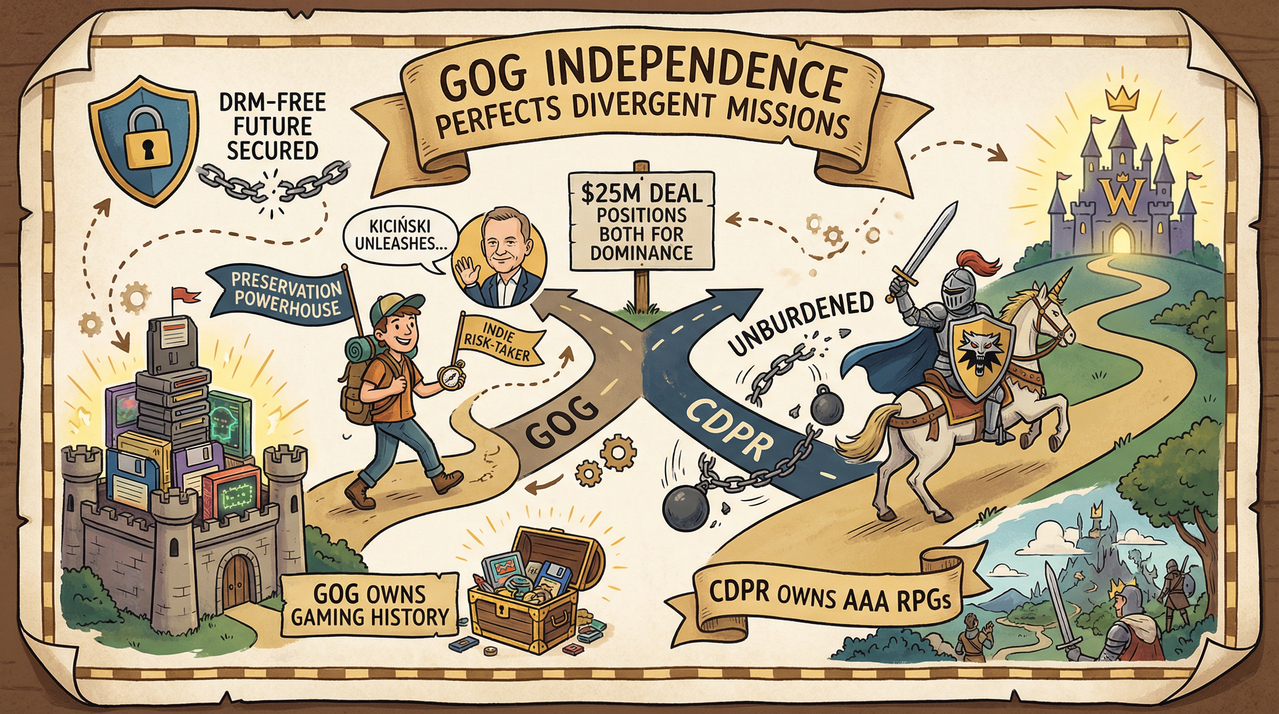
The $25M Independence Deal
Announced December 28, 2025, GOG transitions from CDPR subsidiary to standalone entity under Kiciński’s sole ownership. All user libraries, purchases, and DRM-free philosophy remain intact. Six-year publishing agreement ensures Witcher/Cyberpunk titles continue appearing on GOG alongside Epic Store exclusivity concerns eliminated.
Kiciński, CDPR co-founder since 2002 and GOG originator (2008), returns after 14-year absence. Transaction valued GOG at $25.2 million – modest compared to CDPR’s $8 billion market cap but preserves 18-year legacy serving 10+ million users.
GOG’s Ambitious New Chapter
Independence unlocks strategic freedom previously constrained by CDPR’s AAA focus:
- Classic game “rescue missions” intensify 2026-2027
- Indie publishing debuts (impossible under CDPR)
- DRM-free remains core philosophy
- Modern retro-spirited titles prioritized
- Windows compatibility preservation expands
Why CDPR Sold GOG
Strategic realignment post-Cyberpunk redemption. CDPR refocuses resources on:
– Witcher 4 (Polaris) full production
– Cyberpunk 2 (Orion) pre-production
– Canis Majoris (Witcher 1 remake)
– The Molasses Flood acquisition integration
| Entity | Focus | Timeline |
|---|---|---|
| CDPR | AAA RPG sequels | 2027-2030 |
| GOG | Preservation + indie | 2026-2028 |
Kiciński’s Vision: Risk-Taker Returns
New owner emphasizes rapid decision-making absent corporate oversight. “I’m not afraid of risk,” Kiciński declares. Contrasts GOG’s agility against CDPR’s continental expansion post-Witcher 3. Promises swift publishing deals exploiting niche others avoid.
Physical proximity helps – GOG/CDPR share Warsaw complex. Kiciński’s major CDPR shareholder status ensures collaboration continuity. Anti-DRM crusader famously battled Bandai Namco over Witcher 2 DRM removal (2011).
GOG’s Preservation Mission Expands
2026-2027 “rescue missions” target orphaned classics facing delisting. Recent Horses controversy (Valve/Epic bans) highlights GOG’s safe harbor potential. In-house compatibility tools already revive Windows 95 titles.
Indie publishing targets “retro spirit” modern games rejected elsewhere. Six-year CDPR deal guarantees Witcher 4 day-one availability despite Epic exclusivity elsewhere.
Gaming Community Reactions
r/Games thread exploded with 18K upvotes:
- ‘GOG DRM-free forever preserved’
- ‘Perfect timing post-Horses drama’
- ‘Kiciński anti-DRM warrior returns’
- ‘CDPR focus laser-sharp now’
Business Implications
$25M valuation bargains GOG’s 10M+ userbase, preservation tech, brand loyalty. CDPR sheds non-core asset amid Witcher 4 ramp-up. Kiciński leverages CDPR shares, Warsaw synergy, preservation expertise for profitable niche domination.
FAQs
Do I lose my GOG library?
No. All purchases transfer intact. DRM-free files unaffected.
Will Witcher games stay on GOG?
Yes. Six-year publishing deal confirmed.
What are rescue missions?
Reviving delisted classics via compatibility tools. 2026-2027 expansion planned.
Why did CDPR sell?
AAA RPG focus. GOG distracted from Witcher 4/Cyberpunk 2.
Indie publishing confirmed?
Planned. Targets retro-styled games rejected elsewhere.
Kiciński’s CDPR history?
Co-founder (2002), GOG creator (2008), left 2012 pre-Witcher 3.
Anti-DRM stance changes?
Hardened. Battled Bandai Namco 2011 over Witcher 2.
Conclusion
GOG independence perfects divergent missions. CDPR charges toward Witcher 4 glory unburdened. Kiciński unleashes preservation powerhouse and indie risk-taker. $25M deal positions both for dominance – CDPR owns AAA RPGs, GOG owns gaming history. DRM-free future secured.