With early access launching January 13, 2026, Hytale developer Hypixel Studios published a detailed blog post on January 5 explaining their ambitious plans for world generation. The short version? They’re building a system that fundamentally changes who gets to control procedurally generated worlds, shifting power from programmers to artists and game designers through a node-based editor that requires zero coding knowledge. If they pull it off, this could genuinely redefine how sandbox games in the Minecraft mold approach world creation.
Two Generations of World Building
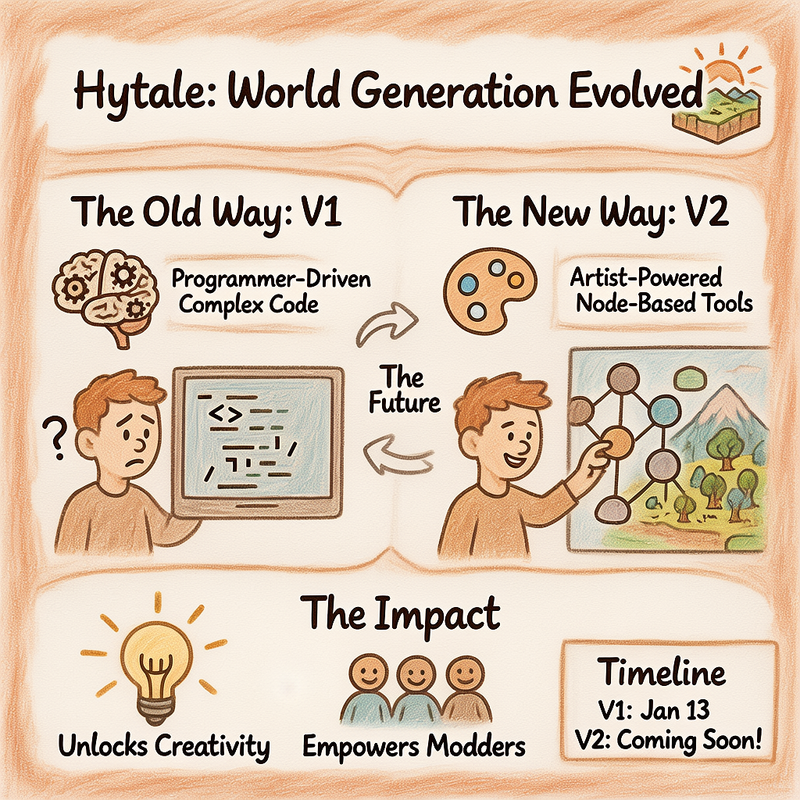
Hytale currently runs two separate world generation systems. Version 1 was developed from 2016 through 2020 and served as the foundation for most of the gameplay footage people have seen over the years. This is the system that will power exploration mode when early access launches next week. It’s functional, it creates interesting landscapes, but it’s also limited in ways that became increasingly frustrating as the development team’s ambitions grew.
Version 2 has been in development since 2021 and represents a complete philosophical shift in how procedural generation works. While V1 follows traditional approaches where programmers write algorithms that spit out terrain, V2 introduces a layer of designer control that most procedurally generated games simply don’t have. The plan is to eventually replace V1 entirely after early access launches, though no timeline has been announced for when that transition happens.
Why This Actually Matters
Traditional procedural generation in games like Minecraft works through algorithms written by programmers. You set parameters for noise functions, biome distribution, structure placement, and other technical variables, then let the system generate terrain based on those rules. The problem is that meaningful changes require programming knowledge and understanding complex systems. Artists and designers can suggest ideas, but they need engineers to actually implement them.
Hytale’s V2 system flips that dynamic by introducing pattern-based generation that designers can control directly. Instead of random distribution governed by noise functions, you can specify meaningful relationships between elements. Want dark-leaved trees to consistently appear over cave entrances, giving players visual cues about underground systems? You can set that pattern without touching code. The blog post showcases experimental worlds including alien planets with completely different generation rules, all created through the same designer-friendly tools.

The Node-Based Editor
The core innovation is a node-based editor that lets you tweak world generation parameters visually rather than through code. If you’ve ever used Unreal Engine’s Blueprint system or Blender’s shader nodes, the concept is similar. You connect nodes representing different generation rules, adjust values through sliders and dropdowns, and see results immediately reflected in-game. No compilation, no programming syntax, no technical barriers preventing iteration.
This approach dramatically reduces the time between having an idea and testing whether it works. A designer can prototype a new biome type, adjust how structures spawn, modify terrain features, and preview everything within minutes instead of waiting for engineering support. The immediate feedback loop encourages experimentation in ways that traditional procedural generation pipelines simply don’t support.
Hiring 15 World Designers
Here’s the detail that really drives home how serious Hypixel Studios is about this approach: they’re hiring over 15 world designers specifically for Hytale. That’s an unusual position for a procedurally generated sandbox game. Most studios in this space have environmental artists who create assets and engineers who write generation algorithms, but dedicated world designers focused purely on crafting the procedural experience? That’s rare.
Founder Simon Collins-Laflamme explains that Hytale’s vision is to feel carefully handcrafted while remaining infinitely procedural, with design always serving gameplay first. You need humans making deliberate decisions about pacing, discovery, and player guidance rather than leaving everything to algorithmic chance. The V2 system gives those designers the tools to actually execute that vision without bottlenecking on programmer availability.

Modder-Friendly By Design
One of Hytale’s core promises since its original 2018 announcement has been deep mod support that goes beyond what Minecraft offers. The V2 world generation system extends that philosophy by making the same tools available to modders that the official team uses. No programming knowledge required means a much larger pool of potential creators can build custom worlds, total conversion mods, and experimental gameplay modes.
The immediate preview functionality is especially valuable for modders working alone or in small teams. You don’t need to spin up dedicated test servers or wait through compilation processes to see if your changes work. Make adjustments, preview instantly, iterate quickly. That accessibility could spawn an ecosystem of user-generated content that rivals or exceeds what established modding communities have created for other sandbox games.
The Messy Road to Launch
It’s worth acknowledging the chaotic development history that led to this point. Hytale was announced in 2018 with massive hype, backed by Riot Games funding. By 2024, after years of delays and scope creep, Riot shut down the project entirely and closed Hypixel Studios. Founder Simon Collins-Laflamme managed to buy back the rights in November 2025, reportedly paying 10 times the market value, and immediately set about salvaging what remained.
According to Collins-Laflamme, it should have taken years to fix everything, but the team got the game into a playable, fun state within weeks. That rapid turnaround was described as “a damn miracle,” and frankly it’s hard to disagree. The fact that early access is launching January 13, just over a month after the acquisition, is legitimately impressive even if the game ships in a rough state.

What Early Access Actually Includes
When Hytale launches in early access next week, players will get the V1 world generation system, not the fancy V2 setup described in the blog post. That’s important to understand because it means the revolutionary features won’t be available immediately. Early access will focus on core gameplay, building systems, combat, and the existing procedural generation that’s been in development since 2016.
The V2 system will arrive later during the early access period, though no specific timeline has been announced. This staggered approach makes sense from a development perspective because it lets the team stabilize the base game before rolling out major systems overhauls. But it also means players buying in at launch shouldn’t expect the bleeding-edge world generation features right away.
Infinite vs Finite Worlds
One question that came up in community discussions is whether Hytale will maintain infinite world generation or shift to finite maps like Terraria. The blog post doesn’t directly address this, but Collins-Laflamme has stated in other communications that the technology still supports infinite generation. The current plan appears to be maintaining that feature, though the V2 system’s focus on more curated, pattern-based design might introduce constraints.
The tension between infinite procedural generation and carefully designed experiences is real. True infinite worlds mean you can’t guarantee players encounter specific content in a particular order. Finite worlds with defined zones let you control pacing and progression more deliberately. How Hypixel Studios resolves that tension in V2 will be fascinating to watch during early access development.
Can It Actually Work
The ambitious vision described in the blog post raises obvious questions about feasibility. Giving artists and designers control over procedural generation sounds great in theory, but procedural systems are complex for good reasons. Balancing randomness with intentionality, ensuring generated worlds remain interesting over hundreds of hours, and avoiding repetitive patterns requires sophisticated algorithms. Can a node-based editor really handle that complexity while remaining accessible to non-programmers?
We won’t know until the system ships and people actually use it. But Hypixel Studios has been working on V2 since 2021, which is nearly four years of development time for a single system. That sustained investment suggests they believe the approach is viable. And hiring 15+ dedicated world designers indicates confidence that the tools are functional enough to support a specialized team working exclusively on procedural content design.
FAQs About Hytale World Generation
When does Hytale launch in early access?
Hytale launches in early access on January 13, 2026 for PC. The game will be available through its own launcher and distribution system rather than Steam initially.
Will the new world generation be available at launch?
No, early access launches with the V1 world generation system developed from 2016-2020. The V2 system will be added later during early access, but no specific timeline has been announced.
What makes V2 world generation different?
V2 uses a node-based editor that lets artists and game designers control procedural generation without programming knowledge. It allows pattern-based generation where you can specify relationships between elements like trees appearing over caves.
Can modders use the new world generation tools?
Yes, modders will have access to the same node-based world generation tools the official development team uses, with immediate preview functionality and no programming required.
Will Hytale have infinite worlds?
The technology still supports infinite world generation according to Simon Collins-Laflamme, though the V2 system’s focus on curated design might introduce some constraints. Details will emerge during early access development.
How much will Hytale cost?
Pricing hasn’t been officially announced, but Collins-Laflamme has stated the base cost won’t be much different from comparable games. Expect something in the $20-30 range for early access.
What happened with Riot Games?
Riot Games funded Hytale development but canceled the project in June 2025. Founder Simon Collins-Laflamme bought back the rights in November 2025, reportedly paying 10x market value, and revived development.
Who is Hypixel Studios?
Hypixel Studios was founded by the creators of the Hypixel Minecraft server, one of the largest and most popular Minecraft multiplayer servers. They started Hytale development in 2016 as an independent project.
Conclusion
Hytale’s world generation blog post reveals genuine innovation in how procedurally generated sandbox games could be designed going forward. Shifting control from programmers to artists and designers through accessible node-based tools has the potential to unlock creativity that traditional algorithmic approaches simply can’t match. Whether the system delivers on that promise depends entirely on execution, and we won’t know for sure until it ships during early access. But the ambition is commendable, and the sustained investment in developing V2 since 2021 suggests Hypixel Studios genuinely believes they’ve cracked a fundamental problem in procedural generation design. Early access launches January 13 with the older V1 system, so players shouldn’t expect these revolutionary features immediately. But if V2 rolls out successfully later in development and proves as accessible and powerful as described, it could genuinely change how the entire block game genre approaches world building. And for modders who’ve struggled with the technical barriers of traditional procedural generation, having production-grade tools that don’t require programming knowledge could spawn a creative explosion that rivals what Minecraft’s modding community has achieved over the past decade. That’s worth getting excited about, even if the road to full release remains long and uncertain.