A technical discussion erupted on Reddit asking whether idTech 8 could be the engine that finally provides a viable alternative to Unreal Engine 5’s dominance. After Doom: The Dark Ages launched showcasing stunning visuals, path-traced lighting, and rock-solid 60fps performance even on aging hardware, the gaming community started wondering why more developers don’t use id Software’s legendary engine. The answer is complicated, involving licensing restrictions, developer culture, and the harsh reality that engines require specific expertise to master.
What Makes idTech 8 Special
idTech 8 represents id Software’s latest iteration of their legendary game engine, debuting with Doom: The Dark Ages in May 2025. The engine builds on idTech 7’s foundation from Doom Eternal and Indiana Jones and the Great Circle but adds significant enhancements including path tracing support, improved global illumination, and massive increases in on-screen enemy counts. According to Digital Foundry’s technical analysis and developer presentations at SIGGRAPH 2025, idTech 8 transitioned from pre-baked lighting to real-time global illumination while somehow maintaining or improving performance.
The engine runs exclusively on Vulkan API, having completely dropped OpenGL support back in idTech 7. This decision enables aggressive multi-threading where multiple parallel threads handle shaders, asset streaming, geometry processing, texture loading, and data decompression simultaneously. Instead of a primary rendering thread creating bottlenecks, idTech 8 distributes workloads intelligently across available CPU cores. The result is an engine that scales remarkably well from minimum spec hardware to bleeding-edge systems.
The Performance Everyone Can’t Stop Talking About
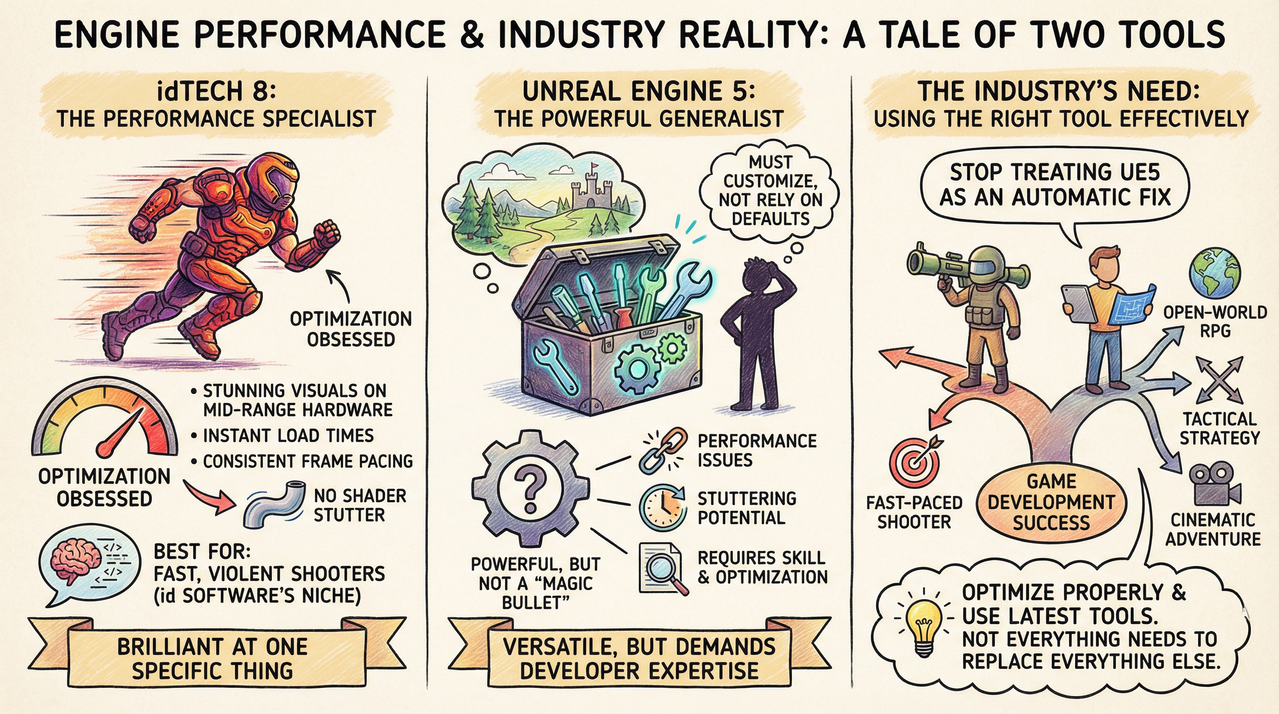
PC gamers testing Doom: The Dark Ages consistently report stutter-free experiences with instant load times, locked frame pacing, and stable performance even during chaotic battles featuring dozens of enemies and extensive environment destruction. Digital Foundry measured frame times showing almost no variance between frames, something rarely seen in modern games. The engine handles shader compilation without the traversal stuttering plaguing Unreal Engine 5 titles, meaning you never experience those jarring frame drops when new effects load for the first time.
Even more impressive, idTech 8 runs competently on 8GB graphics cards despite featuring real-time ray-traced global illumination and reflections. While 8GB cards do experience limitations and Digital Foundry strongly recommends more VRAM, the engine gracefully scales down quality rather than becoming unplayable. Compare this to recent Unreal Engine 5 games that struggle to maintain 30fps on mid-range hardware even with aggressive upscaling, and the performance gap becomes staggering.
Why idTech Isn’t Everywhere
If idTech 8 is so incredible, why aren’t more developers using it? The answer starts with licensing. id Software doesn’t license idTech engines to external studios the way Epic Games licenses Unreal Engine. Currently, only MachineGames, another Bethesda-owned studio, uses idTech 7 for their projects like Indiana Jones and the Great Circle. They maintain a fork called “motor” (Swedish for engine) with significant technology sharing around rendering while keeping gameplay systems separate.
This exclusive arrangement exists for good reasons. idTech engines are highly specialized tools optimized for specific game types that id Software excels at creating: fast-paced first-person shooters with dynamic combat, extensive destruction, and constant action. The engine makes deliberate trade-offs that work brilliantly for Doom and Wolfenstein but might not suit open-world RPGs, strategy games, or narrative adventures. You can’t just drop idTech into any project and expect magic to happen.
The Culture and Expertise Problem
According to Digital Foundry’s discussions with developers, idTech’s exceptional performance comes partly from id Software’s internal culture of obsessive optimization. The team maintains brutal focus on frame times, latency reduction, and eliminating performance variance. They deeply understand their engine’s architecture and continuously profile every system to identify bottlenecks. This institutional knowledge accumulated over decades makes idTech sing in ways that handing the same engine to another studio probably wouldn’t replicate.
The engine requires specific expertise to use effectively. It’s built around Vulkan’s low-level graphics API, which offers tremendous power but demands much more technical knowledge than higher-level abstractions. Teams need programmers who understand GPU architectures, memory management, and parallel processing at fundamental levels. Many studios lack this specialized talent, especially smaller independent developers who rely on engines with better documentation, extensive asset stores, and large communities providing support.

The Unreal Engine 5 Situation
Meanwhile, Unreal Engine 5 has become gaming’s default solution despite persistent performance issues. UE5 games frequently suffer from shader compilation stuttering, inconsistent frame times, aggressive upscaling requirements, and disappointing performance even on high-end hardware. Reddit threads routinely feature complaints about games built on UE5 5.1 exhibiting terrible optimization, though Epic has addressed some issues in later versions that many shipped titles haven’t implemented.
Part of the problem stems from UE5’s accessibility. Epic provides extensive documentation, marketplace assets, and visual scripting tools that lower barriers to entry. Studios can prototype games quickly and hire developers with UE5 experience easily because so many people use the engine. However, this accessibility creates a tragedy of the commons situation where teams rely on engine defaults without deeply understanding the underlying systems, resulting in poorly optimized releases that give UE5 a bad reputation.
The transition to mandatory features like Nanite for geometry and Lumen for lighting created new complications. These technologies can produce stunning results when implemented carefully but require significant optimization work and understanding of their limitations. Many developers treat them as magic solutions that automatically make games look next-gen without realizing the performance costs. The result is beautiful screenshots that run at 25fps on consoles and require frame generation just to be playable on PC.
Could idTech Actually Scale
The technical discussion on Reddit raised an interesting hypothetical: if Microsoft wanted to leverage Bethesda’s ownership of id Software by offering idTech 8 to more studios, could it actually work? The consensus among knowledgeable commenters suggests probably not in the way people imagine. idTech isn’t a general-purpose engine like Unreal. It excels at specific game types but requires substantial customization for different genres.
Consider the Halo franchise as a test case. Digital Foundry discussed whether idTech 8 could work for the next Halo game, concluding that while theoretically possible, it would require extensive bespoke additions for Halo’s specific needs. Systems for large outdoor environments, vehicle physics, multiplayer netcode, cooperative gameplay, and Forge mode editing would need to be built from scratch or heavily modified. Who does that work? It can’t be id Software, they’re busy making Doom and Quake games. The burden falls on whoever is developing Halo.

The Modding Consideration
Another major barrier is modding support. Bethesda’s Creation Engine, despite its technical limitations and ancient codebase, enables extensive community modifications that keep Elder Scrolls and Fallout games relevant for decades. Moving to idTech would essentially kill modding because the engine wasn’t designed with that level of user customization in mind. For franchises where mods represent a core part of their longevity and appeal, switching engines becomes a non-starter regardless of technical advantages.
The Indiana Jones and the Great Circle Reddit discussion highlighted this concern when someone suggested MachineGames could help develop Elder Scrolls VI using idTech. The community response was overwhelmingly negative, emphasizing that modding is too important to sacrifice for better performance. This perspective shows how technical excellence alone doesn’t determine engine suitability. Community ecosystems, development workflows, and specific franchise needs all factor into decisions.
The Path Tracing Future
idTech 8’s upcoming path tracing update for Doom: The Dark Ages represents the engine’s cutting edge. Path tracing produces the most physically accurate lighting, shadows, reflections, and refractions possible by simulating light rays bouncing through scenes more comprehensively than standard ray tracing. The computational demands are enormous, requiring upscaling and potentially frame generation to maintain playable frame rates even on high-end hardware.
According to PC Gamer’s analysis, id Software’s track record of developing exceptionally performant engines suggests they’ll make path tracing viable where other implementations struggle. However, even idTech 8 will require aggressive denoising algorithms to eliminate the visual noise inherent in path tracing calculations. The slower pace of Doom: The Dark Ages compared to previous entries helps since players aren’t moving at breakneck speed where frame rate becomes absolutely critical.
Looking ahead to hypothetical idTech 9 development, PC Gamer speculates that AI integration could become standard for improving graphics quality and maintaining performance simultaneously. By 2030, permanently path-traced games using AI upscaling might become the norm for id Software titles. This trajectory positions idTech as a technological leader but also potentially moves it further from general-purpose engine territory as it optimizes for increasingly specific rendering approaches.
What the Industry Actually Needs
The broader question isn’t whether idTech 8 could replace Unreal Engine 5 but whether the industry needs more engine diversity generally. Unreal Engine’s near-monopoly creates systemic risks where performance issues, stuttering problems, and optimization challenges affect huge swathes of new releases simultaneously. When Epic makes mistakes or prioritizes features that don’t work well for certain game types, developers using UE5 get caught in the fallout.
Competition drives improvement. Unity’s collapse as a viable alternative following disastrous pricing changes left Unreal even more dominant. idTech remaining exclusive to Microsoft-owned studios means it can’t provide market pressure to improve UE5’s weaknesses. What gaming needs is multiple high-quality engines serving different niches, with developers choosing tools that match their specific project requirements rather than defaulting to whatever everyone else uses.
The Creation Engine situation at Bethesda illustrates this point. Despite being technically ancient and frequently mocked, Creation Engine enables experiences and community engagement that no other engine replicates. Switching to idTech or Unreal would sacrifice unique capabilities for generic technical improvements. Similarly, some studios benefit from developing proprietary engines tailored precisely to their needs even though custom development costs more upfront.
Frequently Asked Questions
What is idTech 8?
idTech 8 is id Software’s latest game engine powering Doom: The Dark Ages. It features path tracing support, real-time global illumination, massive enemy counts, and exceptional performance optimization. The engine runs exclusively on Vulkan API with aggressive multi-threading for consistent frame times.
Why isn’t idTech 8 licensed to other developers?
id Software doesn’t license idTech engines externally. Only MachineGames, another Bethesda-owned studio, uses idTech through technology sharing arrangements. The engine is highly specialized for fast-paced first-person shooters and requires specific expertise to use effectively.
How does idTech 8 compare to Unreal Engine 5?
idTech 8 demonstrates superior performance with stutter-free gameplay, instant load times, and stable frame rates even with ray tracing enabled. UE5 games frequently suffer shader compilation stuttering, inconsistent performance, and require aggressive upscaling. However, UE5 offers much better accessibility, documentation, and general-purpose flexibility.
Could Microsoft make idTech 8 available to more studios?
Theoretically yes, but it would require significant resources. idTech is optimized for specific game types and needs extensive customization for different genres. Studios would need specialized expertise to use it effectively, and id Software can’t support every team wanting to license the engine.
Why do so many games use Unreal Engine 5 despite performance issues?
UE5’s accessibility, extensive documentation, marketplace assets, visual scripting, and large developer community make it easy to adopt. Studios can hire developers with UE5 experience readily and prototype quickly. Many performance issues stem from poor optimization rather than fundamental engine problems.
What games use idTech 8?
Currently only Doom: The Dark Ages uses idTech 8. Indiana Jones and the Great Circle uses idTech 7. Future id Software titles will likely adopt idTech 8, and MachineGames may use it for upcoming projects with appropriate modifications.
Can idTech 8 support open-world games or RPGs?
Theoretically possible but would require substantial engine modifications. idTech is optimized for fast-paced linear first-person shooters with intense combat and destruction. Adapting it for sprawling open worlds, complex RPG systems, or persistent multiplayer would demand extensive custom development.
What is path tracing and why does it matter?
Path tracing is the most physically accurate lighting method, simulating light rays bouncing through scenes comprehensively. It produces realistic lighting, shadows, reflections, and refractions but demands enormous computational power. idTech 8 will support path tracing in future Doom: The Dark Ages updates.
The Engine That Could But Probably Won’t
idTech 8 represents what modern game engines can achieve when developed by world-class programmers obsessed with performance optimization. It proves that games can look stunning while running smoothly without requiring the latest GPUs or aggressive upscaling tricks. The engine demonstrates that shader compilation stuttering isn’t inevitable, that load times can be instant, and that frame pacing can be consistent even during chaotic action sequences.
However, wishing idTech could save the industry from Unreal Engine 5’s problems ignores practical realities. Engines aren’t interchangeable tools that work equally well for all projects. idTech excels at what id Software makes, fast murderous shooters with relentless pacing and spectacular violence. Expecting it to work equally well for open-world RPGs, tactical strategy games, or cinematic adventures sets unrealistic expectations that would only lead to disappointment.
What the industry actually needs is for developers to stop treating Unreal Engine as a magic bullet that automatically makes games good. UE5 is a powerful tool, but tools require skill and understanding to use effectively. The performance problems plaguing many UE5 releases stem from developers failing to optimize properly, relying on defaults instead of customizing systems for their specific needs, and shipping games built on outdated engine versions missing critical fixes. Epic provides the tools to make games run well. Studios need to actually use them. Meanwhile, idTech 8 will continue being exactly what it is, the best engine in the world for making Doom games. And honestly, that’s perfectly fine. Not everything needs to scale to replace everything else. Sometimes it’s enough to be brilliant at one specific thing.