Illusive Domain, an indie boss rush action game from solo developer kemomimic, launched its free demo on Steam on January 2, 2026, offering a brutally pure combat experience that eliminates every modern progression crutch. There are no levels to grind, no equipment to find, no skill trees to unlock, and no upgrades to chase. Every ability exists in your arsenal from the first second, and victory depends entirely on your reflexes, timing, and ability to read enemy attack patterns. The game’s philosophy is clear: if you fail, it’s because you failed, not because your stats were too low or your gear wasn’t good enough.
The demo drops players into intense one-on-one duels against warriors pulled from different time periods and regions, each bringing unique fighting styles that force constant adaptation. Nearly every attack can be parried if executed with frame-perfect precision, creating a risk-reward system where brave players who master the timing windows get massive damage opportunities while those who hesitate or block poorly eat punishing hits. Spanish gaming site Kotaku describes it as a game that “eliminates any type of external improvement to put the focus exclusively on the player’s skill,” positioning Illusive Domain as the antithesis of modern action games built around artificial progression curves.
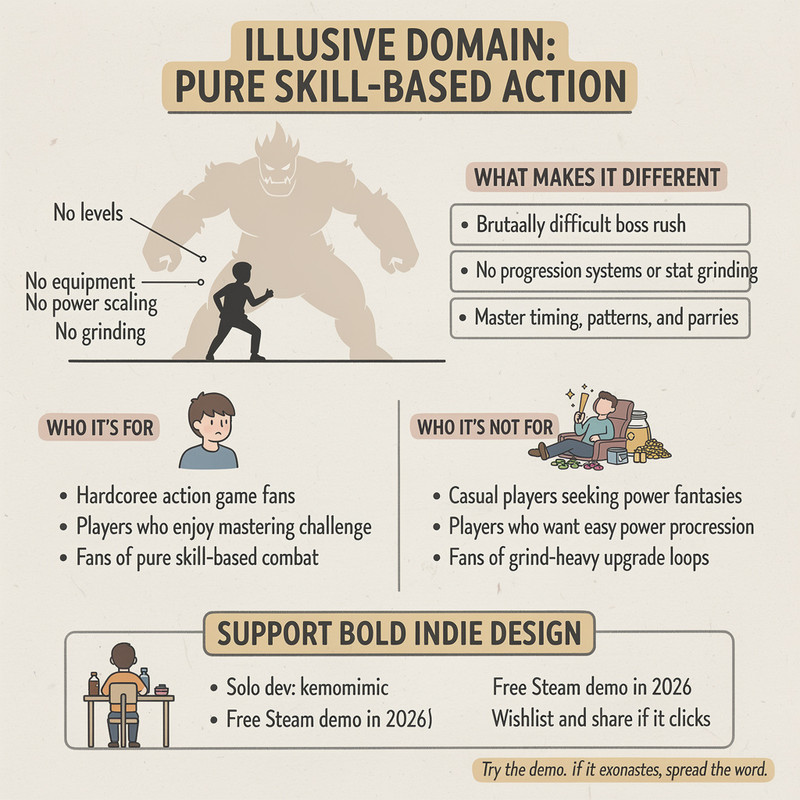
What Makes Illusive Domain Different
In a genre dominated by skill trees, constant upgrades, and complex progression systems, Illusive Domain deliberately goes in the opposite direction. The core design philosophy rejects the Souls-like formula of gradually becoming stronger through leveling and gear acquisition. Instead, kemomimic created what they call a “parry-based boss rush action” experience where mastery comes from understanding combat mechanics deeply rather than grinding for better stats. This approach feels increasingly rare in 2026 when even indie action games typically include some form of meta-progression to ease difficulty curves.
The game features fast-paced, high-intensity action focused exclusively on boss battles without filler content between encounters. You play as a lone wolf warrior venturing into a long-abandoned domain to save her master, fighting through sealed warriors who battle without fear of death in this cursed arena. The narrative remains mostly optional according to the Steam page, though “lots of little interactions advance the plot bit by bit” for players interested in understanding why these warriors are trapped and what the protagonist must do to escape alive.
Combat revolves around seamlessly blending offense and defense through dodges, parries, and counter-attacks. The parry system rewards precision timing with massive damage windows, encouraging aggressive play that some players might initially find overwhelming. According to YouTube gameplay footage from channels like Aria POV and Gamer Linear, successful parries create opportunities to land devastating counter-attacks that quickly turn the tide of battles, but mistiming these attempts results in taking full damage from attacks that could have been safely avoided through dodging instead.
The Combat Philosophy
Kotaku’s Spanish coverage emphasizes that Illusive Domain’s central idea is clear from the first moment: “the victory is not based on statistics, but on reflexes, positioning, and reading enemies.” Each confrontation tests precision and patience, especially because almost all attacks can be countered if executed with exact timing. The game’s own pitch makes this philosophy explicit: success depends on your ability to learn patterns, react appropriately, and execute with skill rather than simply out-statting opponents.
This design creates combat encounters that function as duels rather than wars of attrition. Blocking an attack at the precise moment opens enormous punishment windows, but failing means taking direct damage. There’s no margin for constant errors or strategies based on brute force. The combat becomes a rhythm game of sorts, where memorizing enemy patterns is as important as executing movements correctly. Players can’t simply tank hits and heal through mistakes; survival requires learning why each death occurred and adjusting strategy accordingly.

Warriors Trapped Outside Time
Illusive Domain’s narrative premise positions warriors and masters from different eras and regions as trapped within the same domain, creating a setup that justifies wildly different boss designs and fighting styles. Each warrior brings unique combat patterns reflecting their historical period or regional martial traditions, ensuring no two fights feel identical. This variety is crucial for maintaining the game’s pacing since without environmental variety between pure boss encounters, combat diversity becomes the only thing preventing monotony.
The first gameplay trailer shows a stylized visual approach with anime-inspired character designs featuring animal-themed outfits that add personality without interfering with gameplay readability. Effects are clear and direct, reinforcing the idea that players always maintain control and that any mistake results from poor decisions or bad timing rather than unclear visual communication. Everything is designed for maximum legibility during fast-paced action, ensuring players can track multiple threats and react appropriately without losing track of what’s happening on screen.
The protagonist appears to be a wolf-girl warrior based on the Steam description and gameplay footage, fitting kemomimic’s apparent aesthetic preferences given the developer’s social media handles and branding. While story remains optional, the Steam page promises an evolving hub with interactions that gradually reveal plot details for players interested in understanding the domain’s nature and the circumstances trapping these warriors. This approach allows hardcore players to focus purely on combat mastery while narrative-focused players can engage with optional story content between fights.
Demo Reception and Performance
SteamDB data shows Illusive Domain Demo peaked at just 8 concurrent players on January 2, 2026, reflecting the harsh reality facing solo indie developers trying to break through in an oversaturated market. Despite kemomimic’s enthusiastic “ITS UP NOW GO PLAY IT” announcement on YouTube, the demo hasn’t achieved viral momentum yet. This low player count doesn’t necessarily reflect quality; countless excellent indie games struggle for visibility among thousands of Steam releases competing for attention daily.
IndieDB covered the demo launch on January 2, noting the demo is now live with press materials available for creators wanting to cover the game. Chris Jones Gaming reported on the boss rush demo availability, describing it as an “anime-styled action game” for players wanting to “test themselves against the various bosses.” These smaller gaming news sites provide crucial early coverage that helps indie games find audiences, though breaking through to mainstream gaming press remains difficult for solo developers without marketing budgets or publisher support.
The demo is available on both Steam and Itch.io, with kemomimic noting that “updates here will be more sporadic compared to Steam” on the Itch page. The developer maintains active social media presence on Twitter/X, Bluesky, Discord, Patreon, and Ko-fi for community building and feedback collection. This multi-platform approach helps indie developers maximize reach across different gaming communities, though it also increases workload for solo creators already juggling development, marketing, and community management responsibilities.

Technical Details and Accessibility
Illusive Domain runs on Unity Engine and was created using Blender for 3D modeling, Substance Painter and Designer for textures, and Krita for 2D artwork according to the Itch.io page credits. The game supports Windows with full controller support, keyboard, mouse, and any gamepad input. Average sessions last about an hour according to Itch metadata, suggesting the demo includes multiple boss encounters requiring substantial time investment to master.
The demo weighs 829 MB on Itch.io, a relatively modest file size for a 3D action game in 2026. Steam lists the demo as excluded from Family Sharing because “this content type cannot be shared,” a standard restriction for demos. The full game targets a 2026 release window according to Kotaku’s Spanish coverage, though kemomimic hasn’t announced a specific date beyond “later in 2026.” Development logs on Itch show consistent monthly updates throughout 2025, suggesting active ongoing development rather than an abandoned project.
The game features English language support with potential for additional languages later depending on player interest and developer resources. Tags include 3D, Anime, Boss Battle, Difficult, Female Protagonist, Singleplayer, and Souls-like, accurately communicating what players should expect. The Souls-like tag refers to the punishing difficulty and pattern memorization requirements rather than level-based progression or exploration elements, which Illusive Domain explicitly rejects in favor of pure skill-based combat.
Why No-Progression Design Matters
Illusive Domain’s decision to eliminate all progression systems represents a bold stance in modern game design. Most action games include some form of character advancement because it provides dopamine hits that keep players engaged even during frustrating difficulty spikes. When you can’t beat a boss, grinding levels or upgrading equipment offers an alternative path forward that feels productive even if you’re not improving mechanically. Removing this safety valve means players must improve or quit; there’s no middle ground of artificial progression masking skill deficiencies.
This approach has precedent in fighting games and rhythm games where skill reigns supreme, but it remains rare in single-player action genres. Sifu attempted similar ideas with its aging system that punished death without traditional level grinding, though players could still unlock permanent upgrades between runs. Sekiro: Shadows Die Twice emphasized parry timing over stat building but still featured skill trees and health/posture upgrades. Illusive Domain goes further by truly offering nothing but your base kit from beginning to end, making it perhaps the purest distillation of “git gud” philosophy in recent memory.
The risk is that this design alienates players who enjoy the power fantasy of becoming gradually stronger. Many gamers play action titles specifically for the satisfaction of transforming from weak novice to overpowered god through persistent effort and smart builds. Illusive Domain tells these players “sorry, not here,” potentially limiting its audience to hardcore action game fans who specifically want pure skill challenges. Whether kemomimic finds enough of this audience to justify continued development depends on how the demo reception translates into wishlist conversions and eventual sales.

The Solo Developer Challenge
Kemomimic’s journey with Illusive Domain exemplifies both the opportunities and obstacles facing solo indie developers in 2026. Modern game engines like Unity democratize development by providing powerful tools without massive teams, while digital distribution through Steam and Itch.io eliminates traditional publishing gatekeepers. Social media platforms enable direct community building without PR agencies. Crowdfunding through Patreon and Ko-fi allows creators to fund development through supporter contributions rather than investor deals.
Yet visibility remains the insurmountable challenge. Thousands of games release on Steam annually, most disappearing without trace regardless of quality. Algorithmic discovery favors games that immediately capture momentum, creating brutal winner-take-all dynamics where early success compounds while slow burns rarely get second chances. Marketing budgets for AAA games dwarf entire indie game development costs, making paid advertising impractical for solo creators competing against corporate giants.
Kemomimic’s approach of releasing a free demo represents smart strategy for building awareness and converting skeptics into believers. Players risk nothing trying the demo, and those who enjoy it become organic advocates spreading word-of-mouth recommendations. Development logs documenting progress create narrative investment where potential players feel connected to the game’s evolution. Active social media presence across multiple platforms maximizes reach across different gaming communities. These tactics don’t guarantee success but improve odds compared to simply launching without building any audience beforehand.
FAQs About Illusive Domain Demo
Where can I download the Illusive Domain demo?
The Illusive Domain demo is free to download on Steam and Itch.io. The Steam version launched January 2, 2026, and remains available indefinitely. Kemomimic notes Steam will receive more frequent updates compared to the Itch version.
Does Illusive Domain have any progression systems?
No, Illusive Domain deliberately eliminates all progression systems. There are no levels, no equipment upgrades, no skill trees, and no stat increases. Every ability is available from the start, and victory depends entirely on player skill rather than character stats or gear quality.
What kind of gameplay does Illusive Domain offer?
Illusive Domain is a boss rush action game focused exclusively on intense one-on-one duels against warriors from different eras. Combat revolves around parrying attacks with precise timing to create damage windows, seamlessly blending offense and defense through dodges and counter-attacks.
When does the full version of Illusive Domain release?
Kemomimic plans to release the full version of Illusive Domain sometime in 2026 according to coverage from gaming sites. No specific release date has been announced beyond “later in 2026.” The developer maintains active development with regular updates documented on Itch.io.
Is Illusive Domain difficult?
Yes, Illusive Domain is explicitly designed as a difficult skill-based challenge. Steam tags include “Difficult” and “Souls-like,” reflecting the demanding nature of combat that requires memorizing enemy patterns, executing precise timing, and learning from deaths without relying on stat advantages or equipment upgrades.
Does Illusive Domain have a story?
Yes, though the story is mostly optional. You play as a wolf warrior venturing into an abandoned domain to save her master, fighting sealed warriors trapped in this cursed arena. The game features an evolving hub with optional interactions that gradually reveal plot details for interested players.
What platforms will Illusive Domain support?
Currently, Illusive Domain supports Windows PC with plans for Steam release in 2026. The game offers full controller support plus keyboard and mouse input. No announcements have been made regarding console ports or other platforms beyond PC.
Who is developing Illusive Domain?
Kemomimic, a solo indie developer, is creating Illusive Domain using Unity Engine, Blender for 3D modeling, Substance Painter/Designer for textures, and Krita for 2D artwork. The developer maintains active social media presence on Twitter/X, Bluesky, Discord, Patreon, and Ko-fi.
Conclusion
Illusive Domain represents a refreshing and risky bet on pure skill-based design in an era when most action games cushion difficulty through progression systems and power scaling. By stripping away levels, equipment, upgrades, and every other crutch that typically eases frustration, kemomimic forces players to actually improve rather than simply grind numbers until bosses become trivial. This design philosophy won’t appeal to everyone, casual players looking for power fantasies will likely bounce off the uncompromising difficulty, but for hardcore action game fans tired of artificial progression masking shallow combat, Illusive Domain offers something genuinely different. The free Steam demo provides a risk-free way to test whether this stripped-down approach clicks with your preferences. If you enjoy the satisfaction of mastering timing windows, reading attack patterns, and executing frame-perfect parries, Illusive Domain delivers that experience without dilution. If you prefer gradually becoming overpowered through persistent grinding, this isn’t your game and kemomimic isn’t pretending otherwise. Solo developer projects like this deserve support from players who claim they want innovation and risk-taking in game design. Kemomimic took the risk of creating a brutally difficult boss rush without progression systems in a market that typically demands accessibility and dopamine-driven upgrade loops. Whether that bet pays off depends on enough players discovering the demo, appreciating the purity of its skill-based combat, and wishlisting the full release coming later in 2026. Download the demo, give it an honest try, and if it resonates, spread the word because visibility remains the ultimate challenge for solo indie developers creating uncompromising experiences in an industry increasingly dominated by safe, formulaic design.