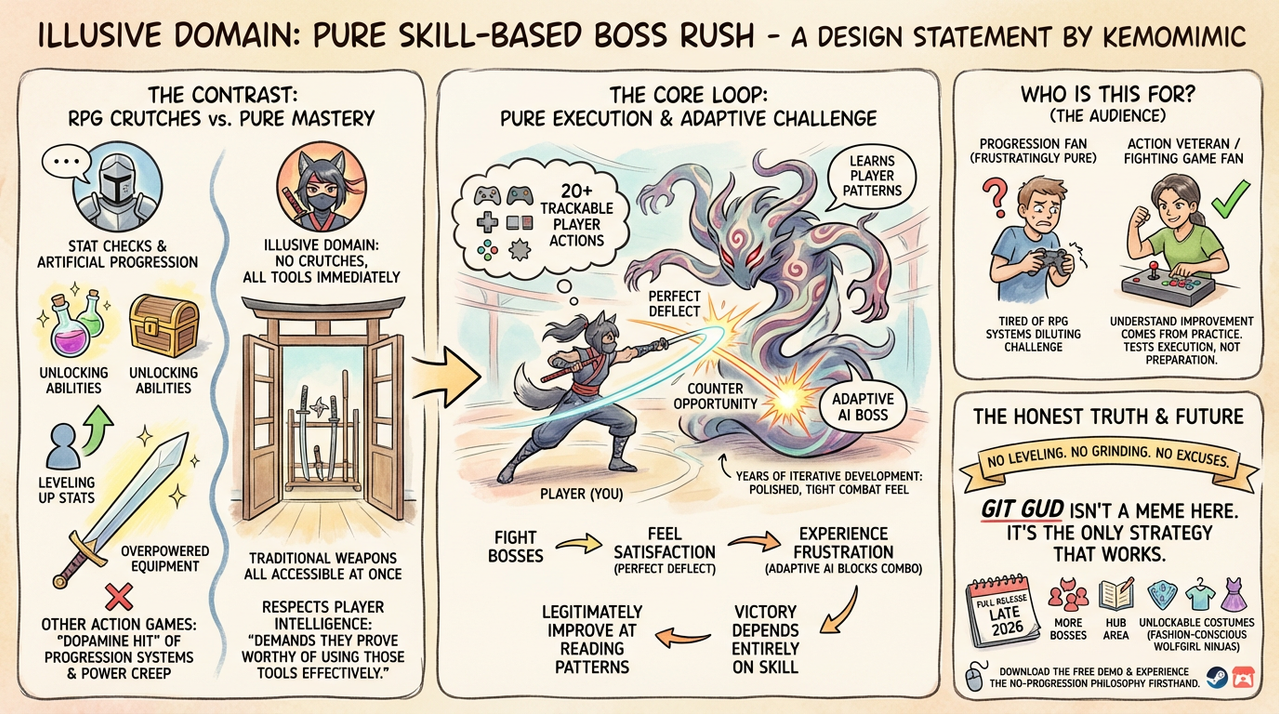
Most action games ease you in. You start weak, gradually unlock abilities, level up stats, and eventually overpower challenges that once seemed impossible. Illusive Domain from solo indie developer kemomimic throws that entire philosophy in the trash. This anime-styled boss rush gives you every single ability from the very first fight. No skill trees to unlock. No equipment upgrades to grind. No leveling system to make future attempts easier. Just pure, unfiltered skill-based combat where the only thing standing between you and victory is whether you can actually master the mechanics. Oh, and you play as a wolfgirl ninja fighting to save your master from a mysterious domain. Because of course you do.
No Progression Means No Excuses
Illusive Domain’s radical design philosophy rejects the safety nets modern action games provide. When you fight the first boss, you have access to your complete moveset: normal attacks, charged variants, deflect counters, kick attacks, iai slashes, throwing knives, dodge attacks, sprint attacks, and jump slashes. When you fight the tenth boss, you have exactly the same toolkit. Nothing changes except your understanding of when and how to use each option.
This design choice forces a mindset shift from typical action games. You can’t blame insufficient stats or locked abilities when you lose. The game isn’t holding anything back. Every tool needed to win exists in your hands from minute one. If you’re failing, it’s because you’re not executing properly, not reading patterns correctly, or not making optimal decisions under pressure. That sounds harsh, but it creates incredible satisfaction when victories arrive purely through personal improvement rather than numerical advantages.
The approach mirrors fighting games more than traditional action RPGs. In Street Fighter, a beginner and an expert have access to the same moves. The difference is execution, timing, and game knowledge. Illusive Domain applies this philosophy to boss rush structure, creating an action game where mastery matters more than grinding. Developer kemomimic describes it as everything depending on “how you use” the abilities, not which abilities you have.

Adaptive AI That Learns Your Patterns
The lack of player progression doesn’t mean bosses stay static. Illusive Domain implements an adaptive AI system where enemies gradually learn your attack patterns during fights. According to kemomimic’s development blogs, each attack you use is tracked and learned, increasing the probability that bosses will block it. Once this learning threshold crosses a certain point, attacks get deflected entirely. This means spamming the same combo repeatedly becomes less effective over time during individual battles.
This AI adaptation forces tactical variety within single encounters rather than across multiple attempts. You can’t just discover one optimal combo and ride it to victory. Bosses adapt mid-fight, forcing you to mix up approaches, use different attacks, and stay unpredictable. The system encourages mastering your full moveset rather than finding one exploit and abusing it. Combined with the no-progression philosophy, this creates boss battles that genuinely test fighting game fundamentals like adaptation, reading, and execution under changing circumstances.
The developer mentions approximately 20+ separate player actions that the AI tracks, from basic attacks and their charged variants to dodge counters, aerial versus grounded throwing knives, and different iai slash follow-ups. This granular tracking means bosses don’t just learn “you’re attacking a lot,” they learn specifically which attacks you favor and adjust accordingly.
Souls-Like Combat Without The Souls
Illusive Domain wears its souls-like influences proudly while carving its own identity. The combat emphasizes precise timing for deflects and parries, rewarding perfectly-timed defensive actions with openings to unleash devastating counters. Dodge rolling provides invincibility frames for avoiding attacks you can’t deflect. Positioning matters as much as raw DPS. Boss patterns require memorization and adaptation. The difficulty is unforgiving, with mistakes punished immediately through significant damage.
What differentiates Illusive Domain from traditional souls-likes is the complete absence of RPG systems. There’s no stat allocation, no weapon upgrades, no armor sets, no consumable items that make attempts easier. Even boss souls usually drop something you can cash in for power increases. Illusive Domain offers none of that comfort. It’s souls-like combat philosophy distilled to pure action, stripping away the RPG wrapper to focus exclusively on mechanical execution.
The comparison to games like Sekiro feels particularly apt. Both emphasize parrying and deflection over dodge-rolling. Both reward aggressive play that maintains offensive pressure while defending simultaneously. Both feature posture-like systems where perfect defensive timing creates attack opportunities. But where Sekiro eventually lets you increase attack power and health through exploration and boss victories, Illusive Domain maintains its day-one power level throughout the entire game.

Wolfgirl Ninja Protagonist
The player character is described as a wolfgirl ninja undertaking a journey into an abandoned domain to save her master. This anime-inspired aesthetic permeates every aspect of Illusive Domain’s presentation, from character designs to visual effects. The protagonist rocks animal-themed attire that gives personality without interfering with gameplay clarity. Kemomimic describes these outfits as kemomimi style, referencing the Japanese term for characters with animal ears.
Between boss battles, players return to a hub area where they can interact with other characters trapped in the domain. These interactions advance the plot gradually, revealing backstory about the domain, the protagonist’s relationship with her master, and the fates of other warriors imprisoned alongside her. The story remains mostly optional according to kemomimic, allowing players who just want pure boss rush action to skip dialogue while providing narrative depth for those who want context.
The hub system includes costume unlocks that provide visual customization without affecting stats. Each boss defeated grants costume pieces or full outfits the player can equip for style points. This represents the only form of progression in the game, purely cosmetic rewards that let you personalize your wolfgirl ninja without gaining mechanical advantages. It’s a clever compromise that gives players something to earn without undermining the skill-based design philosophy.
Warriors From Different Eras
The narrative premise involves warriors and masters from different time periods and regions appearing trapped within the same mysterious domain. Each brings unique combat styles that translate into mechanically distinct boss fights. This setup justifies the variety of opponents while creating thematic cohesion about warriors throughout history facing similar struggles. The domain serves as a sort of purgatory where skilled fighters remain entombed until someone defeats them or proves worthy of escape.
Early boss reveals include characters like the Wandering Vixen Nia, whose design and moveset draw from different martial arts traditions than the protagonist. This diversity ensures no two boss fights feel identical, each requiring adaptation to completely different attack patterns, timing windows, and optimal strategies. The lack of player progression means these mechanical differences matter more, since you can’t just outlevel or outgear challenging encounters.

Solo Developer Journey
Kemomimic is developing Illusive Domain entirely solo, handling programming, design, art, animation, and marketing. The developer maintains transparency through regular development logs on itch.io and social media, documenting progress, design decisions, and technical challenges. This solo development journey has stretched across multiple years, with the project appearing in Demo Day showcases and gradually evolving based on community feedback.
The technical stack includes Unity for the engine, Blender for 3D modeling, Substance Painter and Designer for textures, and Krita for 2D artwork. Music and illustrations come from credited collaborators, but the core game development remains a one-person operation. This solo approach allows kemomimic complete creative control over the vision, resulting in a focused design that prioritizes a specific gameplay philosophy over broader appeal.
Development milestones documented in blog posts show steady progress toward the Steam release. Features like the tutorial redesign, AI rework, dialogue system improvements, and costume functionality all emerged through iterative development and playtesting feedback. The Steam demo launched January 2, 2026, representing years of work compressed into a playable vertical slice showcasing the core boss rush loop.
Demo Available Now
The Illusive Domain demo is playable right now on Steam and itch.io, offering a substantial taste of the full game’s combat and structure. Players can fight multiple bosses, explore the hub area, interact with NPCs, and experience the no-progression philosophy firsthand. The demo provides enough content to determine whether the skill-based approach appeals to you or feels frustratingly unforgiving.
Steam reviews from demo players highlight the tight combat feel, satisfying deflection system, and genuine challenge that forces improvement rather than grinding. Some players note the difficulty curve demands patience and willingness to die repeatedly while learning patterns. Others praise the absence of artificial progression systems that would dilute the pure skill test. The demo polarizes based on exactly the design decision kemomimic intended, attracting players who want uncompromising challenge.
The full game targets a 2026 release on PC via Steam, with the demo serving as both a vertical slice for interested players and ongoing testing ground for balance and polish feedback. Kemomimic actively solicits player impressions through social media, incorporating suggestions that align with the core vision while maintaining the no-progression foundation.

What Makes It Different
The boss rush genre includes plenty of entries from Furi to Titan Souls, each offering condensed action focused purely on epic encounters without filler. Illusive Domain distinguishes itself through the radical commitment to zero progression systems. Even other skill-focused boss rushes typically include some form of upgrade path, optional abilities to unlock, or equipment that makes subsequent attempts easier. Illusive Domain refuses these concessions entirely.
This design creates a unique challenge profile. You can’t brute force victories through patience and grinding. You can’t look up optimal builds or cheese strategies involving overpowered gear combinations. The only path forward is genuinely getting better at the game through practice, pattern recognition, and execution improvement. For players tired of action games where “git gud” ultimately means “grind more stats,” Illusive Domain offers authentic skill-based progression.
The anime aesthetic and wolfgirl protagonist also help Illusive Domain stand out visually in a genre often dominated by grimdark fantasy or sci-fi settings. The colorful, energetic presentation paired with brutal difficulty creates interesting tonal contrast. You’re playing a cute animal-eared ninja getting absolutely destroyed by relentless bosses, then picking yourself up and trying again because no amount of grinding will solve the problem except improving your own skills.
Frequently Asked Questions
When does Illusive Domain release?
The full game is scheduled for 2026 release on PC via Steam. A free demo is available now on Steam and itch.io.
What platforms will Illusive Domain be available on?
PC (Windows) is confirmed. No console versions have been announced yet.
Who is developing Illusive Domain?
Kemomimic (also written as kemomic) is the solo indie developer from Singapore creating Illusive Domain, handling all aspects of development.
Are there really no upgrades or progression systems?
Correct. All abilities are available from the start. The only unlocks are cosmetic costumes. Victory depends entirely on player skill, not character stats or equipment.
How long is the demo?
The demo offers multiple boss fights and hub interactions, taking approximately one hour to experience the available content depending on skill level and how many attempts bosses require.
Is it similar to Sekiro or other souls-likes?
The combat emphasizes parrying, deflecting, and precise timing similar to Sekiro, but removes all RPG progression systems found in traditional souls-likes.
What is the adaptive AI system?
Bosses learn your attack patterns during fights, gradually increasing the likelihood they’ll block or deflect repeated attacks. This forces tactical variety within individual encounters.
Can I play with a controller?
Yes, the game supports full controller functionality. Keyboard and mouse also work.
What’s the story about?
You play as a wolfgirl ninja venturing into an abandoned domain to save your master. Warriors from different eras are trapped inside. The story is mostly optional for players who just want boss battles.
How difficult is the game?
Very difficult by design. Without progression systems to make future attempts easier, improvement requires genuine skill development through practice and pattern memorization.
Final Thoughts
Illusive Domain represents a bold design statement in an era where most action games pad difficulty with stat checks and artificial progression. Kemomimic looked at the boss rush genre and asked: what if we removed every crutch and forced players to actually master the combat? The result is a game that respects player intelligence enough to give them every tool immediately, then demands they prove worthy of using those tools effectively.
This approach won’t appeal to everyone. Players who enjoy the dopamine hit of unlocking new abilities, leveling up stats, or finding overpowered equipment combinations will find Illusive Domain frustratingly pure. But for action game veterans tired of RPG systems diluting mechanical challenge, for fighting game fans who understand improvement comes from practice rather than upgrades, for anyone who’s ever wanted a boss rush that truly tests execution rather than preparation, Illusive Domain offers exactly that experience.
The solo development aspect makes the achievement even more impressive. Kemomimic built an adaptive AI system that learns player patterns, created multiple mechanically distinct bosses with unique movesets, designed a combat system with 20+ trackable player actions, and wrapped it all in anime-styled presentation that’s visually clear and satisfying to watch. Years of iterative development show in the demo’s polish and tight combat feel.
Download the free demo from Steam or itch.io and experience the no-progression philosophy firsthand. Fight a few bosses. Feel the satisfaction when a perfect deflect opens a counter opportunity. Experience the frustration when adaptive AI starts blocking your favorite combo. Realize that the only way forward is legitimately improving at reading patterns and executing under pressure. If that sounds appealing rather than terrifying, Illusive Domain was built specifically for you.
The full release later in 2026 promises more bosses, complete story interactions, additional hub area content, and presumably more unlockable costumes for fashion-conscious wolfgirl ninjas. But the core loop exists in the demo right now: pure skill-based boss rush combat where every ability is available from the start and victory depends entirely on whether you’re good enough to use them. No leveling. No grinding. No excuses. Just you, the bosses, and the question of whether your skills match your ambition. In a genre increasingly dominated by progression systems and power creep, that radical simplicity feels refreshingly honest. Git gud isn’t a meme here. It’s the only strategy that works.