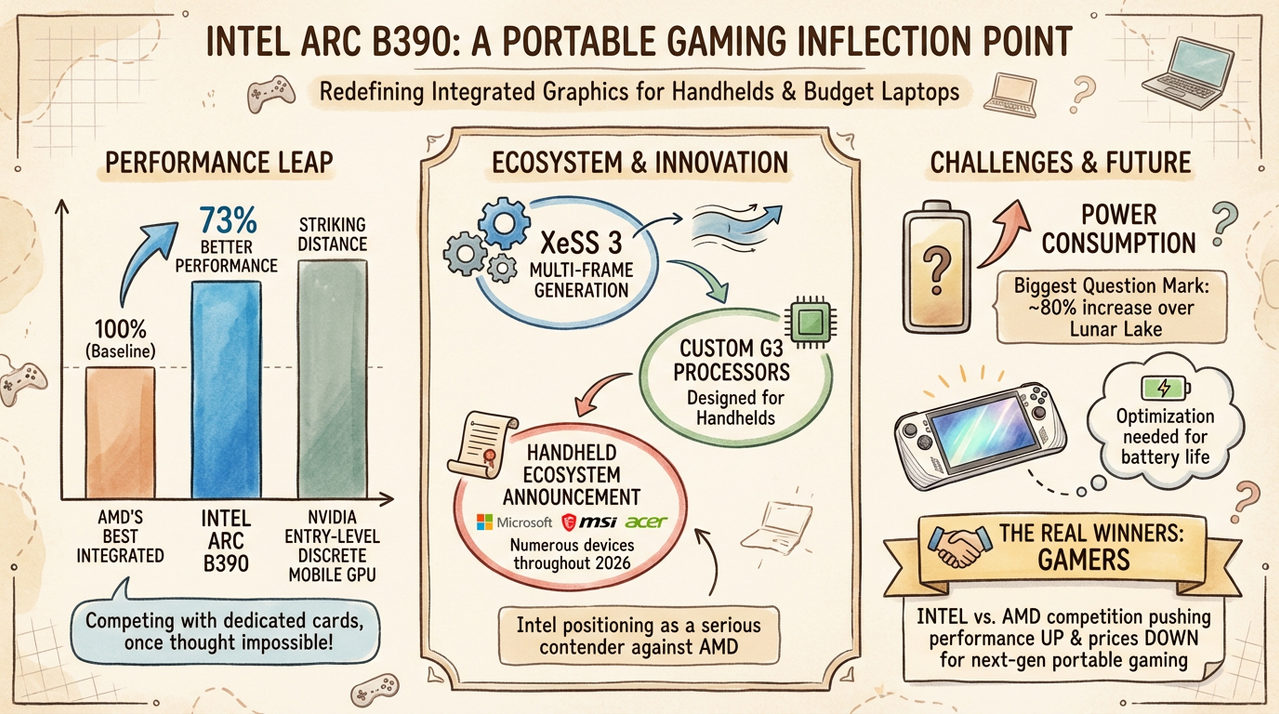
Intel just dropped a bombshell at CES 2026 that could completely reshape handheld gaming. The company’s new Panther Lake Core Ultra 3 processors feature Arc B390 integrated graphics that absolutely destroy the competition, delivering 73% better gaming performance on average than AMD’s Radeon 890M found in Ryzen AI 9 HX 370 chips. Even more impressively, the Arc B390 comes within striking distance of NVIDIA’s RTX 4050 mobile discrete GPU, trailing by just 10% while being built directly into the processor. This represents a massive leap forward for integrated graphics, potentially eliminating the need for entry-level discrete GPUs in gaming laptops and handheld devices.
Intel CEO Lip Bu Tan characterized the Panther Lake launch as a moment where the company has “overdelivered,” and the numbers back that up. The Arc B390 offers up to 77% faster gaming performance over Lunar Lake’s Arc 140V graphics chip that launched just last year. Intel VP and General Manager of PC Products Dan Rogers announced a “whole ecosystem” of gaming handhelds from partners including MSI, Acer, Microsoft, CPD, Foxconn, and Pegatron. The company is even developing handheld-exclusive CPU variants branded as Intel Core G3, custom-built specifically for portable gaming devices with GPU performance prioritized over other specs.
The Numbers Behind the Hype
Intel’s Arc B390 iGPU, built into the 12 Xe-core variant of Panther Lake chips, achieves approximately 6,300 in 3DMark Time Spy graphics tests according to benchmark results. To put that in perspective, Intel’s own comparisons show the Arc B390 is 73% faster on average than AMD’s flagship integrated solution, the Radeon 890M with RDNA 3.5 architecture. This isn’t just a minor improvement, it’s a generational leap that places Intel firmly ahead of AMD in the integrated graphics race.
The RTX 4050 mobile comparison deserves context. Intel compared against a low-wattage 4050 configuration, likely with a 60W system TDP, which doesn’t match full-powered 4050 variants that score around 8,000 on Time Spy. However, when looking at lower-powered 4050s found in ultrabooks like the Dell XPS, the Arc B390’s performance gap narrows considerably. The integrated GPU trails by just 10% in these configurations while consuming significantly less power and requiring no dedicated cooling solutions beyond what the CPU already needs.
Perhaps most impressive is how the Arc B390 completely obliterates NVIDIA’s RTX 3050 mobile. The top-performing 3050 variants typically score between 4,500 and 5,000 on Time Spy, numbers that Intel’s previous 8 Xe-core Arc 140V already approached fairly well. The 12 Xe-core Arc B390 blows past every 3050 configuration on the market, delivering discrete GPU-class performance without requiring a separate graphics chip, additional PCB space, or dedicated cooling infrastructure.
What Changed Between Generations
Intel’s Arc B390 represents the culmination of lessons learned from both the Arc Alchemist discrete GPU launch and the integrated graphics in Lunar Lake processors. When Intel first unveiled Panther Lake in October 2025, the chip’s gaming performance was touted as 50% better than Lunar Lake and 40% better performance per watt over Arrow Lake. At CES 2026, Intel upped those expectations by a significant margin, delivering 77% improvement over Lunar Lake’s Arc 140V iGPU rather than the previously promised 50%.
The architectural improvements stem from Intel’s Xe2 GPU architecture combined with the company’s proprietary 18A foundry process node. This process allows Intel to cut the Panther Lake die in various configurations, enabling hardware-specific variants optimized for different use cases. For handheld gaming devices, Intel can prioritize GPU performance over other aspects of the chip design, potentially offering even better gaming performance than the current Arc B390 specifications suggest.

The Handheld Gaming Revolution
Intel’s announcement of a “handheld ecosystem” represents the company’s most aggressive push into portable gaming since the original MSI Claw launched with disappointing performance. The Intel Core G3 processors will be custom-built specifically for handheld devices, with die configurations that maximize GPU performance where portable gamers need it most. This targeted approach contrasts with AMD’s strategy of using slightly modified versions of laptop chips in devices like the ASUS ROG Ally.
The partnership roster reads like a who’s who of gaming hardware: MSI, Acer, Microsoft, CPD, Foxconn, and Pegatron. Microsoft’s involvement is particularly intriguing given rumors about an Xbox handheld device that have circulated for years. If Microsoft builds a portable Xbox around Intel’s Core G3 processors with Arc B390 graphics, the resulting device could finally challenge Nintendo’s dominance in the handheld market while offering PC gaming compatibility that Switch lacks.
MSI already updated its Claw handheld with the Arc 140V iGPU last year, creating the Claw 8 AI+ that represented Intel’s early lead in handheld performance. However, AMD took the lead back with the ASUS ROG Ally X featuring the Ryzen Z2 Extreme, which was a major win for the Ryzen Z2 series. The Arc B390-powered devices arriving later in 2026 should swing momentum back to Intel’s favor, especially with custom G3 variants tuned specifically for portable gaming rather than general-purpose laptop chips.
XeSS 3 and Multi-Frame Generation
Hardware performance alone doesn’t tell the complete story. Intel’s new XeSS 3 software features 4x multi-frame generation, similar to technologies NVIDIA debuted with DLSS 3 and refined in DLSS 4. This AI-powered frame generation can multiply framerates by inserting generated frames between traditionally rendered ones, potentially allowing a 60 fps game to feel like 240 fps with XeSS 3 enabled.
Combined with the Arc B390’s raw performance, XeSS 3 could enable gaming experiences that rival mid-range discrete GPUs despite running on integrated graphics. IGN’s coverage suggests that Panther Lake’s iGPU with XeSS 3 “could very well replace your old, out of date desktop,” a bold claim that seems less ridiculous when you consider the Arc B390 already matches entry-level discrete mobile GPUs in native rendering performance.
Frame generation technologies have limitations, including added input latency and visual artifacts in fast-motion scenarios. However, for single-player games where absolute minimum latency isn’t critical, the combination of strong native performance plus 4x frame generation could deliver genuinely impressive results on hardware that fits inside a tablet-sized handheld device. The real test will be how well XeSS 3 performs compared to NVIDIA’s DLSS 4 and AMD’s FSR 4 when reviewers get hands-on time with shipping hardware.

Power Consumption Trade-offs
Not everything about the Arc B390 deserves celebration. Reddit discussions highlighted that while the iGPU delivers 77% better performance than Lunar Lake’s Arc 140V, it also consumes approximately 80% more power. Lunar Lake’s peak wattage during power bursts falls short of Panther Lake’s maximum sustained power, making direct power efficiency comparisons somewhat misleading. Still, the reality is that achieving this level of graphics performance requires significant power draw.
For handheld devices, power consumption directly impacts battery life, arguably the most critical spec beyond raw performance. A gaming handheld that delivers desktop-class graphics but dies after 90 minutes of gameplay isn’t particularly useful for portable use cases. Intel will need to balance performance modes carefully, offering high-power profiles for plugged-in gaming and more conservative power limits for extended battery life. The custom G3 variants designed specifically for handhelds may address these concerns with better power management tailored to portable use.
One encouraging data point is that Intel claimed 40% better performance per watt over Arrow Lake when first unveiling Panther Lake specifications. If that efficiency improvement carries through to final shipping hardware, the Arc B390 could deliver strong performance without completely destroying battery life. However, until independent reviewers test actual devices with real-world gaming workloads and battery measurements, power consumption remains the Arc B390’s biggest question mark.
How This Compares to Intel’s Discrete Arc GPUs
Intel launched its first-generation Arc Alchemist discrete GPUs in 2022 with the Arc A770 and Arc A750 targeting budget-conscious gamers. The Arc A750 featured 28 Xe-cores with 2,050MHz graphics clock and 8GB GDDR6 memory, delivering competitive 1080p and 1440p gaming performance against AMD’s RX 6600 and NVIDIA’s RTX 3060. PC Gamer’s review praised the Arc A750’s ray tracing performance and affordable pricing but noted driver issues and inconsistent game compatibility.
The Arc B390 integrated GPU uses 12 Xe2 cores, fewer than the Arc A750’s 28 Xe-cores but built on newer Xe2 architecture versus first-gen Xe. Direct comparisons are difficult because integrated graphics share system memory and power budget with the CPU, while discrete cards have dedicated VRAM and power delivery. However, early benchmarks suggest the Arc B390 punches well above its weight class considering it’s integrated graphics consuming a fraction of the power and PCB space that discrete cards require.
Intel’s second-generation Battlemage discrete GPUs launched in December 2024 with the Arc B580 at $249 and Arc B570 at $229. These cards target the same budget market segment as the Arc A750 but with improved architecture and better driver support. The Arc B580 uses 20 Xe2 cores with 12GB GDDR6 memory and was generally well-received for offering strong 1080p performance at competitive pricing. Rumors persist about a higher-end Arc B770 using the BMG-G31 die with 32 Xe2 cores that could compete with RTX 4070-class cards, though Intel hasn’t officially announced this variant.

What This Means for Gamers
Intel’s Arc B390 performance claims suggest integrated graphics have reached a tipping point where budget discrete GPUs no longer make sense for many users. If a $500-$700 laptop with Panther Lake and Arc B390 delivers gaming performance comparable to a $250 discrete RTX 3050 or RX 6600, why would manufacturers bother including separate graphics cards? The cost savings from eliminating discrete GPU components could fund better displays, larger batteries, or faster storage instead.
For handheld gaming specifically, the Arc B390 represents a genuine threat to AMD’s current dominance. The ASUS ROG Ally and Legion Go with AMD Ryzen Z1 Extreme processors currently offer the best balance of performance and battery life in the handheld PC market. Nintendo’s Switch 2 will compete in the same space with custom NVIDIA hardware. Intel’s Core G3 processors with Arc B390 graphics give manufacturers a third option that appears competitive on performance while potentially offering better x86 compatibility than ARM-based solutions.
The real winners are gamers who benefit from intense competition between AMD and Intel pushing each other to better performance and lower prices. When AMD launched the Ryzen Z2 Extreme with improved integrated graphics, it raised the bar for handheld performance. Intel’s response with Arc B390 and custom G3 chips raises that bar again. AMD will inevitably respond with next-generation RDNA 4 integrated graphics. This competitive cycle drives innovation that results in better hardware for consumers regardless of which company’s products they ultimately purchase.
FAQs About Intel Arc B390 Graphics
How much faster is Intel Arc B390 than AMD Radeon 890M?
Intel claims the Arc B390 integrated GPU is 73% faster on average than AMD’s Radeon 890M found in Ryzen AI 9 HX 370 processors. This represents a significant performance advantage for Intel in the integrated graphics battle, reversing AMD’s previous lead in this segment.
Can Intel Arc B390 compete with discrete GPUs?
Yes, Intel claims the Arc B390 comes within 10% of NVIDIA’s RTX 4050 mobile discrete GPU in gaming performance, though this comparison uses a low-wattage 4050 configuration. The Arc B390 completely outperforms all RTX 3050 mobile variants, delivering discrete GPU-class performance from integrated graphics.
When will Arc B390 graphics be available?
Intel announced Arc B390 graphics at CES 2026 on January 5-6, 2026. Panther Lake Core Ultra 3 processors with Arc B390 graphics should arrive in laptops and handheld gaming devices throughout 2026, with specific release dates varying by manufacturer and device type.
What is Intel Core G3 for handheld gaming?
Intel Core G3 is a handheld-exclusive CPU variant built on the Panther Lake architecture with die configurations optimized specifically for portable gaming devices. These chips prioritize GPU performance over other specs, potentially offering even better gaming performance than standard Panther Lake processors with Arc B390 graphics.
How does Arc B390 compare to Arc A750 discrete GPU?
The Arc B390 uses 12 Xe2 cores versus the Arc A750’s 28 first-gen Xe-cores. While direct comparisons are difficult due to integrated versus discrete architectures, early benchmarks suggest the Arc B390 delivers competitive performance despite being integrated graphics consuming far less power than discrete cards.
What is XeSS 3 multi-frame generation?
XeSS 3 is Intel’s AI-powered upscaling technology featuring 4x multi-frame generation, similar to NVIDIA’s DLSS 3/4 and AMD’s FSR 3/4. It inserts AI-generated frames between traditionally rendered frames to multiply framerates, potentially allowing 60 fps native performance to feel like 240 fps with XeSS 3 enabled.
Which companies are making Arc B390 gaming handhelds?
Intel announced partnerships with MSI, Acer, Microsoft, CPD, Foxconn, and Pegatron to create a “handheld ecosystem” around Arc B390 and Core G3 processors. These devices should launch throughout 2026, competing with AMD-powered handhelds and Nintendo’s Switch 2.
What are the power consumption concerns with Arc B390?
While the Arc B390 delivers 77% better performance than the previous Arc 140V, it also consumes approximately 80% more power. For handheld devices where battery life is critical, this power consumption increase could limit gaming sessions when running unplugged, though custom G3 variants may address this with better power management.
Conclusion
Intel’s Arc B390 integrated graphics represent a genuine inflection point for portable and budget gaming. Delivering 73% better performance than AMD’s best integrated solution while coming within striking distance of NVIDIA’s entry-level discrete mobile GPUs, the Arc B390 proves that integrated graphics can compete with dedicated graphics cards in ways that seemed impossible just a few years ago. Combined with XeSS 3 multi-frame generation and custom G3 processors designed specifically for handhelds, Intel is positioning itself as a serious contender in the portable gaming market currently dominated by AMD. The handheld ecosystem announcement with partners including Microsoft, MSI, and Acer suggests we’ll see numerous Arc B390-powered devices throughout 2026, finally giving consumers viable alternatives to AMD’s Ryzen Z-series processors. Power consumption remains the biggest question mark, as the 80% increase over Lunar Lake could impact battery life in portable devices despite the impressive performance gains. Still, if Intel’s custom G3 variants optimize power management for handheld use cases, the Arc B390 could deliver desktop-class gaming in truly portable form factors without the compromises that have plagued previous attempts. The real winners are gamers who benefit from intense Intel versus AMD competition pushing both companies to deliver better performance at lower prices. Whether you ultimately choose an Intel or AMD-powered device, the Arc B390’s arrival ensures the next generation of gaming handhelds and budget laptops will offer significantly better graphics performance than what’s available today.