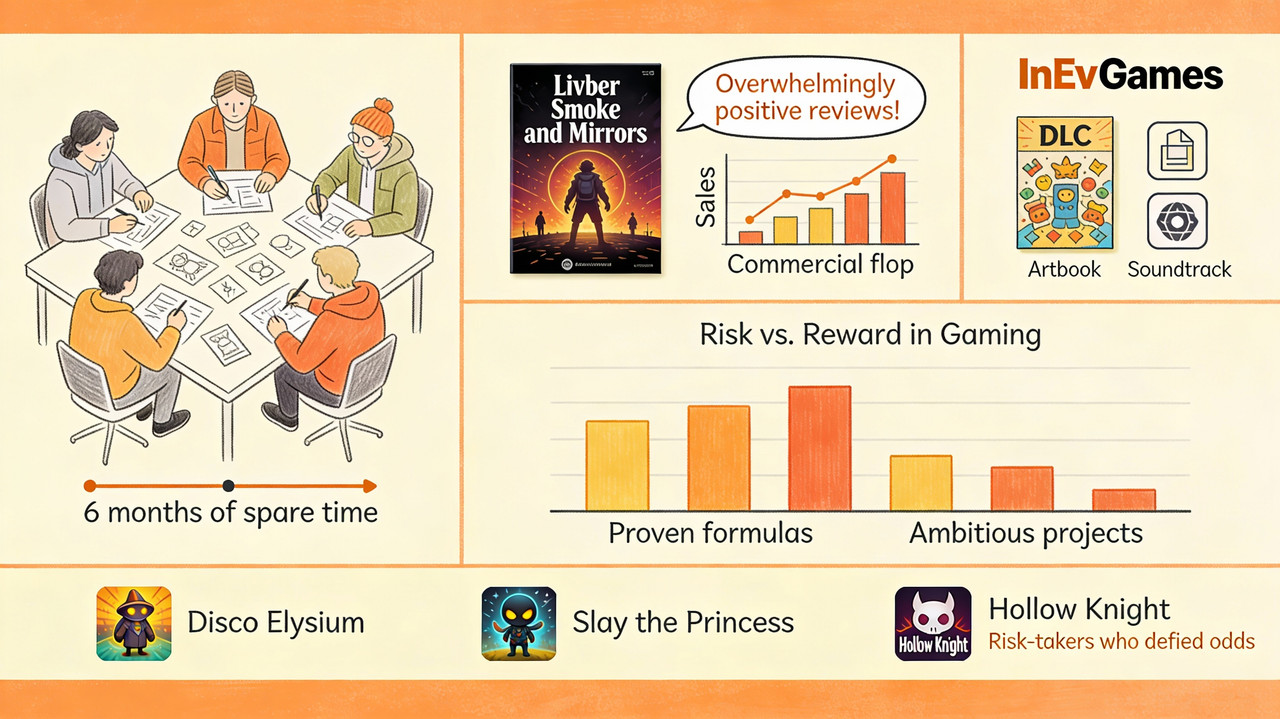
Most developers would walk away after a commercial failure. Cut losses, move to the next project, and pretend the flop never happened. But InEv Games just did the opposite with Livber Smoke and Mirrors, their psychological horror visual novel that launched in October 2025. Despite openly admitting the game didn’t sell much, they just released both an artbook and original soundtrack DLC. Why? Because they poured six months of their lives into creating something they’re genuinely proud of, and they refuse to let sales numbers diminish that achievement.
What Is Livber Smoke and Mirrors
Livber Smoke and Mirrors is a text-based interactive psychological horror visual novel about grief, obsession, and the fractures love can create. The story begins with a gut-punch premise: five years after your girlfriend Lilith died, and you carry the guilt of causing her death, you receive a letter from her stating “I’m going to give birth to your child.” That impossible message sends you back to the home you once shared, where candlelight flickers through windows and something that might be Lilith, or whatever remains of her, waits inside.
The game features 65,000 words of branching narrative with eight different endings shaped entirely by player choices. Every decision matters, from which doors you open to which questions you ask or the silences you keep. InEv Games describes it as inspired by Disco Elysium’s psychological depth and Slay the Princess’s choice-driven horror, creating an experience that asks one haunting question throughout: Who do you become when the one you love is gone?
What sets Livber apart from typical horror visual novels is its complete rejection of jump scares. This isn’t about cheap thrills or sudden loud noises. The horror comes from atmosphere, psychological unraveling, and the slow realization that memory, reality, and madness have become impossible to separate. Reviewers compared it to a text-based Silent Hill, where the protagonist confronts sins he tried to bury and truths he desperately wants to avoid.

Made With Zero AI Content
In an industry increasingly flooded with AI-generated content, InEv Games proudly advertised that Livber contains zero artificial intelligence whatsoever. Every single asset was handcrafted by their five-person team, and apparently one very distracting cat who presumably offered creative input between naps. The game features 50 uniquely hand-drawn illustrations that look like dark oil paintings, creating unsettling visuals that complement the psychological horror perfectly.
The soundtrack consists of 20 original music tracks totaling 65 minutes, composed specifically for the game’s atmosphere. Composer Uluç Kaymak created music described as echoes in full blast, dark, silent, and acoustic, perfectly capturing the dual nature of horror and melancholy that permeates the story. Over 100 sound effects were recorded and implemented to build tension without relying on sudden scares.
This commitment to handmade content matters more than ever. As one Reddit commenter on the game’s announcement post wrote, we’re already inundated with low-quality products created by people who lack genuine interest, and AI threatens to make that problem exponentially worse. InEv Games represents the opposite philosophy: a small team spending six months of their spare time creating something original, personal, and entirely human.
The Creative Team
Interactive story and writing came from Oğuzhan Açıkalın, described as an ink-stained shadow’s allegory. Atmosphere and music were handled by Uluç Kaymak. Localization and translation into English were managed by Muh. Semih Çavuş, ensuring the horror and nuance survived the language shift. Visual design was created by Mihriban Korkmaz, whose artist name Lyrierria appears throughout the credits. Together, this Turkish indie team built something that punches far above its weight class.
The game is set in the Gaia universe, suggesting InEv Games has larger ambitions for worldbuilding beyond this single story. Whether future projects will revisit this setting or explore entirely new concepts remains unclear, but the foundation they’ve established shows potential for expansion if they choose to pursue it.

The Sales Reality
When InEv Games announced the artbook and soundtrack DLC on Reddit, they didn’t hide behind corporate speak or pretend everything was fine. The post title stated plainly: “Well, it didn’t sell much, but I’m still made an Artbook and OST DLC.” That honesty is refreshing in an industry where studios spin failures as learning experiences or pivot quietly without acknowledging disappointment.
Steam reviews currently sit at 97 percent positive, classified as Overwhelmingly Positive, which makes the sales struggles more puzzling. Critics who played it praised the narrative depth, emotional impact, and artistic cohesion. YouTubers created full playthroughs showing genuine investment in the story. A website called AltChar published a review calling it a hand-crafted psychological horror that’s really about toxic relationships and guilt once you get past the scary elements.
So why didn’t it sell? Visual novels face an uphill battle in the Western market where action-driven gameplay dominates. Horror visual novels occupy an even smaller niche. Text-heavy games without voice acting struggle against audience expectations set by AAA productions with celebrity voice casts and cinematic presentation. And indie games generally face visibility challenges on Steam where thousands of titles release annually.
The game launched at $9.99 and frequently goes on sale for 20 percent off at $7.99, with the lowest recorded price hitting $7.46 during December 2025. That’s incredibly reasonable for 65,000 words of branching narrative with multiple endings, but price alone doesn’t guarantee sales. Discoverability is everything, and even excellent indie games can disappear without marketing budgets or algorithmic luck.
Why Make DLC Nobody Asked For
Creating an artbook and soundtrack DLC after admitting your game flopped seems counterintuitive from a business perspective. If nobody bought the base game, why would they buy additional content? But InEv Games wasn’t making a business decision. They were making an artistic one.
The artbook showcases those 50 hand-drawn illustrations in high resolution, likely with developer commentary explaining the creative process behind each piece. For the handful of players who connected deeply with the story, this offers a way to appreciate the artistry more fully. The soundtrack DLC lets fans listen to those 20 original tracks outside the game, which matters for music that took months to compose and record.
More importantly, the DLC serves as a monument to their effort. Six months of spare time represents thousands of hours across five people. Late nights writing dialogue, weekends drawing character designs, countless revision cycles polishing prose and balancing branching paths. That work deserves recognition even if commercial success never materialized. The artbook and soundtrack say this game mattered to us, and we’re proud of what we built.
It’s the creative equivalent of framing your art even if galleries rejected it. Publishing your novel even if agents passed. Recording your album even if labels said no. Sometimes you make things because they need to exist, and you document the process because the work itself has value independent of market validation.
The Branching Narrative Design
Livber’s eight endings aren’t simple good versus bad binary outcomes. Each reflects different psychological states, different interpretations of what happened to Lilith, and different ways the protagonist processes guilt and grief. The game tracks not just major story choices but subtle decisions about how you engage with memories, whether you challenge Lilith’s version of events, and which truths you’re willing to accept.
One playthrough might reveal Lilith as a tragic victim of circumstances beyond her control. Another might paint her as dangerously obsessed with occult rituals that backfired catastrophically. A third could suggest the protagonist’s guilt has manifested a supernatural haunting born from his own tortured psyche. The game deliberately avoids presenting one canonical truth, instead letting players construct meaning from fragments.
Reviewers who reached multiple endings reported wildly different experiences. Some found bittersweet closure where both characters acknowledge their mistakes and find peace. Others discovered horrifying revelations about rituals requiring shared sacrifice and blood alchemy binding souls together. A few stumbled into endings where reality completely collapses, suggesting the entire experience might be the protagonist’s dying hallucination.
This ambiguity frustrated some players who wanted clear answers, but it’s core to the game’s identity. Psychological horror works best when uncertainty persists, when you can’t definitively separate what’s real from what’s imagined. Livber commits fully to that philosophy, trusting players to sit with discomfort rather than demanding neat resolutions.
Frequently Asked Questions
What is Livber Smoke and Mirrors about?
Livber Smoke and Mirrors is a psychological horror visual novel about a man who receives a letter from his dead girlfriend five years after her death, claiming she’s going to give birth to his child. The game explores grief, guilt, obsession, and madness through 65,000 words of branching narrative with eight different endings.
When did Livber Smoke and Mirrors release?
The game launched on Steam on October 28, 2025. It was developed by Turkish indie studio InEv Games over six months of the team’s spare time. The artbook and soundtrack DLC were released in January 2026.
How much does Livber Smoke and Mirrors cost?
The base game is priced at $9.99 on Steam and frequently goes on sale for 20 percent off at $7.99. The artbook and soundtrack DLC are available as separate purchases, though exact pricing wasn’t specified in announcements.
Does Livber Smoke and Mirrors use AI?
No. InEv Games proudly advertised that the game contains zero AI-generated content. All 50 illustrations were hand-drawn, all 20 music tracks were originally composed, and the entire 65,000-word script was human-written by the development team.
How long does it take to complete Livber?
A single playthrough takes approximately 3-4 hours depending on reading speed. However, with eight different endings and significantly branching paths, completionists can expect 15-20 hours to experience all content and see every possible outcome.
Is Livber Smoke and Mirrors scary?
The game focuses on psychological horror and atmosphere rather than jump scares. The horror comes from unsettling themes, existential dread, and the gradual realization that reality is unreliable. Players sensitive to themes of death, guilt, and mental illness should approach with caution.
What games inspired Livber Smoke and Mirrors?
InEv Games cited Disco Elysium and Slay the Princess as primary influences. The game borrows Disco Elysium’s approach to psychological depth and internal dialogue, while taking Slay the Princess’s philosophy of choice-driven horror where every decision fundamentally alters the narrative.
Why did InEv Games make DLC if the game didn’t sell well?
The developers openly stated they created the artbook and soundtrack DLC because they’re proud of the work regardless of sales numbers. After six months of effort creating handmade content, they wanted to properly showcase the art and music even if commercial success didn’t materialize.
What This Says About Indie Development
The story of Livber Smoke and Mirrors represents both the beauty and brutality of indie game development. Five people spent six months of their spare time creating something genuinely original, avoiding trends and AI shortcuts, building every asset by hand with care and intention. They launched to overwhelmingly positive reviews from players who experienced it. And it still flopped commercially.
That outcome would crush most developers. The natural response is bitterness, resignation, or abandoning creative ambitions for more practical pursuits. But InEv Games chose defiance. They made DLC nobody asked for because the work itself deserves celebration. They refused to let market indifference diminish their pride in what they accomplished.
This attitude matters more than it might seem. The gaming industry increasingly chases proven formulas, live service models, and safe bets that maximize return on investment. Innovation gets punished when audiences stick with familiar franchises and established genres. Indie developers who take risks face financial consequences that can end careers before they properly begin.
But if every developer abandoned ambitious projects after commercial failure, we’d lose the games that define entire genres. Disco Elysium almost bankrupted ZA/UM before becoming a critical phenomenon. Slay the Princess started as a small project that exploded because it did something different. Hollow Knight launched from a tiny studio that believed in their vision despite limited resources.
Livber Smoke and Mirrors might never achieve that level of success. It might remain a hidden gem that a few thousand players discover and love while the broader market ignores it entirely. And that’s okay. Not every game needs to be a commercial smash to justify its existence. Sometimes making something you’re proud of, something human and handcrafted and honest, is enough.
The artbook and soundtrack DLC aren’t about making money. They’re about documenting that this game existed, that five people cared enough to build it properly, and that the work has value regardless of sales charts. InEv Games refused to let their first project disappear quietly, and that refusal deserves recognition. In an industry obsessed with metrics and monetization, sometimes the most radical act is simply being proud of what you made. Even when nobody’s buying.