Matt Firor, the veteran developer who co-founded Mythic Entertainment in 1995 and later founded ZeniMax Online Studios in 2007 to build The Elder Scrolls Online, finally broke his six-month silence on January 1, 2026 about why he left Microsoft. The answer is both simple and heartbreaking: they canceled Project Blackbird, an ambitious multiplayer game he describes as the project he’d waited his entire career to create. When your dream game gets axed after years of development, sometimes the only response is walking away from the company that killed it.
The LinkedIn Post That Explained Everything
Firor posted a message on LinkedIn on New Year’s Day that he later shared on Bluesky, addressing speculation about his June 2025 departure from Microsoft. His explanation was direct and unambiguous. “The most obvious explanation is the correct one,” he wrote. “Project Blackbird was the game I had waited my entire career to create, and having it canceled led to my resignation.”
That single sentence carries enormous weight when you consider Firor’s career trajectory. This is someone who helped pioneer online gaming through Mythic Entertainment’s Dark Age of Camelot, then spent nearly two decades building and running ZeniMax Online Studios. The Elder Scrolls Online launched in 2014 to mixed reviews but eventually became a commercially successful MMO with millions of players and regular expansions. Firor earned the right to take creative swings on passion projects. Microsoft said no anyway.
Firor’s statement continued with obvious pain: “My heart and thoughts are always with the impacted team members, many of whom I had worked 20+ years with, and all of whom were the most dedicated, amazingly talented group of developers in the industry.” That’s not corporate-speak. That’s genuine grief for colleagues who lost their jobs when Microsoft shuttered the project and laid off staff as part of their brutal 2025 bloodbath.
What Was Project Blackbird
Details about Project Blackbird remain scarce because Microsoft canceled it before any official announcement. Based on reports from people familiar with the project, Blackbird was envisioned as an online multiplayer loot shooter blending elements of Destiny’s cooperative gameplay with Blade Runner’s dystopian sci-fi aesthetic, all wrapped around MMORPG-style questlines and narrative depth.
That description suggests something genuinely ambitious. Destiny succeeded by making shooting feel incredible while wrapping it in light MMO systems and social spaces. Blade Runner represents one of science fiction’s most influential dystopian visions, with rich thematic depth about humanity, identity, and corporate control. Combining those influences with ZeniMax Online’s expertise in building persistent online worlds could have produced something special.
The key word there is “could.” We’ll never know if Blackbird would have delivered on that potential because Microsoft killed it before players got hands-on time. That’s the brutal reality of game development: even projects with talented teams, clear vision, and passionate leadership die in pre-production for reasons that often have nothing to do with creative merit.

The 2025 Microsoft Massacre
Project Blackbird’s cancellation wasn’t an isolated incident. Microsoft laid off approximately 650 gaming division employees in September 2024, then continued cutting throughout 2025 as part of what Firor diplomatically calls “Microsoft’s 2025 bloodbath.” The layoffs hit multiple studios including ZeniMax Online, Bethesda Game Studios, Arkane, and others across the Xbox ecosystem.
These weren’t performance-based cuts targeting underperforming teams. Microsoft laid off developers working on successful franchises and promising projects alike. The Elder Scrolls Online remained profitable and actively supported. Blackbird was apparently well-received internally, with reports suggesting leadership loved the concept. None of that mattered when the spreadsheets demanded cost reductions.
The gaming industry saw over 10,000 layoffs in 2024 alone, with 2025 continuing the bloodshed. Microsoft’s cuts represented just one company’s contribution to a broader trend of massive corporations eliminating jobs despite posting record profits. For developers like Firor who built careers in an industry they loved, watching talented colleagues lose jobs while executives collect bonuses creates justifiable bitterness.
Why Good Games Get Canceled
Here’s the uncomfortable truth about game development: quality doesn’t guarantee survival. Publishers cancel promising projects constantly for reasons including shifting market priorities, internal politics, budget reallocation, and simple cold calculation that projected revenue won’t justify continued investment. The fact that a team is passionate and talented means nothing if the business case wobbles.
Project Blackbird likely faced additional challenges specific to its genre. Live service games require enormous ongoing investment beyond the initial development. Destiny, the obvious comparison point, cost hundreds of millions to build and support across multiple years. Even successful live service games like Anthem and Marvel’s Avengers failed catastrophically despite big budgets and established studios.
Microsoft may have looked at Blackbird and decided the risk wasn’t worth the potential reward, especially given their existing portfolio. They already own massive live service franchises like Halo Infinite, Forza Horizon, Sea of Thieves, and Fallout 76. Adding another live service game requiring years of post-launch support might have seemed redundant rather than complementary, particularly if internal projections suggested modest rather than explosive success.

The Personal Cost
What makes Firor’s LinkedIn post particularly poignant is the personal investment visible between the lines. “The game I had waited my entire career to create” isn’t hyperbole for someone with 30+ years in the industry. This was his magnum opus, the project he’d spent decades preparing to build through experience gained on Dark Age of Camelot, Warhammer Online, and The Elder Scrolls Online.
Imagine spending your career mastering a craft, building a studio, earning credibility, and finally getting the opportunity to create your dream project. Then watching a corporation cancel it for reasons that have nothing to do with whether the game is good. That’s not just a business setback. It’s the death of a vision you’ve carried for years or decades.
The fact that Firor resigned rather than staying to work on other projects speaks volumes. He could have remained at Microsoft, collected a paycheck, and overseen The Elder Scrolls Online’s continued development. Instead, he walked away because continuing felt impossible after watching his dream die. That’s the kind of decision you only make when staying would be worse than leaving.
What’s Next For Firor
In his LinkedIn post, Firor admits he hasn’t figured out his next move yet. “I still haven’t figured that out,” he wrote, though he’s not “totally sitting on the sidelines.” He hasn’t “seriously contemplated spinning up a new development studio” but has “made some investments in small teams that I know will play a big part in changing the industry in the future.”
That measured approach makes sense for someone processing what sounds like genuine grief. Rushing into a new studio or project immediately after watching your dream game die would be emotionally and strategically foolish. Taking time to decompress, evaluate options, and invest in talented developers without the pressure of personally leading another studio shows wisdom earned through decades of industry experience.
Whether Firor eventually returns to active development remains an open question. He’s 50-something years old with enough financial security from his successful career that he doesn’t need to work if he doesn’t want to. But people who’ve spent 30 years building games rarely stop completely. The passion that drove him to describe Blackbird as his career-defining project doesn’t just disappear because one company canceled one game.

The Broader Industry Context
Firor’s story represents a microcosm of broader problems plaguing the gaming industry. Major publishers demand bigger budgets, longer development cycles, and live service monetization to justify investments. Then they panic about costs and cancel promising projects when market conditions shift or executive priorities change. Developers caught in this cycle lose years of work and colleagues they’ve built relationships with over decades.
The human cost of these corporate decisions rarely gets acknowledged in earnings reports and shareholder presentations. When Microsoft announces layoffs, they frame it as necessary business optimization. They don’t mention veterans like Matt Firor walking away after watching dream projects die. They don’t discuss teams disbanded despite producing quality work. The spreadsheet doesn’t care about passion or talent.
This dynamic creates a toxic cycle where experienced developers burn out and leave, taking institutional knowledge with them. Studios lose the veterans who mentor junior developers and maintain long-term vision. The industry becomes increasingly transactional, with developers viewing companies as temporary stops rather than career homes. Everyone suffers except shareholders and executives.
Lessons From a Dream Deferred
What can aspiring developers learn from Firor’s experience? First, that even enormous success and industry credibility don’t guarantee creative freedom. Firor co-founded Mythic, built one of the biggest MMOs in the world, and still watched his passion project die because a corporation decided it didn’t fit their portfolio.
Second, that knowing when to walk away matters. Firor could have stayed at Microsoft, collected a paycheck, and worked on projects he didn’t care about. Instead, he recognized that remaining would be spiritually corrosive and chose to leave. That decision requires both financial security and emotional clarity that many developers don’t have, but it’s worth aspiring toward.
Finally, that the games we make aren’t guaranteed to reach players no matter how talented the team or compelling the vision. The industry wastes enormous creative potential through cancellations, layoffs, and corporate restructuring. The only way to maintain sanity is accepting that reality while fighting to change it when possible.

FAQs About Matt Firor and Project Blackbird
Who is Matt Firor?
Matt Firor co-founded Mythic Entertainment in 1995 (Dark Age of Camelot) and founded ZeniMax Online Studios in 2007 to develop The Elder Scrolls Online. He resigned from Microsoft in June 2025 after they canceled Project Blackbird.
What was Project Blackbird?
Project Blackbird was an online multiplayer loot shooter blending Destiny-style gameplay with Blade Runner’s dystopian aesthetic and MMORPG-style questlines. Microsoft canceled it before any official announcement.
Why did Microsoft cancel Project Blackbird?
Microsoft hasn’t provided official explanation, but the cancellation came during massive 2025 layoffs affecting 650+ gaming division employees. The decision was likely financial rather than quality-based.
Did Matt Firor quit or was he fired?
Firor resigned voluntarily in June 2025 after Microsoft canceled Project Blackbird. He chose to leave rather than continue working for the company that killed his dream project.
How long was Project Blackbird in development?
Development timeline hasn’t been confirmed, but Firor worked with some team members for 20+ years, suggesting significant investment before cancellation. The project never reached public announcement.
Will Project Blackbird ever be revived?
Extremely unlikely. Microsoft owns the IP, and Firor no longer works there. He’s made investments in small development teams but hasn’t announced plans to create a similar game elsewhere.
Is The Elder Scrolls Online still being developed?
Yes, The Elder Scrolls Online continues active development with regular expansions and updates. Firor’s departure didn’t affect the game’s ongoing support.
What is Matt Firor doing now?
Firor is taking time to figure out his next move. He’s made investments in small development teams but hasn’t committed to founding a new studio or leading another major project yet.
Conclusion
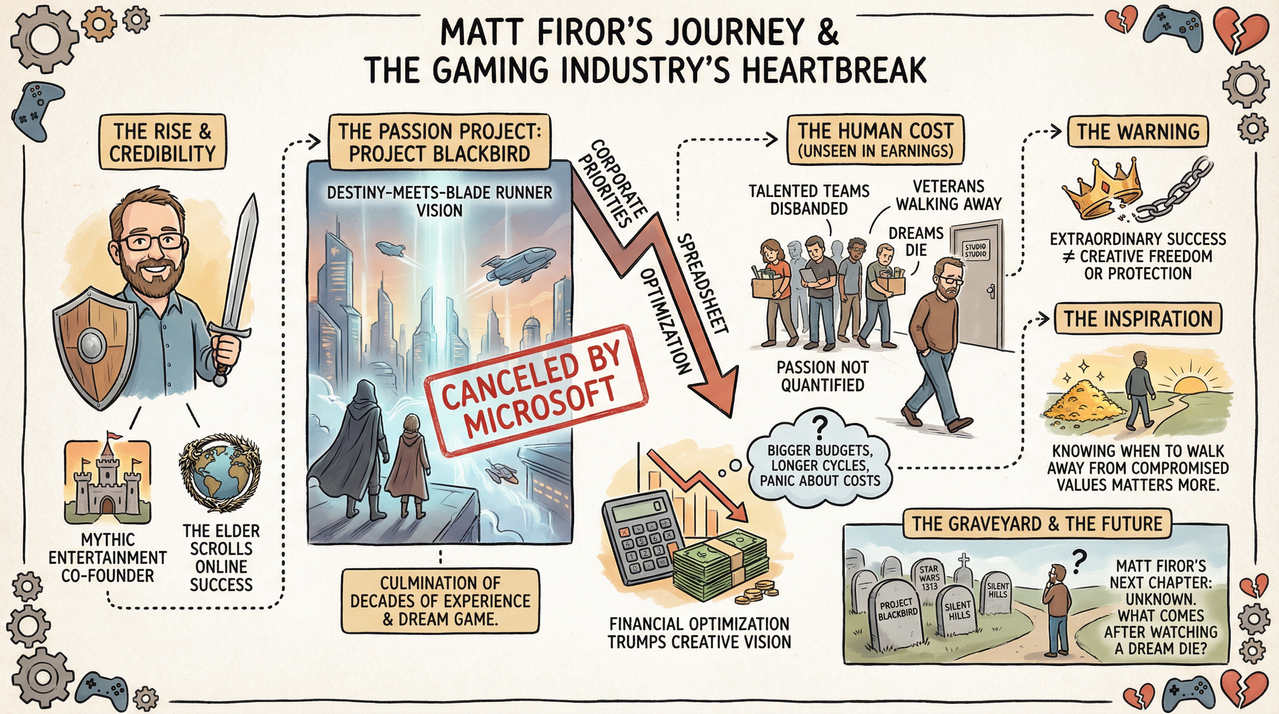
Matt Firor’s story is a reminder that the gaming industry regularly breaks the hearts of even its most successful veterans. Co-founding Mythic Entertainment and building The Elder Scrolls Online into a commercially successful MMO earned him the credibility to pursue passion projects. But corporate priorities don’t care about credibility, and spreadsheet optimization trumps creative vision when executives decide to cut costs. Project Blackbird represented the culmination of decades of experience, the game Firor had been preparing his entire career to create. Microsoft canceled it anyway, triggering his resignation and leaving talented developers jobless despite producing quality work. That’s not an anomaly in modern gaming. It’s increasingly the norm as major publishers demand bigger budgets and longer development cycles while simultaneously panicking about costs and canceling promising projects when market conditions shift. The human cost rarely appears in earnings reports. We don’t see the veterans walking away after watching dreams die or the teams disbanded despite years of collaboration. The spreadsheet doesn’t quantify passion or talent, so those factors don’t influence decisions driven purely by financial optimization. Whether Firor returns to active development or remains on the sidelines investing in small teams, his experience serves as both warning and inspiration. The warning: even extraordinary success doesn’t guarantee creative freedom or protection from corporate whims. The inspiration: knowing when to walk away from situations that compromise your values matters more than clinging to prestige or paychecks. For now, Project Blackbird joins the vast graveyard of canceled games that might have been special. We’ll never know if it would have delivered on its Destiny-meets-Blade Runner vision because Microsoft killed it before players could decide for themselves. And Matt Firor, who waited his entire career for that opportunity, is left figuring out what comes next after watching his dream die.