Meta’s VR bloodbath just claimed a high-profile victim. According to YouTuber Gamertag VR and multiple VR insiders, Skydance Games was developing an official Harry Potter VR experience for Quest before Meta abruptly pulled funding during this week’s Reality Labs restructuring. The cancellation comes alongside studio closures and signals Meta’s retreat from premium VR gaming content.
The Harry Potter Project Details
Skydance Interactive – creators of The Walking Dead: Saints & Sinners and Behemoth – had reportedly received tens of millions in Meta funding for the Harry Potter VR title. Development was underway with a planned Quest exclusivity deal before Meta’s January 13, 2026 layoffs eliminated third-party funding across Reality Labs.
Sources describe the project as a full Hogwarts experience featuring wand-based spellcasting, Quidditch matches, and exploration of key locations from the Wizarding World. Gamertag VR’s reporting cites Skydance’s narrative expertise positioning the game as a potential Hogwarts Legacy-style VR hit ahead of HBO’s 2027 Harry Potter series reboot.
Meta’s VR Retreat
The Harry Potter cancellation forms part of Meta’s broader pivot away from VR gaming investment. This week’s layoffs shuttered three first-party studios (Deadpool VR, Resident Evil 4 VR, Asgard’s Wrath teams) while Cloudhead Games (Pistol Whip) lost 70% of staff after Meta withdrew funding from two unannounced titles.
- Supernatural fitness app discontinued
- Horizon Start Program defunded
- $60M third-party budget eliminated
- 10% Reality Labs staff cut
Meta invested billions establishing Quest dominance but now redirects toward AI, smart glasses, and AR hardware. Gaming shifts to social multiplayer experiences targeting teenagers rather than premium single-player titles.

Skydance’s VR Legacy
Skydance Interactive built VR credibility through narrative excellence. Saints & Sinners delivered survival horror depth while Behemoth showcased technical wizardry with giant robot combat. Both titles earned Game of the Year nominations, positioning Skydance perfectly for premium IP like Harry Potter.
The studio’s cancellation compounds industry trendlines. Warner Bros axed Wonder Woman and Hogwarts Legacy DLC amid gaming restructuring. Premium VR single-player experiences face existential threats as platforms prioritize live-service models and social features.
Why Harry Potter VR Mattered
Perfect timing aligned Harry Potter VR with HBO’s 2027 series reboot. Hogwarts Legacy proved massive appetite for Wizarding World gaming despite J.K. Rowling controversies. VR offered unmatched immersion – flying broomsticks, dueling Death Eaters, exploring Diagon Alley in spatial 3D.
Meta’s funding withdrawal kills what could’ve been Quest’s tentpole exclusive. No other platform holds Harry Potter VR rights. Warner Bros focuses on Hogwarts Legacy sequel across traditional platforms while Meta abandons single-player VR entirely.

VR Gaming’s New Reality
Meta’s pivot mirrors Facebook-to-Meta rebrand logic – use gaming losses to bootstrap platform dominance, then extract value through social features and AR hardware. Quest 3 owners face content drought after hardware refresh cycle completes.
Industry analysts predict SteamVR and Pimax benefit from Meta’s retreat. PC VR offers richer libraries while avoiding walled-garden economics strangling Quest exclusives. Valve’s rumored Steam Frame headset gains market advantage absent Meta competition.
FAQs
Was Harry Potter VR officially announced?
No public reveal occurred. Skydance received substantial Meta funding before cancellation during Reality Labs layoffs on January 13, 2026.
Which studio developed the game?
Skydance Interactive (The Walking Dead: Saints & Sinners, Behemoth). Studio earned VR credibility through narrative excellence and technical achievements.
Why did Meta cancel the project?
Reality Labs restructuring eliminated $60M third-party budget. Meta pivots toward AI, AR glasses, social VR rather than premium single-player gaming.
What did the game feature?
Hogwarts exploration, wand spellcasting, Quidditch, Diagon Alley. Planned Quest exclusive positioned ahead of HBO’s 2027 Harry Potter series.
Will Harry Potter VR appear elsewhere?
Unlikely. Warner Bros prioritizes Hogwarts Legacy sequel for traditional platforms. No competing VR platforms hold Wizarding World rights.
What other VR projects died this week?
Three Meta studios closed (Deadpool VR, RE4 VR, Asgard’s Wrath). Cloudhead Games lost 70% staff. Supernatural fitness app discontinued.
Is VR gaming dead?
No. PC VR (SteamVR, Pimax) thrives with richer libraries. Meta abandons premium content but social VR survives alongside hardware shipments.
What’s Meta’s new focus?
AI development, AR smart glasses, social multiplayer VR targeting teenagers. Gaming becomes platform feature rather than standalone business.
Conclusion
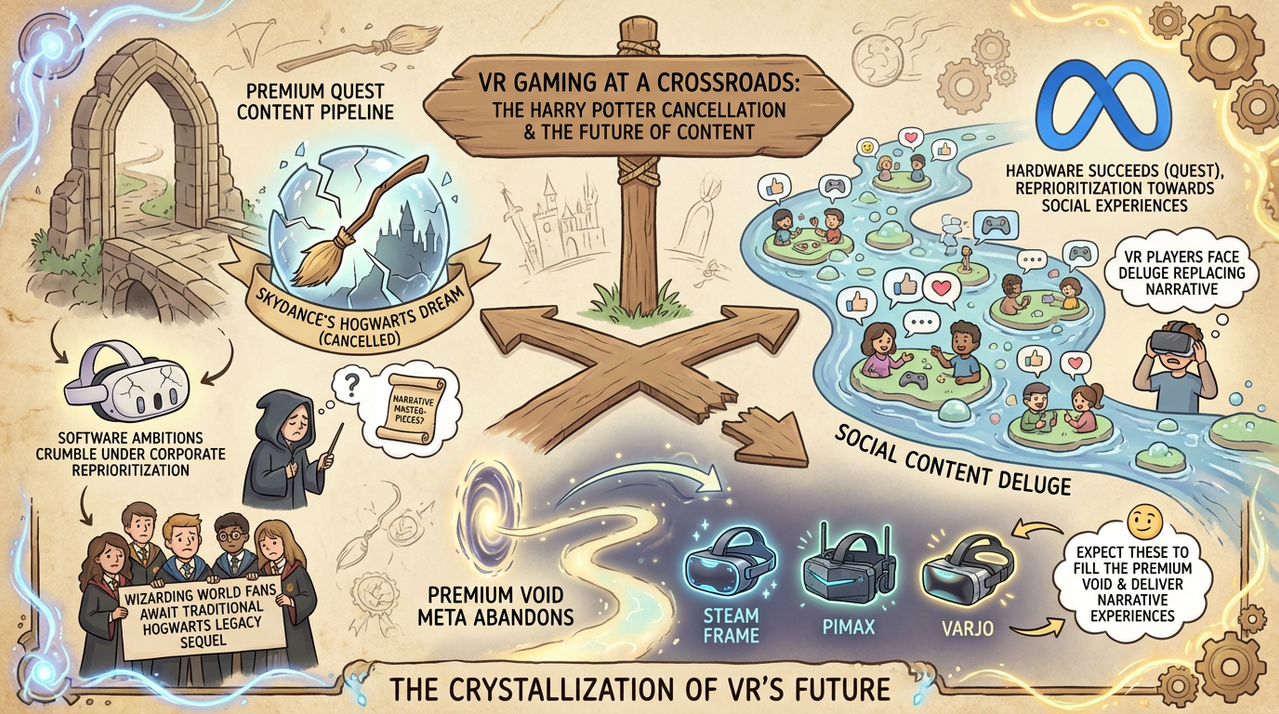
Meta’s Harry Potter VR cancellation crystallizes VR gaming’s crossroads. Skydance’s Hogwarts dream dies alongside premium Quest content pipeline. Hardware succeeds while software ambitions crumble under corporate reprioritization. Wizarding World fans await traditional Hogwarts Legacy sequel while VR players face social content deluge replacing narrative masterpieces. Expect Steam Frame, Pimax, Varjo to fill premium void Meta abandons.