The Monster Hunter Wilds Switch 2 story keeps getting more interesting. Following the initial discovery of local multiplayer support and NSW2 references in the game’s code, dataminers have dug deeper into Title Update 4 and uncovered fascinating technical details about how Capcom plans to make this demanding game run on Nintendo’s upcoming console. Spoiler alert: it involves some serious optimization tricks and potentially massive implications for other Capcom games.
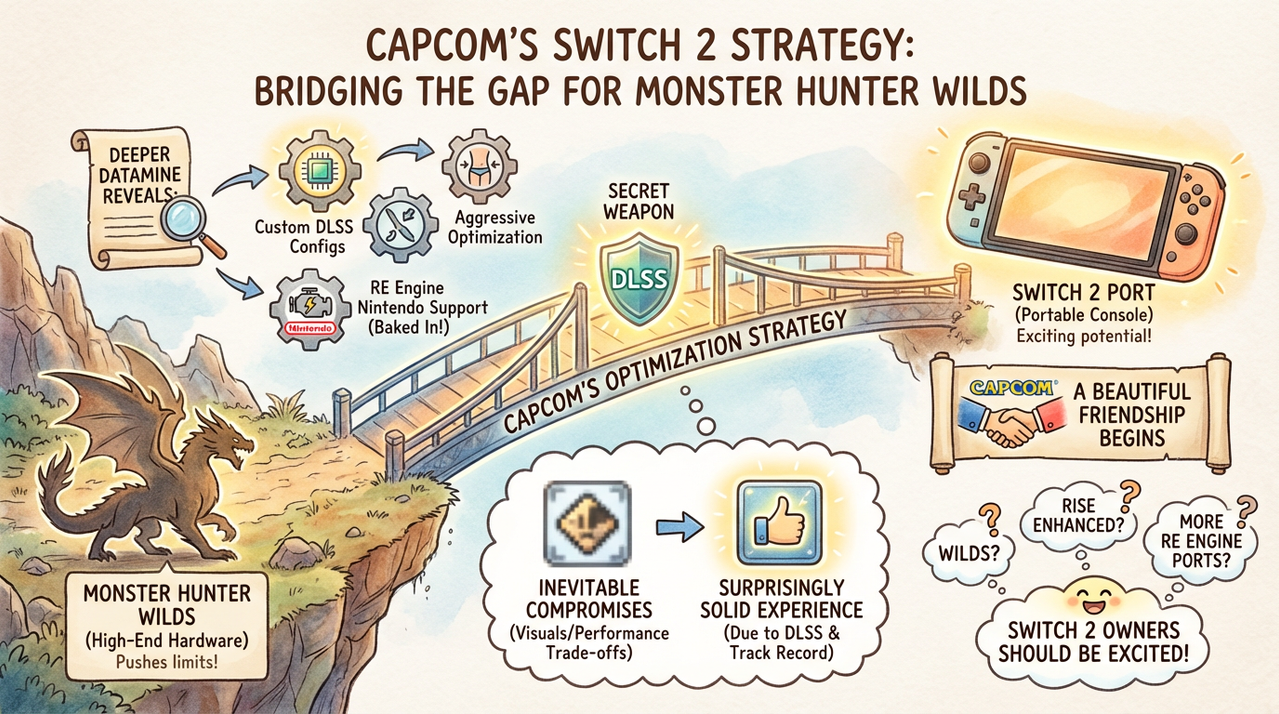
Custom DLSS Presets Are The Secret Weapon
The most significant technical revelation is that Monster Hunter Wilds on Switch 2 will feature its own dedicated DLSS preset configurations. DLSS, or Deep Learning Super Sampling, is Nvidia’s AI-powered upscaling technology that renders games at a lower native resolution before intelligently upscaling them to higher resolutions. The Switch 2 reportedly uses a custom Nvidia Tegra chip with Ampere-based GPU architecture that supports DLSS, making this the perfect solution for running demanding games on portable hardware.
According to the datamine, the standard PC version of Monster Hunter Wilds contains Presets A through C, which are now considered outdated and unnecessary. The Switch 2 version, however, has completely custom presets built specifically for the console’s hardware capabilities. This suggests Capcom and Nvidia have been collaborating closely to optimize performance specifically for Nintendo’s platform rather than just slapping on generic settings and hoping for the best.
NPC Culling Gets Aggressive
The datamine revealed some of the visual compromises Capcom is making to hit their performance targets on Switch 2. The most notable change involves NPC culling, which determines how far away characters and creatures can be before the game stops rendering them to save processing power. In the Switch 2 version, NPC activation distances have been cut in half compared to other platforms.
For example, if the PlayStation 5 and Xbox Series versions render NPCs at 100 meters away, the Switch 2 version only renders them at 50 meters. The term NPC here doesn’t just mean human characters but encompasses all creatures, monsters, and environmental entities. Additionally, there’s a parameter labeled “Always” set to true for consistent culling, though dataminers aren’t entirely sure what this specifically controls yet.

The Endemic Life Mystery
One of the more concerning discoveries involves endemic life, the small environmental creatures that populate Monster Hunter worlds. These include bugs, birds, fish, and other critters that make the environments feel alive and vibrant. The datamine suggests the spawn rate for endemic life might be reduced to one-fifth (20% of normal) in the Switch 2 version, which would make the world feel significantly emptier.
However, there’s an important caveat here. The file containing this information is labeled “OPT,” which likely stands for optimization. Dataminer Lener30 noted that this might actually be related to low-spec PC settings that Capcom plans to introduce in a January 2026 Steam update, allowing players with weaker computers to reduce environmental clutter for better performance. If this theory is correct, the endemic life reduction might be optional rather than mandatory for Switch 2, or it could apply to a performance mode while a quality mode maintains fuller spawns.
What About That Upgrade Edition?
| Discovery | What It Means |
|---|---|
| NSW2 Upgrade Edition Code | Built into RE Engine, not Wilds-specific |
| Custom DLSS Presets | Nvidia and Capcom optimizing specifically for Switch 2 hardware |
| NPC Culling Distance | Reduced by 50% to improve performance |
| Endemic Life Spawns | Possibly reduced to 20%, but might be PC low-spec option |
| Local Multiplayer | Supports local wireless network play for up to 4 Switch 2 consoles |
The datamine uncovered references to something called “via.store.Native.ns2UpgradeEdition” in the RE Engine files, which initially sparked speculation about a potential upgrade path for existing Wilds owners. However, after deeper analysis, dataminers concluded this is actually a general feature built into Capcom’s RE Engine itself rather than something specific to Monster Hunter Wilds.
This discovery has massive implications beyond just Wilds. If the NSW2 upgrade functionality is baked directly into the RE Engine, that means every Capcom game running on this engine could potentially support Switch 2 versions with upgrade paths. We’re talking about Resident Evil titles, Street Fighter 6 (which already launched on Switch 2), Devil May Cry 5, and potentially even older RE Engine games getting surprise ports.

Could Monster Hunter Rise Get Enhanced?
One of the most interesting theories floating around is that the RE Engine’s NSW2 upgrade functionality might actually be intended for Monster Hunter Rise rather than Wilds. Rise launched as a Switch exclusive in March 2021 before being ported to PlayStation, Xbox, and PC with enhanced visuals and performance. The original Switch version is locked at 30fps with lower resolution textures and reduced effects.
With Switch 2’s improved hardware and DLSS support, Capcom could offer a $5 to $10 upgrade for Rise owners that unlocks 60fps gameplay, higher resolution textures, improved anti-aliasing, and faster load times. Rise sold over 7 million copies on Switch, so there’s definitely a financial incentive to bring players back with an enhanced version. Plus, it would give Switch 2 owners a Monster Hunter experience while they wait for Wilds to potentially arrive later.
The RE Engine Flexibility
Capcom’s RE Engine has proven incredibly scalable across different hardware configurations. The engine powers everything from high-end PC and console experiences like Resident Evil Village to more modest productions like Monster Hunter Stories. This flexibility is exactly why a Switch 2 port of Monster Hunter Wilds is even conceivable despite the game’s demanding nature on other platforms.
The fact that NSW2 support appears to be integrated at the engine level rather than game-by-game suggests Capcom made a strategic decision to fully support Nintendo’s new platform across their entire catalog. This aligns with statements from Capcom executives about wanting to maximize their audience reach and make their games available on as many platforms as possible.
When Could We See An Announcement?
Capcom hasn’t officially confirmed Monster Hunter Wilds for Switch 2, and all current information comes from datamining rather than official sources. However, the sheer volume of platform-specific code and optimization work discovered in the files strongly suggests this is a real project in active development rather than just placeholder code.
The timing for an announcement could come at several potential events. Monster Hunter Festa, the annual fan celebration, happens in February 2026 and would be the perfect venue for a Switch 2 reveal. Alternatively, Capcom could announce it during a Nintendo Direct presentation, potentially in spring or summer 2026. Given that functional UI elements and local multiplayer infrastructure already exist in the code, the port seems fairly far along in development.

Performance Reality Check
Let’s address the elephant in the room. Monster Hunter Wilds struggles to maintain stable performance even on high-end gaming PCs and current-generation consoles. The game launched in February 2025 with widespread performance complaints, and while Title Update 4 made improvements, many players still report frame drops and stuttering, particularly in areas with multiple large monsters.
The Switch 2, despite being more powerful than the original Switch, is still fundamentally a portable console with mobile-class hardware. Even with DLSS, aggressive NPC culling, reduced endemic life, and other optimizations, getting Wilds to run acceptably will be a significant technical challenge. The port will almost certainly target 30fps rather than 60fps, and players should expect noticeable visual downgrades from other versions.
That said, Monster Hunter Rise proved that a well-optimized 30fps experience can still feel responsive and enjoyable for this type of game. If Capcom can maintain a locked 30fps with minimal stuttering and keep input lag low, the Switch 2 version could be perfectly playable, especially for the portable Monster Hunter audience that values being able to hunt anywhere over having the absolute best graphics.
What This Means For Other Capcom Games
The discovery that NSW2 support is built into the RE Engine itself opens up exciting possibilities for Capcom’s catalog on Switch 2. Games that previously seemed impossible for Nintendo hardware might suddenly become viable with DLSS and the console’s improved specs. Resident Evil Village, Devil May Cry 5, and the Resident Evil 2 and 3 remakes could all potentially come to Switch 2 with proper optimization.
Street Fighter 6 already launched on Switch 2 back in June 2025, demonstrating that the RE Engine can deliver solid fighting game performance on the platform. Dragon’s Dogma 2, while extremely demanding, might also become possible with significant downgrades. The Monster Hunter Wilds datamine essentially confirms that Capcom is all-in on supporting Nintendo’s new console across their major franchises.
FAQs
What new information was revealed in the latest Monster Hunter Wilds datamine?
The datamine discovered custom DLSS presets specifically for Switch 2, NPC culling distances reduced by 50%, potential endemic life spawn reductions to 20%, and that NSW2 upgrade functionality is built into the RE Engine itself rather than being Wilds-specific.
Will Monster Hunter Wilds use DLSS on Switch 2?
Yes, the datamine revealed that the Switch 2 version features its own dedicated DLSS preset configurations, separate from the standard PC presets. This is Nvidia’s AI-powered upscaling technology that will help the game run on portable hardware.
What visual compromises will the Switch 2 version have?
NPC rendering distances will be cut in half compared to other platforms, endemic life may spawn at reduced rates (though this might be optional), and the game will likely target 30fps rather than 60fps with various graphical settings turned down.
Could Monster Hunter Rise get a Switch 2 upgrade instead?
Possibly. The NSW2 upgrade functionality is built into the RE Engine itself, which could be used to enhance Rise with 60fps, improved textures, and better performance. Rise sold 7 million copies on Switch, making an upgrade financially attractive for Capcom.
What does this mean for other Capcom games on Switch 2?
Since NSW2 support is integrated into the RE Engine at a fundamental level, potentially every Capcom game using the engine could come to Switch 2. This includes Resident Evil titles, Devil May Cry 5, Dragon’s Dogma 2, and others.
When will Capcom officially announce Monster Hunter Wilds for Switch 2?
No official announcement has been made. Potential venues include Monster Hunter Festa in February 2026, a Nintendo Direct in spring or summer 2026, or a Capcom-specific showcase event.
Will the Switch 2 version support cross-platform play?
Unknown. The main Wilds game supports full cross-platform play between PC, PlayStation, and Xbox. Whether Switch 2 would be included in that ecosystem or kept separate due to performance differences hasn’t been revealed.
What frame rate will the Switch 2 version target?
Almost certainly 30fps. The game struggles to maintain 60fps even on powerful consoles and PCs, so a locked 30fps would be the realistic target for Switch 2’s mobile-class hardware.
Is the endemic life reduction final?
Not necessarily. The datamine notes suggest this might actually be related to low-spec PC optimization settings coming in January 2026, meaning it could be an optional performance mode rather than mandatory for Switch 2.
Conclusion
The deeper datamine of Monster Hunter Wilds reveals a fascinating picture of how Capcom is approaching the Switch 2 port. Custom DLSS configurations, aggressive optimization strategies, and RE Engine-level Nintendo support all point to a company that’s serious about bringing their biggest games to the platform. Yes, there will be visual compromises and performance trade-offs. That’s inevitable when porting a game that pushes high-end hardware to a portable console. But with DLSS as the secret weapon and Capcom’s proven track record of excellent RE Engine optimization, the Switch 2 version could deliver a surprisingly solid Monster Hunter experience. The fact that this support is baked into the engine itself means we’re likely looking at the beginning of a beautiful friendship between Capcom and Nintendo’s new hardware. Whether it’s Wilds, Rise Enhanced, or a flood of other RE Engine ports, Switch 2 owners should be excited about what’s coming from Capcom.