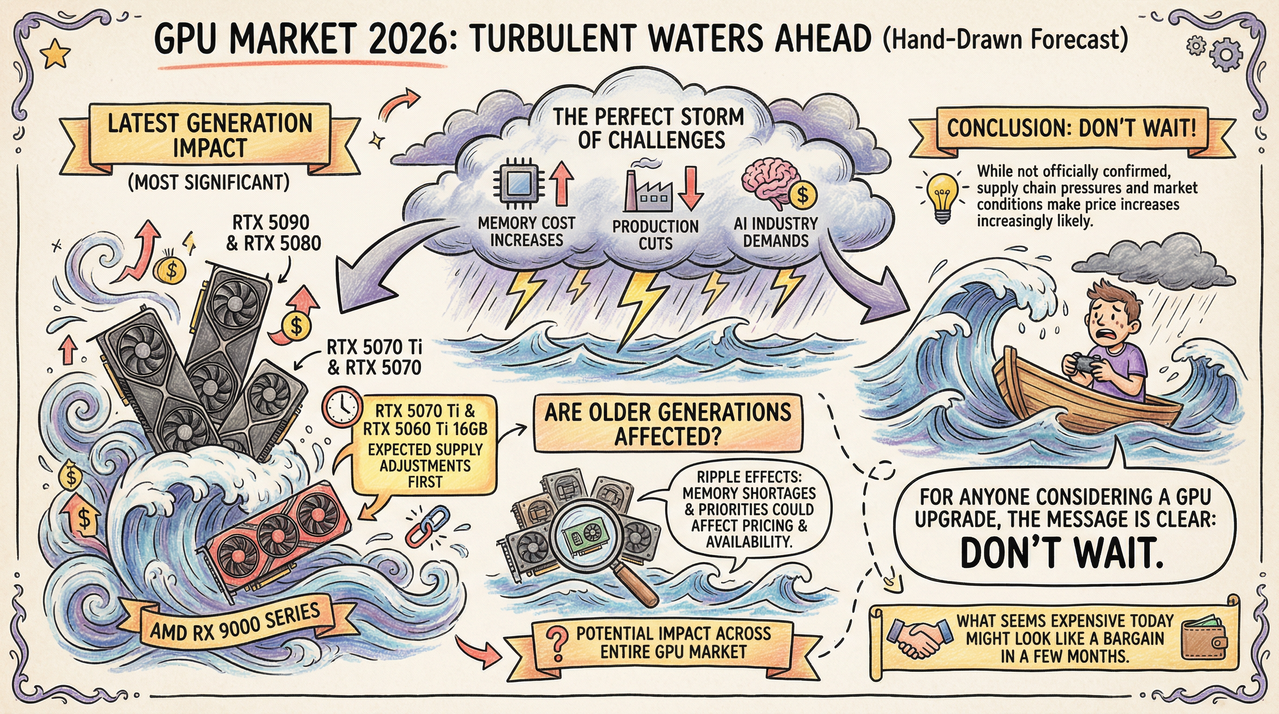
If you’ve been eyeing a new graphics card, you might want to pull the trigger now. Both Nvidia and AMD are reportedly gearing up to significantly increase GPU prices starting in early 2026, and the news keeps getting worse for PC gamers looking to upgrade their rigs.
The Price Hike Timeline
According to reports from Chinese tech forum Board Channels, AMD is expected to move first with price increases as early as January 2026, while Nvidia will likely follow suit around February 2026. The timing couldn’t be worse for gamers, as both companies just launched their latest generation of graphics cards – Nvidia’s RTX 50 Blackwell series and AMD’s RX 9000 series.
The magnitude of these increases is staggering. Nvidia’s flagship RTX 5090, which launched with an MSRP of $1,999 in early January 2025, could potentially reach up to $5,000 according to some industry insiders. Even though the card was initially scalped to over $4,000 at launch and has since settled around $3,000, another price hike would put high-end gaming further out of reach for most enthusiasts.
Why Are Prices Going Up?
The culprit behind this price surge is memory costs. Over the past six months, memory prices have doubled, increasing the manufacturing cost of graphics cards by a whopping 80%. Market research firm Counterpoint predicts that memory prices will continue to rise by more than 40% before the second quarter of 2026.
The situation is particularly dire for GDDR7 memory, which powers the latest generation of GPUs. Memory manufacturers are prioritizing production for AI data centers, which typically involve long-term contracts and higher margins. This leaves consumer graphics cards competing for scraps in an already tight supply environment.
Production Cuts Making Things Worse
As if rising prices weren’t bad enough, Nvidia is reportedly planning to cut gaming GPU production by 30% to 40% in the first half of 2026 compared to the same period in 2025. This decision stems from VRAM supply issues and the company’s need to allocate resources for its rumored RTX 50 Super variants, which are expected to use 3GB GDDR7 modules instead of the standard 2GB ones.
Industry sources suggest that Nvidia has also stopped bundling VRAM with its GPU dies, forcing add-in card partners to source memory directly from manufacturers like Samsung and Micron. This change particularly impacts smaller GPU vendors who lack established relationships with memory suppliers, potentially pushing them out of the market entirely.
What This Means for Gamers
| Impact Area | Details |
|---|---|
| Price Increases | 10% or more across both AMD and Nvidia lineups |
| Availability | 30-40% reduction in Nvidia gaming GPU production |
| Timeline | January 2026 (AMD), February 2026 (Nvidia) |
| Affected Models | RTX 50 series, AMD RX 9000 series |
| Memory Cost Impact | 80% increase in manufacturing costs |
The situation creates a perfect storm for PC gamers. Reduced supply combined with increased prices means that getting your hands on a new graphics card at a reasonable price will become increasingly difficult. The first models expected to see adjusted supply include the GeForce RTX 5070 Ti and RTX 5060 Ti 16GB GDDR7 GPUs, according to reports from AIC partners and component suppliers.
The AI Factor
The root cause of these issues extends beyond simple supply and demand. The explosive growth of AI applications has created unprecedented demand for GPUs and memory. Data centers are consuming massive quantities of hardware, and manufacturers are prioritizing these high-margin customers over consumer gaming products.
Some custom chip factories are even hoarding consumer graphics cards like the RTX 5060 Ti, RTX 5070, and RTX 5080, expanding their VRAM to make them suitable for AI applications. This practice further reduces the already limited supply available to gamers.
Should You Buy Now?
If you’ve been on the fence about upgrading your GPU, the math is pretty straightforward. With production cuts starting in early 2026 and price increases hitting shortly after, current prices – while not great – may be the best you’ll see for quite some time. The combination of reduced availability and higher costs suggests we’re entering what some industry observers are calling a “year-long price increase cycle.”
It’s worth noting that while Nvidia is reportedly trying to avoid price hikes at the manufacturer level, board partners facing low supply may increase their margins anyway, leading to higher retail prices regardless. AMD, meanwhile, seems more willing to pass costs directly to consumers with explicit price increases.
FAQs
When will GPU prices increase?
AMD is expected to increase prices as early as January 2026, with Nvidia following around February 2026. These increases will affect the latest RTX 50 series and RX 9000 series graphics cards.
How much will GPU prices go up?
Reports suggest price increases of 10% or more across both manufacturers’ lineups. Some high-end models like the RTX 5090 could potentially reach up to $5,000, nearly 2.5 times its original $1,999 MSRP.
Why are GPU prices increasing?
Memory costs have doubled over the past six months, increasing manufacturing costs by 80%. Additionally, memory manufacturers are prioritizing AI data center products over consumer graphics cards, creating supply shortages.
Will Nvidia cut GPU production?
Yes, Nvidia is reportedly planning to reduce gaming GPU production by 30-40% in the first half of 2026 compared to the same period in 2025, primarily due to VRAM supply constraints.
Should I buy a GPU now or wait?
If you need a GPU upgrade, buying before January 2026 appears to be the smarter financial decision. With both price increases and production cuts on the horizon, availability and pricing are likely to get worse before they get better.
Which GPU models will be affected most?
The latest generation cards including the RTX 5090, RTX 5080, RTX 5070 Ti, RTX 5070, and AMD’s RX 9000 series will see the most significant impact. Nvidia’s RTX 5070 Ti and RTX 5060 Ti 16GB models are expected to see supply adjustments first.
Are older generation GPUs affected?
While the focus is on latest-generation cards, memory shortages and production priorities could create ripple effects across the entire GPU market, potentially affecting pricing and availability of older models as well.
Conclusion
The GPU market is heading into turbulent waters in 2026. Between memory cost increases, production cuts, and AI industry demands, gamers are facing a perfect storm of challenges. While neither Nvidia nor AMD has officially confirmed these price increases, the convergence of supply chain pressures and market conditions makes them increasingly likely. For anyone considering a GPU upgrade, the message is clear – don’t wait. What seems expensive today might look like a bargain in a few months.