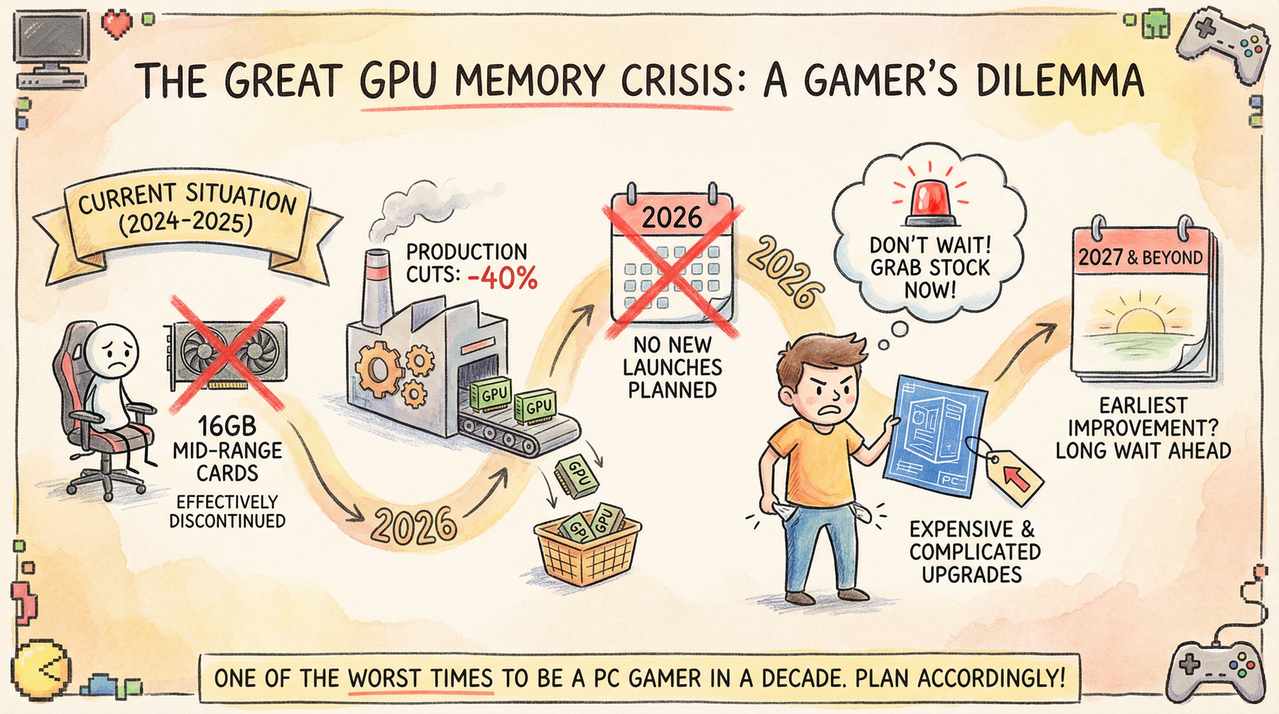
The GPU market just got a lot messier. Nvidia is reportedly restricting supply on graphics cards with 12GB or more VRAM throughout 2026, effectively killing off some of its most promising mid-range options before they even had a chance. The RTX 5070 Ti and the 16GB version of the RTX 5060 Ti are being discontinued, leaving gamers with fewer choices and potentially higher prices.
The Memory Crisis Behind the Cuts
The root cause is a severe shortage of GDDR7 memory, the cutting-edge RAM that powers Nvidia’s latest RTX 50-series cards. According to leaker Moore’s Law Is Dead and reports from Hardware Unboxed at CES 2026, Nvidia has informed board partners like Asus that chip allocation for 16GB models is being severely limited. This isn’t just about discrete graphics cards either, the restrictions reportedly extend to laptops and prebuilt PCs.
Multiple retailers across Australia and other markets have confirmed that existing stock of the RTX 5070 Ti and RTX 5060 Ti 16GB will be the last units available through at least Q1 2026. Several GPU manufacturers have quietly designated both cards as end of life, meaning no new production runs are planned. While Asus later clarified that the cards haven’t been officially discontinued, they warned that supply will be extremely limited due to RAM shortages impacting production and restocks.
Which Cards Are Affected
The cuts specifically target cards with higher VRAM configurations. Here’s what we know so far:
- RTX 5070 Ti (16GB) – effectively discontinued with no new stock expected
- RTX 5060 Ti 16GB – production halted, focus shifting to 8GB model
- RTX 5070 (12GB) – currently unaffected but may face constraints
- RTX 5080 and RTX 5090 – still in production but only available at inflated prices
- RTX 5060 and RTX 5060 Ti 8GB – production continuing as planned
The situation creates a bizarre hierarchy where Nvidia’s most affordable 16GB cards effectively disappear from the market, leaving only the expensive RTX 5080 and RTX 5090 as options for gamers who need higher VRAM for modern titles, content creation, or AI workloads.
Production Cuts Across the Board
The problems go beyond just 16GB models. Reports from Chinese Board Channels forum suggest Nvidia plans to reduce gaming GPU production by 30 to 40 percent in the first half of 2026 compared to the same period in 2025. More recent leaks claim GPU supply to add-in-card partners has been slashed by 15 to 20 percent, with sources indicating there will be no new product launches in 2026.
This means the RTX 50 Super refresh that was expected to launch at CES 2026 has been delayed indefinitely or possibly cancelled altogether. The Super variants were anticipated to use 3GB GDDR7 modules instead of 2GB ones, which would have provided better performance and higher VRAM capacities. But with memory suppliers struggling to meet demand, Nvidia apparently can’t guarantee sufficient VRAM supply for both standard and Super models.
Why GDDR7 Specifically
The shortage centers on GDDR7, the latest generation of graphics memory that offers significantly higher bandwidth than GDDR6. Nvidia is currently the only major GPU manufacturer using GDDR7 across its RTX 50-series lineup, while AMD’s RDNA 4 cards and Intel’s Arc Battlemage GPUs still rely on GDDR6. Samsung appears to be the primary producer of GDDR7 modules at scale, creating a supply bottleneck when demand surged.
Cards with 16GB require twice as many memory modules as their 8GB counterparts. The RTX 5060 Ti 16GB uses double the chips of the 8GB version, while the RTX 5070 Ti needs 33 percent more modules than the RTX 5070. With limited GDDR7 supply, Nvidia is prioritizing its most profitable products, the flagship RTX 5080 and RTX 5090, plus lower-cost 8GB models that use fewer memory chips.
What This Means for Gamers
The timing couldn’t be worse. Modern games increasingly demand more VRAM, with titles like Cyberpunk 2077, Starfield, and upcoming releases recommending 16GB for optimal settings. Numerous outlets have shown massive performance gaps between 8GB and 16GB models of the same GPU, especially at higher resolutions or with ray tracing enabled.
With the RTX 5070 Ti and RTX 5060 Ti 16GB effectively gone, gamers looking for mid-range cards with adequate VRAM are stuck with limited options. They can either settle for 8GB models that may struggle with demanding titles, or shell out significantly more for the RTX 5080, which currently sells well above MSRP due to high demand and limited supply.
There’s speculation that Nvidia might revive older cards to fill the gap. Reports suggest the company informed partners that the RTX 3060 could return in Q1 2026, though it’s unclear whether this would be the 8GB or 12GB variant. Since the RTX 3060 uses older GDDR6 memory that isn’t affected by the current shortage, it could provide a stopgap solution, albeit with older architecture and lower performance.
The Bigger Picture
This situation highlights how Nvidia’s business priorities have shifted. The company is allocating limited GDDR7 supply to AI and data center products, which generate far higher profit margins than consumer gaming GPUs. When memory shortages force difficult decisions, gamers end up at the back of the line.
AMD and Intel could theoretically capitalize on this moment since their GPUs use GDDR6, but both companies face their own challenges in competing with Nvidia’s performance and feature set. Unless GDDR6 supply is significantly better than GDDR7, or unless AMD and Intel can deliver compelling alternatives quickly, gamers may simply be stuck waiting.
Industry insiders suggest this situation could drag on through the end of 2026 or even longer, depending on how memory supply stabilizes. If you’re considering a GPU upgrade, waiting until spring or summer probably isn’t wise. Remaining stock of 16GB cards is already climbing in price and will only get worse as inventory depletes.
FAQs
Why is Nvidia discontinuing 16GB graphics cards?
Nvidia is facing severe shortages of GDDR7 memory, the high-speed RAM used in RTX 50-series cards. Cards with 16GB require twice as many memory modules as 8GB versions, making them expensive and difficult to produce during the shortage. Nvidia is prioritizing supply for flagship models and cheaper 8GB cards.
Are the RTX 5070 Ti and RTX 5060 Ti 16GB completely discontinued?
While Asus clarified they haven’t been officially discontinued, multiple manufacturers and retailers report no new stock will be available through at least Q1 2026. Effectively, current inventory may be the last units you can buy, making them functionally discontinued even without an official announcement.
Should I buy an 8GB graphics card instead?
It depends on your needs. For 1080p gaming on medium to high settings, 8GB can be adequate. However, modern AAA titles increasingly demand more VRAM, especially at 1440p or 4K with high settings and ray tracing. Performance testing shows significant gaps between 8GB and 16GB models in demanding games.
Will GPU prices go up because of this?
Yes, prices are already climbing and expected to continue rising. With production cuts of 30 to 40 percent and no new product launches planned for 2026, supply will remain tight while demand stays high. Remaining stock of 16GB cards will likely see price increases as inventory depletes.
What about AMD and Intel graphics cards?
AMD’s RDNA 4 and Intel’s Arc Battlemage GPUs use GDDR6 memory, which may not face the same severe shortages as GDDR7. This could present an opportunity for both companies to gain market share if they can deliver competitive products. However, Nvidia still dominates in performance and features like DLSS and ray tracing.
Is Nvidia bringing back older GPUs?
There are reports that Nvidia may restart production of the RTX 3060 in Q1 2026 to address the shortage. Since it uses GDDR6 memory, it wouldn’t be affected by GDDR7 supply issues. However, details about which variant and timing remain uncertain.
When will the RTX 50 Super cards launch?
The RTX 50 Super refresh was expected at CES 2026 but has been delayed indefinitely. With GDDR7 shortages and reports of no new products in 2026, the Super series may be cancelled altogether or pushed to 2027, depending on how memory supply stabilizes.
Does this affect gaming laptops too?
Yes, the restrictions reportedly extend beyond discrete graphics cards to laptops and prebuilt PCs. Gaming laptops with higher VRAM configurations may become harder to find or see price increases throughout 2026.
Conclusion
The memory crisis hitting Nvidia’s GPU lineup represents one of the most challenging periods for PC gamers in recent years. With 16GB mid-range cards effectively discontinued, production cuts of up to 40 percent, and no new launches planned for 2026, building or upgrading a gaming PC just became significantly more expensive and complicated. If you’ve been eyeing a GPU upgrade, don’t wait. Grab remaining stock now before prices climb even higher and inventory vanishes completely. The situation likely won’t improve until 2027 at the earliest, making this one of the worst times to be a PC gamer in over a decade.