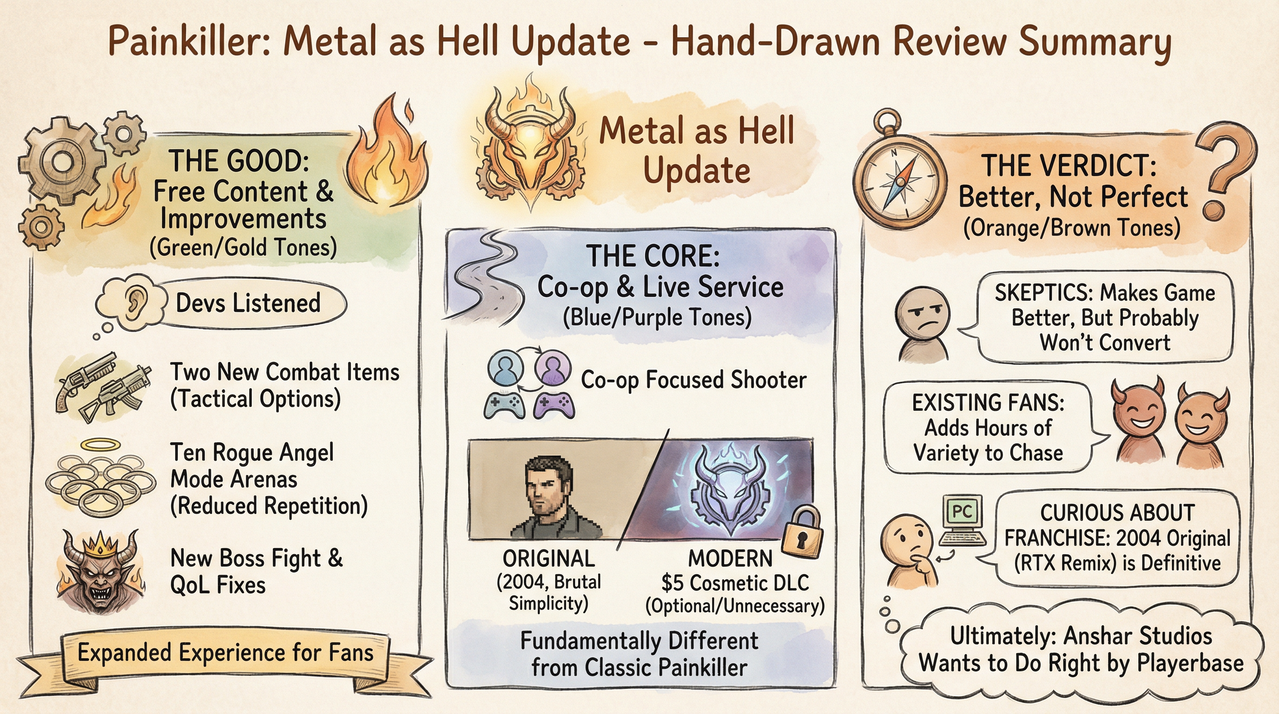
Anshar Studios’ reimagined Painkiller shooter just got significantly more hellish. The Metal as Hell content update launched in mid-December 2025, bringing two new throwable combat items, ten additional arenas for the roguelike Rogue Angel Mode, an extra boss fight, and numerous quality-of-life improvements. The entire update is free for all players on PC, PlayStation 5, and Xbox Series X|S. Additionally, a paid Metal as Hell DLC pack featuring four character skins and six weapon skins released alongside the update for $4.99, though Season Pass owners get it free.
This marks the first major post-launch support for the Painkiller reboot that launched in October 2025. The game, which reimagines People Can Fly’s 2004 cult classic FPS as a co-op demon-slaying shooter, received mixed reviews at launch. Critics praised its brutal combat and satisfying weaponry but noted it felt more like a generic co-op shooter than a true Painkiller successor. The Metal as Hell update represents developer commitment to expanding and improving the experience based on player feedback.
Demon Blood and Holy Orb Turrets
The centerpiece additions are two new throwable items that expand tactical options during combat. Demon Blood is a leeching consumable that drains health from enemies while healing the player, creating risk-reward scenarios where getting close to demon hordes becomes strategically valuable. The Holy Orb Turret functions as a deployable automated weapon that players can strategically place to cover chokepoints or provide covering fire during intense battles.
These additions address one of the criticisms leveled at the base game: combat could feel repetitive during extended sessions. By giving players additional tools beyond just shooting and melee attacks, the Metal as Hell update adds layers of strategy to arena encounters. Properly timing Demon Blood usage during overwhelming waves or positioning Holy Orb Turrets before triggering ambushes creates opportunities for tactical depth that wasn’t present at launch.
Both items integrate into the existing gameplay loop without fundamentally changing the core experience. Painkiller remains a fast-paced demon shooter focused on clearing waves of enemies with brutal efficiency, but now players have more options for how they approach those encounters, particularly in higher difficulty situations or during Rogue Angel Mode runs.
Rogue Angel Mode Gets Expanded
Rogue Angel Mode, the roguelike component of Painkiller’s package, received the most substantial content additions. Ten new procedurally-generated arenas join the existing rotation, increasing variety during runs and reducing the repetition that plagued the mode at launch. Each arena features different layouts, enemy compositions, and environmental hazards that require adapting strategies on the fly.
The new boss fight adds another major encounter to the Rogue Angel Mode pool, giving players an additional challenge to overcome during their progression through Purgatory. Boss fights in Painkiller demand pattern recognition and careful resource management, so adding another one diversifies the experience for players grinding through multiple runs to unlock upgrades and improve their characters.

Quality of Life Improvements
Beyond new content, the Metal as Hell update introduced several quality-of-life features that address player complaints from the launch period. A revive progress bar now appears when teammates attempt to resurrect fallen players during co-op sessions, providing clear visual feedback about how long revival takes and when enemies might interrupt the process. This seemingly small addition significantly improves communication in random matchmaking situations where voice chat isn’t being used.
Speaking of voice chat, the update added push-to-talk functionality, addressing one of the more annoying omissions at launch. Players no longer need to deal with open microphones broadcasting every background noise during sessions. Combined with improved settings options that give players more control over audio mixing, visual effects intensity, and other preferences, the update makes Painkiller feel significantly more polished than its October launch state.
Weapon progression in Rogue Angel Mode received adjustments based on player feedback, though specific details weren’t provided in the patch notes. The titular Painkiller weapon, the spinning blade fan that serves as the franchise’s signature tool, also got tweaks to make it feel more satisfying to use. Balancing changes across the board aim to smooth out difficulty spikes and ensure all four playable characters (Ink, Void, Sol, and Roch) remain viable in different situations.
The Metal as Hell DLC Pack
The paid Metal as Hell DLC, priced at $4.99 for standalone purchase or free for Season Pass owners, focuses entirely on cosmetics. Four character skins give Ink, Void, Sol, and Roch metal-inspired outfits that lean heavily into the game’s aggressive aesthetic. Six weapon skins provide alternative looks for the game’s arsenal of demon-slaying tools, all designed to match the metalhead vibe the DLC name suggests.
For players who already own the Season Pass, the DLC represents bonus value at no additional cost. For everyone else, $5 for purely cosmetic content may be a tough sell, especially given the base game’s mixed reception. However, the cosmetics do look legitimately cool from trailer footage, and for fans who’ve embraced the reimagined Painkiller, having additional customization options adds some personality to co-op sessions.

Reception and Community Response
The Painkiller reboot launched to mixed reviews in October 2025, currently sitting with a “mixed” user rating on Steam. The primary criticism focused on the game feeling like a generic co-op shooter rather than a true successor to the cult classic original. Players expected the focused, arena-based demon slaying of the 2004 game but got something that felt smaller, more constrained, and heavily balanced around four-player co-op rather than solo play.
IGN’s review captured the sentiment, noting that while Painkiller isn’t technically a bad game, it’s utterly unremarkable compared to modern standards and fails to capture what made the original special. PC Gamer’s Andy Chalk was even more direct, stating the new Painkiller “really not very good” and recommending players stick with the original 2004 game, particularly with the stunning RTX Remix mod that won NVIDIA’s best overall prize in their modding contest.
The Metal as Hell update represents Anshar Studios’ attempt to win back skeptical players and demonstrate ongoing commitment to improving the experience. Free content updates that add meaningful gameplay additions rather than just cosmetics show good faith, though whether it’s enough to change minds about the core experience remains to be seen. The update certainly makes Painkiller a better game than it was at launch, but it may not address the fundamental issues that caused the mixed reception.
How It Compares to Classic Painkiller
For players wondering whether the reimagined Painkiller captures the magic of People Can Fly’s 2004 original, the answer appears to be a definitive no. The original Painkiller was a focused, arena-based shooter where players entered areas, killed waves of enemies, and moved forward in a relentless rhythm. Combat felt visceral and satisfying, with weapons that had genuine impact and enemy encounters that demanded quick reflexes and spatial awareness.
The 2025 reimagining shifts focus toward co-op gameplay, class-based character perks, tarot card upgrade systems, and roguelike elements that dilute the original’s simplicity. While these aren’t inherently bad design choices, they fundamentally change what Painkiller is. The new game feels like it’s chasing trends (live service co-op shooters, roguelike modes, season passes) rather than honoring what made the original beloved.
PC Gamer’s recommendation to play the original Painkiller Black Edition with the RTX Remix mod installed remains the best advice for fans of the franchise. That mod transforms the 20-year-old game with modern lighting, reflections, shadows, and enhanced enemies while preserving the tight gameplay loop that made Painkiller special. The RTX Remix mod team even won $20,000 from NVIDIA for their work, validating that sometimes the best way to experience classic games is through faithful enhancement rather than complete reimagining.
FAQs About Painkiller Metal as Hell Update
When did the Painkiller Metal as Hell update release?
The Metal as Hell content update released on December 16, 2025, for PC (Steam), PlayStation 5, and Xbox Series X|S. The update is free for all players, while the accompanying Metal as Hell DLC with character and weapon skins costs $4.99 or is free for Season Pass owners.
What does the Metal as Hell update add to Painkiller?
The free update adds two new throwable items (Demon Blood and Holy Orb Turret), ten new arenas for Rogue Angel Mode, an additional boss fight, and quality-of-life improvements including a revive progress bar, push-to-talk voice chat, weapon progression adjustments, and various balancing changes.
Is the Metal as Hell DLC worth buying?
The Metal as Hell DLC is purely cosmetic, offering four character skins and six weapon skins for $4.99. It’s free for Season Pass owners but may be a tough sell for others given the base game’s mixed reception. The value depends entirely on how much you’re enjoying Painkiller and want additional customization options.
How is the new Painkiller different from the 2004 original?
The 2025 Painkiller reimagining focuses on co-op gameplay with up to four players, class-based characters with unique perks, tarot card upgrade systems, and a roguelike Rogue Angel Mode. The original 2004 game was a focused solo arena shooter with straightforward wave-based combat and visceral weapon feedback.
What is Rogue Angel Mode in Painkiller?
Rogue Angel Mode is a roguelike game mode featuring procedurally-generated arenas, random weapon and upgrade rewards, and permadeath mechanics. The Metal as Hell update added ten new arenas and an additional boss fight to this mode, increasing variety for players grinding through runs.
Can you play Painkiller solo or is it co-op only?
Painkiller supports both solo play and online co-op for up to three players (four total including yourself). However, the game is heavily balanced around co-op gameplay, and many reviewers noted the solo experience feels less satisfying than playing with a full squad.
Should I play the new Painkiller or the 2004 original?
Most critics recommend playing the 2004 Painkiller Black Edition with the RTX Remix mod, which won NVIDIA’s best overall modding prize and transforms the classic with modern graphics while preserving the tight gameplay. The new Painkiller received mixed reviews for feeling generic compared to the original.
What platforms is the new Painkiller available on?
The reimagined Painkiller is available on PC via Steam, PlayStation 5, and Xbox Series X|S. The Metal as Hell update and DLC released simultaneously across all platforms in December 2025.
Conclusion
The Metal as Hell update represents Anshar Studios’ commitment to supporting their Painkiller reimagining beyond the initial launch, and that deserves recognition. Adding two new combat items, ten Rogue Angel Mode arenas, a new boss fight, and quality-of-life improvements for free shows the developers listened to feedback and want to improve the experience. The additions are meaningful, expanding tactical options and reducing repetition in the roguelike mode that many players enjoyed. However, the update can’t fundamentally change what Painkiller is at its core: a co-op focused shooter that traded the original’s brutal simplicity for modern live service design trends. For players who bounced off the October launch, the Metal as Hell update makes the game better but probably won’t convert skeptics. For those already enjoying the demon-slaying action with friends, the free content adds several more hours of variety to chase. The cosmetic DLC at $5 is fine for die-hard fans but feels unnecessary for most players. Ultimately, the Metal as Hell update proves Anshar Studios wants to do right by their playerbase, even if the base game never quite captured the magic that made Painkiller a cult classic two decades ago. If you’re curious about the franchise, the 2004 original with RTX Remix remains the definitive experience. But if you want modern co-op demon slaying with friends and don’t mind the changes, the Metal as Hell update makes now a better time than ever to jump in.