Yahtzee Croshaw dropped his final Semi-Ramblomatic video of 2025 exploring one of gaming’s most fascinating topics: the weird traditions, rituals, and customs that gamers follow religiously without ever stopping to question why. From repeatedly crouching on enemy corpses to typing polite messages after getting destroyed, gaming culture has developed unspoken rules that would look absolutely insane to anyone who doesn’t play video games. Yet we all follow them like sacred laws.
Press F: Gaming’s Most Accidental Meme
The title itself references one of gaming’s most enduring memes: Press F to Pay Respects. This phrase originated from Call of Duty: Advanced Warfare in 2014 during an early funeral scene where the game prompts PC players to press the F key to have their character solemnly touch a coffin. The moment was supposed to be emotional and meaningful, adding player agency to a tragic cutscene. Instead, it became immediately and universally mocked for being hilariously awkward.
The absurdity of reducing grief and respect to a button press created instant comedy gold. Conan O’Brien ripped it apart during his Clueless Gamer segment, and within days the internet transformed it into a meme. Now, over a decade later, people still type F in chat windows across Twitch, Discord, and social media whenever something unfortunate happens. It evolved from mockery into genuine shorthand for expressing sympathy, both sincere and sarcastic. Call of Duty: Vanguard even acknowledged the meme in 2021 with an achievement literally called F that you earn by killing yourself with your own grenade.
Ghost of Tsushima’s Better Version
Interestingly, Ghost of Tsushima found a way to make this concept actually work. When Jin visits graves throughout the game, you’re prompted to pay respects, but instead of just pressing a button to trigger an animation, the game has you compose a haiku while Jin sits quietly contemplating. This transforms the interaction from awkward forced interactivity into something genuinely reflective and thoughtful. It’s still very video gamey, but at least it feels like you’re actually engaging with the moment rather than just advancing a cutscene.
Teabagging: Gaming’s Most Enduring Taunt
Few gaming traditions are as universally recognized or bizarrely specific as teabagging. For the blissfully uninitiated, teabagging refers to crouching and uncrouching repeatedly over an opponent’s dead body before it despawns. The name comes from the visual resemblance to an inappropriate sexual act, and it serves as the ultimate victory dance and humiliation tactic in competitive shooters.
The practice dates back to at least the late 1990s, with players reporting memories of teabagging in Team Fortress Classic. However, it exploded into mainstream gaming culture through Halo, where the mechanic felt perfectly designed for the taunt. The practice spread across every multiplayer shooter, from Call of Duty to Valorant, becoming so embedded in gaming culture that professional esports tournaments have struggled with how to handle it.
The Teabagging Controversies
Despite being widely accepted as part of gaming culture, teabagging has sparked genuine controversies. In 2016, organizers for the Killer Instinct World Cup attempted to ban teabagging during competition after tensions escalated between players. The ban was later walked back, but it highlighted the uncomfortable gray area between harmless taunting and unsportsmanlike conduct.
Riot Games faced backlash in 2022 when they suspended two Valorant players for nine months and three months respectively after a public disagreement about teabagging. The controversy erupted when a member of the Galorants community compared teabagging to sexual assault, a statement that was widely mocked but led to suspensions for players who criticized the comparison. The incident forced uncomfortable conversations about where gaming traditions cross lines and whether context matters when evaluating behavior.
The fighting game community remains similarly divided. Some view teabagging as disrespectful and damaging to the scene’s legitimacy, while others consider it an integral part of competitive trash talk. Street Fighter pro NuckleDu famously taunts opponents with teabag-style crouches when they’re near death, maximizing the humiliation factor. The personal nature of one-on-one fighting games makes the taunt feel especially cutting compared to team-based shooters where blame can be distributed.

Saying GG: The Politeness Paradox
Yahtzee specifically highlighted the tradition of saying GG (Good Game) after matches as one of gaming’s stranger customs. In virtually every competitive multiplayer game with text chat, players type GG at the conclusion of a match regardless of whether the game was actually good, close, or enjoyable. You could get absolutely demolished 50-0, steamrolled so thoroughly that you never stood a chance, and the expected behavior is still to type GG before leaving.
The tradition emerged from sportsmanship rituals in physical sports where teams shake hands after games. However, the gaming version has become somewhat hollow through overuse and obligation. GG now functions less as genuine praise for a well-played match and more as basic etiquette, like saying bless you after someone sneezes. Not saying GG can mark you as a poor sport, even when the game was objectively terrible and nobody had fun.
This creates weird social dynamics where saying GG becomes almost sarcastic when one team dominated. If you just destroyed the opposing team without letting them score a single point, typing GG feels like rubbing salt in the wound. But not saying it feels worse, like you’re being a bad winner. The whole thing would be completely baffling to explain to someone who doesn’t play online games. Imagine losing a basketball game 120-15 and being expected to sincerely tell your opponents good game as if it was a close contest.
Crouch Jumping and Bunny Hopping
Movement exploits that became standard techniques represent another category of gaming traditions. Bunny hopping, the practice of continuously jumping to move faster, started as an unintended consequence of how game engines handled momentum. Developers could have patched it out, but it became so integral to skill expression in games like Counter-Strike and Quake that removing it would have fundamentally changed competitive play.
Similarly, crouch jumping emerged from players discovering they could reach higher ledges by crouching mid-jump. What began as exploiting hitbox quirks became expected knowledge for navigating maps. Games eventually started designing levels around the assumption that players would crouch jump, transforming the exploit into intentional design. These movements now separate skilled players from beginners, creating informal skill gates that the games themselves never explicitly teach.

The Meta Game of Emotes and Gestures
Dark Souls popularized a whole language of gestures and emotes that convey meaning far beyond their intended purpose. Bowing before PvP duels became expected etiquette in the community, and violating this unwritten rule by attacking during the bow marked you as dishonorable. The Praise the Sun gesture became so iconic that players use it in every possible context from celebrating victories to marking hidden paths.
Fortnite took this concept even further by monetizing emotes and creating a meta game around taunting. Doing the floss dance over someone’s eliminated body carries the same psychological weight as traditional teabagging but with more personality and significantly more corporate profit. The ability to spend real money on increasingly elaborate ways to humiliate opponents represents peak modern gaming culture.
Sea of Thieves players developed an unspoken tradition of playing music together when meeting friendly crews. Two ships might encounter each other, and instead of immediately fighting, crews will gather on deck to play instruments in harmony. This wholesome tradition exists alongside the equally strong tradition of betraying alliances at the worst possible moment, creating a fascinating tension between cooperation and chaos.
Speedrunning Etiquette and Clipping Through Reality
The speedrunning community has developed elaborate traditions around competitive play. Runners congratulate world record holders regardless of whether that record beat their own time. When someone loses a record they held for years, the expected response is gracious acknowledgment and praise for the new champion. This stands in stark contrast to most competitive gaming communities where trash talk dominates.
Speedrunners also maintain extensive documentation of discovered skips and glitches, crediting original discoverers even decades later. The community treats game-breaking exploits with academic rigor, naming techniques after their discoverers and maintaining detailed histories of how routes evolved. Skipping 80% of a game by clipping through a wall became not just acceptable but celebrated as the ultimate expression of mastery.
Frequently Asked Questions
What does Press F to Pay Respects mean?
Press F to Pay Respects is a meme originating from Call of Duty: Advanced Warfare where players press F during a funeral scene to show respect. The awkward prompt became widely mocked and evolved into internet shorthand for expressing sympathy, both sincere and sarcastic.
Why do gamers teabag?
Teabagging involves crouching repeatedly over defeated opponents as a victory taunt and humiliation tactic. It became popular in shooters like Halo and spread across competitive gaming as a way to celebrate victories and get under opponents’ skin psychologically.
Is teabagging considered bad sportsmanship?
This depends heavily on context and community. Some competitive scenes consider it unsportsmanlike and unprofessional, while others view it as harmless trash talk and part of gaming culture. Professional tournaments sometimes ban it, but enforcement varies wildly.
Why do players say GG even after bad games?
Saying GG (Good Game) after matches has become basic etiquette similar to shaking hands after sports. Not saying it can mark you as a poor sport, so players type it regardless of match quality. It functions more as polite ritual than genuine assessment.
What is bunny hopping in games?
Bunny hopping is continuously jumping to move faster by exploiting how game engines handle momentum. It started as an unintended movement exploit but became so integral to competitive play in games like Counter-Strike that developers kept it as a skill expression mechanic.
Who is Yahtzee Croshaw?
Yahtzee Croshaw is a game critic known for Zero Punctuation and Semi-Ramblomatic video series. He provides fast-paced, brutally honest game reviews and industry commentary with distinctive humor and animation style. His latest Semi-Ramblomatic video explores gaming traditions.
Why do Dark Souls players bow before fights?
Bowing before PvP duels in Dark Souls became community etiquette signaling respect and intention to fight honorably. Attacking during the bow marks you as dishonorable. The tradition emerged organically from player culture rather than game design.
How did Ghost of Tsushima fix the Press F problem?
Ghost of Tsushima transformed paying respects from awkward button press to composing haikus while Jin sits quietly at graves. This creates genuine reflection and engagement rather than just advancing a cutscene, making the interaction feel meaningful instead of forced.
The Unspoken Rules We All Follow
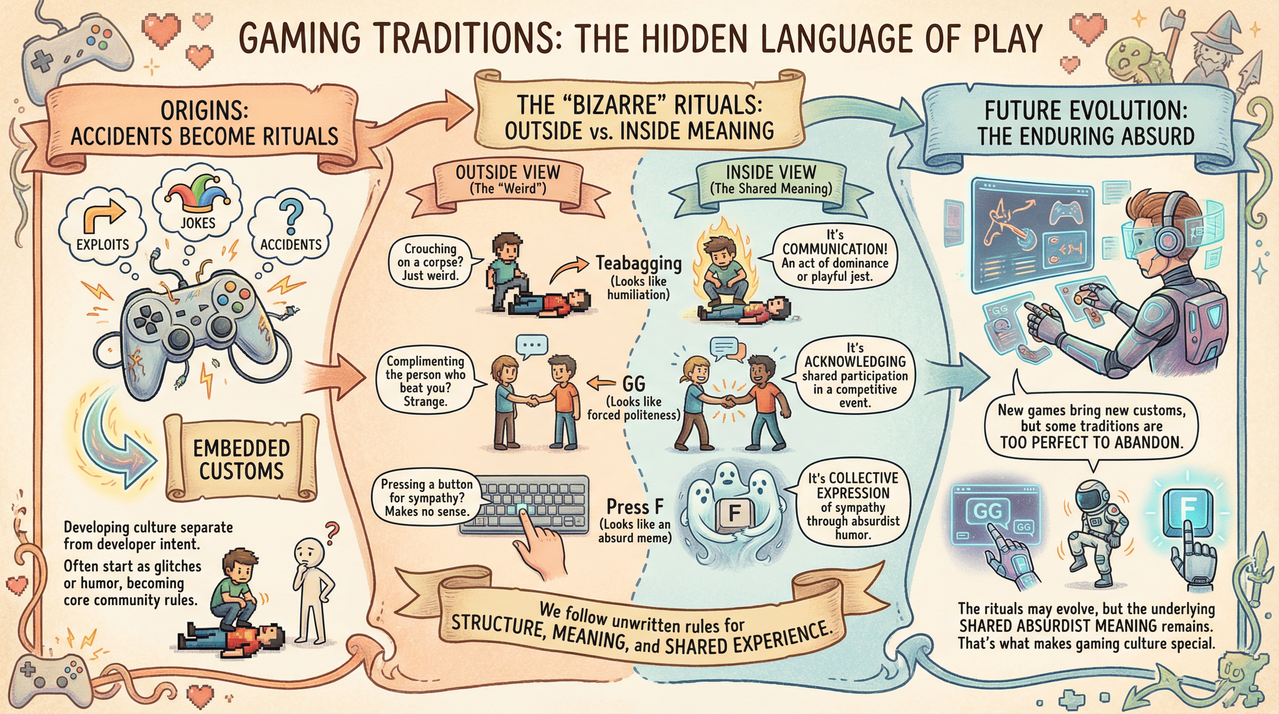
Gaming traditions reveal how communities develop their own cultures, languages, and social rules separate from what developers intended. These customs often start as exploits, jokes, or accidents that become so embedded they feel like core features. Try explaining to someone who doesn’t play games why crouching repeatedly on corpses is considered normal behavior, or why you’re obligated to compliment opponents who just destroyed you.
Yahtzee’s exploration of these traditions highlights how bizarre gaming culture looks from outside while simultaneously feeling completely natural to anyone who participates. We follow these unwritten rules without questioning because they provide structure, meaning, and shared experience. Teabagging isn’t just humiliation, it’s communication. GG isn’t just politeness, it’s acknowledging shared participation in something competitive. Press F isn’t just a meme, it’s collective expression of sympathy through absurdist humor.
These traditions will continue evolving as new games introduce new mechanics and communities develop fresh customs. Twenty years from now, gamers will probably follow equally strange rituals that we can’t even imagine yet. But they’ll still type GG after getting demolished, probably still crouch on corpses when feeling spicy, and definitely still press F when something dies. Some traditions are just too perfect to abandon, no matter how ridiculous they look to everyone else. And honestly, that’s what makes gaming culture special. We all collectively agreed that these weird behaviors mean something, and now they do. Try finding that level of shared absurdist meaning anywhere else.