One of Batman’s most tantalizing what-ifs just got a lot more real. A former developer’s hard drive yielded over 20 minutes of Project Apollo footage plus design documents from Monolith Productions’ canceled Batman game. This 2010 casualty would have delivered Gotham’s most grounded detective experience before Rocksteady redefined the genre.
Monolith, fresh off Gotham City Impostors and the F.E.A.R. series, pitched Project Apollo around 2009 as a hardcore Batman detective simulator. Think LA Noire meets Arkham Asylum with investigative gameplay rivaling modern Immersive Sims. Warner Bros shelved it in 2010 when Christopher Nolan reportedly refused tie-in approval, clearing the path for Rocksteady’s cinematic dominance.
What Project Apollo Promised
The leaked videos showcase Apollo’s groundbreaking crime scene investigation. Batman dusts for prints, analyzes blood spatter trajectories, reconstructs bullet paths, and interrogates witnesses using psychological profiling. Combat took direct inspiration from Arkham Asylum’s freeflow system, but with more environmental interaction and gadget integration.
- Full forensic crime scene reconstruction
- Bloodstain pattern analysis mini-games
- Interactive interrogation with truth/lie detection
- Detective Vision showing past events
- Gadget-based environmental puzzles
Documents reveal a story focused on Batman dismantling Black Mask’s criminal empire through evidence chains rather than fists alone. Side missions included hunting serial killers and corrupt GCPD officers, with progression unlocking case files and Batcave upgrades. The game targeted 2011 alongside Arkham City.
Why Nolan Killed the Project
Christopher Nolan’s Dark Knight trilogy tie-ins left bitter memories after 2008’s lackluster Batman Begins LEGO sets and McFarlane Toys. Sources claim Nolan explicitly blocked video game adaptations, believing they diluted his grounded aesthetic. Warner Bros couldn’t risk alienating the director whose films grossed over $2 billion.
Monolith staff told DidYouKnowGaming that Rocksteady proactively severed Dark Knight connections during Arkham Asylum’s development. Apollo’s cinematic presentation and detective focus too closely mirrored Nolan’s aesthetic without blessing. The studio pivoted to Middle-earth: Shadow of Mordor, birthing the Nemesis System instead.
Leaked Gameplay Highlights
| Feature | Implementation |
|---|---|
| Crime Scene | Interactive laser scanning, evidence linking |
| Combat | Arkham-style freeflow with counters |
| Batmobile | Pursuit sequences, not drivable |
| Villains | Black Mask, Killer Croc cameos |
| Engine | LithTech Jupiter (pre-Nemesis tech) |
The footage quality varies from tech demos to polished sequences. Early builds show Batman reconstructing a jewelry heist with holographic overlays connecting bullet casings to escape routes. Later clips demonstrate interrogation where Batman reads micro-expressions to detect lies, Arkham-style.

Monolith’s Near-Miss Legacy
Project Apollo represented Monolith’s attempt to leap from horror shooters to AAA superheroics. Losing Batman forced reinvention, yielding Shadow of Mordor’s revolutionary Nemesis System that redefined AI companions. The studio’s Gotham experience directly informed Middle-earth’s reactive worldbuilding.
Fans recognize Apollo’s DNA in later titles. Batman: Arkham Origins’ case files echo the investigative focus. LA Noire’s interrogation theater matches leaked dialogue trees. Even detective mode’s evolution owes debt to Apollo’s forensic vision prototypes.
Modern Relevance in 2026
Today’s Batman: Arkham Shadow and rumored Arkham Academy revisit detective gameplay Apollo pioneered. The leak arrives as WB Games battles Suicide Squad fallout, making Monolith’s lost vision newly relevant. Could Apollo assets inform future Gotham Knights content?
Preservationists celebrate the find. Unlike vaporware like Scalebound, Apollo reached playable alpha with complete systems. The 20+ minute compilation preserves what might have been gaming’s definitive Batman detective experience before Rocksteady shifted focus to cinematic beat-em-ups.

Technical Breakdown
- Engine: Custom LithTech Jupiter EX
- Target Platforms: PS3, Xbox 360, PC
- Development Span: 2009-2010
- Team Size: ~80 developers
- Playable Build: Crime scene demo + 3 cases
FAQs
Why was Project Apollo canceled?
Christopher Nolan blocked WB from making Batman games tied to Dark Knight aesthetic. Monolith’s cinematic detective vision clashed with Nolan’s film purity demands.
Did Apollo influence Arkham games?
Absolutely. Investigative mechanics, case files, and interrogation theater all trace back to Apollo prototypes Rocksteady refined.
Could Apollo assets resurface?
WB owns IP rights but Monolith staff confirm no playable builds survived post-cancellation cleanup. Leaked footage represents final preservation.
How does Apollo compare to Arkham Asylum?
Equal combat quality, superior investigation. Apollo emphasized brains over brawn while matching Arkham’s polish.
What happened to Monolith after Apollo?
Pivoted to Middle-earth: Shadow of Mordor. Apollo’s AI reactivity evolved into Nemesis System revolutionizing companions.
Any chance of Apollo revival?
Zero. Technology obsolete, IP conflicts resolved via Arkham dominance. Serves purely as historical artifact now.
Where can I watch the leaked footage?
Developer MrTalida’s Bluesky hosts compilation. Search ‘Project Apollo Batman leak’ for archival copies across platforms.
Conclusion
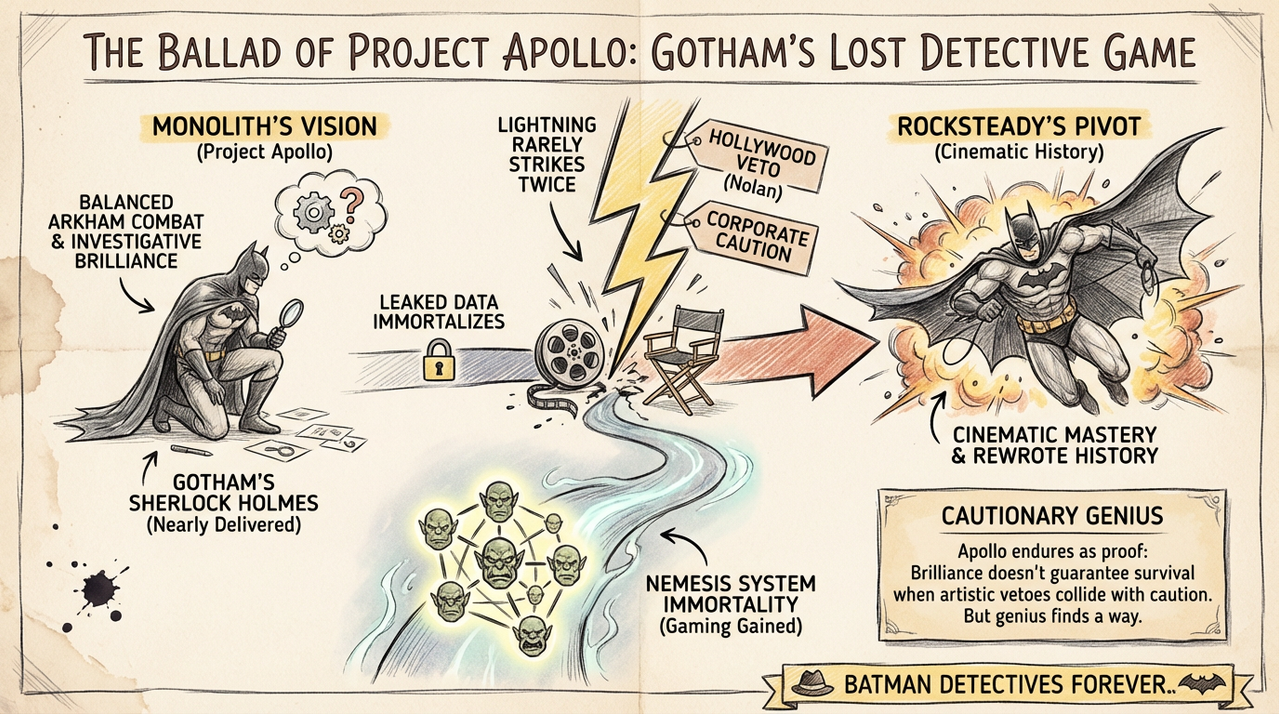
Project Apollo’s resurrection proves lightning rarely strikes twice in game development. Monolith nearly delivered Batman detective perfection before Nolan’s veto and Rocksteady’s cinematic pivot rewrote history. The leaked data immortalizes what could have balanced Arkham’s combat mastery with investigative brilliance. Gotham lost its Sherlock Holmes, but gaming gained Nemesis System immortality. Apollo endures as cautionary genius – proof brilliance doesn’t guarantee survival when Hollywood vetoes collide with corporate caution. Batman detectives forever.