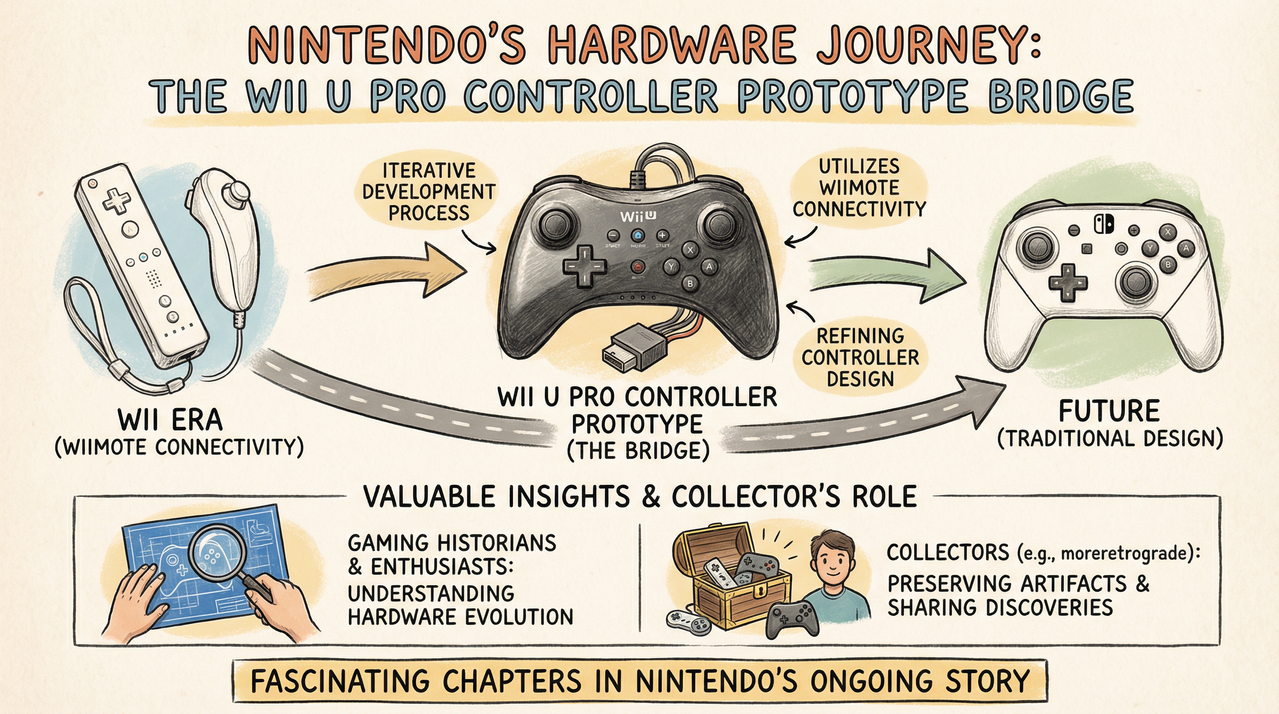
The gaming preservation community has uncovered another piece of Nintendo history. Reddit user moreretrograde recently shared images of an extremely rare Wii U Pro Controller prototype that appears to have been used with early Wii U development kits. What makes this discovery particularly intriguing is that the controller connects via a Wiimote instead of pairing directly with the console, revealing an interesting transitional phase in Nintendo’s hardware development.
What Makes This Prototype Special
Unlike the final Wii U Pro Controller that launched with the console in 2012, this prototype features a distinctive design quirk at the top where it physically connects to a Wiimote. The prototype plugs into the Wii Remote’s nunchuck port, which was Nintendo’s standard approach for connecting additional controllers during the Wii era. This design choice suggests the prototype was created during a transitional period when Nintendo was still utilizing legacy connection methods from the original Wii hardware.
According to moreretrograde, the controller functions perfectly and can indeed connect to a Wiimote. The design closely resembles the final retail version that consumers eventually received, featuring the same symmetrical analog stick layout and button configuration that made the Wii U Pro Controller popular among gamers. However, the permanent fixture at the top for the connection port distinguishes it from the wireless Bluetooth-enabled final model.
Connection to Early Development Kits
The prototype is believed to have been used with the Wii U Toucan development kit, specifically versions 1 and 2. These early devkits, known as CAT-DEV (Cafe Tool for Development) units, were distributed to game developers before the console’s retail launch. Early development hardware often featured different connection methods and specifications compared to final retail products, as Nintendo iteratively refined both the console and its accessories based on developer feedback.
Development kits typically arrived at studios with a variety of prototype controllers and accessories. According to industry reports from developers who worked on Wii U titles, early devkits presented numerous challenges, from immature toolchains to incomplete network infrastructure. The existence of this prototype controller aligns with the known timeline of Wii U development, when Nintendo was still finalizing both hardware specifications and controller designs between 2011 and 2012.
Why Nintendo Changed the Design
The final Wii U Pro Controller that shipped to consumers featured several key improvements over this prototype. Most notably, Nintendo removed the Wiimote dependency entirely, allowing the controller to pair directly with the Wii U console via Bluetooth. This change gave the Pro Controller significantly better battery life, with the retail version famously lasting up to 80 hours on a single charge, one of the longest-lasting wireless controllers ever made.
The shift away from the Wiimote connection also simplified the user experience. Requiring a Wiimote as an intermediary would have been cumbersome and confusing for consumers, especially since the Wii U was already struggling with messaging problems about whether it was a new console or just an accessory for the Wii. By making the Pro Controller a standalone wireless device, Nintendo created a more traditional gaming experience that appealed to core gamers who preferred conventional controller layouts.
The Wii U Pro Controller Legacy
Despite the Wii U’s commercial failure, the Pro Controller remains highly regarded among gamers. Its comfortable ergonomics, excellent battery life, and well-placed symmetrical analog sticks made it a favorite for players who wanted a more traditional control scheme. Many users continue to use their Wii U Pro Controllers with modern systems through third-party adapters, connecting them to Nintendo Switch, PC, and other platforms.
The controller’s design philosophy influenced Nintendo’s later products, with the Switch Pro Controller adopting a similar button layout and ergonomic approach. While the plastic may have looked somewhat cheap compared to competitors like Sony’s DualShock 4 or Microsoft’s Xbox controllers, the Wii U Pro Controller delivered on functionality and comfort, earning it a dedicated fanbase that persists years after the console’s discontinuation.
FAQs
How rare is this Wii U Pro Controller prototype?
This appears to be an extremely rare prototype that hasn’t been documented elsewhere online. Development hardware was typically produced in limited quantities and distributed only to game studios working on Wii U titles. Most devkit hardware is either destroyed, returned to Nintendo, or remains in private collections.
Can this prototype connect to a retail Wii U console?
Since it requires connection through a Wiimote’s nunchuck port, it would need the Wiimote to be synced with the console first. The Wii U supported Wiimote connectivity, so theoretically it could work with retail hardware, though it was designed for development kit environments.
What was the Wii U Toucan development kit?
The Toucan was one of several codenames for early Wii U development hardware, also known as CAT-DEV units. These development kits were larger than retail consoles and featured additional ports and connections specifically for game development and debugging purposes.
Why did the Wii U Pro Controller have such amazing battery life?
The retail Wii U Pro Controller used a 1300mAh rechargeable lithium-ion battery and featured power-efficient Bluetooth connectivity. Unlike controllers with rumble motors, LED light bars, or touchpads that drain power quickly, the Pro Controller kept features minimal, resulting in its legendary 80-hour battery life.
Did Nintendo reuse controller connectors from previous generations?
Yes, Nintendo has a long history of repurposing proprietary connectors across hardware generations. GameCube devkits used N64 cables, DS devkits used GameCube cables, 3DS devkits used Wii cables, and Switch devkits were compatible with Wii U cables. This prototype’s use of the Wiimote nunchuck port fits that pattern.
Can I still use a Wii U Pro Controller today?
Absolutely. The Wii U Pro Controller works with Nintendo Switch through third-party adapters like those made by 8BitDo. It also functions on PC through Bluetooth pairing or USB adapters, making it a viable option for modern gaming despite being over a decade old.
Who is moreretrograde and how did they get this prototype?
Moreretrograde is a game collector and preservationist who shares rare gaming hardware on Reddit. They haven’t disclosed exactly how they acquired the prototype, but development hardware typically enters the collector market through studio closures, employee sales, or auctions of abandoned tech equipment.
Conclusion
The discovery of this Wii U Pro Controller prototype offers valuable insight into Nintendo’s iterative hardware development process. While the Wii U itself may have struggled in the marketplace, the engineering effort that went into refining its controllers shows Nintendo’s commitment to creating quality gaming experiences. This prototype represents a bridge between two eras of Nintendo hardware, utilizing the Wiimote connectivity of the past while moving toward the more traditional controller design that would define the company’s future. For gaming historians and Nintendo enthusiasts, artifacts like this prototype provide tangible evidence of how hardware evolves from concept to consumer product. Thanks to collectors like moreretrograde who preserve and share these discoveries, we can better understand the decisions Nintendo made during one of its most challenging console generations. Whether you’re a Wii U defender or someone who skipped the console entirely, there’s no denying that finds like this add fascinating chapters to Nintendo’s ongoing hardware story.