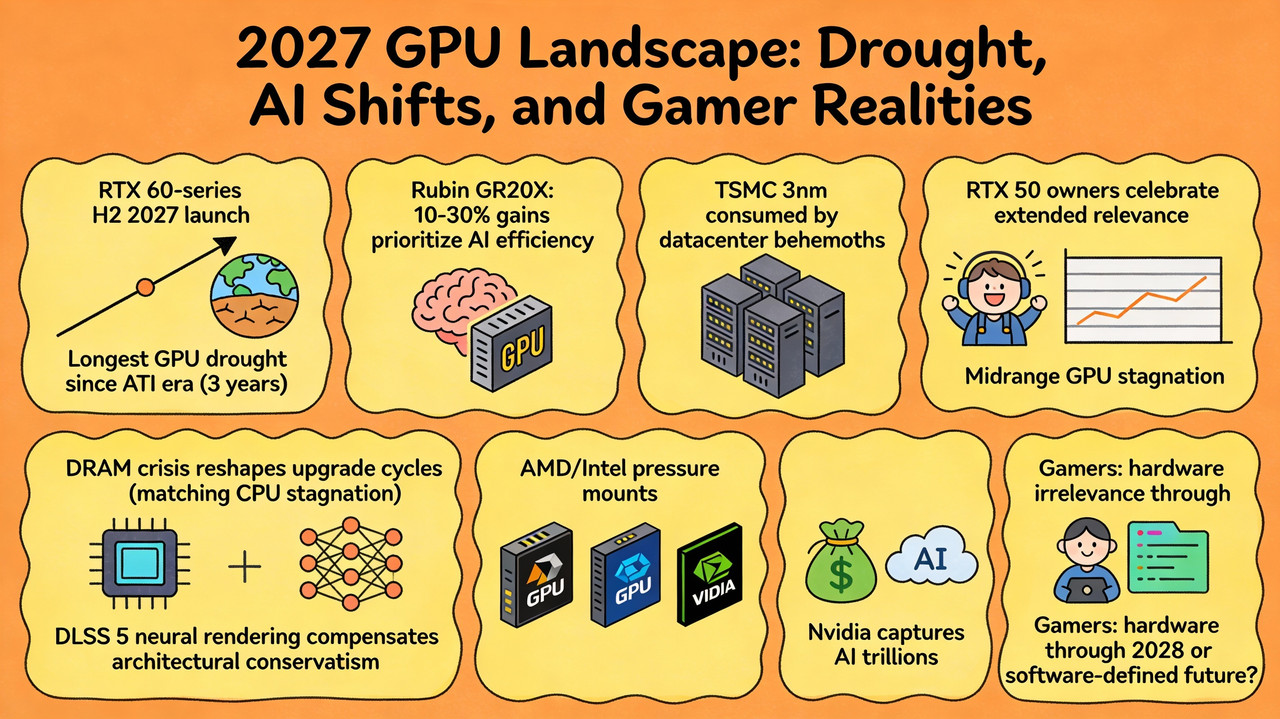
NVIDIA’s next-generation RTX 60-series graphics cards face major delays, with reliable leaker Kopite7kimi confirming H2 2027 launch window. The Rubin architecture-powered GR20X dies deliver modest 10-30% performance gains over Blackwell RTX 50-series, prioritizing AI efficiency over gaming rasterization leaps amid persistent DRAM shortages.
The Rubin Delay Explained
Kopite7kimi’s timeline pushes RTX 60xx to second half 2027 – nearly three years after RTX 5090 launch. GR20X architecture targets 10-30% generational uplift focusing neural rendering efficiency matching CEO Jensen Huang’s CES 2026 vision. Consumer gaming GPUs deprioritized as NVIDIA captures $100B+ AI datacenter revenue.
TSMC 3nm production allocated primarily to Rubin AI accelerators through 2027. Gaming GPUs receive secondary tranches post-H100/B200 fulfillment. Samsung’s doubled GDDR7 capacity insufficient against AI memory demand, delaying 60-series memory configurations originally planned for 2026.
RTX 50 Super Cancellation Fallout
RTX 50-series Super refresh reportedly cancelled due to identical DRAM constraints. RTX 5080 Super (24GB), RTX 5070 Super (16GB) variants scrapped despite prototype validation. NVIDIA considers reintroducing RTX 40-series with GDDR7 retrofits to bridge 30-month gap to Rubin consumer launch.
AMD RDNA 5 (UDNA) follows identical timeline – early 2027 flagship despite skipping high-end RDNA 4. Intel Battlemage refresh expected Q4 2026 before Arc Celestial 2027. Three-year GPU cadence unprecedented since GeForce 8→9 transition, driven by AI infrastructure prioritization.
Performance Expectations Tempered
| Generation | Architecture | Expected Uplift | Launch Window |
|---|---|---|---|
| RTX 40 | Ada Lovelace | RTX 30 +40% | 2022 |
| RTX 50 | Blackwell | RTX 40 +30% | 2025 |
| RTX 60 | Rubin (GR20X) | RTX 50 +10-30% | H2 2027 |
AI Memory Crisis Impact
HBM3e/HBM4 production consumed by AI clusters delays GDDR7 gaming supply. RTX 6060 likely retains 8GB despite 2027 launch as 24GB modules prioritize Rubin Ultra workstation cards. NVIDIA explores LPDDR6 mobile VRAM repurposing for mainstream 60xx models.
Console implications significant – PS6/Xbox Next GPU finalization pressures mount with UDNA/Rubin 18+ months distant. Microsoft Surface team prototypes reportedly integrate RTX 50 mobile for interim gaming handhelds through 2028.

Consumer Implications Brutal
RTX 5090 owners gain 4-year relevance window through Rubin delay. Midrange gamers face RTX 5060/5070 stagnation until 2028. Steam Hardware Survey dominance continues as upgrade path collapses. DLSS 5 neural rendering compensates modest rasterization gains.
AMD’s $550 RDNA 5 AT2 (RTX 5080 perf) tempts Nvidia defectors. Intel Arc Celestial 2027 entry pressures midrange pricing. Three-year GPU drought unprecedented since ATI→AMD transition era.
FAQs
Why 3-year GPU gap?
AI datacenter revenue ($100B+) consumes TSMC 3nm capacity. Gaming GPUs deprioritized as HBM3e/HBM4 allocation starves GDDR7 production.
RTX 60 performance realistic?
10-30% rasterization uplift focuses neural rendering efficiency. DLSS 5 neural reconstruction delivers effective 50%+ generational leap.
RTX 50 Super cancelled?
Yes – DRAM shortages kill 24GB 5080 Super, 16GB 5070 Super. RTX 40 GDDR7 retrofit considered as stopgap.
Console impact severe?
PS6/Xbox Next GPU finalization pressures mount. UDNA/Rubin 18+ months distant forces RTX 50 mobile integration.
RTX 6060 still 8GB?
Likely – 24GB GDDR7 prioritizes workstation. LPDDR6 mobile VRAM possible for mainstream models.
Kopite7kimi reliability?
Perfect RTX 50-series track record. Samsung GDDR7 doubling validated months prior to announcement.
AMD RDNA 5 identical timeline?
Confirmed early 2027 despite high-end RDNA 4 skip. UDNA unified architecture matches Rubin delay.
Conclusion
RTX 60-series H2 2027 launch confirms three-year GPU drought longest since ATI era. Rubin GR20X modest 10-30% gains prioritize AI efficiency as TSMC 3nm consumed by datacenter behemoths. RTX 50 owners celebrate extended relevance while midrange stagnates.
DRAM crisis reshapes upgrade cycles matching CPU stagnation patterns. DLSS 5 neural rendering compensates architectural conservatism. AMD/Intel pressure mounts as Nvidia captures AI trillions. Gamers brace for hardware irrelevance through 2028 – or embrace software-defined futures.