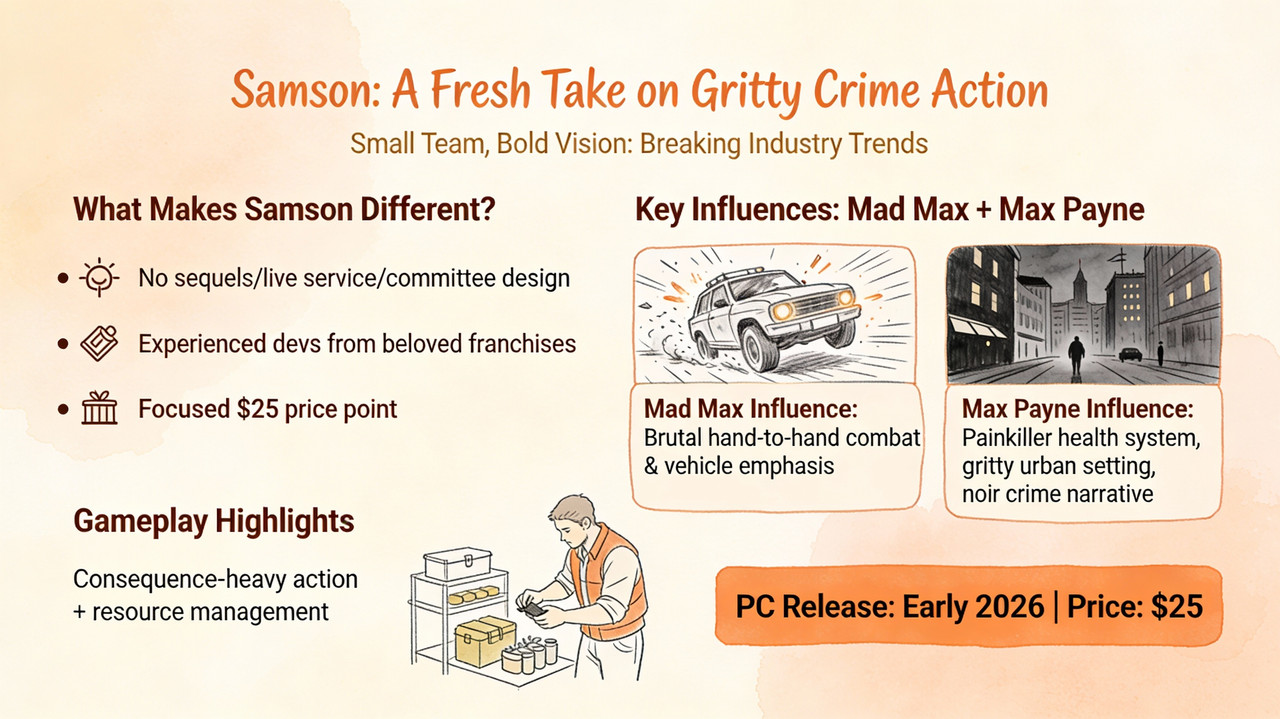
If you’ve been craving a grounded, consequence-heavy crime game that doesn’t let you play invincible superhero, Samson might be exactly what you need. This new action-adventure comes from Liquid Swords, a studio packed with veterans who worked on Just Cause and Mad Max. The game director describes it as “Mad Max meets Max Payne,” which sounds like the perfect elevator pitch for anyone tired of consequence-free open-world chaos.
- The Game Where Your Debt Actually Matters
- Combat That Leaves Marks
- A City That Pushes Back
- The Development Story Behind the Scenes
- AAA Ambitions at AA Price
- Why This Could Work Despite Industry Chaos
- What Makes It Different From GTA
- Frequently Asked Questions
- The First Book in a Longer Series
- Why You Should Pay Attention
The Game Where Your Debt Actually Matters
Samson puts you in the worn-out shoes of Samson McCray, an aging criminal stuck in Tyndalston, a grimy city that game director Christofer Sundberg lovingly calls “the asshole of the world.” After a getaway job went sideways in St. Louis, Samson’s sister Oonagh managed to cut a deal with the crew he screwed over. The catch? He needs to pay back what was lost, with interest, and that interest keeps climbing every single day.
This isn’t just narrative window dressing. Your debt actively grows as you play, creating genuine pressure to keep moving and taking jobs even when you’re low on resources. The game uses a Daily Quota system where missing targets causes interest spikes, making your situation exponentially worse. You can’t just grind the same safe mission repeatedly because the game limits how much you can do each day through Action Points, forcing you to make tough decisions about which jobs are worth the risk.
Action Points function as your daily stamina pool. Every mission, every violent confrontation, every choice burns through this limited resource. Once you’re out, you’re done for the day, and the debt keeps growing while you sleep. It creates a brutal loop where standing still makes everything worse, but rushing into dangerous situations without proper planning can get you killed or arrested, which also makes your debt worse. There’s no comfortable middle ground, just constant pressure.
Combat That Leaves Marks
Forget stylish gun-fu or superhuman abilities. Combat in Samson is described as grounded, physical, and dangerous, drawing inspiration from crime films like Heat, Ronin, and The French Connection where violence is fast and decisive. The game features exclusively hand-to-hand combat with improvised weapons, meaning you grab whatever’s available in the environment rather than maintaining a curated arsenal.
You might swing a wrench, smash someone with a tire iron, or bash them with a brick. Environmental objects break during fights, and both Samson and his opponents show visible damage from the beatings they take. Melee weapons can be stashed in your car’s trunk for convenience, but the emphasis stays on using what’s at hand in the moment. This approach makes every fight feel desperate and messy rather than choreographed.
Health management follows the Max Payne school of thought with painkillers serving as your primary healing item. Given that Samson is set in the 1990s, this fits the era’s aesthetic perfectly. The decade’s identity crisis plays into every aspect of the game’s presentation. Cell phones existed but weren’t ubiquitous yet, cash remained king, and people still smoked everywhere. It’s that specific layer of grit that defines late 90s crime films, and Liquid Swords is leaning into it hard.
Core Gameplay Systems
- Daily Quota system with growing debt and hourly interest
- Action Points limiting how many jobs you can complete per day
- Improvised weapon combat using environmental objects
- No guns for players, law enforcement and hardened criminals only
- Reactive city that remembers your actions and responds accordingly
- 25+ skill tree upgrades focused on brawling, driving, and survival
A City That Pushes Back
One of Liquid Swords’ main design philosophies is treating Tyndalston as a character itself rather than just a sandbox playground. The world actively reacts to your behavior in ways that go beyond typical wanted level systems. Interact with random people on the street, cause property damage, or do anything unexpected and the city takes notice. Law enforcement operates under specific rules about who can possess guns, creating a clear power imbalance.
The game tracks your reputation with different factions and neighborhoods. Violence in one area might make certain jobs unavailable or increase police presence. The developers emphasize that you won’t get away with everything. Reckless chaos has actual costs rather than being a viable long-term strategy. This creates interesting decisions about when violence is worth the consequences versus when you should find alternate solutions.
Driving plays a major role, pulling directly from the team’s Mad Max experience. Each vehicle type feels different with realistic mass, inertia, and physical impact. Unlike Grand Theft Auto where you yank drivers out and steal their rides, Samson apparently steals cars with the owners still inside, though exact details haven’t been fully confirmed. The focus stays on making vehicles feel weighty and dangerous rather than arcade-style responsive.
The Development Story Behind the Scenes
Liquid Swords was founded in 2020 by Christofer Sundberg, who spent over a decade at Avalanche Studios as founder, owner, and creative director before striking out on his own. The studio received investment from NetEase in 2022 and planned to grow to 100 employees by early 2024. Things didn’t go according to plan.
In February 2025, Liquid Swords announced layoffs affecting approximately half the team. Sundberg’s statement explained that while they achieved much of their original vision for a small expert-driven studio with sustainable work practices, shifting market conditions prevented them from succeeding within their intended timeframe. The incredibly difficult decision to cut staff forced major changes to Samson’s scope and design.
The original vision was a 100-hour RPG experience with heavier base-building mechanics and more complex systems. After the layoffs, the team had to pivot hard. They shelved the RPG elements they’d been working on because the reduced staff simply didn’t have bandwidth for that level of complexity. What emerged is a more focused, session-based experience targeting completionist playthroughs of around 25 hours instead of the original 100-hour epic.
Before and After Layoffs
| Original Vision | Current Scope |
|---|---|
| 100-hour RPG experience | 25-hour focused campaign |
| Heavy RPG mechanics and base-building | Streamlined action-adventure systems |
| Full AAA scope and budget | AA scope at $25 price point |
| Launch across all platforms | PC first, consoles later |
AAA Ambitions at AA Price
The reduced scope directly influenced pricing strategy. Samson launches in early 2026 on PC via Steam and Epic Games Store for just $25. That’s remarkably cheap for what Liquid Swords is attempting to deliver, and Sundberg acknowledges they’re specifically trying to punch above their weight class. The team describes this as delivering a AAA experience at AA scope and budget.
As an independently developed and published title without the overhead of a large organization, Liquid Swords has flexibility in pricing that major publishers don’t. They’re betting that the $25 entry point encourages players to take a chance on an unknown property from a new studio, even if it means tighter profit margins. Console versions are planned for later release, but the team wants to nail the PC version first rather than spreading resources too thin.
The game focuses exclusively on single-player with no multiplayer component whatsoever. There are also zero microtransactions. When you buy Samson, you get the complete game with no additional monetization hooks. Liquid Swords views this as respecting players’ time and money, particularly important given how the industry has shifted toward live service models and constant additional purchases.
Why This Could Work Despite Industry Chaos
The gaming industry is currently navigating brutal market conditions. Major studios have laid off thousands of developers throughout 2024 and 2025. Budgets have ballooned to unsustainable levels where games need to sell millions of copies just to break even. Against this backdrop, Samson represents a different approach entirely.
By accepting the limitations forced on them and refocusing on a tighter, more achievable scope, Liquid Swords might actually have better odds of success than teams chasing massive AAA ambitions. The $25 price point significantly lowers the barrier to entry. Players might skip a $70 game from an unknown studio but are far more likely to take a gamble on something that costs less than dinner for two.
The Mad Max and Max Payne comparison also works in their favor. Both games have dedicated fanbases that feel underserved by current releases. Mad Max was underrated and undersupported by Warner Bros despite strong sales and positive reception. Max Payne hasn’t had a new entry since 2012. Combining elements from both franchises into a gritty 90s crime thriller scratches an itch that few modern games even acknowledge exists.
What Makes It Different From GTA
The obvious comparison is Grand Theft Auto given the open-world crime setting, but Samson deliberately diverges from Rockstar’s formula in significant ways. Where GTA lets you play an unstoppable force causing chaos without meaningful long-term consequences, Samson makes you vulnerable. You’re not a rising crime lord building an empire, you’re a desperate guy trying to dig himself out of a hole that keeps getting deeper.
The Action Point system alone fundamentally changes how you approach the game. GTA lets you grind missions endlessly, build up resources, and eventually become too powerful for the world to threaten. Samson limits what you can accomplish each day, forcing strategic thinking about which opportunities to pursue. The reactive city that remembers your actions creates persistence that most open-world games lack.
Combat eschews guns entirely for players, another major departure. GTA is fundamentally about shooting people with increasingly powerful weapons. Samson strips that power fantasy away and makes you rely on fists and improvised melee weapons, creating a very different tone. Violence remains brutal and ever-present, but you’re never the most dangerous thing in any given situation.
Frequently Asked Questions
When does Samson release?
Samson launches in early 2026 on PC via Steam and Epic Games Store. A specific date hasn’t been announced yet but the team promises more details in coming months. Console versions are planned for later release after the PC version is fully polished.
How much does Samson cost?
The game is priced at $24.99 USD. Liquid Swords deliberately chose this lower price point to encourage players to try an unknown property from a new studio. As an independently developed and published title without major publisher overhead, they have flexibility in pricing that larger studios don’t.
Who is making Samson?
Liquid Swords, a studio founded in 2020 by Christofer Sundberg, the creator of Just Cause and former founder of Avalanche Studios. The team includes veterans who worked on Just Cause and Mad Max. The studio faced layoffs in early 2025 that reduced staff by approximately half and forced them to scale back the game’s original scope.
How long is Samson’s campaign?
Completionist playthroughs are expected to take around 25 hours. The game was originally planned as a 100-hour RPG experience but was redesigned as a more focused, session-based adventure after development challenges forced the team to reduce scope. Despite being shorter, the developers emphasize meaningful content density over artificial padding.
Does Samson have multiplayer or microtransactions?
No on both counts. Samson is a strictly single-player experience with no multiplayer component. There are also zero microtransactions or additional monetization. When you purchase the game for $25, you receive the complete experience with no additional costs or content locked behind paywalls.
What makes Samson different from Grand Theft Auto?
Samson emphasizes consequences and vulnerability rather than power fantasy. The Action Point system limits how many missions you can complete daily, preventing endless grinding. Players use only melee combat with improvised weapons instead of guns. The reactive city remembers your actions with lasting consequences. Your debt grows constantly, creating genuine pressure. The tone skews toward desperate survival rather than criminal empire building.
Why is Samson set in the 1990s?
Game director Christofer Sundberg chose the 90s specifically for the identity crisis that defined the decade. Cell phones existed but weren’t common yet, cash remained dominant, and people still smoked everywhere. This creates a specific layer of grit that fits the crime thriller aesthetic better than either the 1970s or modern day. The era’s ambiguity enhances the game’s noir atmosphere.
The First Book in a Longer Series
Despite the reduced scope, Liquid Swords views Samson as just the beginning. Sundberg describes this release as “the first book in a series of books to be told about the city and character.” The world of Tyndalston is designed to be scalable, meaning future entries could expand on the foundation established here if the game finds commercial success.
That approach makes sense given the development realities. Rather than bet everything on one massive game that might never ship, Liquid Swords is delivering a complete experience at an accessible price point to prove the concept works. If players respond positively, sequels or expansions could explore more of Tyndalston’s criminal underworld, introduce new characters, or expand the time period.
The city itself is described as tiny compared to Just Cause 2 but extremely dense with meaningful content. Size isn’t the focus, filling that space with activities that matter is. This philosophy stands in stark contrast to many modern open-world games that prioritize map size over content quality, leaving players with vast empty spaces filled with repetitive busywork.
Why You Should Pay Attention
In an industry dominated by safe sequels, live service games, and committee-designed products, Samson represents something genuinely different. A small team of experienced developers who’ve worked on beloved franchises are trying something focused and deliberate rather than chasing trends or maximizing monetization. The $25 price point removes much of the financial risk for players curious about what they’re attempting.
The Mad Max meets Max Payne pitch isn’t just marketing speak either. You can see both influences clearly in the gameplay footage and design philosophy. The brutal hand-to-hand combat and vehicle emphasis comes straight from Mad Max. The painkiller health system, gritty urban setting, and noir crime narrative pull directly from Max Payne. Combining those elements into a consequence-heavy action game with resource management creates something that feels fresh despite familiar components.
Whether Samson delivers on its ambitious promises remains to be seen. The development challenges and forced scope reduction could have compromised the original vision too much. But the team’s transparency about their situation and willingness to adapt rather than release an unfinished mess deserves respect. If nothing else, it should be interesting to see what a lean team of Just Cause and Mad Max veterans can accomplish when freed from publisher pressure and forced to focus on what truly matters.
Samson hits PC in early 2026 for $25. Given everything the team is attempting and the surprisingly low asking price, it’s worth keeping on your radar if you’re hungry for gritty crime action that doesn’t pull punches. The city of Tyndalston is waiting, and your debt is already growing.